
Prevent Pipe Bursts Step by Step: LA Homeowner Guide
To prevent pipe bursts step by step, run four actions immediately: locate and test your main water shutoff valve, isolate the affected supply line, relieve pressure by dripping faucets, and protect exterior spigots with insulated covers. If water is flowing uncontrollably, shut the main valve first and call a licensed plumber without delay.
Immediate checklist (under five minutes):
- Locate your main shutoff valve and confirm it closes fully. See Ez-plumbing’s main shutoff guide for exact locations in LA homes.
- Isolate the affected zone using a branch shutoff if one exists.
- Open the lowest cold-water faucet in the house to drain residual pressure.
- Cap or cover all exterior hose bibs with insulated faucet covers.
If you cannot shut the water off or the valve is stuck, call Ez-plumbing (C-36 License #583868) immediately. A burst pipe can cost thousands in water damage repairs, making a $50 insulated cover or a scheduled inspection one of the most cost-effective decisions you can make as a homeowner.
Table of Contents
- How do you prevent pipe bursts step by step before a cold snap?
- Where is your main water shutoff valve, and how do you test it?
- Which insulation materials actually protect your pipes?
- How do water pressure and your water heater affect burst risk?
- What can temporary repairs actually do, and what are their limits?
- When should you call a licensed plumber, and what will it cost in LA?
- What does a year-round pipe maintenance schedule look like?
- Key Takeaways
- Why preventative maintenance is the smarter call
- Ez-plumbing handles the work you should not do alone
- Useful sources and further reading
How do you prevent pipe bursts step by step before a cold snap?
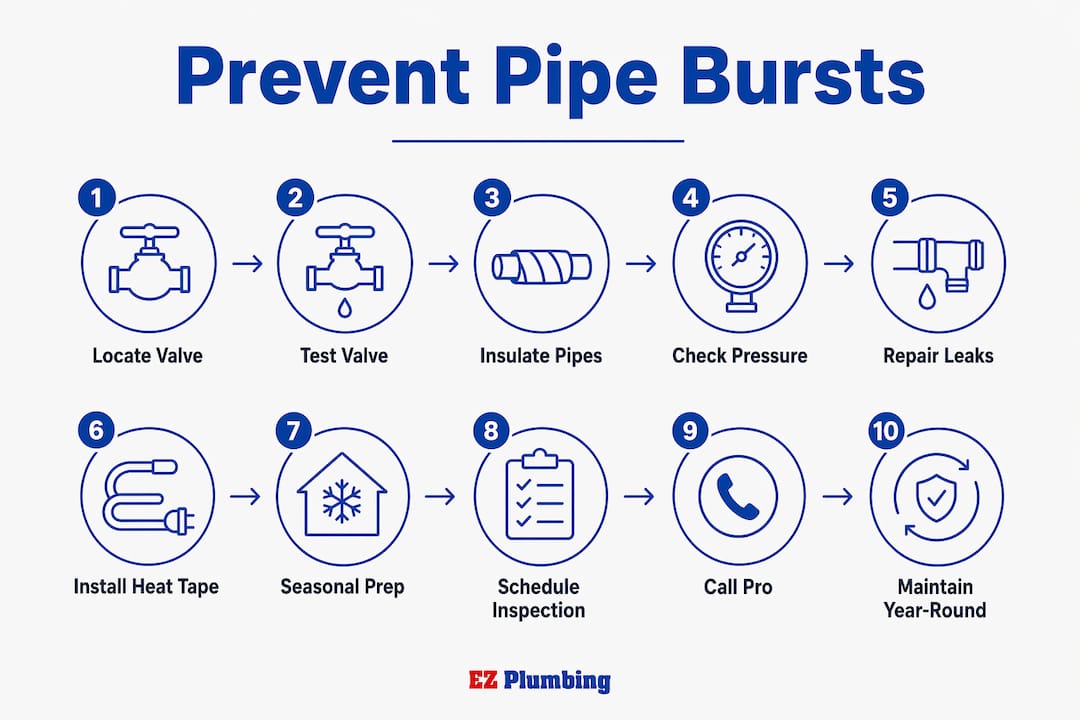
Follow this ordered workflow. The sequence matters: you isolate risk first, then add protection.
- Shut off and test the main valve before doing anything else. Confirm it closes fully and reopens without sticking.
- Disconnect all outdoor hoses. Water left in a connected hose backs pressure into the bib and the supply line behind it.
- Drain exterior supply lines. Open the outside bib after closing the interior shutoff so remaining water can expand safely.
- Install insulated faucet covers on every exterior spigot.
- Open cabinet doors under kitchen and bathroom sinks to let warm interior air reach pipes running against exterior walls.
- Set your thermostat to a minimum of 55°F if you leave the property, day or night. Consumer Reports recommends keeping the same temperature around the clock during cold weather rather than dropping it at night.
- Let cold-water faucets drip on lines served by exposed pipes. Even a trickle keeps water moving and reduces freeze risk.
- Inspect crawl spaces and attic runs for uninsulated sections and seal any air gaps near pipe penetrations.
- Test heat tape or heating cables if installed; replace any section that does not warm up within a few minutes of activation.
- Schedule a professional inspection for older galvanized or copper lines before the first cold snap of the season.
Timeline: Steps 1–4 are immediate (under 30 minutes). Steps 5–7 are same-day. Steps 8–10 are seasonal prep, ideally completed each fall. Property managers overseeing multi-unit buildings should add steps 8–10 to a formal maintenance calendar and assign a responsible party per building.
Pro Tip: For multi-unit properties or homes with older galvanized plumbing, prioritize crawl-space and exterior-wall runs first. Galvanized corrosion narrows the pipe interior over time, which raises pressure and makes those sections the first to fail under freeze stress.
Where is your main water shutoff valve, and how do you test it?
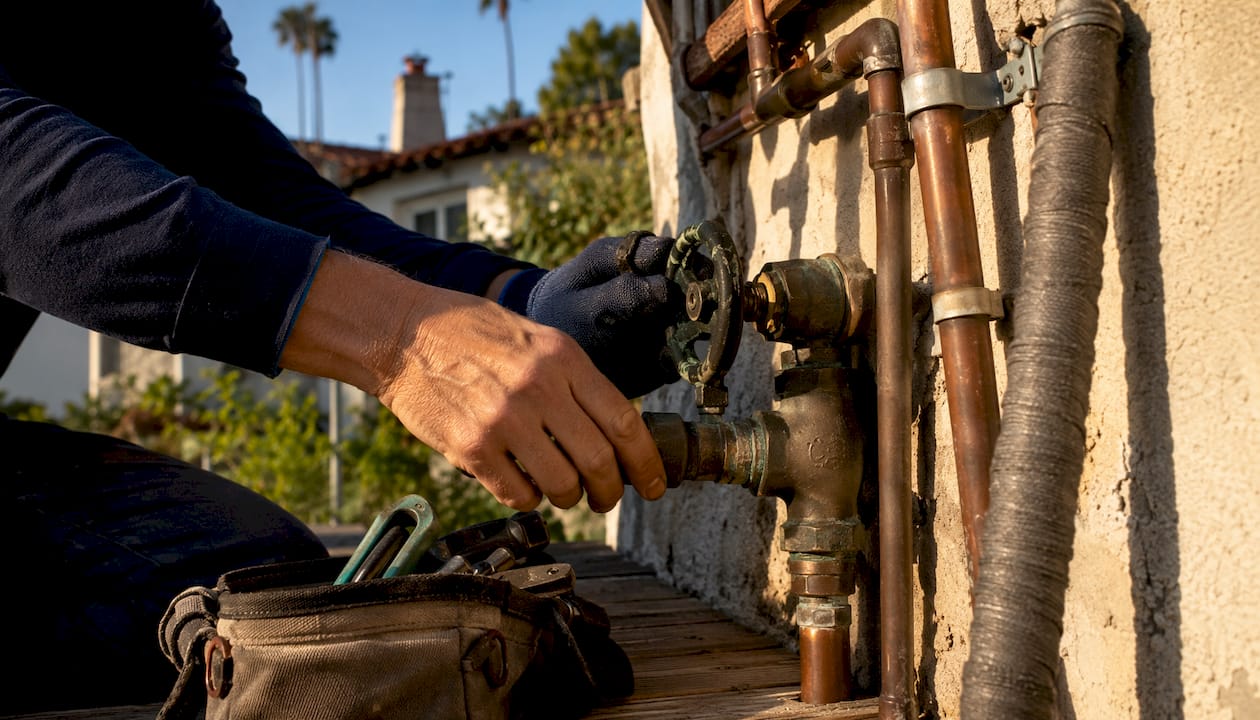
In most Los Angeles homes, the main shutoff valve sits in one of four places: the laundry room, the garage, near the water meter at the street (in a landscaping box), or along the exterior wall where the supply line enters the foundation. Older homes in neighborhoods like Silver Lake or Echo Park often have the meter box at the sidewalk curb.
To test the valve:
- Turn the handle clockwise until it stops (gate valve) or rotate the lever 90 degrees perpendicular to the pipe (ball valve).
- Open a cold-water faucet inside the house. Flow should stop within 30 seconds.
- Reopen the valve slowly and confirm full pressure returns.
- If the valve is stiff, do not force it. A stuck gate valve can shear internally and leave you with no shutoff at all.
A non-working or corroded shutoff valve is a code-compliance and safety issue that requires a licensed plumber to replace properly. Ez-plumbing’s step-by-step shutoff guide covers valve types and troubleshooting in more detail.
Which insulation materials actually protect your pipes?
Proper pipe insulation prevents freezing, condensation, and energy loss. The right material depends on where the pipe runs and how much temperature exposure it faces.
| Material | Best location | Thickness notes |
|---|---|---|
| Foam polyethylene sleeves | Indoor exposed runs, under sinks | recommended thickness varies based on exposure level |
| Closed-cell elastomeric | Humid underfloor, exterior walls, crawl spaces | Seal all longitudinal seams with contact adhesive |
| Fiberglass wrap | Near water heaters, boiler rooms | Follow manufacturer temperature rating |
| Self-regulating heat tape | Severe exposure: attic runs, exterior walls in cold snaps | UL-listed only; inspect connections annually |
For elastomeric insulation, mitre the elbows and seal every seam with contact adhesive. A gap at a tee or elbow is where condensation and freeze damage start. The American Red Cross recommends pipe sleeves or UL-listed heat tape as the most reliable products for exposed water pipes.
Pro Tip: Inspect insulation annually — foam can shift at pipe hangers and tape adhesive degrades over time. A five-minute visual check each fall catches failures before the first cold night. For a professional installation workflow, the pipe insulation guide at AG-Plumbing walks through assessment, surface prep, cutting, and final inspection in sequence.
How do water pressure and your water heater affect burst risk?
High water pressure is one of the most overlooked contributors to pipe failure in LA homes. Residential supply pressure should generally stay in the 40–80 psi range. Anything above that stresses fittings, joints, and older pipe walls continuously, not just during a cold snap.
Quick checks to run:
- Attach a pressure gauge to a hose bib or washing machine supply line and read the static pressure. Gauges are available at most hardware stores for under $15.
- Inspect the temperature and pressure (T&P) relief valve on your water heater. Lift the test lever briefly; water should discharge from the drain pipe. If nothing comes out or the valve drips afterward, it needs replacement.
- Look for corrosion, mineral staining, or moisture around the heater base and nearby fittings. These are early signs of a failing connection.
- If pressure consistently reads above 80 psi, a pressure-reducing valve (PRV) installed on the main supply line is the permanent fix.
Do not attempt to drain or adjust the T&P valve if you are not comfortable with the procedure. Water heater servicing and PRV installation are jobs for a licensed plumber.
What can temporary repairs actually do, and what are their limits?
Self-fusing pipe tape and epoxy repair putty are emergency-only measures. They buy time, not a permanent fix.
Common temporary options and their realistic scope:
- Self-fusing silicone tape: Effective for small pinhole leaks on straight pipe runs. Shut off the water first, dry the pipe, and stretch the tape tightly as you wrap. Life expectancy: days to a few weeks under normal pressure.
- Epoxy repair putty: Works on slightly larger cracks. Clean, dry, and roughen the surface before applying. Sets in minutes, but it is not rated for sustained high pressure.
- Pipe repair clamps: The most durable temporary option. A rubber gasket backed by a metal band can hold a leak longer than tape or putty, but it still does not meet plumbing code.
Leaving a temporary repair in place is not a neutral decision. Licensed professionals consistently warn that DIY patches left beyond the emergency window lead to progressive structural damage, mold growth behind walls, and repair costs that dwarf the original fix. Schedule a permanent, code-compliant repair as soon as the immediate crisis is controlled. For guidance on sealing a leaky pipe safely, Ez-plumbing’s guide covers the steps and the limits clearly.
When should you call a licensed plumber, and what will it cost in LA?
Call a licensed plumber if: you have an active burst you cannot isolate, the main shutoff valve is stuck or broken, you see water near electrical panels or structural framing, or a temporary fix has been in place for more than 24–48 hours.
What a licensed plumber will do:
- Fully isolate the affected section and assess the extent of damage.
- Locate failed pipe segments using camera inspection or pressure testing.
- Replace damaged sections, upgrade insulation, and install heat tape where needed.
- Verify all work meets LA municipal code and pull permits where required.
- Test the full system before signing off.
| Service | Estimated LA cost range |
|---|---|
| Pipe insulation upgrade (per linear foot) | $3–$8 |
Cost ranges are general estimates for the greater Los Angeles area and will vary by property age, access, and scope. Always request a written estimate.
Response time for a 24/7 emergency call is typically within a few hours. Scheduled preventive work can usually be booked within a few days. When you call, ask for proof of a C-36 contractor license, confirmation of insurance, and a written estimate before work begins.
What does a year-round pipe maintenance schedule look like?
A twice-yearly inspection, pre-winter and pre-summer, prevents most burst events. Quarterly visual checks catch the rest.
- Fall (October–November): Insulate exposed runs, test heat tape, service the water heater, and locate the main shutoff valve. Disconnect and drain all outdoor hoses.
- Winter (December–February): Monitor pressure, keep the thermostat above 55°F, and drip faucets during cold snaps. Check cabinet pipes after any night below 32°F.
- Spring (March–April): Inspect all insulation for shifting or damage. Look for galvanized corrosion on older lines and check under-sink supply connections for mineral staining.
- Summer (May–September): Inspect exterior faucets and hose bibs for wear. Test water pressure and confirm the PRV is operating correctly if one is installed.
Property managers and HOAs should log each inspection with a date, the inspector’s name, and any corrective actions taken. Ez-plumbing’s office plumbing maintenance workflow provides a facility-scale template that adapts well to multi-unit residential properties. For LA-specific seasonal considerations, the essential plumbing maintenance guide covers local drafts, crawl-space conditions, and older clay lateral issues.
Key Takeaways
Preventing pipe bursts comes down to four disciplines: shut off and test your main valve, insulate every exposed run correctly, keep water pressure in the 40–80 psi range, and schedule professional inspections before each cold season.
| Point | Details |
|---|---|
| Shut off first | Locate and test your main shutoff valve before any emergency occurs. |
| Insulate correctly | Use foam sleeves indoors and closed-cell elastomeric in crawl spaces; seal every seam. |
| Monitor pressure | Keep residential supply pressure at 40–80 psi; install a PRV if readings run higher. |
| Temporary fixes expire | Tape and putty buy hours, not weeks; schedule a permanent repair within 24–48 hours. |
| Ez-plumbing for LA | Ez-plumbing (C-36 License #583868) provides 24/7 emergency response and preventive maintenance across greater Los Angeles. |
Why preventative maintenance is the smarter call
The properties that generate the most expensive emergency calls share a common pattern: deferred maintenance on shutoff valves, uninsulated crawl-space runs, and water heaters that have not been serviced in years. By the time a burst occurs, the damage has usually been building for months.
Preventative maintenance is not just about avoiding a single repair bill. It protects tenants, preserves property value, and keeps a building code-compliant. For property managers overseeing multiple units, a documented inspection schedule also limits liability exposure when something does go wrong.
The step-by-step approach in this guide reflects what licensed plumbers actually recommend: start with isolation, add protection in order, and verify the system annually. Skipping steps or reversing the order, such as insulating before testing the shutoff, leaves the most critical safety mechanism unverified.
Ez-plumbing handles the work you should not do alone
Ez-plumbing is the licensed, insured plumbing contractor Los Angeles homeowners and property managers call when prevention steps reveal a problem that needs a professional. Whether you need a shutoff valve replaced, heat tape installed on an exposed attic run, a water heater serviced or replaced, or a full leak detection inspection before winter, Ez-plumbing handles it under C-36 License #583868, fully code-compliant with LA municipal requirements.
Services relevant to pipe-burst prevention include insulation upgrades, heat-tape installation, pressure-regulator installation, shutoff valve replacement, emergency burst repair, and scheduled preventive maintenance contracts for HOAs and property managers. Ez-plumbing serves the greater Los Angeles area with 24/7 emergency response.
To book a preventive inspection or request an emergency call, visit ez-plumbing.com or call directly for a written estimate.
Useful sources and further reading
- Consumer Reports: How to Keep Your Pipes From Freezing and Bursting — covers freeze thresholds, thermostat strategy, and the cost case for prevention.
- American Red Cross: Preventing and Thawing Frozen Pipes — detailed guidance on pipe-sleeve and heat-tape products and safe thawing methods.
- CBS Texas: What to Do If Your Pipes Burst — plumber-sourced advice on outdoor hose disconnection and shutoff location.
- SERVPRO: How to Prevent Pipes From Bursting — covers insulation, pressure testing, and when to call a licensed contractor.
- Lowe’s: Pipe Leak Repair Guide — step-by-step instructions for temporary repair products and their limitations.
- AG-Plumbing: How to Insulate Water Pipes and Prevent Freezing — professional-grade insulation techniques and product selection guidance.
- Ez-plumbing: C-36 License #583868, greater Los Angeles — licensed, insured residential and commercial plumbing services including emergency response and preventive maintenance.
This article provides general information for homeowners and property managers. For code-specific requirements in your municipality or questions about your property’s plumbing system, consult a licensed plumber or your local building department.