
Natural Gas Leak Repair Guide for Los Angeles Homes
You're standing in the kitchen when the familiar rotten-egg smell reaches you. The stove is off, there's no visible damage, and the odor seems faint. Treat it as a real gas leak until qualified professionals say otherwise. Natural gas leak repair begins with protecting people, not locating the broken fitting.
This isn't a rare maintenance issue. PHMSA-reported data documented about 509,763 distribution leaks repaired in 2020, and 78% of those repaired leaks were on service lines. The scale of that activity shows why prompt detection, safe shutdown, and competent repair matter across ordinary homes, rental properties, and multifamily buildings. PHMSA's distribution leak data provides the broader infrastructure context.
Table of Contents
- Recognizing the Signs of a Gas Leak
- Your Immediate Emergency Response Plan
- The Professional Diagnosis and Repair Process
- Repair Timelines and Expected Costs in LA
- Los Angeles Permitting and Safety Mandates
- Preventing Gas Leaks with Proactive Maintenance
- FAQs About Natural Gas Leak Repairs
Recognizing the Signs of a Gas Leak
The odorant added to natural gas is designed to smell unpleasant, often like sulfur or rotten eggs. If you notice it near a stove, water heater, furnace, meter, garage, crawl space, or outdoor gas line, don't dismiss it because the smell fades. Odors can move with air currents, and a weak smell can still indicate a dangerous condition. If you're unsure what you're smelling, this guide to what methane gas smells like can help you recognize the warning.
Other signs deserve attention. A hissing or whistling sound near a pipe or appliance connection may indicate escaping gas. Dead or discolored vegetation close to a buried gas line can point to a subsurface problem, especially when the surrounding plants appear healthy. Physical symptoms such as dizziness, nausea, headache, or unusual fatigue also require immediate caution, although those symptoms can have many causes and shouldn't be used to diagnose a leak.
Safety rule: A suspected gas leak is an emergency until the gas company or emergency responders have assessed the property.
Leave immediately if you smell gas or hear escaping gas indoors. Don't stay inside to inspect the meter, sniff around appliances, or search for the source. The nationwide repair volume reinforces a practical point for Los Angeles property owners: leaks are recurring infrastructure failures, not problems that should be ignored until a smell becomes overwhelming.
Once everyone is outside and away from the building, call 911 and the gas utility from a safe location. A licensed plumber can perform the later diagnostic work, but emergency responders and the utility should be contacted first when gas may be accumulating.
Your Immediate Emergency Response Plan
Your actions during the first moments matter more than identifying the exact appliance or pipe. Get people and pets out, avoid anything that could create an ignition source, and make calls only after reaching a safe distance.
What to do immediately
-
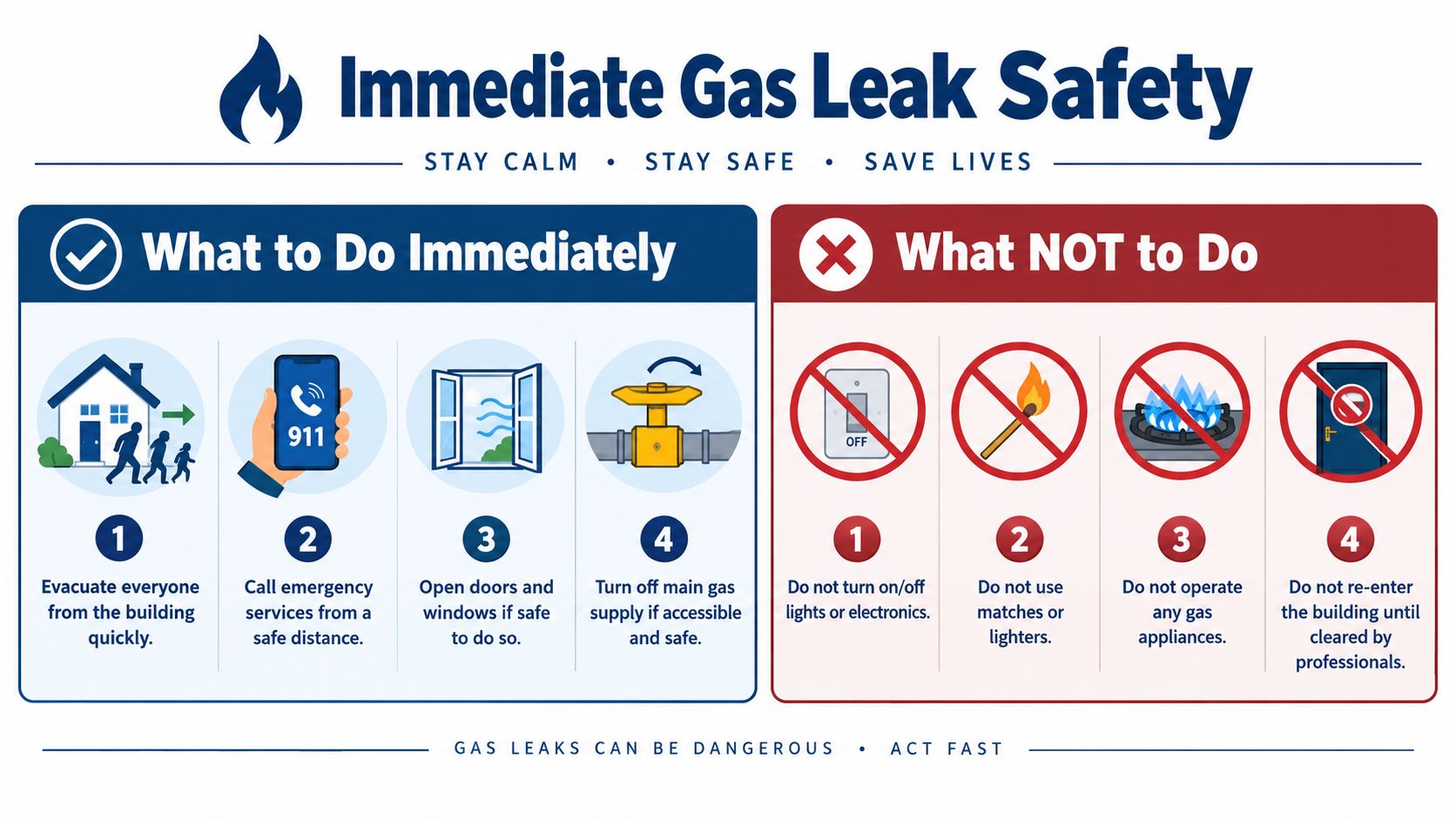
Evacuate everyone. Tell household members, tenants, employees, and visitors to leave without stopping to collect belongings. Move away from the building and any area where gas may be escaping.
-
Avoid switches and electronics. Don't turn lights on or off, operate a garage door, use a phone indoors, plug in a charger, or start an appliance. A small electrical spark can ignite a gas-air mixture.
-
Leave doors open only if you can do so naturally while exiting. Don't go back inside to ventilate the property. If a door is already open, leave it that way. Never delay evacuation to open windows.
-
Call 911 from outside. Report the suspected leak and provide the property address. Then contact the gas utility from a safe location so it can shut off or investigate the supply.
-
Wait for clearance. Keep everyone out until emergency personnel or the utility confirms that re-entry is safe. A faint odor outside doesn't prove that the building is safe inside.
What you must never do
Don't hunt for the leak. Don't test a fitting with a flame, light a cigarette, strike a match, or operate a gas appliance. Don't assume the problem is minor because the odor is localized near a stove or because the smell disappears outdoors.
Don't turn the main gas valve unless it's outside, readily accessible, and you can operate it without entering or approaching a dangerous area. If reaching the valve requires you to enter the building, stop. The utility or emergency responders can manage the shutoff safely.
Don't re-enter for wallets, medication, phones, or pets. Tell responders what remains inside instead. The same discipline applies in a vacant rental or commercial property. Locking a door, protecting equipment, or avoiding a service interruption never outweighs evacuation.
For a concise homeowner reference, review what to do if you smell gas. The priority doesn't change: leave first, call from outside, and wait for professionals.
The Professional Diagnosis and Repair Process
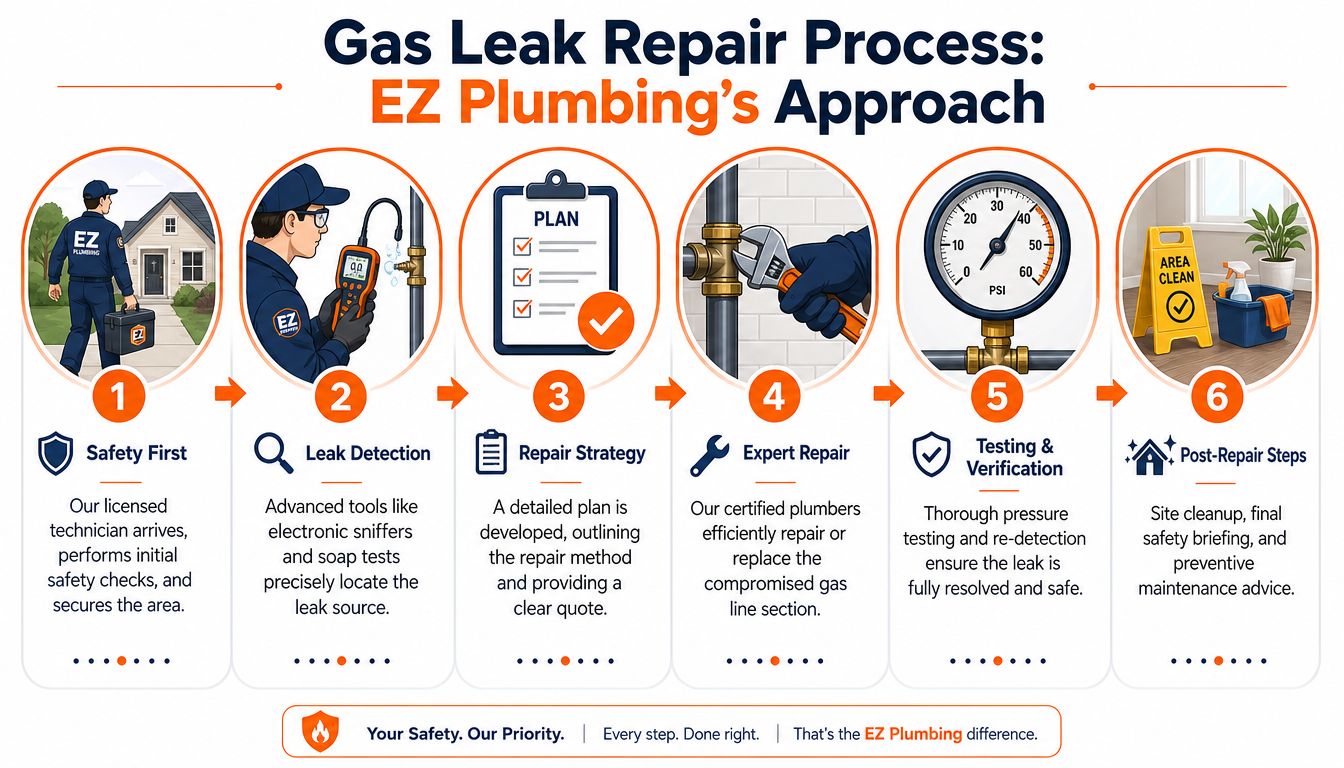
After the utility or emergency responders make the area safe, a licensed technician can begin the actual diagnosis. The technician's first task isn't to dismantle the nearest appliance. It's to assess the property, confirm whether gas is present, identify affected sections, and decide whether the supply must remain shut off during testing.
A professional may use an electronic combustible-gas detector, an electronic gas sniffer, a combustible gas indicator, and a soap solution at accessible joints. Each tool answers a different question. Electronic instruments help locate gas concentration, while a soap test can reveal bubbling at a suspected fitting. The technician also considers pipe routing, appliance connections, wall cavities, crawl spaces, and conditions that can make an intermittent leak difficult to reproduce.
How the repair is selected
An accessible loose fitting may need proper tightening and a new approved seal. A damaged flex connector, valve, or appliance connection may require replacement. Corroded or compromised piping can call for removal and replacement of the affected section, sometimes with additional access work if the line runs behind a wall, under flooring, or through a crawl space.
A responsible technician should explain the source, the repair method, the parts involved, and any work that falls outside the immediate correction. For contractors and property managers, understanding insurance responsibilities is also useful. A practical reference on contractors' liability insurance can help clarify why documentation and defined scopes matter when gas work affects a building or third party.
Verification separates repair from guesswork
The repair isn't complete when the smell disappears. The system should be tested according to the applicable procedure, and the technician should re-check the repaired area with detection equipment. Depending on the work, that may include pressure testing, leak re-detection, appliance checks, and documentation of the result.
A California study identified 9,861 repair failures from 2014 to 2017, equivalent to a 20% failure rate, where a later leak report or repair occurred at the same location within a year. The study's definition allowed time for residual gas to dissipate before counting a later report, which is why the California repair-failure study supports follow-up measurement rather than relying on a quick surface fix.
For local service, a licensed gas plumber should be able to explain the detection, repair, testing, and closeout process in plain language. Ask for the findings and test results in writing, especially if you manage tenants, an HOA, or a commercial property.
Repair Timelines and Expected Costs in LA
No honest plumber can quote a precise price from the odor alone. The final cost depends on where the leak is, how much piping is affected, whether the line is accessible, which materials are required, and how much restoration follows the repair. A visible appliance connector and a gas line concealed behind finished walls are entirely different jobs.
Access often drives the labor. A technician may need to remove a panel, open drywall, excavate a small exterior area, or coordinate with a utility and building representative. The estimate should separate diagnosis, repair, testing, permitting, and restoration where those items apply. Property managers should also ask whether the proposal covers tenant coordination and written closeout records.
For budgeting, compare the actual scope rather than choosing from a generic online range. A resource on estimating plumbing rehab costs can help owners think through labor, materials, access, and related rehabilitation work without treating a broad estimate as a guaranteed Los Angeles price.
Why severity changes the schedule
Gas companies and regulators prioritize leaks by risk. California Public Utilities Commission reporting found that Grade 1 leaks had a weighted average repair time of 2 days, while Grade 2 leaks averaged 157 days. The report also showed Grade 2 repair times ranging from 11 to 185 days across gas companies. The CPUC joint report demonstrates why two repairs that both get called “gas leaks” may receive very different schedules.
That classification doesn't give a homeowner permission to ignore an odor. If gas is actively escaping inside your home, evacuate and report it immediately. The grade and repair schedule are professional determinations made after detection and risk assessment.
For a private plumbing repair, a simple accessible correction may be completed promptly once the area is safe and parts are available. A concealed or extensive repair can take longer because testing, access, inspection, and restoration must be coordinated. Ask the technician what can be completed immediately, what requires a permit or inspection, and what documentation you'll receive.
Los Angeles Permitting and Safety Mandates
Gas piping work in Los Angeles shouldn't be treated like an ordinary cosmetic plumbing repair. Whether a permit and inspection are required depends on the scope, location, property type, and applicable city requirements. Replacing or modifying gas piping, relocating an appliance, altering a branch line, or performing work in a multifamily or commercial building may trigger permitting and inspection obligations.
Before work begins, ask the contractor to identify the authority having jurisdiction, confirm whether a permit is needed, and explain who will obtain it. Don't rely on a verbal assurance that “it's fine” when the work changes gas piping. A clear scope should identify the affected line, the planned repair, testing requirements, permit responsibility, and any inspection appointment.

What property records should show
For a homeowner, keep the invoice, permit information, inspection result, test documentation, photographs when available, and any utility shutoff or restoration record. For a landlord, HOA, or facilities manager, add the affected unit or area, date of detection, severity information provided by the utility, repair description, contractor credentials, and post-repair verification.
These records help the next person understand what happened. They can also support maintenance planning, communication with residents, insurance discussions, and future property transactions. A repair with no written scope or test record leaves owners guessing about whether the work addressed the source or only the visible symptom.
Why compliance is becoming more structured
Recent regulatory changes are moving leak management toward documented detection and follow-up. A 2025 PHMSA rule requires repair attempts within 30 days of detection and requires a resurvey after repair. The PHMSA final rule applies to regulated pipeline operators, so it shouldn't be presented as a universal deadline for every private residential repair. It does show the direction of professional leak management, detect, prioritize, repair, and verify.
Los Angeles owners should ask for inspection-ready records even when a job seems small. If a tenant later reports an odor, an inspector asks for maintenance history, or a buyer reviews the property, documentation is far more useful than a statement that someone “tightened a fitting.”
Preventing Gas Leaks with Proactive Maintenance
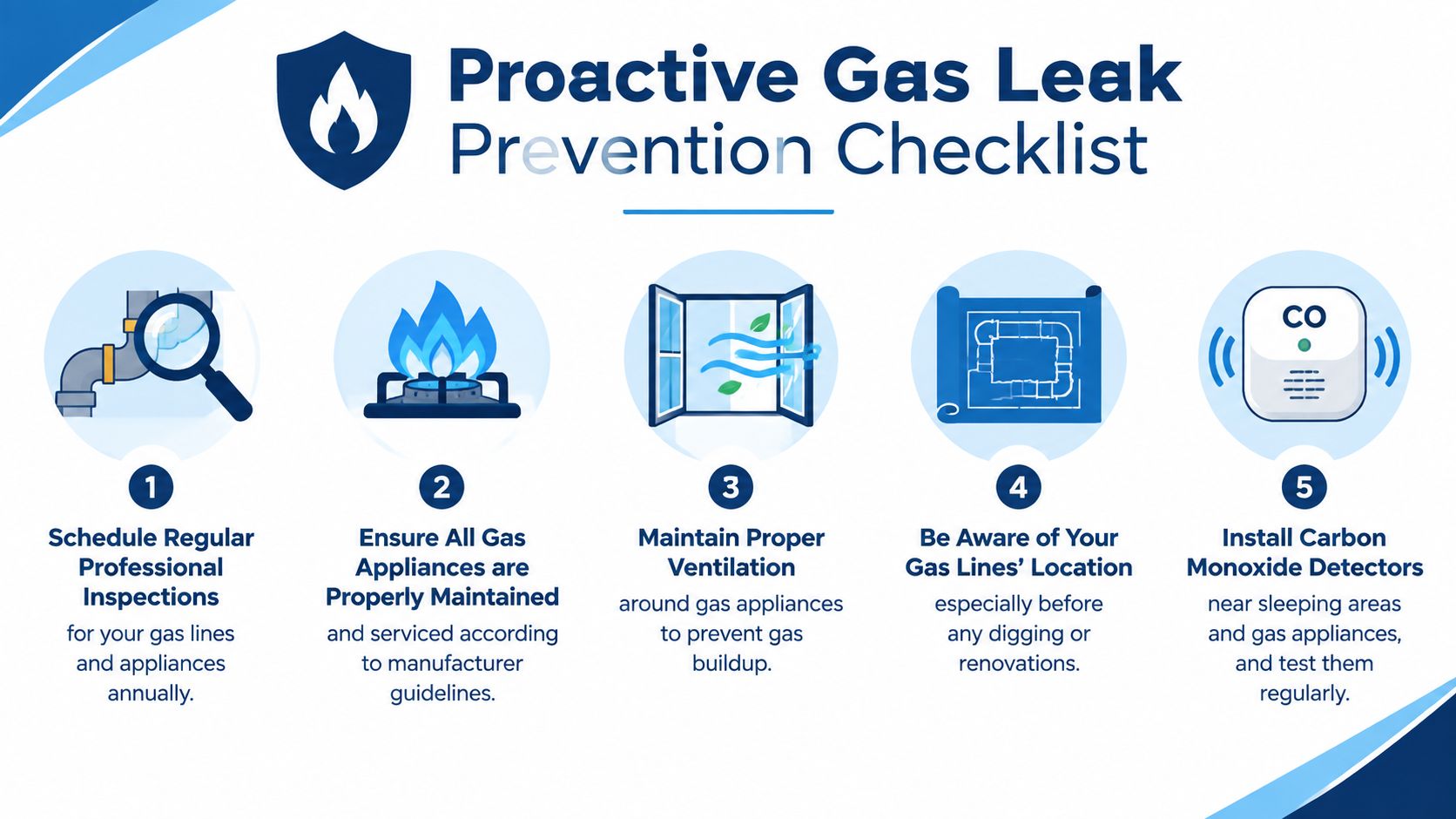
Emergency response protects people today. Proactive maintenance reduces the chance that a small defect becomes an emergency tomorrow. Have a qualified professional inspect gas piping and appliances when a property is older, when appliances are replaced, after remodeling, or when connections show corrosion, movement, or physical damage.
Keep appliance areas clear and properly ventilated. Follow the manufacturer's service instructions for furnaces, water heaters, ranges, and dryers. Don't paint over valves, conceal accessible connections, or allow storage to block inspection points. Before digging or renovating, identify the route of buried or concealed gas lines and use the required utility-locating process.
A practical maintenance checklist
- Inspect connections: Look for corrosion, damaged tubing, loose supports, or signs that an appliance has shifted. Don't attempt to tighten a suspected leaking connection yourself.
- Maintain appliances: Arrange qualified servicing and keep combustion equipment accessible for inspection.
- Protect ventilation: Never block vents or use a mechanical room for storage.
- Track line locations: Give contractors and grounds workers clear information before excavation or renovation.
- Use alarms: Install carbon monoxide detectors near sleeping areas and gas appliances, then test them regularly. Carbon monoxide detection doesn't replace gas leak detection, since the alarms address different hazards.
Detection technology is also changing. Industry tools now include infrared sensors that can identify methane across a broad concentration range, equipment that measures concentration alongside flow rate, aerial and satellite methods, and smart methane monitors that can send warnings continuously. Recent industry coverage of methane detection tools reflects a shift from a single “find and fix” visit toward quantified prioritization and ongoing awareness.
Schedule a professional gas line safety inspection with EZ Plumbing before an odor forces an emergency decision. Ask for detection, appliance and piping checks, pressure testing where appropriate, and written recommendations for any repair or monitoring work.
FAQs About Natural Gas Leak Repairs
Is a small gas leak covered by homeowners insurance?
Coverage depends on the policy, the cause of the damage, exclusions, maintenance obligations, and whether the claim involves resulting property damage or the cost of correcting a worn component. Don't delay emergency action while trying to interpret coverage. Evacuate, contact 911 or the gas utility as appropriate, and notify your insurer after the property is safe. Keep invoices, photographs, permits, test results, and communication records.
What if the smell appears only near the stove or water heater?
Treat an appliance-specific odor as a real leak. Turn off the appliance only if you can do so without creating a hazard, then leave the building and call from outside. Don't relight a pilot, test the burner, move the appliance, or spray a household product around the connection. A technician can isolate the appliance, connector, shutoff valve, and nearby piping with professional detection equipment.
What signs suggest a slow underground leak?
Watch for persistent dead or stressed vegetation near a gas route, unexplained bubbling in wet soil, a faint outdoor odor, or a hissing sound near the meter or buried line. These signs aren't conclusive, and the absence of an odor doesn't prove that an underground line is sound. Keep people away from the area, avoid digging, and report the concern to the gas utility or emergency services before arranging non-emergency repair work.
EZ Plumbing provides licensed gas leak detection, natural gas leak repair, gas piping work, pressure testing, and documented post-repair checks for Los Angeles homes, rentals, HOAs, and commercial properties. If you've noticed an odor, need a safety inspection, or want a clear repair plan, contact EZ Plumbing to schedule professional service.