
Is Drano Safe for Pipes? the Real Risks Explained
You're probably standing over a sink or tub right now, watching water hang there longer than it should. Maybe it still drains, just slowly. Maybe it's backed up completely. Either way, the bottle under the sink starts to look like the fastest answer.
That's when most homeowners ask the same question. Is Drano safe for pipes? The short answer is no if you care about the long-term condition of your plumbing. The reason isn't just that chemical cleaners are harsh. It's that they work by creating heat inside a system that was never meant to be treated like a reaction chamber.
I've seen the aftermath often enough to say this plainly. The issue isn't only the dramatic failure people worry about. The bigger problem is the hidden one. The clog may improve, but the pipe, joint, or seal can come out weaker than it was before. If you want to avoid turning a drain problem into a pipe problem, it helps to understand what's really happening and why clearing blocked drains early helps prevent costly damage.
Table of Contents
- That Slow Drain Dilemma and the Drano Temptation
- How Chemical Drain Cleaners Actually Work
- The Real Risks Drano Poses to Your Plumbing System
- Emergency Steps When a Chemical Cleaner Fails
- Safer Alternatives and Professional Drain Cleaning
- Frequently Asked Questions About Drain Cleaners
- Is Drano safe for pipes if I only use it once
- Is Drano safe for older galvanized or cast iron plumbing
- Should I use Drano in a toilet
- What if the drain is completely blocked and full of standing water
- Can I mix Drano with another household cleaner
- Do plumbers ever recommend Drano
- What's the best first move for a recurring slow drain
That Slow Drain Dilemma and the Drano Temptation
A slow drain creates urgency fast. In a kitchen, it means standing water and food residue. In a shower, it means you're ankle-deep before the water finally slips away. In a bathroom sink, it often starts as a nuisance and turns into a daily irritation.
So the appeal of Drano makes sense. It's available almost everywhere, it promises a quick fix, and it feels easier than pulling apart a trap or calling a plumber. For many people, it seems like the responsible first step. Pour, wait, flush, move on.
That's exactly why this product causes so many long-term problems. The label focuses your attention on the clog. Your plumbing system pays the price for what the chemical has to do in order to attack that clog.
Practical rule: If a drain cleaner needs a strong chemical reaction to work, don't assume the pipe is unaffected just because the water starts moving again.
The common mistake is treating a drain line like a disposable part of the house. It isn't. Every trap, fitting, glue joint, and section of pipe has a service life. A harsh cleaner can shorten that life without giving you any obvious warning.
Homeowners usually remember the moment the clog happened. They don't connect it to the leak under the cabinet months later, the loose toilet seal, or the drain line that starts failing repeatedly. But in the field, those problems often trace back to the same pattern. Quick chemical fix first. Mechanical damage or corrosion later.
How Chemical Drain Cleaners Actually Work
Drano and similar products don't “gently dissolve” a clog. They rely on a strong exothermic chemical reaction. In plain terms, that means the cleaner creates heat while it reacts with what's in the drain.
The most important ingredients in many formulas are sodium hydroxide and aluminum. When they meet water and organic blockage, they generate heat and gas. That heat speeds up the breakdown of grease, hair, soap residue, and other soft buildup. Think of it as a controlled chemical fire inside the pipe. It's meant to attack the clog, but it doesn't have perfect aim.
What happens inside the line
When the cleaner reaches standing water or a partial blockage, several things happen at once:
- Chemical contact begins: Sodium hydroxide reacts with grease and organic matter.
- Heat builds: The reaction creates thermal energy inside the pipe.
- Gas forms: Hydrogen gas can be produced during the reaction.
- The clog softens: Hair, sludge, and grease may start to break down.
- Flow may improve: If enough material loosens, water starts moving again.
That sequence sounds useful until you focus on the heat. According to this explanation of Drano's effect on galvanized pipes, Drano can generate localized temperatures often exceeding 100°C, enough to degrade zinc coating on galvanized pipe and soften PVC. The same source explains that the reaction produces hydrogen gas and significant thermal energy, which can break down protective linings and accelerate corrosion in older metal systems.
Why slow drains are a bad setup
A partially blocked drain gives the cleaner time to react in one concentrated area. A fully blocked drain is worse. Instead of moving through the pipe and diluting, the chemical can sit where the line is already under stress.
That matters because chemical cleaners aren't selective. They don't know the difference between a grease blockage, a rubber seal, old galvanized lining, or PVC glue at a joint. They react where they land.
If the product is sitting in standing water, it's still working chemically even when it's no longer helping mechanically.
That distinction matters. A mechanical clog removal tool clears a path. A chemical cleaner may only alter the material at the blockage while exposing the surrounding pipe to heat, caustic residue, and pressure.
The Real Risks Drano Poses to Your Plumbing System
A drain can look fine the day after Drano works. Then six months later, a slip joint starts weeping under the sink, or a glued PVC joint begins to seep inside a wall. Homeowners usually blame age or bad luck. In practice, chemical heat is often part of the story.
The mistake is treating Drano as harmless unless someone misuses it. Overpouring, mixing products, and using the wrong cleaner in the wrong fixture do create immediate danger. But even proper use relies on a caustic reaction that generates heat inside a closed plumbing system. That heat does not disappear just because the water starts moving again.
Why the one-time use myth causes trouble
Manufacturers often frame chemical cleaners as safe if you follow the label and use them occasionally. That leaves out the part plumbers see later. Pipe damage is often cumulative, not dramatic.
One treatment may not split a pipe on the spot. It can still stress PVC, attack older metal surfaces, and weaken rubber or wax components around the clog. Then the next clog gets another dose of heat and caustic residue in the same general area. Over time, that repeated exposure turns a quick drain fix into a repair call for a leaking trap, a softened fitting, or corrosion that spreads past the original blockage.
That is why “it worked last time” is a poor safety test.
How different pipe materials react
Different materials fail in different ways, but none get stronger from chemical drain cleaner use.
| Pipe Material | Risk Level | Type of Damage |
|---|---|---|
| PVC | High | Softening, slight warping, weakened joints and glued connections |
| Galvanized steel | High | Loss of protective coating, faster rusting, rougher interior walls |
| Cast iron | High | Surface deterioration, scale disruption, joint stress |
| Copper | Moderate | Less prone to softening, but repeated chemical exposure still wears on the system |
| Rubber seals and wax rings | High | Breakdown, distortion, and loss of sealing strength |
In older homes, the weak point is often not the straight run of pipe. It is the joint, the trap, the transition between materials, or the seal that was already aging before the cleaner went in.
What homeowners usually do not see
Chemical cleaner damage is often hidden at first. The clog partially opens, water drains, and everyone assumes the problem is solved. Meanwhile, the pipe may be left rougher inside, the joint may be slightly weakened, or the cleaner may have burned a path through the blockage without removing it completely.
That creates the pattern plumbers get called for later:
- Recurring clogs because the blockage was softened, not fully cleared
- Loose joints under sinks or behind walls
- Slow leaks around fittings, traps, or glued connections
- Faster corrosion in galvanized or cast iron piping
- Premature failure of seals, gaskets, and toilet components
A mechanical tool clears differently. It removes or breaks up the obstruction with less risk of heat damage to the pipe itself. If you want to compare the safer DIY approach, read this guide on how to snake a kitchen sink safely before pouring another bottle down the drain.
Toilets deserve separate caution. A toilet stoppage has seals, fixture surfaces, and a trapway that do not respond well to caustic cleaner sitting in place. If that is the problem you are dealing with, these safer methods for toilet blockages are a better starting point than chemical cleaner.
A drain that opens after Drano is not proof the plumbing is fine. It often means the damage is still hidden.
Emergency Steps When a Chemical Cleaner Fails
When Drano doesn't clear the clog, the situation changes. You no longer have just a blocked drain. You have a blocked drain containing caustic chemical residue, and that makes every next step more hazardous.
What to stop doing immediately
Don't add another chemical. Don't switch brands. Don't pour in bleach, vinegar, or any other cleaner to “boost” the reaction.
Also avoid using a plunger on a drain that may contain chemical cleaner. Plunging can force contaminated water back up toward your face, hands, clothing, or surrounding surfaces. The same caution applies to taking apart the trap casually if you don't know what's sitting in it.
A lot of homeowners also reach for a hand snake at this stage. That can work in some DIY scenarios, but if the line is holding chemical residue, feeding a cable into it can splash or spread the material. If you're considering mechanical clearing after using chemicals, read this guide on how to snake a kitchen sink first so you understand the safety issues before touching the drain.
What to do instead
Start with basic safety and containment.
- Ventilate the area. Open windows and keep the space from trapping fumes.
- Keep people away from the fixture. Children and pets shouldn't be near a contaminated sink, tub, or toilet.
- Avoid contact with standing water. Treat it as chemically active unless you know it has been fully flushed.
- Watch for leaks. Check the trap, cabinet base, and nearby flooring.
- Tell the plumber exactly what was used. This is not a minor detail. It changes how the line is handled.
The last point matters for the technician's safety too. A plumber working on a chemically loaded drain needs to know what's in that line before disconnecting, snaking, or opening any fitting. Honest disclosure prevents injuries and helps the job get handled correctly.
Safer Alternatives and Professional Drain Cleaning
If Drano is a bad bet for pipe health, the next question is obvious. What should you do instead?
The answer depends on the kind of clog, how long it's been building, and where it sits in the system. Some homeowner methods are safe and worth trying on minor blockages. Others are best left to a plumber with the right tools.
What homeowners can try first
For a fresh, mild slowdown, start with methods that don't rely on caustic chemistry. A careful plunger, removing hair from a tub stopper, cleaning a sink trap, or using a hand auger can all help when the obstruction is close and accessible.
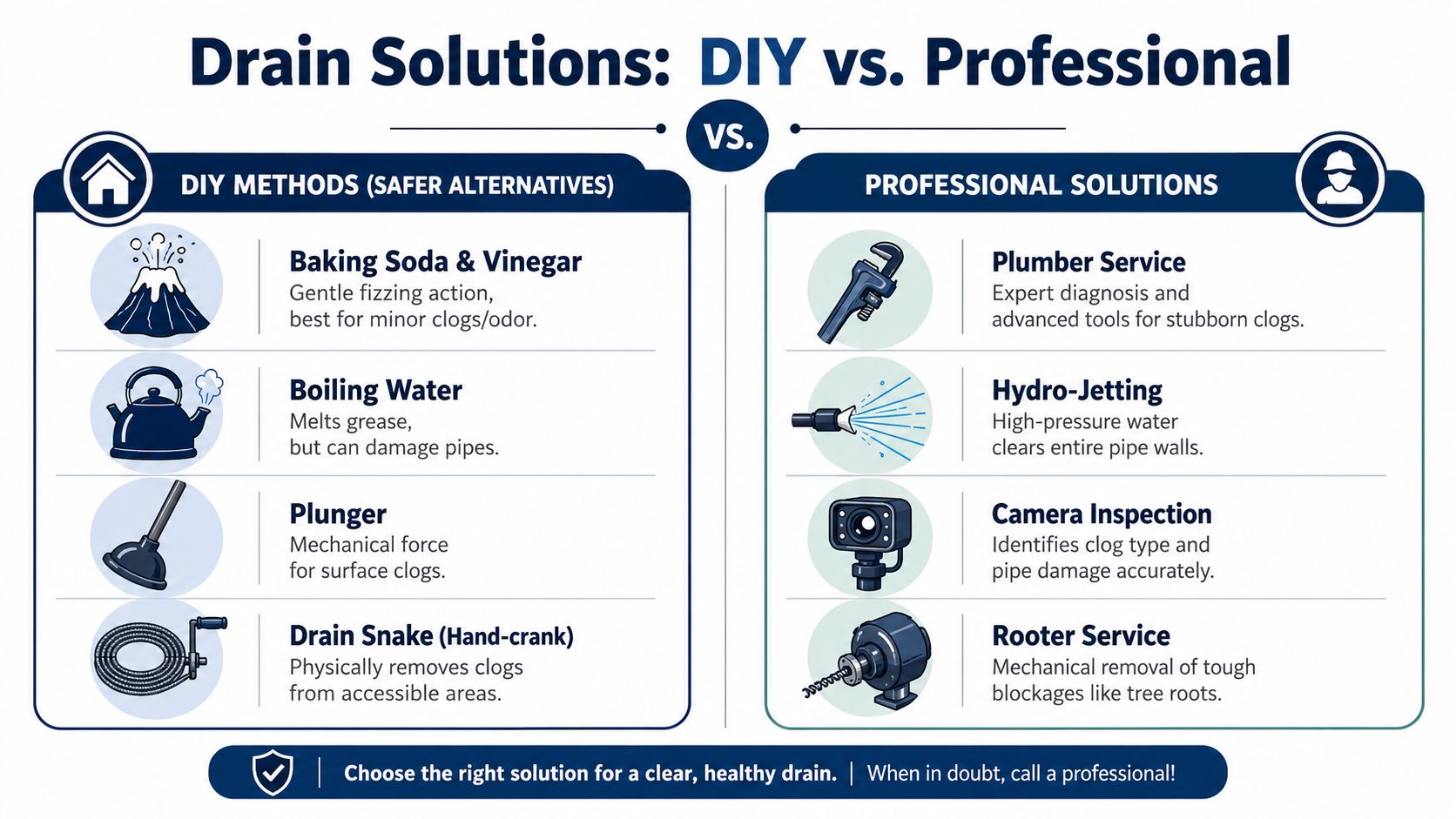
Some homeowners also try baking soda and vinegar. That approach is gentler than chemical drain cleaner, and it may help with odor or light residue. It isn't a serious solution for a heavy grease mass, a deep hair blockage, scale buildup, or a line with years of sludge.
If you want a practical starting point, this guide on how to unclog a drain without chemicals covers the safer end of the DIY spectrum.
When professional equipment is the better move
A stubborn clog usually needs physical removal, not a stronger chemical. That's where professional drain cleaning changes the outcome.
A plumber can inspect the line, identify the blockage type, and choose a method that clears the drain without cooking the pipe from the inside. Depending on the situation, that may include:
- Drain snaking: Good for hair clogs, paper buildup, and localized stoppages.
- Camera inspection: Useful when the problem keeps returning or the line may be damaged.
- Rooter equipment: Better for tougher intrusions and heavier blockages.
- Hydro jetting: Best when the pipe walls are coated with grease, sludge, or recurring buildup.
This video gives a helpful visual of the kind of professional approach that clears a line rather than just reacting with it:
The long-term advantage is that professional cleaning removes the obstruction from the system. It doesn't leave caustic residue behind to keep attacking seals and joints. The verified data for this topic states that repeated Drano use in slow or fully blocked lines can cause channel rot, degrade joints and seals, and lead to leaks or water damage months later. That same verified data also notes reported repair costs ranging from $5,000 to $100,000 for systemic failures, cited in this discussion of hidden pipe damage from Drano.
The smartest drain-cleaning method is the one that removes the blockage without creating a second problem in the pipe.
That's why calling a professional shouldn't be viewed as the last resort after multiple rounds of chemicals. In many homes, it's the safer first choice.
Frequently Asked Questions About Drain Cleaners
Is Drano safe for pipes if I only use it once
That's the myth that gets homeowners in trouble. One use may not trigger immediate failure, but the process still relies on heat and caustic action inside the pipe. Safety shouldn't be judged only by whether the drain opens afterward.
Is Drano safe for older galvanized or cast iron plumbing
Older systems are a poor match for chemical drain cleaners. Aging metal, worn coatings, and older joints are less forgiving. If your home has older plumbing, a mechanical clearing method is the safer route.
Should I use Drano in a toilet
No. Toilets have different blockage patterns than sinks and tubs, and chemical products can create extra risk around seals and fixture surfaces. A toilet auger or a professional service call is a much better option.
What if the drain is completely blocked and full of standing water
That's one of the worst situations for chemical cleaner use. The product can sit in one place, stay concentrated, and continue reacting without removing the obstruction. Stop adding chemicals and treat the fixture as hazardous until it's handled safely.
Can I mix Drano with another household cleaner
No. Don't mix it with anything. Don't “follow it” with another product. Don't experiment with bleach, vinegar, or a second drain opener. Mixing cleaners can create dangerous reactions and makes the line more hazardous for anyone who has to work on it.
Do plumbers ever recommend Drano
For a lasting fix, plumbers generally prefer methods that physically remove the clog or inspect the line. Chemical cleaners can hide the problem, damage materials, and make the repair more dangerous.
What's the best first move for a recurring slow drain
Treat recurring drainage as a warning sign, not a chemistry problem. Repeated slowdowns usually mean buildup, a partial obstruction, or a line condition that needs proper cleaning and possibly inspection.
If your drain is slow, backed up, or already treated with chemicals, EZ Plumbing can help you handle it safely. EZ Plumbing has served Los Angeles since 1989 with licensed, insured plumbing service, including drain cleaning, hydro jetting, sewer diagnostics, and 24/7 emergency response. Call (818) 908-2710 or schedule online for professional service that protects your pipes instead of putting them at risk.