
How to Fix a Leaking Bathtub: A Complete DIY Guide
You're probably here because something changed fast. Maybe you hear a drip after everyone's asleep. Maybe the paint on the ceiling below the bathroom just bubbled. Maybe the tub only leaks when someone showers, which is even worse because that kind of leak tricks people into thinking it's small.
A leaking bathtub is one of those problems that punishes guessing. Homeowners often replace the faucet because they can see it, then find out the leak was the overflow gasket, the drain flange, or failed caulk where water splashes into the wall. If you want to know how to fix a leaking bathtub, the shortest path isn't starting with tools. It's finding the exact place where water escapes.
That's how plumbers approach it in Los Angeles homes, especially older properties where one leak can travel before it shows up. The stain you see is often not the place the water started. The right repair depends on whether the leak happens with the water on, with the tub full, while it drains, or only during a shower.
Table of Contents
- That Drip Is Costing You More Than Sleep
- First Play Detective to Find the Leak's True Source
- Fixing Leaks from Faucets Spouts and Handles
- Sealing Leaks from Drains Overflows and Gaskets
- Stopping Splash Leaks by Resealing Grout and Caulk
- When to Call a Plumber Recognizing a Job for the Pros
- Leaking Bathtub FAQ Your Lingering Questions Answered
That Drip Is Costing You More Than Sleep
The part that bothers first is often the sound. The part that costs money is everything happening after that. A dripping tub faucet seems minor until the ceiling below stains, the baseboard swells, or the drywall near the tub starts feeling soft.
In the field, the stressful calls usually start the same way. Someone noticed water where it shouldn't be and waited because the leak looked slow. Then they used the shower the next morning, and the stain got larger. That's when the problem changes from annoyance to property damage.
A bathtub leak can come from the faucet, the spout, the drain, the overflow, the caulk line, the grout joints, or piping you can't see. Each one behaves differently. Some leak only when the water is running. Others only leak when the tub holds water. Some only show up when someone showers and splashes against a weak wall joint.
Practical rule: If you don't know which test makes the leak appear, you don't know what you're fixing yet.
That's why random repair usually fails. New caulk won't stop a worn cartridge. A new cartridge won't stop a drain flange leak. Tightening visible parts won't solve a hidden crack or corroded connection behind the wall.
The goal is simple. Make the leak happen on purpose, under controlled conditions, and watch what changes. Once you know that, the repair path gets much clearer, and you can decide whether it's a safe DIY job or one that needs backup before water damage spreads.
First Play Detective to Find the Leak's True Source
The best diagnosis starts before you remove a single screw. You need to know when the leak happens and what part of the tub system is active at that moment.
Start with timing not tools
If water appears when no one uses the tub, suspect the faucet or supply side. If it only shows when the tub is full, look hard at the drain assembly and overflow. If it appears only during a shower, focus on the spout, tile joints, caulk lines, and shower spray direction.
A water meter check can also help confirm whether you have a plumbing leak even before opening anything up. EZ Plumbing has a simple guide on how to read a water meter for leaks if you want to verify whether water is moving when everything inside should be off.
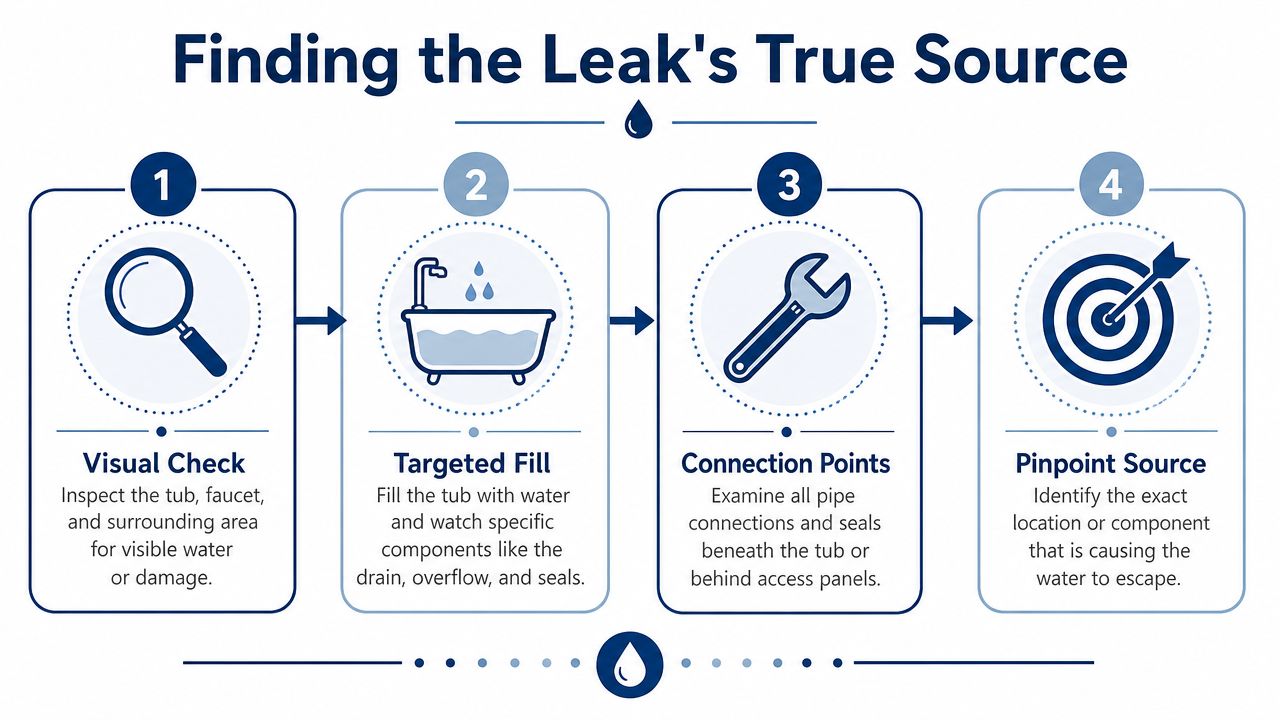
Run four simple tests
Use a flashlight, a dry paper towel, and access panels if you have them. If there's a ceiling below, don't ignore it. That's often where the leak announces itself first.
Test the faucet with the tub empty
Don't run a bath. Just turn the faucet on and off, then watch the spout and handle area. If dripping continues from the spout after shutoff, the issue often points to the faucet's internal wear parts rather than the drain.Fill the tub but don't drain it yet
Put water in the tub and stop. Watch around the drain flange and overflow area. A leak during standing water usually tells you the seal at the drain or overflow is weak.Drain the tub while watching below
If the leak appears mainly when water exits, the drain assembly or connected piping becomes more suspect than the faucet body or tub walls.Run the shower and control the spray
Point water only at one area at a time. Don't soak everything at once. If the leak appears when spray hits the wall corners, tub edge, or grout lines, that's usually a surround or caulk problem, not a plumbing connection.
Dry the suspected area before each test. If you start with wet surfaces, you'll chase old water and misread the results.
Bathtub Leak Diagnosis Cheat Sheet
| Leak Source | Common Symptom | DIY Difficulty | When to Call a Pro |
|---|---|---|---|
| Faucet cartridge or stem | Drip from tub spout after shutoff | Moderate | If the correct replacement part still doesn't stop it |
| Handle area | Water leaks around trim when faucet runs | Moderate | If corrosion or damaged metal shows after disassembly |
| Tub spout or diverter | Water goes where it shouldn't during shower use | Moderate | If replacing the spout doesn't solve it |
| Drain flange | Leak shows when tub holds water or while draining | Moderate | If resealing fails or the assembly seems damaged |
| Overflow gasket | Leak appears when water reaches overflow level | Moderate | If the opening is damaged or water keeps returning |
| Caulk or grout joints | Leak only during shower spray | Easy to moderate | If the wall feels soft or damage extends beyond the joint |
| Hidden pipe or behind-wall leak | Leak returns after surface repairs | Not a DIY first choice | Call when source isn't visible or damage is spreading |
What works here is patience. What doesn't work is replacing three parts at once and hoping one of them fixes it. If you isolate the trigger, you'll spend less time, buy fewer parts, and avoid creating a second problem while chasing the first one.
Fixing Leaks from Faucets Spouts and Handles
When the leak points to the faucet side, the repair usually centers on parts designed to wear out first. That's good news. It means many tub faucet leaks can be repaired without opening walls or replacing the whole fixture.
What usually fails
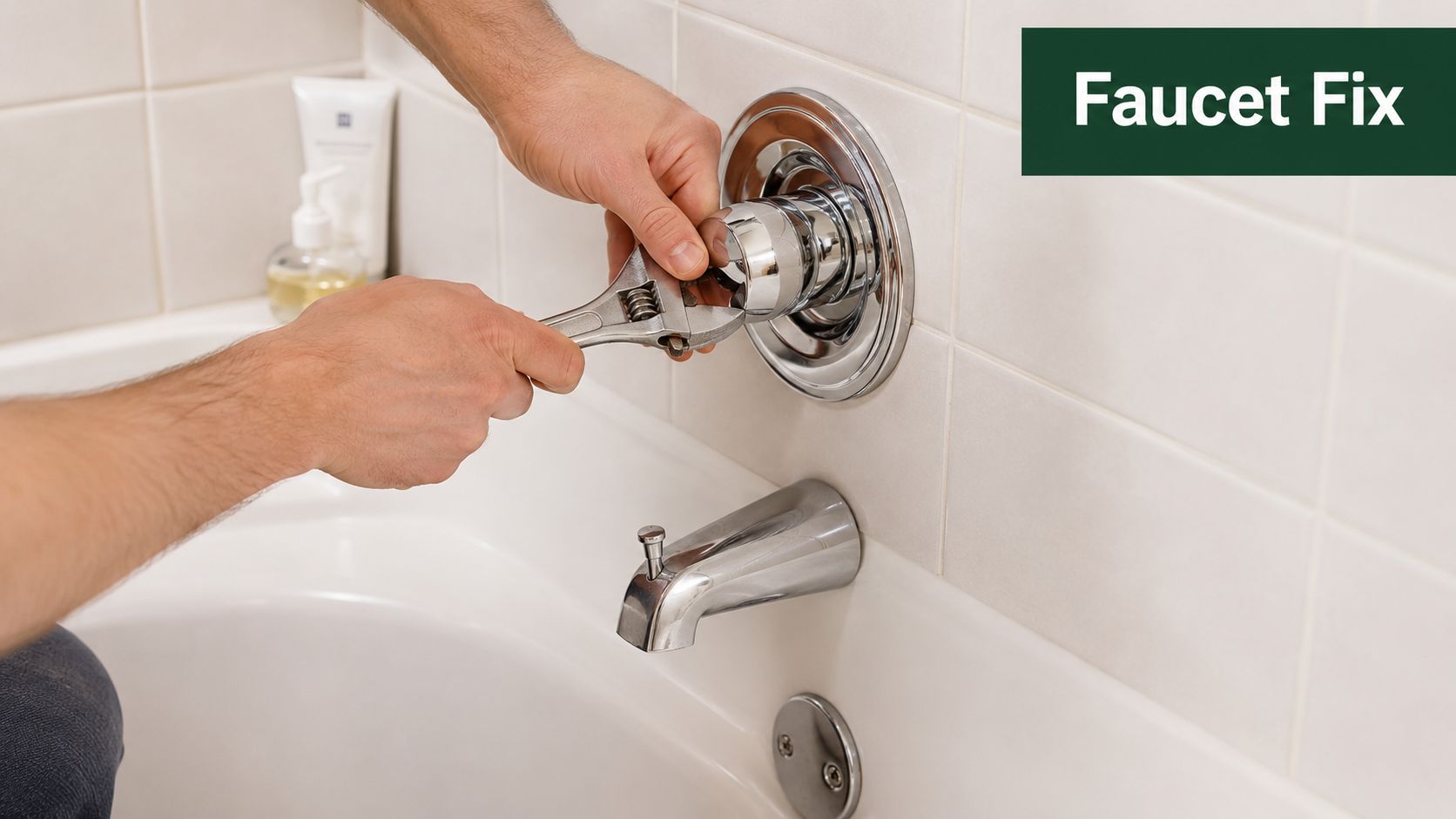
Home Depot's bathtub faucet repair guide explains the standard workflow clearly: shut off the water supply at the house shut-off valve or meter, remove the handle, inspect the cartridge or stem and spout, install the correct replacement part, then test for leaks. It also notes that DIY materials often run about $15 to $100, while hiring a plumber may cost roughly $150 to $350, and that stems and cartridges are brand-specific, so the wrong part can leave the leak unresolved even after the work is done (bathtub faucet repair steps and cost range).
That brand-match point matters more than people think. Two cartridges can look almost identical on the counter and still fail to seal correctly once installed.
A repair that usually works
Start with the water off. If you skip that, you'll regret it the second a retaining clip or cartridge comes loose.
Use this order:
- Remove the handle carefully: Most tub handles come off with a screw or an Allen set screw hidden under a cap.
- Take off the trim plate: This gives you access to the valve area and lets you see whether moisture has been escaping behind the wall opening.
- Pull the cartridge or stem: Some come out easily. Others need a cartridge puller or steady twisting to break mineral buildup loose.
- Inspect for damage: If the metal around the valve looks corroded or damaged, stop and reassess. That's where simple DIY can turn into a larger repair.
- Match the old part exactly: Bring the original cartridge or stem to the supply house or hardware store. Don't guess from memory.
- Reinstall and test: Turn the water back on and check both the spout and handle area.
A useful outside reference is this set of expert tips on fixing a leaky faucet, especially if you want another practical viewpoint before buying parts. If the leak is isolated to the fixture and you want service instead of trial and error, EZ Plumbing also handles faucet repair.
For a visual walk-through, this video is helpful:
When the tub spout is the problem
Sometimes the faucet valve isn't the leak. The tub spout or diverter spout is. In a repair video, one leaking bathtub faucet was fixed either by replacing a cartridge or by swapping a rubber washer that cost less than $10. The same guidance notes that if the leak remains after replacing the handle, washer, and stem, the entire bathtub spout may need replacement. It also shows the standard DIY tool set many homeowners use, including an Allen wrench, screwdriver, adjustable wrench, plumber's tape, and silicone grease (bathtub faucet and spout repair video).
If water keeps slipping out of the tub spout when the shower is on, don't assume the valve body is bad. A worn diverter spout is often the simpler answer.
What usually doesn't work is overtightening trim, reusing an old cartridge seal, or forcing in a “close enough” replacement. When a faucet repair fails twice, it's usually because the part match was wrong or the damage goes deeper than the replaceable part.
Sealing Leaks from Drains Overflows and Gaskets
Drain leaks and overflow leaks fool a lot of homeowners because the tub can look dry from above while water escapes below. These repairs aren't about replacing moving parts. They're about restoring a watertight seal.
Drain leak versus overflow leak
The drain flange sits at the bottom opening of the tub. The overflow plate is higher up on the tub wall and connects to a gasket behind it. Either one can leak if the seal dries out, shifts, or was installed poorly.
A fast way to separate them is to watch what water level triggers the leak. If the leak starts before water reaches the overflow, the drain flange is more likely. If it starts only when water rises high enough to reach the overflow opening, look there first.
How to reseal it correctly
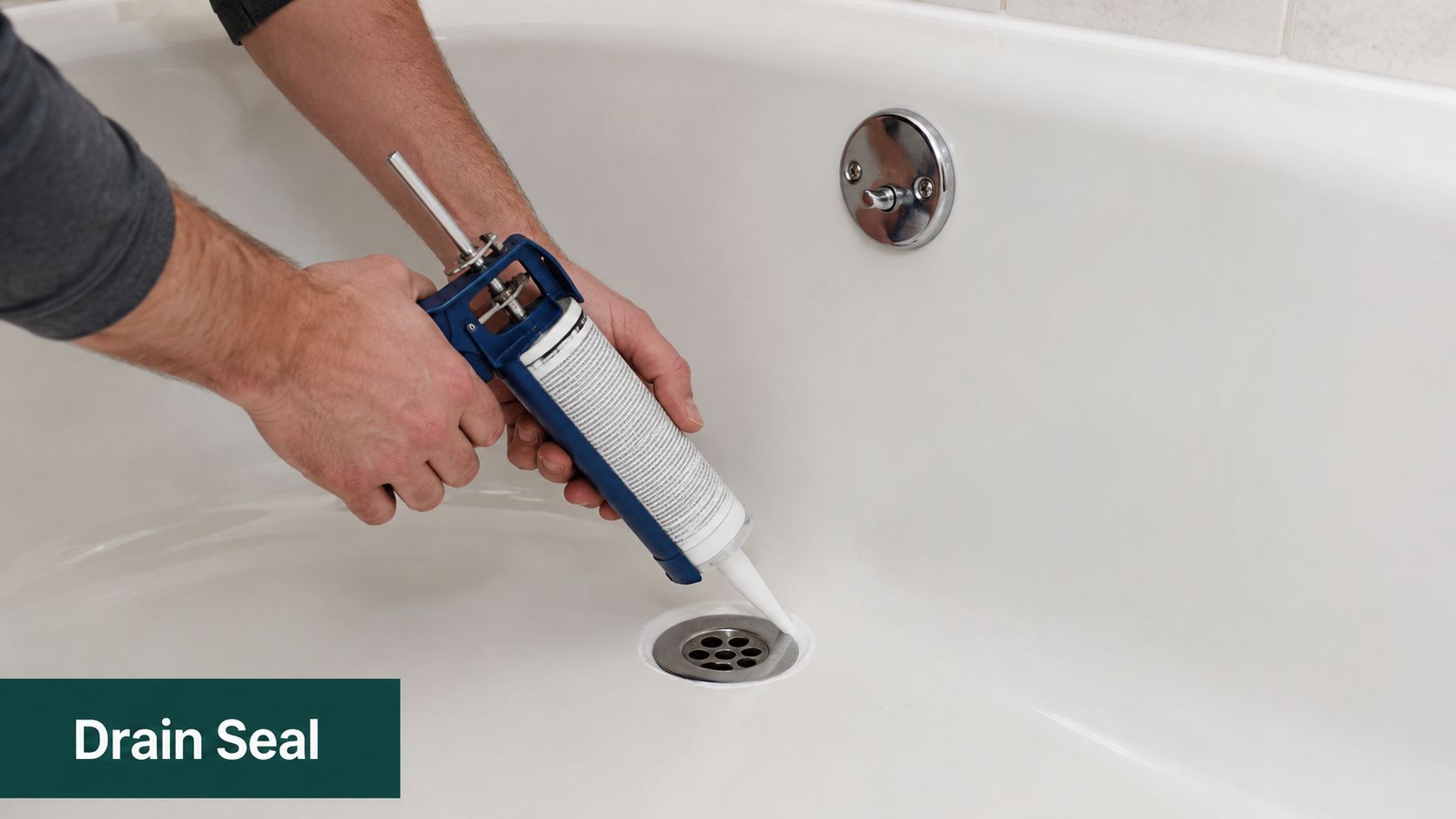
Roto-Rooter's bathtub leak guide lays out the core process: isolate the leak point, dry the area completely, reseal with plumber's putty or silicone, then let the sealant cure for about three hours before testing. It also advises filling the tub and letting it sit for a couple of hours before draining to confirm the new seal holds, and checking exposed pipes for corrosion or rust if leakage continues (bathtub drain and surround leak repair guidance).
Use a methodical approach:
- For a drain flange leak: Remove the drain, clean off all old putty or residue, dry the area fully, apply fresh sealant, and reinstall evenly.
- For an overflow leak: Remove the overflow plate, inspect the gasket behind it, replace or reseat it if needed, and make sure the mating surfaces are clean before tightening.
- For either repair: Don't test too soon. Fresh sealant needs time to set.
The main mistake here is bad prep. New sealant over wet residue, soap film, or old crumbling putty won't hold for long.
A clean, dry surface does more for a drain repair than extra sealant ever will.
If you reseal carefully and the leak still appears during the standing-water or drain test, stop blaming the caulk gun. At that point, the assembly itself may be damaged, the opening may be warped, or the leak may be in connected piping just beyond what you can see.
Stopping Splash Leaks by Resealing Grout and Caulk
A lot of bathtub leaks aren't plumbing leaks at all. Water stays inside the tub system until shower spray finds a failed joint, a gap in the caulk, or a weak grout line, then slips into the wall or floor.
What splash leaks look like
These leaks usually follow a pattern. The tub doesn't leak during a bath. It doesn't leak while standing full. It leaks when someone showers, especially if spray hits the corners, the tub-to-wall seam, or the edge where the surround meets the deck.
Look for these clues:
- Cracked caulk: Gaps at corners, along the tub edge, or around trim openings.
- Peeling or shrunken sealant: Old material pulling away from one side of the joint.
- Dark or stained grout lines: A sign that water is sitting where it shouldn't.
- Soft wall or trim nearby: A signal the leak has moved beyond a cosmetic issue.
If you want another trade-focused perspective on wet-area diagnosis and surface waterproofing, this DIY shower leak repair guide is worth reviewing.
How to recaulk without wasting your time
What doesn't work is smearing new caulk over old caulk. That's a patch, not a repair.
Do it in this order:
- Remove all failed caulk with a scraper or removal tool.
- Clean the joint thoroughly so there's no soap film, loose debris, or residue left.
- Let the area dry fully.
- Apply a continuous bead of bathroom-grade silicone along the joint.
- Tool the bead so it fully bridges the gap and bonds to both sides.
- Keep the area dry while it cures.
Short, broken beads fail early. So does rushing the prep. Most ugly caulk jobs aren't caused by bad hands. They're caused by trying to seal over contamination or moisture.
If grout is cracked badly or joints keep reopening, don't assume fresh caulk will solve everything. Repeated movement or hidden moisture may be telling you the enclosure needs closer inspection than a tube of silicone can provide.
When to Call a Plumber Recognizing a Job for the Pros
DIY has a place. A stubborn bathtub leak also has a way of teaching people where that place ends.
The smart move isn't proving you can do every repair yourself. The smart move is knowing when the leak has crossed into structural risk, hidden damage, or a repair that can get worse fast if the diagnosis is wrong.
The red flags that change the decision
Taskrabbit's guidance puts the line in the right place: if a leak returns after a simple fix like replacing a cartridge or recaulking, hidden damage becomes more likely, including failed seals, stripped threads, or corroded pipes behind the wall, and that's when DIY stops being cost-effective (when recurring leaks need professional diagnosis).
Those repeat leaks are the big warning. So are signs outside the tub area itself.
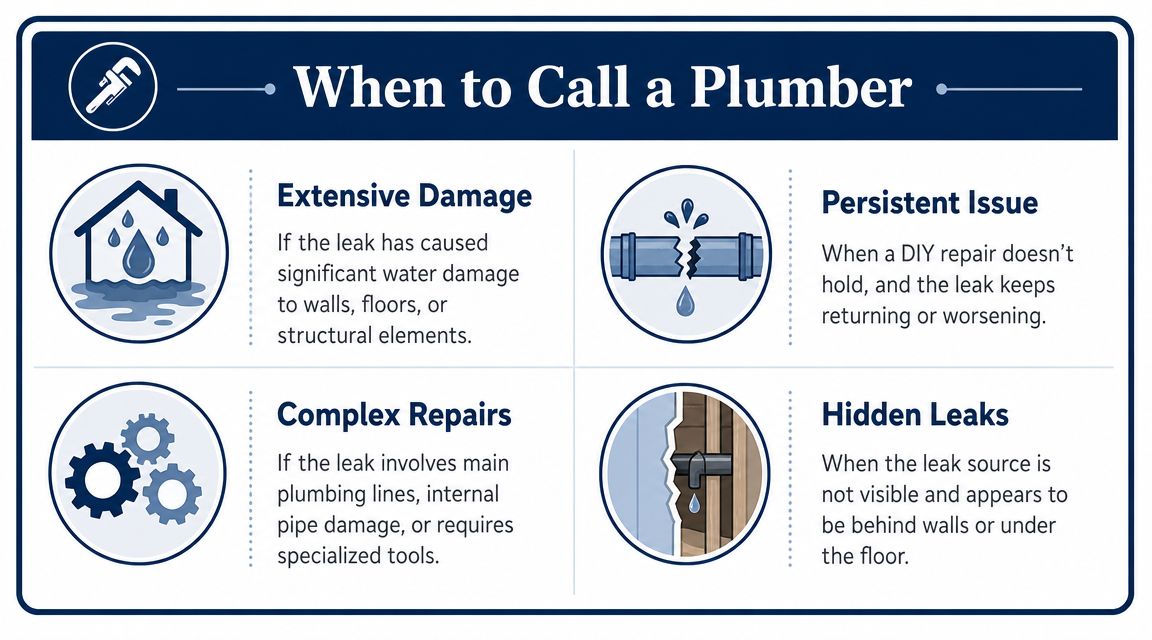
Call for help when you see any of these:
- Damage beyond the bathroom: Stains on ceilings below, swollen trim, or damp drywall in the next room.
- Corrosion or damaged metal: Especially around the valve body, threads, or pipe connections.
- A leak that changed behavior: It used to drip only after use, now it shows up unpredictably.
- No visible source: You know water is escaping, but every exposed part looks dry.
- A failed second attempt: You replaced the obvious part and the leak came back.
Why repeated DIY attempts get expensive
A lot of homeowners lose money by staying in DIY mode too long. They buy a second cartridge, then a new spout, then another tube of silicone, then finally call a plumber after the wallboard is already wet.
That's the trade-off. The first attempt can make sense when the source is clear and the fix is accessible. The third attempt usually means the source wasn't clear.
One maintenance topic that overlaps with this issue is caulking bathroom tiles. Surface sealing matters, but it only helps when the leak starts at the surface. It won't solve a failed drain connection or a hidden piping defect.
When the same leak survives a reasonable repair, believe the leak, not your first assumption.
What professional help actually changes
A plumber doesn't just bring tools. A good plumber narrows the leak path faster, checks behind access points without unnecessary demolition, and can tell the difference between a simple reseal and a failing assembly.
In Los Angeles, that matters because a lot of homes and multifamily buildings have older valves, mixed-material repairs from different decades, and tight access that punishes trial and error. For behind-wall leak tracing, recurring bathtub leaks, or repairs that may need fixture or piping work, bathtub repair is one of the service categories EZ Plumbing handles for local properties. That's often the safer route when moisture has already spread beyond the tub.
If there's active leakage, visible property damage, or signs the source is concealed, don't wait for a weekend opening in your schedule. Water keeps moving even when the leak looks slow.
Leaking Bathtub FAQ Your Lingering Questions Answered
Why does my bathtub only leak when I shower, not when I take a bath
That usually points away from the drain body itself and toward the shower side of the system. Common suspects are the tub spout diverter, wall joints, failing caulk, or splash getting through weak grout lines. Run a controlled shower test and direct spray to one area at a time.
If I fixed the faucet and it still leaks, what should I check next
Check whether the water is really coming from the faucet side. A lot of people hear dripping and assume cartridge failure, but the actual source can be the spout connection, overflow gasket, or a leak traveling from behind the wall opening. If the leak returned after a reasonable repair, treat that as a clue, not bad luck.
Can I just add new caulk over the old bead
You can, but it usually won't last. Old caulk often holds soap residue, trapped moisture, or loose sections that prevent a new bead from bonding well. Full removal and cleaning takes longer, but it's the repair that holds.
What about older homes in Los Angeles
Older homes often have more than one generation of plumbing parts in the same bathroom. That means the visible trim may not tell you what valve or piping sits behind it. Be cautious with brittle trim, seized screws, and corroded metal. If parts don't come apart cleanly, forcing them can turn a small repair into an open-wall job.
Do I need a permit to fix a leaking bathtub
Simple maintenance and part replacement often don't raise the same issues as major plumbing rework, but permit requirements can change based on the scope of the repair and local rules in Los Angeles. If the job moves beyond replacing accessible parts and into piping changes or wall-opening work, verify requirements before starting.
Is a very slow drip really a big deal
Yes. Even when the leak looks minor, constant moisture is hard on finishes, framing, and ceilings below. The bigger issue isn't always the amount of water. It's where that water goes and how long it stays there.
If you've tracked the leak and it's clearly beyond a simple cartridge, drain reseal, or recaulk job, contact EZ Plumbing. They're a licensed, insured Los Angeles plumbing contractor serving homes, HOAs, property managers, and commercial properties since 1989, with 24/7 emergency response, same-day scheduling for planned repairs, and experienced technicians who handle leak diagnosis without turning a small problem into a bigger one.