
How Much Does Slab Leak Repair Cost in 2026?
The average slab leak repair in the United States costs $2,280, but the actual-world range is much wider, from about $300 for a minor accessible repair to $6,750 or more when access is difficult. If you're standing on a warm floor, hearing water run when everything is off, or staring at a water bill that suddenly makes no sense, that range is what matters most.
In Los Angeles, slab leak pricing often turns into a bigger decision than homeowners expect. The leak itself is only part of the problem. The harder question is whether you should open the slab and fix one bad section, or stop chasing old pipe failures and reroute the line entirely. In older homes, especially pre-1980s properties with aging copper under the slab, that choice can save you from the expensive cycle of repairing one leak only to pay for another one a few years later.
When this happens, plumbing jargon isn't necessary. What's needed instead is a straight answer about cost, what drives the bill, where contractors overcharge, and which repair makes financial sense over time. That's what this guide covers.
Table of Contents
- What Is a Slab Leak and Why Is It an Urgent Problem
- The Real Cost of Slab Leak Repair A 2026 Price Breakdown
- Key Factors That Influence Your Final Bill
- Comparing Slab Leak Repair Methods and Their Costs
- The Hidden Costs of Delaying Slab Leak Repair
- How to Get an Accurate Slab Leak Repair Estimate
- Your Los Angeles Slab Leak Solution EZ Plumbing
What Is a Slab Leak and Why Is It an Urgent Problem
A slab leak is a water line leak beneath the concrete foundation of your home. You usually don't see the pipe. You see the warning signs around it. A warm patch on the floor. Damp flooring with no clear source. The sound of running water when no fixture is on. A water bill that suddenly looks wrong.
That hidden location is why slab leaks worry people so much. The leak isn't just wasting water. It's happening under the structure you live on. If you think you may have one, this guide on how to tell if you have a slab leak is a useful place to confirm the common symptoms before you start calling contractors.
Why homeowners panic when they hear the word slab
They panic because access is hard. A plumber isn't just tightening a fitting under a sink. The work may involve electronic detection, exposing the line, breaking concrete, repairing pipe, pressure testing, then patching what had to be opened to reach it.
That also explains why the price spread is so wide. One slab leak may be in an easy location with minimal finish damage. Another may sit under tile, hardwood, cabinets, or a section of the home where access is miserable. Same type of problem. Very different invoice.
Practical rule: A slab leak is never a good problem to “watch for a few days” if you already have active signs. Hidden water under a foundation rarely gets cheaper with time.
Why speed matters
Urgency doesn't always mean panic. It means getting it diagnosed quickly and choosing the right repair method before the damage spreads or the job becomes more invasive.
In Los Angeles, I'd be especially cautious with older slab-on-grade homes. If the plumbing under the slab has age-related wear, the first leak may not be the last. In those cases, the cheapest repair on day one isn't always the cheapest repair over the life of the house.
The Real Cost of Slab Leak Repair A 2026 Price Breakdown
The best starting point is the verified national data. The average cost for slab leak repair in the United States is $2,280, and that total includes leak detection, which typically adds $150 to $400 to the bill according to Angi's slab leak repair cost guide.
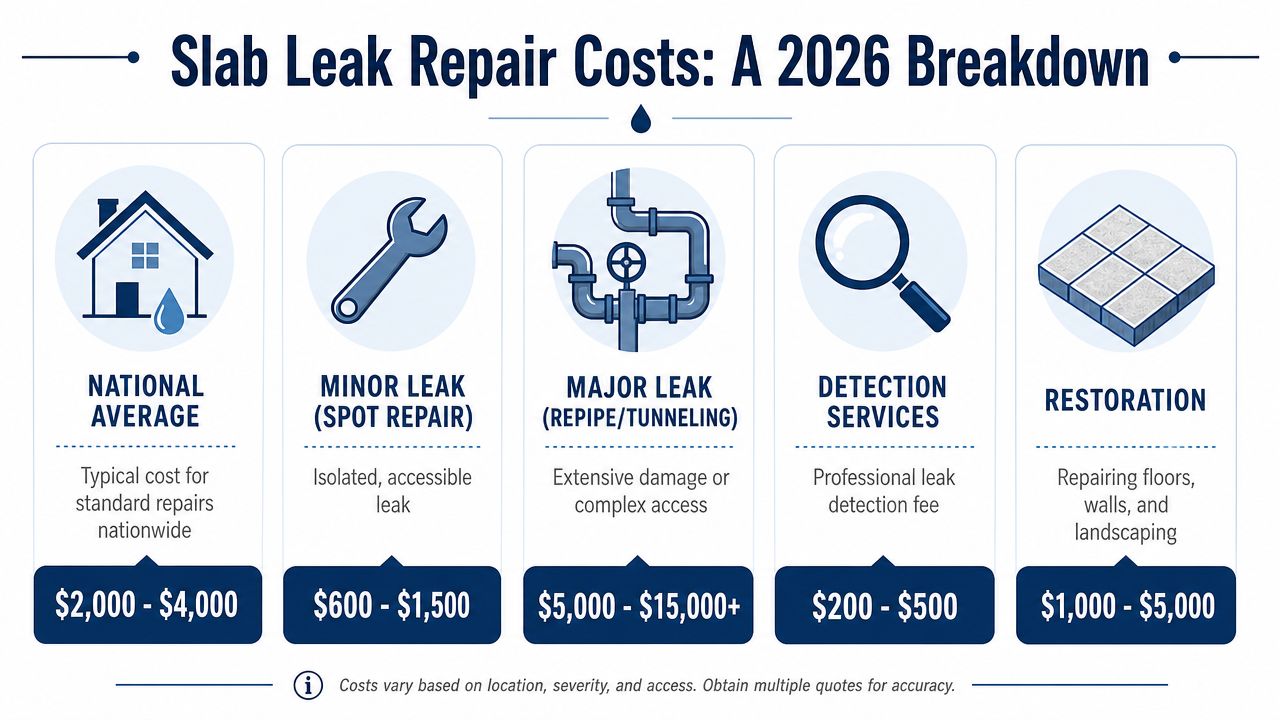
That same source puts minor accessible repairs at $300 on the low end, while jobs with difficult access can reach $6,750 or higher. In many larger markets, homeowners commonly land between $630 and $4,400 for standard repairs, with the final price changing based on labor rates and the method used.
Where the money actually goes
The biggest misunderstanding I see is homeowners assuming pipe material is the expensive part. Usually, it isn't.
Per the same Angi cost breakdown, labor runs from $500 to $4,000, or about $75 to $150 per hour, while the actual materials for the pipe repair are often under $100. That lines up with real field logic. The work is expensive because the crew has to find the exact leak, protect the surrounding area, create access, perform the repair, test it, and then leave the area safe for restoration.
A slab leak bill often includes work like:
- Leak detection: Locating the failure under concrete before anyone starts opening the wrong area.
- Demolition and access: Cutting slab or reaching the line through another route.
- Pipe repair: Replacing or reconnecting the failed section.
- Testing: Making sure the system holds and the leak is resolved.
- Basic patching: Closing the immediate plumbing access point, depending on scope.
Most slab leak jobs are labor-heavy construction tasks disguised as plumbing repairs.
What low-end and high-end pricing usually means
A low-end repair usually means the leak is isolated and easy to reach. That might be a small opening in a favorable location with limited finish restoration.
A high-end repair usually means the pipe sits in a brutal spot. Mid-room access, hard flooring, cabinetry, complex routing, or a need to avoid repeated slab openings can all push the cost upward. When a homeowner sees a wide estimate range, that doesn't automatically mean someone is overcharging. It often means the access strategy still hasn't been nailed down.
What matters is whether the quote clearly shows what's included and why.
Key Factors That Influence Your Final Bill
Two homes can have the same type of leak and very different final invoices. The difference usually comes down to access, repair strategy, and how complete the estimate is.
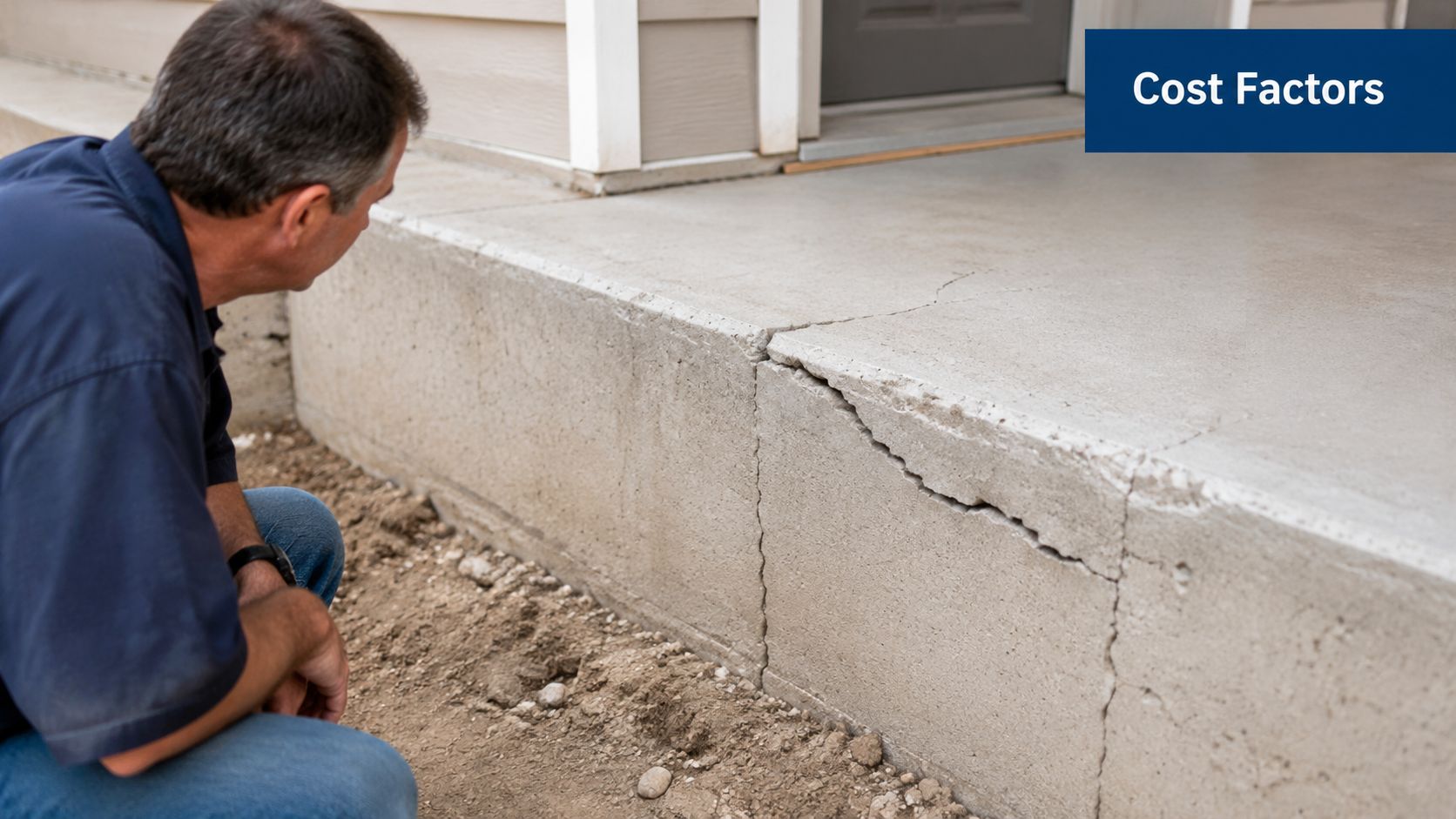
Access changes everything
If the line is under a simple area with straightforward access, the repair may stay relatively contained. If it's under finished flooring, built-ins, or a part of the home that requires careful demolition and restoration, the bill rises fast.
Here are the biggest cost drivers I'd tell any homeowner to ask about:
- Leak location: A leak under open concrete is one thing. A leak under tile, wood, or a kitchen footprint is another.
- Chosen repair method: A direct spot repair may cost less upfront than bypassing the old line, but that doesn't make it the cheaper decision long term.
- Secondary damage: Flooring, drywall, cabinets, and trim can shift the total cost more than people expect.
- Permit and inspection requirements: In Los Angeles, local requirements can affect scheduling and scope.
- Insurance handling: Coverage often depends on how the policy treats sudden damage versus long-term leakage.
- Emergency timing: After-hours response and immediate dispatch can carry a premium compared with scheduled work.
A careful contractor should explain which of those factors are already included in the price and which aren't.
The charges homeowners miss on the first quote
A common problem is a quote that includes the plumbing repair but stays vague about what happens after the pipe is fixed. That's where people get blindsided.
Ask whether the estimate includes:
| Item | Why it matters |
|---|---|
| Access opening | You need to know exactly what will be cut or removed |
| Concrete patching | Some plumbers include it, some don't |
| Finish restoration | Tile, wood, paint, drywall, and cabinets may be separate |
| Permit coordination | Delays and extra billing often start here |
| Post-repair testing | You want confirmation the system is sound |
If you're trying to understand the insurance side before you authorize the work, this guide on water damage insurance claims Phoenix gives a practical overview of how homeowners often approach leak-related claims and documentation.
A quick visual can also help if you're evaluating what a contractor is proposing.
What I tell homeowners: If a quote sounds low, check what it leaves out before you compare it to a higher bid.
Comparing Slab Leak Repair Methods and Their Costs
Not every slab leak should be repaired the same way. The method should match the condition of the pipe system, the leak location, and how long you plan to own the property. In Los Angeles, that last part matters more than people think.
The strongest cost trade-off in older homes is spot repair versus rerouting. Verified pricing from The Waterboy slab leak cost guide shows that a minor spot repair can cost $300 to $4,400, while a full reroute averages $7,500 to $14,000. The same source also notes that in aging pipe systems common in pre-1980s homes, spot repair carries a high risk of recurrence within 2 to 5 years, while rerouting offers a permanent solution that prevents future leaks in the abandoned line path.
Spot repair when it makes sense
A spot repair means opening the area at the leak and fixing that specific failed section. This can be the right move when the rest of the system is in solid shape and the leak looks isolated rather than systemic.
Good candidates for spot repair usually have one or more of these characteristics:
- Newer piping condition: The leak appears to be a one-off failure, not a symptom of widespread wear.
- Clear leak location: Detection has narrowed it down well enough to avoid exploratory demolition.
- Reasonable access: The line can be reached without destroying major finishes or built-ins.
What doesn't work well is using spot repair as a default when the pipe system is already showing its age. That's how homeowners fall into repeated opening, patching, and restoration.
Rerouting when the pipe system is the real problem
A reroute bypasses the failing pipe under the slab and runs a new line through a more accessible path. Up front, it's a much bigger number. Long term, it may be the cheaper move if the old buried line is likely to keep failing.
That trade-off is especially important in older Los Angeles homes. If one under-slab line has corrosion or age-related weakness, there's a fair chance the rest of the same system isn't far behind.
If you own a pre-1980s home and the plumber only talks about the current hole in the pipe, ask a second question. “What does this say about the rest of the line?”
Here's the side-by-side comparison most homeowners need:
Slab Leak Repair Method Comparison
| Method | Average Cost Range | Disruption Level | Best For |
|---|---|---|---|
| Spot repair | $300 to $4,400 | Moderate to high, depending on slab access | Isolated leak in an otherwise healthy system |
| Full reroute | $7,500 to $14,000 | Moderate, often less slab demolition but more routing work | Aging pipe systems, repeated leaks, older homes |
| Line reroute alternative | $300 to $1,500 for a line, $2,000 to $15,000 full | Varies by scope and route | Selected bypass work where full system conditions support it |
| Slab tunneling | Qualitatively varies with access and soil conditions | High outside disruption, less interior slab opening in some cases | Cases where below-slab access from the exterior is more practical |
For homes that may also need concrete or surface restoration after invasive access, a specialty contractor can matter. If you want to understand the type of exterior and structural finish work that sometimes follows these jobs, this overview of Atlanta masonry repair for homes is a decent example of the restoration side homeowners often forget to price.
Tunneling and other access-driven options
Tunneling can make sense when the plumber wants to avoid opening finished interior slab areas, but it's highly site-specific. Yard access, footing layout, soil conditions, and the leak's position all matter.
I wouldn't choose tunneling because it sounds less invasive in theory. I'd choose it only when the access math works for your property.
For older Los Angeles homes, the financial decision usually comes down to this: if the plumbing system is aging and you're already seeing buried-line failures, a cheap repair can become an expensive habit.
The Hidden Costs of Delaying Slab Leak Repair
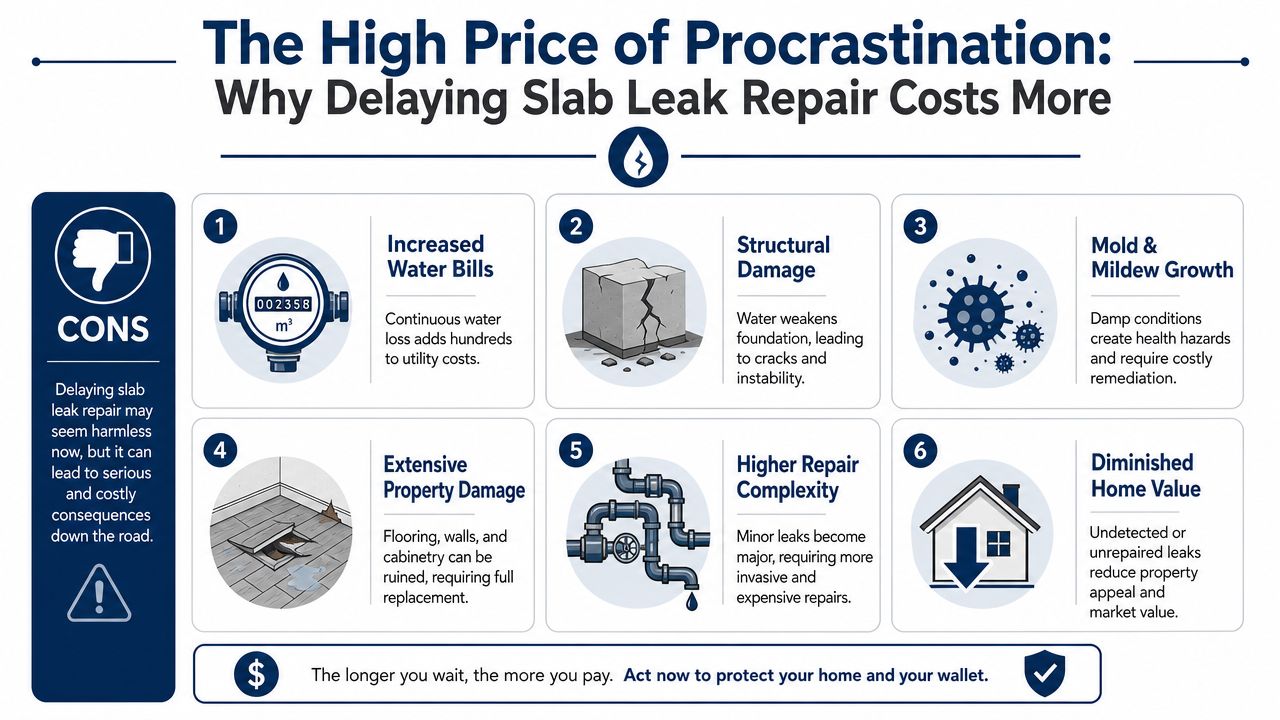
A slab leak rarely stays in the neat, affordable category once it's left alone. The water keeps moving. The affected materials keep absorbing it. The repair options usually get worse, not better.
What starts small gets expensive fast
Most homeowners first notice the leak through symptoms, not the leak itself. The floor changes. The smell changes. The water bill changes. By that point, the house may already be dealing with more than a pipe issue.
Delaying repair can lead to:
- Higher utility bills: Active water loss keeps adding cost every billing cycle.
- Foundation-related movement: Persistent moisture under a slab can affect surrounding support conditions.
- Mold and mildew conditions: Damp hidden areas under flooring and behind walls create the environment for growth.
- Broader property damage: Flooring, baseboards, drywall, and cabinetry can all become part of the job.
If you want a homeowner-focused explanation of why acting early usually costs less, this article on why timely leak repairs save money and protect your home covers the logic well.
Why planned work is cheaper than emergency work
When you deal with a slab leak early, you usually have more choices. You can schedule detection. Compare estimates. Decide whether a local repair still makes sense or whether rerouting is smarter.
When you wait, the leak often decides for you. A small concealed failure can become a major break, and then you're no longer shopping for the best approach. You're paying for immediate containment, broader restoration, and whatever emergency access is required to stop active damage.
A controlled repair is almost always cheaper than a crisis response tied to wet floors, damaged finishes, and a family trying to stay in the house during active water loss.
The people who get hit hardest by delay are often the ones who wanted to save money. That instinct is understandable. It just points in the wrong direction with slab leaks.
How to Get an Accurate Slab Leak Repair Estimate
The fastest way to overpay is to approve the first vague quote because you're stressed. A slab leak estimate should be specific enough that you can compare scope, not just price.
Questions to ask before you sign
Ask for an itemized written estimate. Not a verbal range. Not a text saying “around this much.” You need to see what the plumber is charging for detection, access, repair method, testing, and patch-back.
Use this checklist when comparing bids:
- Ask how the leak was located: If the contractor can't explain the detection method clearly, that's a bad start.
- Confirm the repair method: Spot repair, reroute, or another access strategy should be named plainly.
- Get the restoration scope in writing: Find out whether the quote includes concrete patching, finish repair, or only plumbing work.
- Verify license and insurance: Slab work affects real property, not just pipe.
- Ask what could change the price: A good contractor can explain the conditions that trigger a change order.
For your own documentation, it also helps to verify whether water use is still ongoing. This simple guide on how to read a water meter for leaks can help you confirm active loss before and after discussions with contractors.
Red flags that usually lead to overpaying
You don't need to be in the trade to spot a bad estimate. Watch for these patterns:
- Vague scope: If the bid doesn't say what gets opened, repaired, and restored, expect disputes later.
- Pressure to sign immediately: Good plumbers don't need panic tactics.
- No discussion of alternatives: If the house is older and the plumber never mentions rerouting, that's a warning sign.
- One suspiciously low number: Low bids often exclude restoration, testing, or permit coordination.
A fair estimate isn't always the cheapest one. It's the one that tells you exactly what problem is being solved, how it will be solved, and what won't be included.
Your Los Angeles Slab Leak Solution EZ Plumbing
Los Angeles slab leaks aren't just plumbing events. They're property decisions. The right move depends on where the leak is, how much access it takes, and whether the existing pipe system deserves another patch or a more durable solution.
That's why the smartest homeowners focus on total cost, not entry price. A small repair bill can be the expensive choice if it leads to another leak, another slab opening, and another round of restoration. In older homes, especially pre-1980s properties, that long-term view matters.
If you're evaluating contractors locally, one practical option is EZ Plumbing, a licensed and insured Los Angeles plumbing contractor serving the area since 1989 with 24/7 emergency response, same-day scheduling for planned repairs, and service across neighborhoods including Santa Monica, Glendale, Burbank, Pasadena, Beverly Hills, West Hollywood, and the San Fernando Valley. For homeowners also reviewing policy options before a claim situation gets complicated, it can help to compare home insurance quotes and understand how coverage terms vary.
For urgent slab leak concerns, the main thing is to get a precise diagnosis and a quote that explains the repair path clearly. If the house is older, ask directly whether the recommendation solves one leak or the bigger piping problem. That single question often saves the most money.
If you need help with a slab leak in Los Angeles, EZ Plumbing can inspect the problem, explain your repair options clearly, and schedule service for urgent or planned work. Call (818) 908-2710 or book online to get a straightforward estimate before the damage spreads.