
Galvanized Pipe Corrosion in Los Angeles Homes
A galvanized pipe system that has been in service for decades may be at the end of its useful life, and corrosion can become both a structural failure problem and a water-quality problem. In some settings, galvanized pipe has lasted 40 to 50 years or longer, while corrosive soil and water conditions can shorten service life sharply.
You may be dealing with this right now in a 1940s bungalow in Echo Park, a Mid-City duplex, or a San Fernando Valley home with original plumbing hidden behind plaster. The first clue might be brown water after the house has been quiet overnight, a shower that loses pressure when someone opens a faucet, or a damp patch below an upstairs bathroom. Rusty water gets your attention, but the bigger concern isn't just appearance. A corroded pipe can restrict flow, develop pinhole leaks, damage walls, and hold or release contaminants accumulated inside the plumbing.
Galvanized pipes have been used since the late 1800s and became especially common in homes built during the 1950s and 1960s. Much of that plumbing is now well beyond the service window its owners expected, as discussed in this historical review of galvanized plumbing and pipe corrosion. The right response in Los Angeles isn't automatically a full repipe, and it isn't automatically another patch. You need to understand the pipe's condition, the water chemistry, the contamination risk, and whether a partial repair or modern replacement makes sense.
Table of Contents
- What Galvanized Pipe Corrosion Really Means
- How Zinc and Steel React Over Time
- Warning Signs You Can See and Measure
- The Hidden Risk Most Homeowners Miss
- Inspection and Diagnostic Steps
- Repair, Replacement, and Modern Alternatives
- Costs, Timelines, and Emergency Response
- When to Call a Licensed Los Angeles Plumber
What Galvanized Pipe Corrosion Really Means
A homeowner in Echo Park recently notices that the kitchen faucet spits orange particles on Monday morning. Under the sink, the exposed pipe looks dull and rough, with a crust around the threaded connection. The line hasn't failed yet, so it feels reasonable to clean the aerator and wait. That approach can miss what is happening inside the wall.
Galvanized pipe corrosion begins when the zinc coating on a steel pipe gradually breaks down. Zinc is intended to protect the steel beneath it, but water, dissolved oxygen, minerals, deposits, and metal connections all affect how long that protection lasts. Once the zinc is consumed in a localized area, moisture reaches the steel core and iron corrosion produces scale that grows inward.
Why the inside matters
The pipe may look acceptable from the outside while its bore is already rough and narrowed. Corrosion products cling to the wall, catch sediment, and create more sites for localized attack. The result is often lower flow before the homeowner sees a visible leak.
A galvanized pipe can also become a water-quality concern. A Water Research Foundation project examines how galvanized iron pipe can accumulate and release lead, while utility guidance notes that lead-containing scales may form on pipe walls and later dislodge or dissolve. The pipe may therefore act as a reservoir, not merely a deteriorating conduit. Read the Water Research Foundation project on lead accumulation and release when deciding why a water test needs careful interpretation.
Practical rule: Treat recurring discoloration, reduced flow, and corrosion at several fixtures as evidence of a system condition, not as isolated faucet problems.
This guide focuses on how zinc and steel deteriorate, which symptoms deserve attention, how a plumber evaluates the system, and when PEX or CPVC makes more sense than another threaded repair. It also separates emergency action from planned replacement, because a leaking pipe and a contaminated plumbing system require related but different decisions.
How Zinc and Steel React Over Time
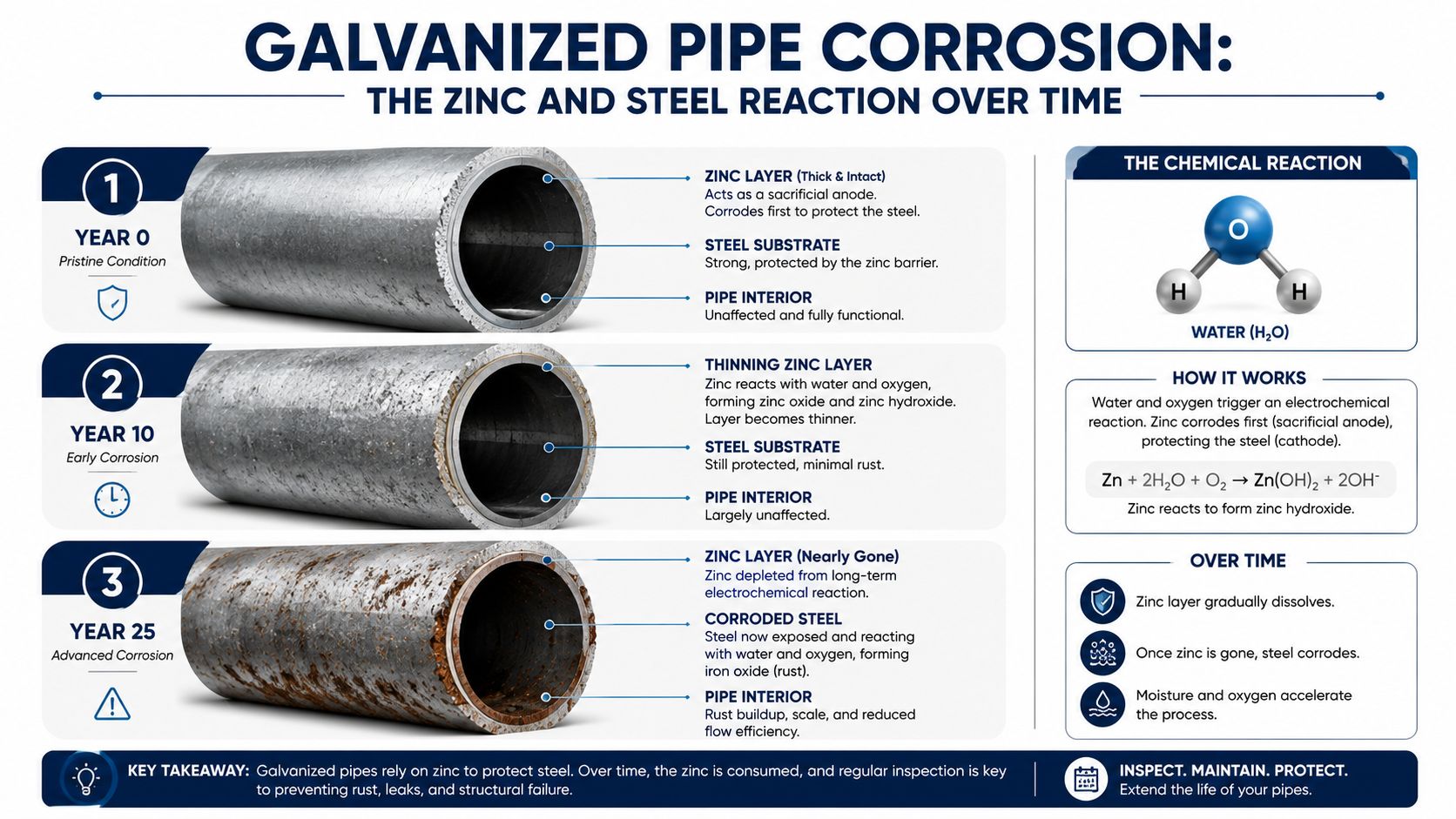
Think of galvanized pipe as a steel tube wearing a protective zinc skin. The steel provides strength. The zinc acts as a barrier and sacrifices itself electrochemically when water reaches the coating. While that zinc remains intact, it helps keep the steel from reacting directly with moisture and dissolved oxygen.
The corrosion sequence
The process usually follows a recognizable pattern, although the speed varies by location.
- The zinc coating reacts first. Water chemistry, temperature, flow conditions, and deposits gradually consume the protective layer.
- Small weak points appear. Threads, joints, scratches, stagnant sections, and low-flow areas can corrode differently from the rest of the pipe.
- Steel becomes exposed. Iron begins producing corrosion products that roughen the interior and reduce the open passage.
- Scale and tubercles build inward. Sediment and rust attach to the rough wall, restricting flow and creating localized cells.
- Pitting develops. Instead of thinning evenly, the pipe can fail at a small, heavily attacked area, producing a pinhole leak.
Water chemistry controls the pace. Zinc performs best in roughly pH 5.5 to 12, while corrosion rises sharply below pH 4 and above pH 12. Soft water can be especially aggressive because protective calcium-zinc carbonate scales form less readily, and chloride above about 50 ppm can accelerate attack. A technical review describes 80 ppm chloride in soft water as causing severe corrosion, while harder water may tolerate much higher chloride when protective scales form. These values and the chemistry discussion come from this technical reference on galvanized steel corrosion.
Why connections can speed failure
Copper joined directly to galvanized steel can create a galvanic couple, especially when the connection lacks the appropriate dielectric separation. The dissimilar metals interact through the water, and the galvanized side may suffer accelerated attack near the joint.
For a broader explanation of zinc coating behavior and the limits of galvanizing, NSP Coatings' discussion of galvanising provides useful background. In a home, the practical lesson is simple: once the zinc protection is gone, steel corrosion isn't a slow cosmetic change. Roughness, pitting, tuberculation, and pinhole leaks can develop in stages, often with flow loss appearing before a major rupture.
Warning Signs You Can See and Measure
A self-check can help you decide whether to schedule an inspection, but it can't prove that a pipe is safe. Walk through the home with a flashlight, a clean container, and a written list of symptoms. Look for patterns rather than relying on one rusty faucet.
Start with exposed pipe
Check the garage, crawl space, utility area, under-sink cabinets, and any access panels.
| Symptom Category | What to Look For | Where to Check |
|---|---|---|
| Exterior corrosion | White or chalky deposits, rust blooms, flaking, dimples | Threaded joints, valves, exposed runs |
| Moisture damage | Damp drywall, peeling paint, staining, musty areas | Ceilings below bathrooms, walls near pipe chases |
| Flow restriction | Weak streams or pressure changes | Kitchen sink, shower, hose bib |
| Sediment | Orange grit or dark particles | Faucet aerators, toilet tanks, shower screens |
| Water appearance | Brown or yellow first-draw water that clears | Cold-water taps after overnight stagnation |
Brown water that clears after several seconds often indicates settled corrosion products being disturbed when flow starts. That doesn't tell you whether the source is a short branch line, the building supply, or upstream work, so map which fixtures show it and which don't.
Compare fixtures, not just pressure
Run the kitchen faucet and then compare it with an outdoor hose bib supplied by a different branch. If the hose bib has strong flow while the kitchen sink struggles, the restriction may sit in the interior galvanized branch rather than at the street connection. If several fixtures weaken together, the problem may be closer to the main or may involve a broader buildup pattern.
You can remove and rinse aerators, inspect toilet tanks for sediment, and observe whether the water heater is collecting debris. A basic pH or TDS meter can flag unusual readings, but these tools don't identify lead or confirm pipe-wall integrity. Multiple symptoms justify professional evaluation, especially when the property has original galvanized plumbing.
Rust at one joint may be a repair. Rust at several fixtures, repeated leaks, and falling flow usually point to a system decision.
Don't scrape a corroded pipe aggressively or twist a seized fitting just to inspect it. Old galvanized connections can fail when disturbed, turning a diagnostic effort into an active leak.
The Hidden Risk Most Homeowners Miss
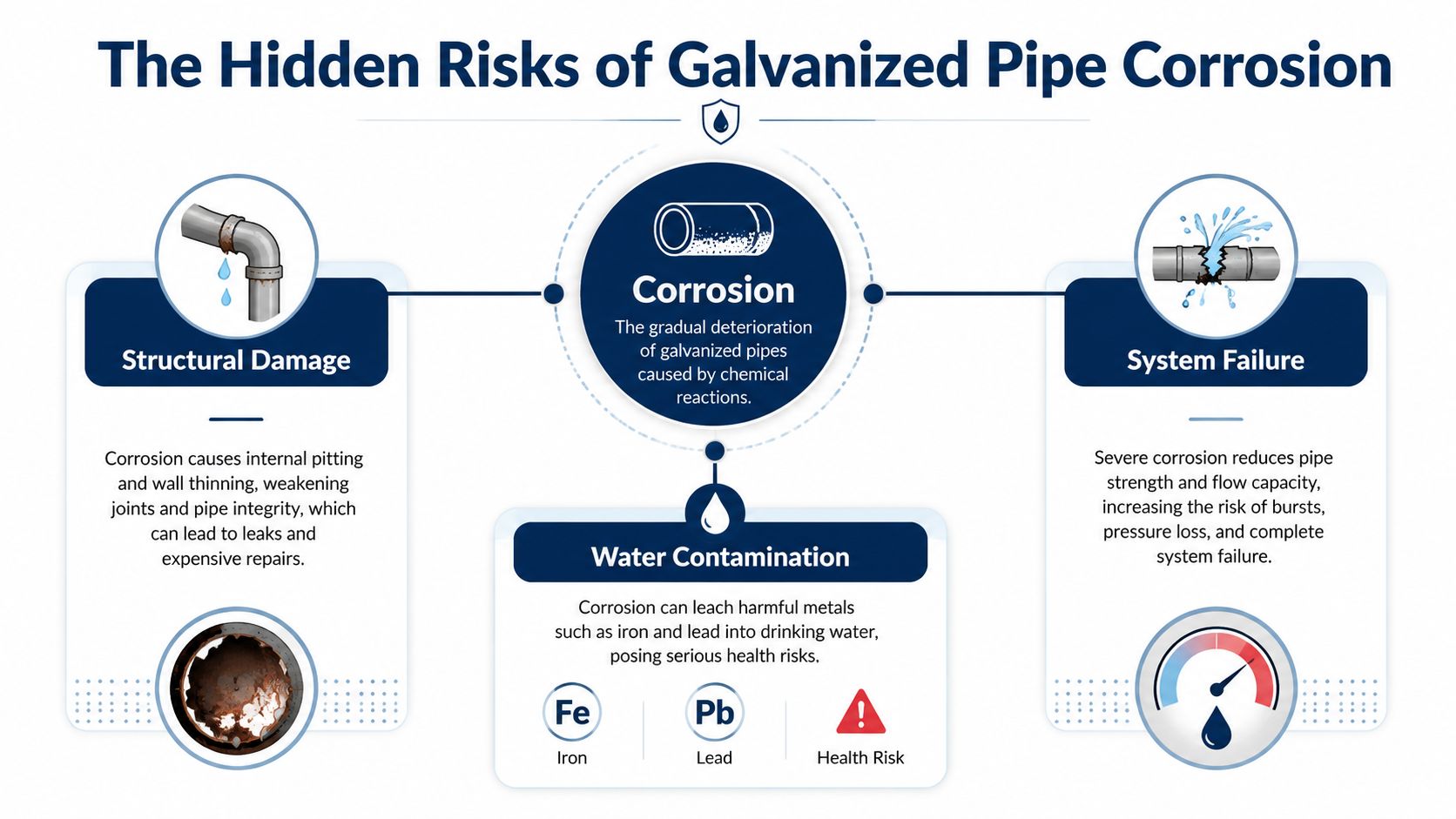
Many homeowners think galvanized pipe corrosion means rusty water and weak pressure. Those are visible symptoms, but the less obvious concern is that old pipe can collect and later release lead-bearing scale.
EPA reporting explains that galvanized iron plumbing can act as a sink and source for lead. It may capture lead released from an upstream service line, then release particles or dissolved material later. The Virginia Tech research on galvanized pipe and mixed-metal plumbing describes why partial lead service-line replacement can create a more complicated corrosion environment than a complete replacement. The verified findings include a configuration that was 40% worse than a full lead service line under moderate-flow sampling, and lead release that increased by 140% at 14 months compared with earlier data during the first eight months.
Why one water sample may not settle the question
A sample taken after the tap has run can miss particles sitting in an aerator or pipe section. A first-draw sample can show contamination, but results still depend on where the sample came from, how long the water stood, and whether recent plumbing work disturbed scale. A qualified tester should explain the sampling method and whether the question concerns dissolved lead, particulate lead, or both.
That matters in older Los Angeles properties, particularly buildings with mixed materials, old service connections, and original galvanized branches. The pipe can continue acting as a reservoir even after a source elsewhere in the system changes.
A family that sees brown water only after a long weekend may be seeing stagnant water dislodge particles. A tenant reporting an unusual taste doesn't establish a health diagnosis, but it does establish a reason to investigate. If a child has an elevated blood lead result, the plumbing should be considered alongside other possible exposure sources, not dismissed because the water looks clear.
Legionella concerns also require careful handling. A homeowner shouldn't assume that every corroded pipe contains bacteria, but stagnant, scaled plumbing can complicate water management in buildings. The health-first response is to test appropriately, reduce exposure to questionable water for drinking and cooking, and obtain professional guidance rather than relying on appearance alone.
Inspection and Diagnostic Steps
A licensed plumber doesn't begin by recommending a repipe based only on the home's age. The useful diagnosis connects visible pipe condition, fixture behavior, pressure, leak evidence, and water testing.
Step one begins at the pipe
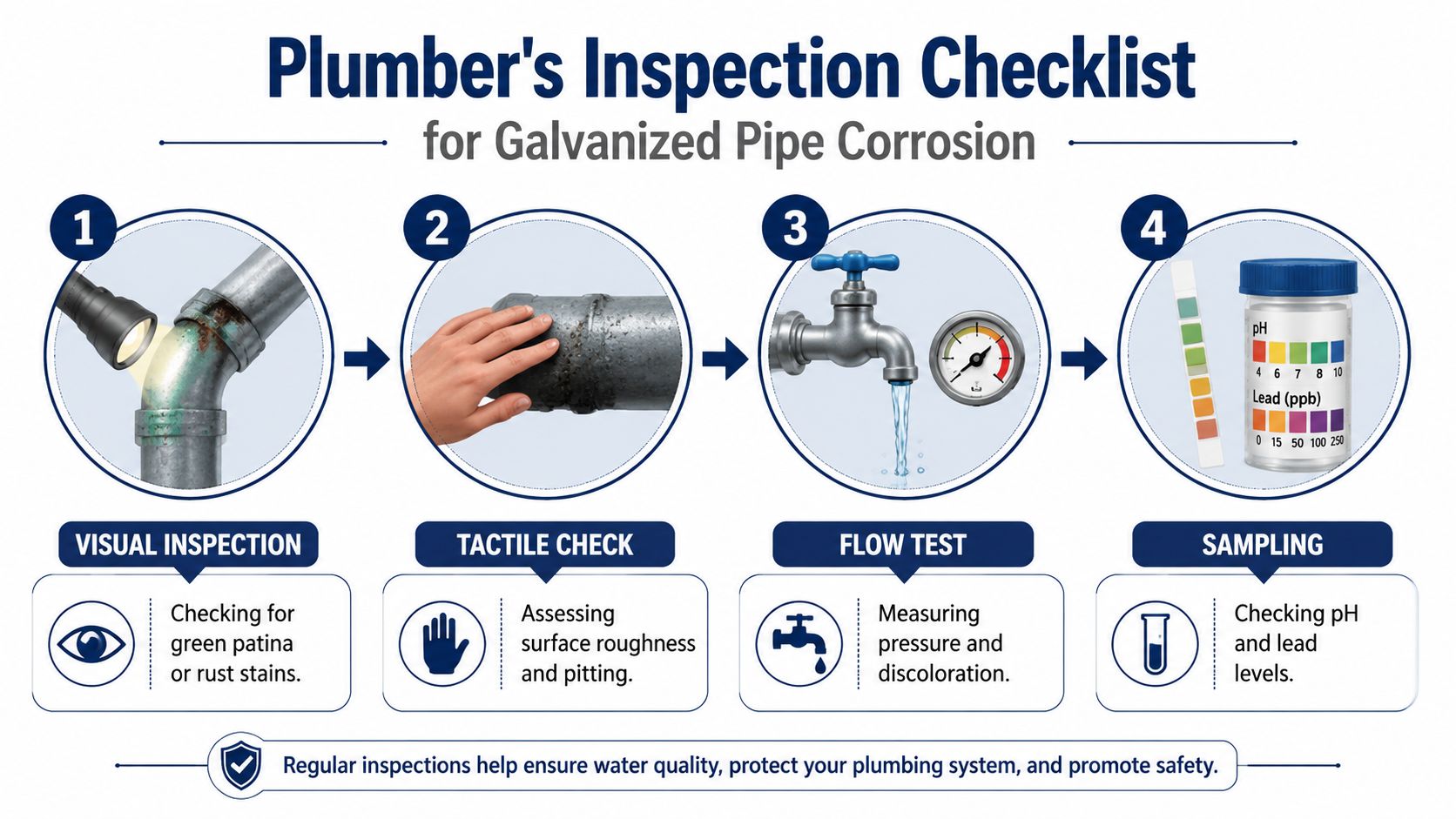
The inspection starts with exposed runs in garages, crawl spaces, utility closets, and access panels. The plumber looks for rust staining, white deposits, flaking, bulges, dimpling, and moisture around threaded joints. A pipe that feels rough or shows localized swelling deserves more caution than one with uniform surface discoloration.
Next comes fixture mapping. The plumber records which faucets show first-draw color, which aerators contain orange grit, and whether hot and cold lines behave differently. The water heater and nearby shutoff valves also matter because sediment and old fittings can create local restrictions that resemble whole-house corrosion.
Testing restriction versus leakage
Pressure testing helps distinguish a blocked line from a leak. A static pressure reading can look acceptable while the flow collapses when several fixtures operate, so a plumber should test under use rather than rely on one gauge reading. A meter check can also help identify hidden water movement. Homeowners who want to understand the basics can use this guide on reading a water meter for leaks.
An in-line camera may show interior scale in accessible sections, but camera access isn't universal for small residential supply lines. Where the question involves contamination, collect samples through a qualified laboratory or experienced water professional. The testing plan may include lead, iron, and zinc, plus pH and other chemistry indicators when corrosion conditions are unclear.
Ask for evidence: A useful written assessment should identify affected branches, explain the testing performed, separate urgent leaks from long-term replacement needs, and state what remains uncertain.
The final decision tree is practical. One isolated leak with good flow may support a spot repair and monitoring. Several restricted branches, repeated leaks, or contamination concerns support a sectional or full-system evaluation. A plumber should inspect before disturbing fittings, because old galvanized threads may be too fragile for casual replacement.
Repair, Replacement, and Modern Alternatives
Once corrosion is confirmed, the choice usually falls into three categories. A spot repair addresses an immediate failure. A sectional repipe replaces the branches that are clearly restricted or deteriorated. A full repipe removes the aging galvanized network and installs a modern supply system.
| Option | Best For | Material Lifespan | Typical LA Timeline | Relative Cost |
|---|---|---|---|---|
| Spot repair | One accessible leak with otherwise usable nearby pipe | Temporary system solution | Shortest | Lowest |
| Sectional repipe | Worst branches, phased budgets, mixed-material homes | Depends on replacement material | Often shorter than full work | Moderate |
| Full repipe with PEX or CPVC | Widespread corrosion, poor flow, contamination concerns | PEX and CPVC are selected for long-term service | Longest | Highest |
Spot repairs can use threaded replacement sections or approved couplings, but they don't restore zinc coating inside the remaining pipe. They also leave upstream scale and future failure points in place. Use this path when the plumber can document that the problem is isolated, not just because the repair is less disruptive today.
PEX often suits Los Angeles retrofits because installers can route flexible tubing through accessible paths with fewer joints. CPVC can make sense where project requirements, material preferences, or routing conditions favor rigid plastic. Neither option should be selected without considering local code, support, connections, heat exposure, and seismic installation requirements.
For readers comparing pipe materials, this homeowner's practical guide to plumbing pipes can help organize the questions. Coatings may have a role in specialized corrosion-control work, but a coating isn't automatically a substitute for removing failed potable-water piping. For technical background on polymer-based protective systems, see APEX NANO military-grade polymers.
The right test is not “Can this fitting be patched?” It is “Will this choice address the failure pattern and water-quality concern for this property?”
Costs, Timelines, and Emergency Response
A responsible Los Angeles estimate depends on pipe access, wall and ceiling finishes, permit requirements, fixture count, and whether the work is limited to one branch or extends throughout the building. Because those variables change substantially from property to property, a plumber should provide a written scope rather than a made-up universal price.
| Option | Typical Cost Range (LA, 2026) | Timeline | Best For |
|---|---|---|---|
| Single galvanized pipe repair | Requires a site-specific estimate | Often same-day when accessible | Active leak or isolated failure |
| Sectional repipe | Requires a site-specific estimate | Commonly shorter than a full repipe | Phased work and affected branches |
| Full PEX or CPVC repipe | Requires a site-specific estimate | May extend from several days into a larger project | Widespread corrosion and system renewal |
A planned repair can involve opening cabinets, removing access panels, or cutting drywall. A full repipe adds routing, fixture reconnection, inspection, and surface restoration. Permit and patching needs should appear in the proposal, not emerge as surprises after the pipe is opened.
If the pipe bursts
Act quickly, but don't turn a leak into an electrical hazard.
- Shut off the main water valve at the property or meter.
- Open lower faucets to drain residual pressure and water.
- Turn off electricity to affected areas if standing water is near outlets, appliances, or electrical equipment. Don't enter unsafe areas to reach a panel.
- Photograph the damage before cleanup when practical, and notify the insurer.
- Call a licensed plumber before attempting a compression-fit patch on a weakened line.
Insurance policies commonly distinguish sudden accidental damage from gradual deterioration. A sudden burst may receive different treatment from long-term corrosion, and coverage for the failed pipe itself may differ from coverage for resulting water damage. Read the policy and ask the adjuster specific questions.
Waiting for a burst converts a plumbing decision into a restoration emergency. Early inspection gives you control over access, materials, scheduling, and water testing.
When to Call a Licensed Los Angeles Plumber
Call for an evaluation when you see persistent low pressure, recurring leaks, discolored water, visible flaking, or multiple fixtures producing sediment. A home built before 1990 with original galvanized supply lines deserves particular attention, especially if the system includes copper transitions, older service materials, or a history of water-quality complaints.
The plumber you choose should verify an active CSLB license, carry insurance, explain the diagnostic method, and provide a written estimate. For repipe work, ask how the contractor handles LADBS permitting, access openings, fixture reconnection, pressure testing, and final inspection. A low verbal quote over the phone can't account for hidden pipe routes or the condition of threaded connections.
What a useful service conversation includes
Ask whether the contractor can:
- Map the system: Identify galvanized branches instead of treating one visible leak in isolation.
- Test the water: Explain sample collection and laboratory analysis for lead and other relevant metals.
- Evaluate alternatives: Compare spot repair, sectional replacement, PEX, and CPVC based on the property's layout.
- Handle permits: State which permit and inspection responsibilities are included.
- Document the result: Provide photographs, findings, recommendations, and a clear scope of work.
EZ Plumbing is one Los Angeles option that provides emergency response, camera-based leak detection, water-quality testing, PEX and CPVC repiping, and permit support. Homeowners researching plumbing business operations can also review this guide on how contractors book more plumbing jobs, although marketing claims should never replace license verification and a site-specific assessment.
The important decision isn't whether galvanized pipe is automatically bad. It is whether your particular system has consumed its protective coating, developed localized failure, restricted flow, or become a contamination reservoir. A written inspection can separate those conditions and show whether a targeted repair is defensible or whether replacement will better protect the property.
For more guidance on contractor credentials and why licensing matters, review why hiring a licensed plumber protects your home.
If your Los Angeles home has original galvanized plumbing, contact EZ Plumbing at (818) 908-2710 to request a galvanized pipe inspection, water-quality evaluation, or written repipe assessment. Visit EZ Plumbing to schedule service and discuss whether a spot repair, sectional repipe, PEX, or CPVC is the right long-term choice for your property.