
Drain Cleaning Pasadena CA: Fast & Expert Service 2026
Professional drain cleaning in Pasadena typically costs $110 to $800, with an average around $200, depending on how severe the clog is and which part of the system is blocked. If you're trying to figure out what your drain problem will cost to fix, the exact answer depends on whether you're dealing with a simple fixture clog, a deeper line restriction, or a sewer issue that needs more than a basic snake.
That's usually the first question homeowners ask, and it's the right one. A slow kitchen sink, a tub that holds water, or a toilet that starts acting up can feel like a small nuisance at first, but the price changes fast when the actual problem is misread. A local clog in one fixture is one thing. A blockage further down the line is another.
More plumbing jargon is unnecessary. What is needed instead is a clear way to tell what drains are saying, what usually works, what doesn't, and when it's time to stop trying store-bought fixes and bring in the right equipment. That's what this guide is for.
Table of Contents
- When Slow Drains Signal a Bigger Problem
- What Your Drains Are Trying to Tell You
- Your Options for Drain Cleaning in Pasadena
- When Snaking Is Not Enough Hydro Jetting Explained
- Proactive Maintenance to Keep Your Drains Flowing
- Why Pasadena Trusts EZ Plumbing for Drain Cleaning
- Frequently Asked Questions About Drain Cleaning
When Slow Drains Signal a Bigger Problem
It often starts the same way. The kitchen sink empties a little slower than usual. Then you hear a gurgle after the dishwasher drains. A day later, the bathroom sink seems sluggish too, and now you're wondering whether this is just buildup or the start of something more serious.
That concern is reasonable. Drains rarely go from perfect to fully blocked without warning. They usually give smaller signs first, and those signs matter.
A slow drain by itself doesn't always mean disaster. Hair, soap residue, grease, food particles, and scale can all narrow the inside of a pipe over time. But when the symptom keeps returning after a quick fix, or when one fixture starts affecting another, the job changes from simple clearing to actual diagnosis.
Practical rule: If the same drain keeps slowing down after plunging or a basic hand snake, stop treating it as a one-time clog and start looking for the reason it's recurring.
Homeowners often lose time and money by solving only the visible symptom. A sink may drain after a temporary fix, while the underlying restriction remains further down the branch line or in the sewer line itself. That's where a proper inspection becomes more valuable than another round of guesswork. If the pattern keeps repeating, a sewer line inspection can show whether the problem is grease, roots, scale, or a blockage deeper in the system.
The good news is that most drain problems leave clues before they become emergencies. If you know how to read those clues, you can usually tell whether you're dealing with a local clog, a system-wide issue, or a line that needs more than a basic cleaning.
What Your Drains Are Trying to Tell You
A drain problem is easier to solve when you stop thinking of it as one symptom and start treating it like a pattern. The sound, location, smell, and timing all help narrow down the cause.
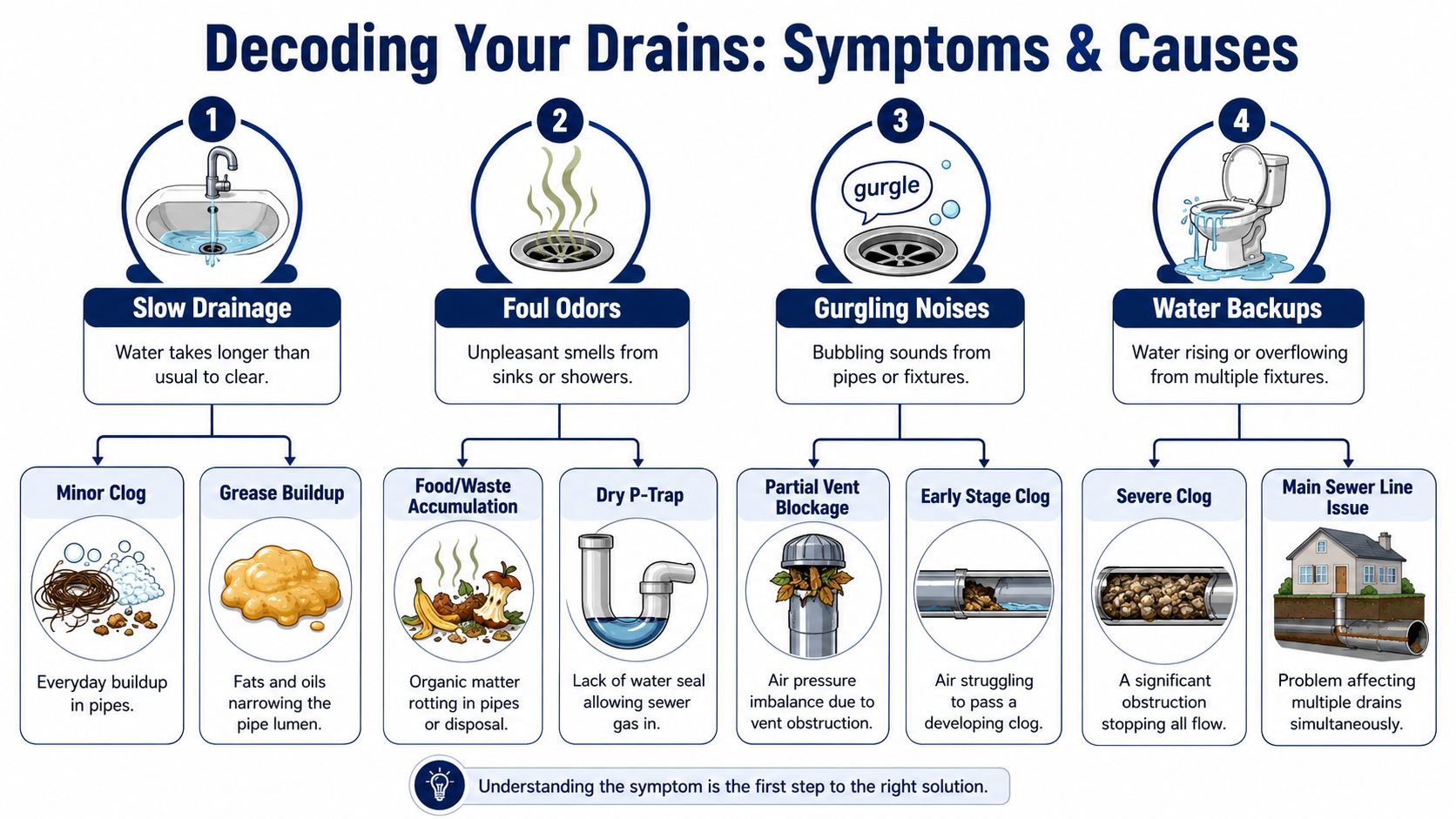
A single fixture problem usually stays local
If only one sink, tub, or shower is draining slowly, the blockage is often close to that fixture. Bathroom sinks usually collect soap residue and hair. Kitchen lines tend to trap grease and food debris. Tubs and showers often clog where hair combines with soap film and forms a stubborn mat.
A few clues are especially useful:
- Slow bathroom sink: Often points to buildup near the stopper assembly or trap.
- Tub draining poorly: Hair is a common cause, especially if the slowdown gets worse over time.
- Kitchen sink gurgling after use: Often suggests grease or food accumulation in the branch line.
- Bad smell from one drain: Could be decaying organic matter in the drain line or a dry trap in a fixture that hasn't been used recently.
For homeowners who want a clearer picture of how sink assemblies hold water, trap debris, and develop common restrictions, this guide to sink drain anatomy and maintenance from HomeProBadge is useful background.
Multiple fixtures point to a larger blockage
When more than one fixture starts acting up, think beyond a local clog. A single slow sink is a side-street traffic jam. A toilet that gurgles when the shower drains, or water appearing in one fixture when another is used, is closer to a freeway shutdown.
Watch for combinations like these:
- Toilet gurgles when a sink or tub drains
- Shower backs up after flushing
- Two or more drains slow down at the same time
- Water rises in the lowest fixture in the house
Those symptoms often suggest a blockage further down the drainage system, sometimes in the main line. That's also when chemical cleaners become less useful, because they don't address a blockage that's beyond the fixture trap or packed along the pipe wall.
Gurgling usually means air is struggling to move past water because something in the system is restricting flow.
There's another symptom people overlook. Intermittent problems matter. If a drain works fine in the morning, struggles at night, then clears again, that doesn't mean the problem is gone. It usually means the line is partially open, not fully clear.
When homeowners describe the issue clearly, the repair gets faster. Instead of saying “the drains are weird,” it helps to say which fixture started first, whether another fixture reacts when water runs, and whether the problem is constant or comes and goes.
Your Options for Drain Cleaning in Pasadena
A backed-up kitchen sink and a slow shower do not call for the same fix. The right drain cleaning method depends on where the blockage sits, what it is made of, and whether the line is plugged or coated inside.
For a lot of Pasadena homes, the first job is figuring out whether the problem is local or deeper in the system. That diagnosis matters more than the gadget or the price tag. A cheap service that only pokes a small opening through a heavy clog often leads to another backup a few weeks later.
When a professional snake is the right tool
A professional drain snake, also called an auger, is usually the best choice for a single, localized blockage. It feeds a flexible cable into the drain to break apart or pull back the obstruction. For toilets, tubs, bathroom sinks, and some kitchen lines, that is often the fastest and cleanest fix.
HomeAdvisor's drain cleaning cost guide shows why prices vary so much. Simple drain clearing is usually far less involved than main sewer line work, and costs rise with access difficulty, line length, and the equipment needed to finish the job correctly.
That trade-off shows up on real calls every week. A hair clog a few feet inside a tub line is usually straightforward. A grease blockage farther down a kitchen branch line takes more time. A main line stoppage under a yard or slab is a different level of work entirely.
Snaking is usually the right call for:
- Toilets blocked by paper or waste
- Bathroom sinks with hair and soap buildup
- Showers and tubs draining slowly from localized clogs
- Branch lines with an isolated obstruction
It is less effective when buildup is spread along the pipe wall. Grease, scale, sludge, and roots do not always form one solid plug. In those cases, a cable may restore flow without fully cleaning the line.
DIY cleaners versus professional snaking
Liquid drain cleaners are easy to buy. They are also one of the more common reasons a routine drain call becomes harder and messier.
If the product sits in a blocked line, it can leave caustic residue in the fixture and trap. That creates a handling hazard and still may not clear the stoppage. Professional snaking uses mechanical force instead of relying on chemicals to eat through an unknown blockage.
| Factor | Chemical Drain Cleaners | Professional Snaking (EZ Plumbing) |
|---|---|---|
| Best use case | Minor slowdown close to the drain opening | Localized clogs in toilets, sinks, tubs, and some branch lines |
| What it actually does | Tries to dissolve part of the blockage | Breaks through or removes the obstruction directly |
| Reliability | Inconsistent on grease, hair mats, and deeper clogs | More accurate when the blockage is within reach of the cable |
| Risk to pipes and fixtures | Can leave harsh residue behind if it fails | Lower risk when performed with the right cable and head |
| What happens if it fails | You still have a clog and now a chemical safety issue | The plumber can inspect further and choose the next method |
| Long-term outcome | Often temporary | Works well if the problem is truly local |
Homeowners who want a clearer picture of what a cable can and cannot do can review this guide on how to snake a kitchen sink.
The goal is not just to get water moving again. The goal is to choose the method that fits the condition of the line, so the drain stays open and the repair holds.
When Snaking Is Not Enough Hydro Jetting Explained
Some drain lines don't need a hole punched through the blockage. They need the inside of the pipe cleaned back to the wall. That's the difference between a temporary opening and a deeper restoration.
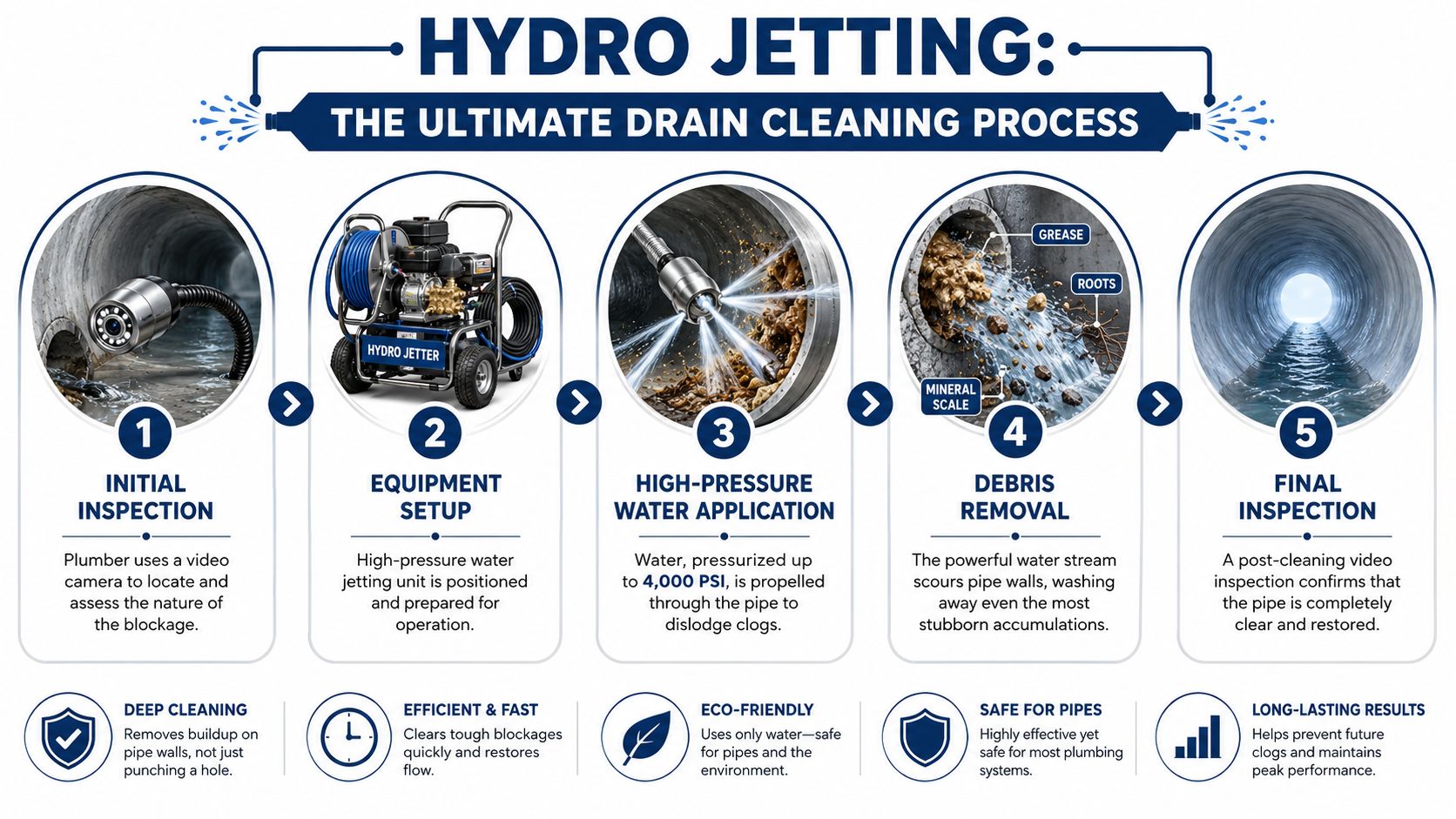
What hydro jetting actually does inside the pipe
Hydro jetting is best understood as pressure washing for the inside of your pipes. Instead of using a cable to poke through a clog, the system sends high-pressure water through a specialized nozzle that cleans the line much more thoroughly.
According to hydro jetting details provided here, hydro jetting systems operate at 3,000 to 4,000 PSI. The nozzles use forward-facing jets to cut into the blockage and rear-facing jets to scour the pipe walls, removing grease, scale, mineral deposits, and roots more completely than basic snaking.
That matters most in lines with heavy residue. Grease doesn't just sit in one lump. It coats the pipe and narrows the opening. Scale does the same. Tree roots can create repeated snag points that keep catching debris even after the line seems open.
Here's a simple version of the decision process:
- Inspect first. A camera inspection helps confirm what's in the line and whether the pipe can handle jetting safely.
- Choose the method based on the obstruction. A solid local clog may only need a snake. A pipe lined with buildup often needs hydro jetting.
- Verify the result. A post-cleaning look tells you whether the line is thoroughly clean or just passable.
If you want a homeowner-friendly explanation of how the method works and when it makes sense, this guide on what hydro jetting is is worth reading.
Later in the process, it helps to see the equipment in action:
When hydro jetting makes more sense than repeated snaking
Hydro jetting is often the better choice when the same line keeps clogging, when a kitchen line has long-term grease accumulation, or when root intrusion is part of the problem. It's also useful when a previous snake cleared the blockage but didn't solve the recurrence.
A drain that clogs on schedule usually isn't suffering from bad luck. It's telling you the line was opened, not cleaned.
Hydro jetting isn't automatic for every house. Older or damaged lines need to be evaluated first. That's why experienced plumbers don't lead with the machine. They lead with diagnosis.
For many Pasadena homes, especially those with mature landscaping and older underground piping, that distinction matters. The right job isn't the one with the biggest machine. It's the one that matches the condition of the line.
Proactive Maintenance to Keep Your Drains Flowing
Drain problems are cheaper to prevent than to chase. Most homeowners already know the common-sense basics, but the bigger point is that routine maintenance isn't just personal preference in Pasadena. It's local best practice.
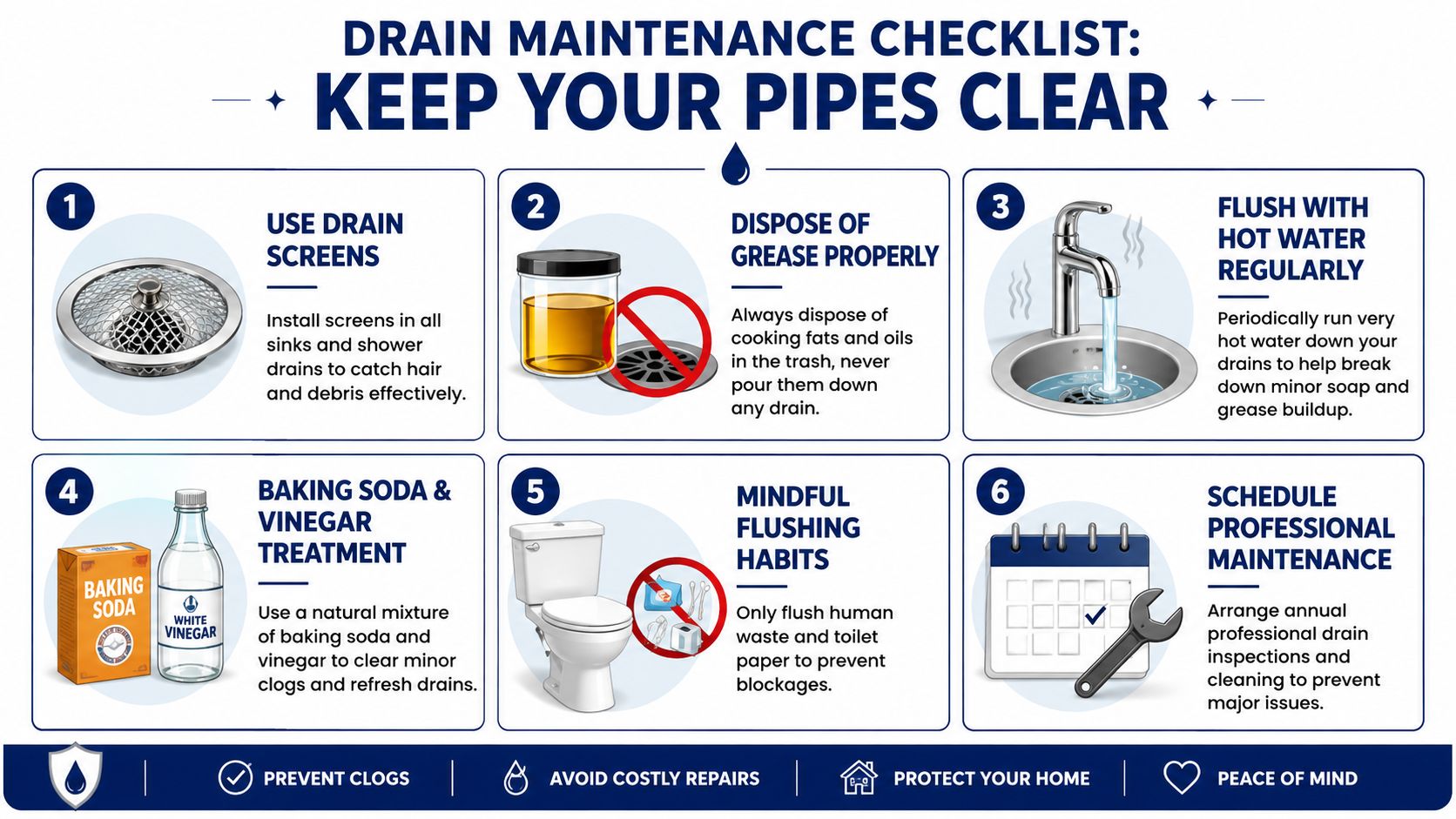
What Pasadena homeowners should treat as standard maintenance
The City of Pasadena's Department of Public Works recommends that residents have their house sewer lines cleaned and inspected annually and advises against planting trees or shrubs near sewer lines because of root intrusion risk, as stated in the city's house sewer guidance for residents.
That recommendation carries weight because it reflects what causes real sewer trouble in the field. Roots don't need a large opening to create problems. They find moisture, enter weak points, and trap waste over time. Once that starts, a line may work intermittently before the blockage becomes obvious.
Habits that reduce avoidable drain problems
Good maintenance at home isn't complicated, but it does require consistency.
- Catch solids early. Use strainers in showers, tubs, and sinks so hair and debris never enter the line in the first place.
- Treat grease like trash, not liquid. Grease may go down warm, but it doesn't stay warm in the pipe.
- Be selective about what gets flushed. Toilets aren't built for wipes, paper towels, hygiene products, or other solids.
- Watch landscaping choices. If you're planting near the house, keep sewer routing in mind before roots create a long-term underground problem.
- Pay attention to repeat symptoms. A recurring slowdown is maintenance trying to get your attention before an emergency does.
Small clogs are usually maintenance problems. Backups are what happen when maintenance gets postponed long enough.
Annual inspection and cleaning won't prevent every plumbing issue, but it gives you a much better chance of catching buildup, roots, and developing restrictions before wastewater has nowhere to go.
Why Pasadena Trusts EZ Plumbing for Drain Cleaning
When you hire a plumber for drain work, you're not just paying for someone to make water move again. You're trusting that person to tell the difference between a minor clog and a line that needs a deeper fix.
What to look for before you hire any plumber
A dependable drain cleaning company should bring more than a cable machine.
Look for these basics:
- Licensed and insured service so the work is handled professionally.
- Real diagnostic capability including camera inspection and hydro jetting when needed.
- Clear communication about what's clogged, where it's clogged, and which fix makes sense.
- Emergency readiness because backups don't wait for business hours.
- Experience with homes, property managers, and multi-unit buildings where recurring drain issues often have bigger causes.
Fast response matters too, and not just from the technician. Many plumbing companies improve emergency intake and after-hours communication by using systems similar to specialized call handling for plumbers, because a homeowner with sewage backing up needs a live, organized response, not voicemail.
EZ Plumbing fits the profile homeowners usually want. The company is licensed and insured, has served Los Angeles since 1989, offers 24/7 emergency response and same-day scheduling for planned repairs, and handles both standard drain clearing and more advanced sewer diagnostics. That combination matters because the best outcome usually comes from solving the right problem the first time.
Frequently Asked Questions About Drain Cleaning
Are chemical drain cleaners a good idea
Usually no, especially for a drain that has been slow for a while or keeps clogging. Chemical cleaners can sit in the pipe, soften certain types of buildup, and still leave the underlying obstruction in place. That creates two problems. The drain still does not work right, and the next person who opens that line may be dealing with caustic liquid.
For a simple hair clog near the opening, a basic mechanical cleaning is safer and more reliable. For recurring stoppages, the better move is to clear the line properly and confirm what is in the pipe.
What are the clearest signs of a main line clog
Watch for more than one fixture acting up at the same time. A toilet that gurgles when the sink drains, a shower that fills when the washing machine runs, or water showing up first at the lowest drain in the house usually points to a sewer line problem, not an isolated fixture clog.
That pattern matters. One slow sink often means a local blockage. Several fixtures reacting together usually means the problem is farther down the system and needs a broader diagnosis.
How long does professional drain cleaning usually take
It depends on what is clogged, where it is located, and whether the plumber needs to inspect the line before choosing a cleaning method. A basic sink or tub stoppage can often be cleared on a standard service call. A main line backup, heavy grease buildup, root intrusion, or a line with poor access can take longer because the work may involve snaking, camera inspection, and sometimes hydro jetting.
Speed matters less than accuracy. Opening the drain for today is not the same as solving the reason it backed up.
What does 24-7 emergency drain service really mean
It means help is available when a backup cannot wait until morning. The calls that usually qualify are sewage coming up, water threatening floors or walls, or a blockage that takes out the only working toilet or shower in the home.
A good emergency response starts with triage. The first goal is to stop overflow and protect the property. After that, the plumber determines whether the line needs standard cable cleaning, a camera inspection, or a stronger cleaning method to restore proper flow.
If you need professional help with drain cleaning in Pasadena, CA, EZ Plumbing offers licensed, insured service, same-day scheduling for many drain problems, and 24/7 emergency response when a backup can't wait. Call (818) 908-2710 or schedule online to get a clear diagnosis and the right fix, not just a temporary opening.