
Commercial plumbing: key systems, codes, and services
Most property owners in Los Angeles assume commercial plumbing is simply a larger version of what you have at home. That assumption can lead to serious code violations, costly shutdowns, and liability exposure. Commercial plumbing operates under an entirely different set of regulations, involves far more complex infrastructure, and demands a level of specialized knowledge that goes well beyond standard residential work. Whether you manage a restaurant in Koreatown, an office tower in Century City, or a medical facility in West Hollywood, understanding what your plumbing systems require is not optional.
Table of Contents
- How commercial plumbing differs from residential systems
- Key systems and code requirements for Los Angeles
- Essential maintenance strategies and schedules
- Common challenges and specialized solutions
- What most property owners miss about commercial plumbing
- How EZ Plumbing supports Los Angeles businesses
- Frequently asked questions
Key Takeaways
| Point | Details |
|---|---|
| Complex code compliance | Commercial plumbing in LA must meet strict state and city regulations, requiring licensed pros and regular inspections. |
| Specialized system needs | Systems like backflow prevention and fire suppression are essential and differ from residential setups. |
| Proactive maintenance | Routine checks and cleaning help prevent costly emergencies and extend system life. |
| Facility-specific risks | Restaurants and older buildings face unique plumbing challenges needing targeted solutions. |
| Expert partnership advantage | Working with local professionals ensures code compliance, safety, and operational continuity. |
How commercial plumbing differs from residential systems
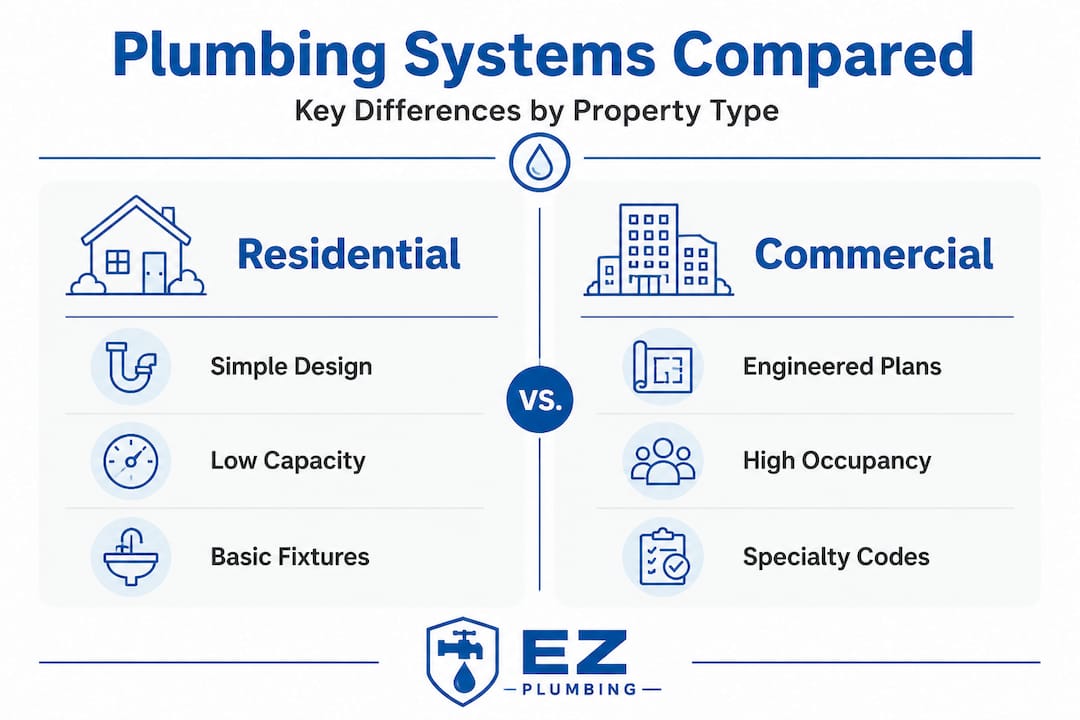
The most important thing to understand is that commercial and residential plumbing are fundamentally different disciplines, not just different in scale. A residential system serves one household with predictable, low-volume water demands. A commercial building serves dozens, hundreds, or even thousands of occupants daily, each with unpredictable usage patterns and legally mandated safety protections that simply don’t exist in a home setting.
Commercial buildings require infrastructure that residential systems never need. According to the Commercial Plumbing Contractor Services authority, key systems include potable water distribution with backflow prevention, sanitary drainage and venting sized for high occupancy, stormwater drainage, natural gas piping per NFPA 54, process piping, medical gas systems, and fire suppression coordination. That’s a significantly different scope than the supply and drain lines running through a single-family home.
| Feature | Residential | Commercial |
|---|---|---|
| Occupancy load | 1 to 5 people | Dozens to thousands |
| Pipe diameter | 1/2 to 1.5 inches | Up to 4 inches or larger |
| Systems required | Supply, drain, water heater | Backflow, grease interceptors, fire suppression, gas piping, medical gas |
| Code oversight | Basic CPC | CPC, LADBS, NFPA, ADA, Title 24 |
| Licensing required | General plumber | C-36 licensed contractor |
| Maintenance frequency | As needed | Scheduled, code-mandated |
The design complexity alone separates these two worlds. Commercial buildings require engineered plans, coordinated mechanical systems, and multiple permit approvals before a single pipe is installed. You can find more context about how these distinctions affect real LA properties through our commercial plumbing insights.
Understanding this distinction is not just academic. If you’re operating a commercial facility and relying on a residential-style plumbing approach, you’re likely out of compliance and probably don’t know it yet.
Now that you understand why commercial plumbing is a distinct discipline, let’s break down the essential systems found in LA commercial facilities.
Key systems and code requirements for Los Angeles
Los Angeles operates under some of the most detailed plumbing regulations in the country. The governing framework is the California Plumbing Code (CPC, Title 24 Part 5) with Los Angeles Department of Building and Safety (LADBS) amendments layered on top. Per the Los Angeles Plumbing Authority, LA commercial projects require C-36 licensed contractors, permits for all installations and alterations, plan checks for projects exceeding 10,000 square feet, annual backflow testing, ADA-compliant fixtures, and low-flow compliance with public faucets not to exceed 0.5 gallons per minute.
That’s a dense set of requirements. Here’s how they break down in practice:
1. Backflow prevention. Every commercial building with a connection to the municipal water supply must have a certified backflow preventer installed. This device stops contaminated water from flowing backward into the public supply. Annual testing by a certified tester is required, and documentation must be filed with the local water utility.
2. Grease interceptors. Any food service operation, from fast-casual counters to full-service restaurants, must install and maintain a grease interceptor. This trap prevents fats, oils, and grease (FOG) from entering the sanitary sewer system. LA County regularly inspects these, and violations can result in fines or permit revocation.
3. Water heater and hot water distribution. Commercial water heating systems must meet both efficiency standards and temperature requirements. Hot water for handwashing must reach a minimum temperature, while anti-scald protections are required at fixtures accessible to the public.
4. ADA and low-flow fixtures. Under Los Angeles plumbing regulations, all restrooms open to the public must use ADA-compliant fixtures with proper reach ranges, flush valve heights, and accessible clearances. Low-flow requirements apply to toilets, urinals, and faucets throughout the facility.
5. Gas piping. Commercial natural gas systems follow NFPA 54 standards, requiring pressure testing, seismic shutoff valves, and flexible connectors on seismically active equipment. In Los Angeles, seismic compliance isn’t a suggestion.
For large facilities, the permitting process requires engineered drawings reviewed by LADBS plan checkers before any work begins. If you’re expanding an existing building or converting a space to a new use, those plan checks can add weeks to your project timeline. Having a licensed contractor familiar with LADBS processes prevents costly delays. Knowing when to call for emergency plumbing LA support versus scheduled work is equally important for keeping your facility operational.
With the main systems and legal requirements established, it’s essential to understand how ongoing maintenance protects your investment and reputation.
Essential maintenance strategies and schedules
Reactive maintenance, fixing things only when they break, is an expensive and risky approach for commercial properties. The maintenance standards outlined by the Commercial Plumbing Preventive Maintenance Checklist establish clear inspection intervals: monthly visual inspections, quarterly professional service visits, annual backflow testing, annual water heater flushing, and drain camera inspections for lines older than 20 years.
Following this kind of structured approach translates directly into operational stability. Here’s what each layer looks like in practice:
Monthly visual inspections should cover faucet and valve operation, visible pipe connections under sinks and in mechanical rooms, water heater status indicators, and any signs of moisture around fixtures or floor drains. Your facility manager or designated maintenance staff can handle these without specialized training.
Quarterly professional inspections are where a licensed plumber examines the full system. This includes testing water pressure at multiple points, checking backflow preventer function, inspecting grease interceptor fill levels, reviewing venting stack condition, and running water through floor drains to confirm they aren’t running dry (which creates sewer gas entry points).
Hydro-jetting is one of the most effective cleaning methods available for commercial drain systems. It uses pressurized water between 1,500 and 4,000 PSI to clear buildup from pipe walls, cutting through grease accumulation, mineral scale, and debris. Restaurants should budget for quarterly hydro-jetting on kitchen drain lines, and any hydro-jet service should be preceded by a CCTV camera inspection to confirm pipe integrity. You can review our maintenance guide for drains for more detail on timing and what to expect.
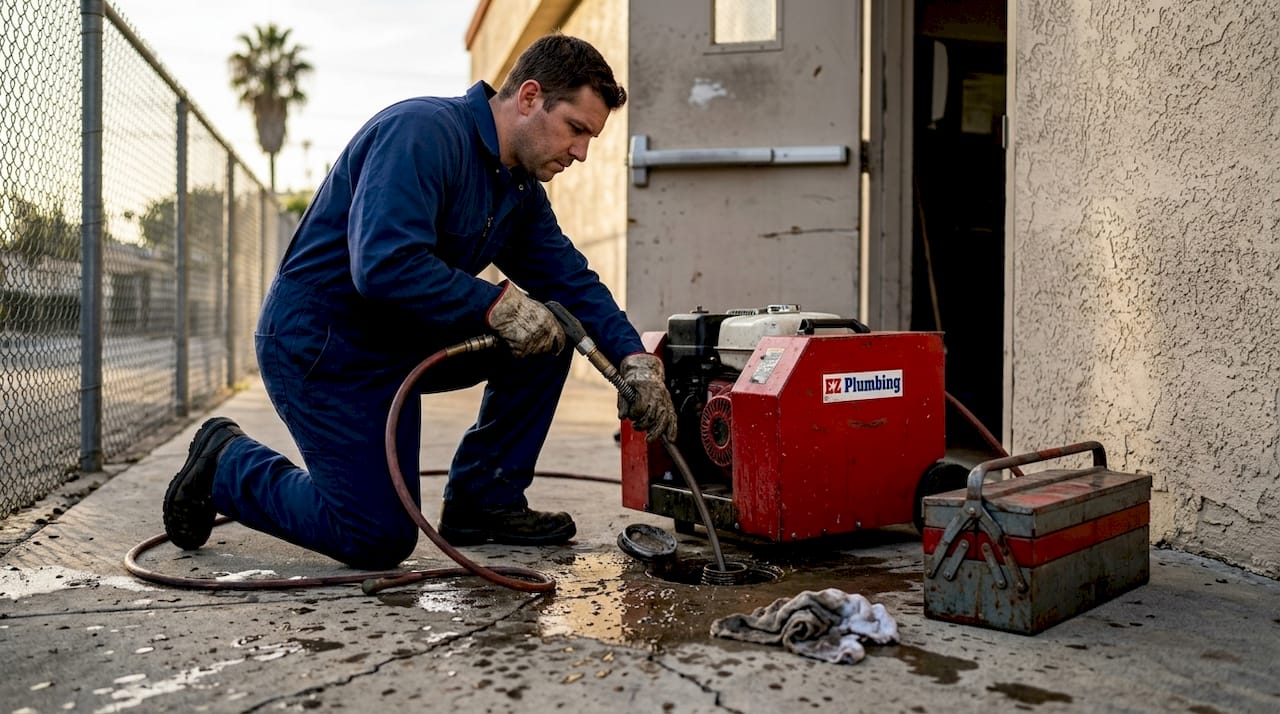
Annual tasks include flushing the water heater to remove sediment buildup, certifying the backflow preventer with documentation filed appropriately, and a full inspection of gas line connectors and seismic strapping on water heaters.
Pro Tip: Keep a maintenance log for every service visit. Document the contractor’s license number, the work performed, and any findings. This record is invaluable during LADBS inspections, insurance audits, or liability claims related to water damage or code violations. It also helps identify recurring issues before they become emergencies.
For a detailed look at managing plumbing work from start to finish, the step-by-step LA plumbing repairs guide covers permitting, contractor selection, and inspection coordination in practical terms.
While routine upkeep solves most needs, complex properties or food-based businesses demand even more specialized attention to edge cases and high-risk issues.
Common challenges and specialized solutions
Not all commercial plumbing problems follow a predictable pattern. Facility type, building age, occupancy patterns, and even the neighborhood can influence what kinds of issues you’re most likely to encounter. Understanding the specific risk profile of your property type is the first step toward preventing expensive failures.
Restaurants and food service facilities face the highest plumbing risk of any commercial category. Grease and FOG accumulation in drain lines is the primary culprit. According to Hydro-Jetting for Clogs, grease interceptors must be pumped every 30 to 90 days when capacity reaches 25 percent, and pre-hydrojet CCTV inspection is mandatory before high-pressure cleaning on older cast iron or clay pipes to avoid causing the very damage you’re trying to prevent. This is especially relevant in older Los Angeles neighborhoods where building infrastructure may date back 40 to 70 years.
Office buildings deal with a different set of issues. Scale buildup from Los Angeles’s hard municipal water is a persistent concern in restroom fixtures and water heaters. Over time, mineral deposits restrict flow, reduce heating efficiency, and accelerate fixture wear. Quarterly descaling and annual water heater flushing address these directly.
Medical and dental offices require the most specialized attention of all. These facilities often have medical gas systems (oxygen, nitrous oxide, vacuum) that are entirely separate from standard plumbing but still fall under the plumber’s scope of work during construction and renovation. Any work on these systems must comply with NFPA 99 and requires specific certifications beyond the standard C-36.
Seismic considerations apply across all facility types. Los Angeles sits in one of the most seismically active zones in the country, and water heaters must be strapped to walls with approved hardware to prevent them from toppling during an earthquake. Gas line connections on seismically mounted equipment must use flexible connectors approved for seismic movement. These aren’t just code requirements; they’re genuine safety measures that protect your staff and your building. Explore our hydro-jetting for drains service page for specifics on what a professional cleaning process involves for commercial lines.
Pro Tip: If your building was constructed before 1980 and you haven’t had a camera inspection of the main sewer lateral, schedule one. Clay and cast iron pipes of that era often show root intrusion, offset joints, or partial collapses that aren’t visible from the surface. Catching these early means relining or spot repair. Ignoring them risks a full collapse that can shut down your facility for days.
With a comprehensive understanding of systems, codes, and real-world challenges, let’s discuss the biggest misunderstandings and what truly makes a commercial plumbing strategy successful in Los Angeles.
What most property owners miss about commercial plumbing
Here’s the honest truth: most commercial property owners in Los Angeles approach plumbing the same way they approach their car. They don’t think about it until something stops working. That mindset is understandable, but in a city with the regulatory complexity of LA, it’s also genuinely costly.
The biggest missed opportunity is treating code compliance as a burden rather than a protection. Backflow testing, grease interceptor maintenance, and ADA fixture upgrades aren’t bureaucratic hurdles. They’re the documented proof that your facility operates safely and responsibly. When a tenant gets sick, when a flood damages a neighboring unit, when a city inspector shows up unannounced, that documentation is what separates a manageable situation from a legal and financial crisis.
The second major gap is underestimating how quickly specialty requirements accumulate when you change a building’s use. Converting a retail space to a restaurant? You’ve just added grease interceptor requirements, ventilation coordination, and commercial kitchen fixture standards. Adding a medical suite to an office building? You may need gas piping upgrades, medical vacuum systems, and new permit filings. These changes aren’t simply plumbing add-ons; they trigger full-scale reviews.
Property owners who work with a consistent, trusted commercial plumbing contractor build something genuinely valuable over time: a documented service history, a plumber who knows the quirks of their specific building, and a relationship that makes emergency response faster. That’s not a soft benefit. When a water main fails at 2 a.m. before a major tenant event, having an established contractor relationship is the difference between a two-hour fix and a 12-hour disaster.
Our real-life commercial plumbing tips resource reflects what we’ve learned from years of working across LA’s diverse commercial building stock, from mid-century office parks to modern mixed-use developments. If you’re ready to move from reactive to strategic in how you manage your building’s plumbing, that’s the right place to start.
How EZ Plumbing supports Los Angeles businesses
EZ Plumbing holds a C-36 License (#583868) and operates across the greater Los Angeles area with the full range of services your commercial facility requires, all performed in compliance with California Plumbing Code and LADBS requirements.
From drain cleaning services including hydro-jetting and CCTV inspection, to certified water heater services that meet Title 24 energy standards, to main sewer line repair for aging infrastructure, we cover the work your property depends on. We also handle backflow testing, repiping, leak detection, and emergency response for commercial clients throughout Los Angeles. Contact EZ Plumbing to schedule a commercial assessment or discuss ongoing maintenance planning for your facility.
Frequently asked questions
What permits are required for commercial plumbing projects in Los Angeles?
Los Angeles mandates permits for all installations and alterations, with plan checks required for projects over 10,000 square feet, and only C-36 licensed contractors may legally perform the work.
How often should commercial plumbing systems be inspected?
Monthly visual checks and quarterly professional inspections are the baseline recommendation, with specific tasks like annual backflow testing required by code.
What are the most common causes of commercial drain blockages?
Restaurants face grease and food waste buildup as the primary cause, while offices typically deal with scale and mineral deposits from Los Angeles’s hard water.
When is hydro-jetting safe for older pipes?
Hydro-jetting is safe only after a pre-hydrojet camera inspection confirms pipes are structurally intact, particularly for older cast iron or clay lines found in many LA buildings.
Are ADA and low-flow fixtures mandatory in commercial buildings?
Yes, all public-facing fixtures must meet ADA and low-flow standards under California Plumbing Code and applicable Los Angeles ordinances.