
Category 3 Water Damage: Risks, Response, and Recovery
A ceiling stain after a storm, a sewer smell from a floor drain, or brown water rising through a shower in a Los Angeles property usually means the problem has already crossed from plumbing into contamination. Once the source is unknown, foul, or tied to floodwater or sewage, the job changes fast, because category 3 water damage is not a mop-and-dry situation. It's a health, habitability, and structural response, and the first hour matters more than the first sale pitch.
Table of Contents
- When the Water Coming In Is a Different Kind of Problem
- What Category 3 Water Damage Means
- Health Hazards and Building Material Impacts
- First 24 Hours What Owners and Managers Should Do
- How Professionals Remediate a Category 3 Job
- Typical Costs and How Insurance Handles Category 3
- LA Specific Guidance Weather Versus Sewage and Choosing Help
- A Quick Decision Framework for the Moment You Need It
When the Water Coming In Is a Different Kind of Problem
A West LA duplex can look fine from the street and still be a mess inside by morning. A tenant calls because the lowest shower is bubbling, the hall smells like a sewer, and water is tracking across old laminate into the adjacent bedroom. In a hillside home after a hard rain, the first sign may be wet baseboards and a stain that grows while everyone is still arguing about whether it's “just rain.”
That's the moment the response has to change. If the water is backing up from a mainline, coming through a floor drain, or arriving with a smell you'd never want in a living space, treat it as a contamination event, not a routine leak. Speed matters, but so does source-path awareness, because the same visible puddle can mean very different work depending on where it came from and what it contacted.
Practical rule: if you're wondering whether to dry it like clean water, assume the answer is no until the source is confirmed.
In Los Angeles, that judgment call matters because delays are common. Traffic, access restrictions, and after-hours HOA rules can slow the response, and that lag gives contaminated water more time to spread into drywall, base trim, cabinets, and flooring. Once it reaches porous finishes, the cleanup usually stops being a simple extraction job and becomes a controlled demolition and sanitation project.
The practical takeaway is straightforward. Unknown-origin water, sewer odor, floodwater, and water that's already soaked porous materials should be treated as category 3 water damage until a qualified inspection says otherwise. That keeps people out of harm's way and prevents a small failure from turning into a full-building problem.
What Category 3 Water Damage Means
The three categories in plain language
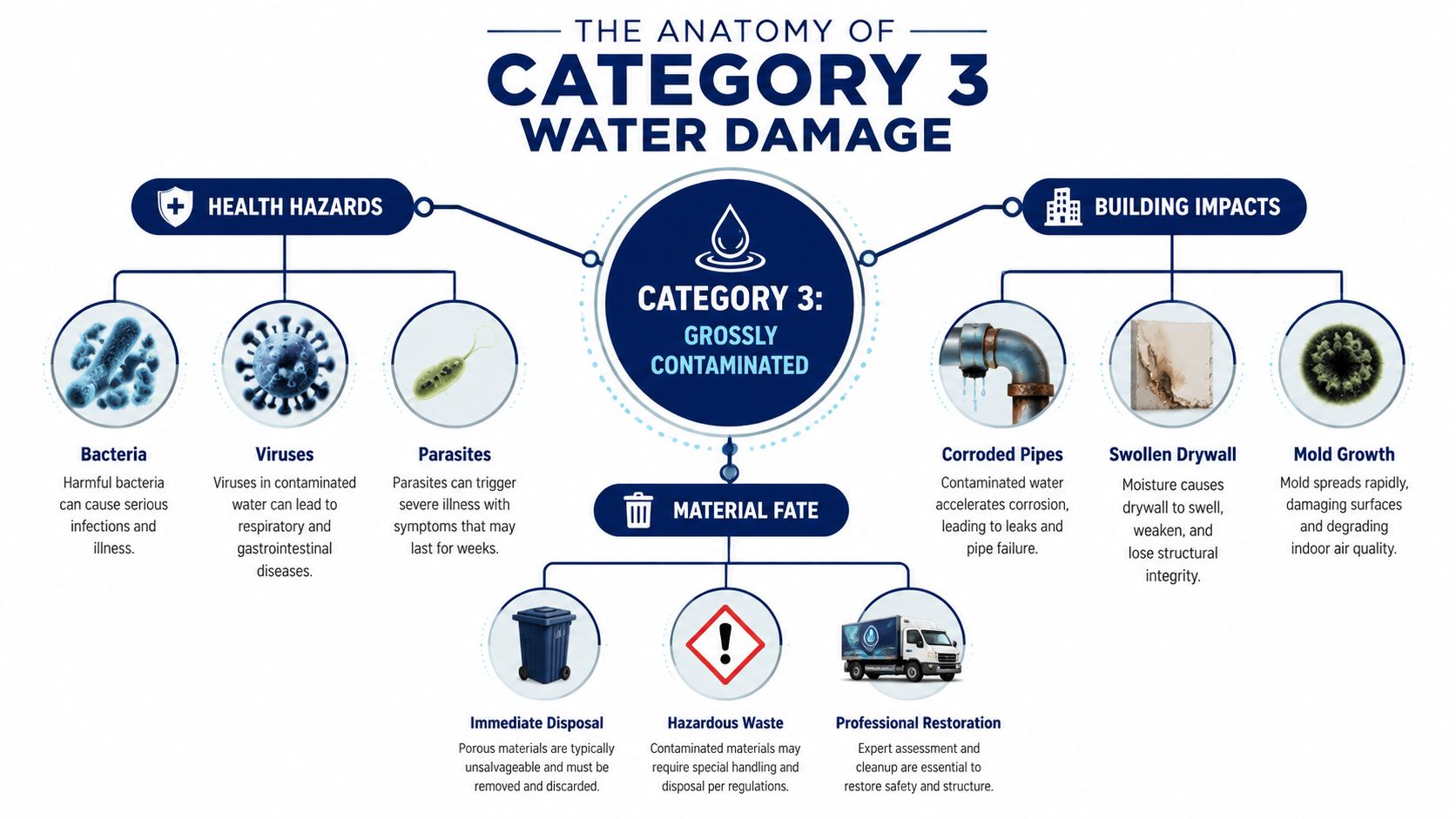
Restoration standards divide water damage into three categories. Category 1 is sanitary water from a clean source, like a supply line break. Category 2 is water with some contamination, such as a dishwasher overflow or a sump failure. Category 3 is grossly contaminated water that can carry pathogenic or other harmful agents, including sewage, toilet backflows beyond the trap, seawater, and river or rising floodwater CU Anschutz remediation standard.
That category split is not paperwork detail. It decides whether a crew can dry materials in place or has to remove them, and it changes the protective gear, containment, and disposal steps a contractor should use. On a real job, that means the difference between a straightforward mitigation and a controlled demolition with sanitation.
The 48-hour reclassification rule
The piece many property owners miss is dwell time. Water that starts as Category 2 can be reclassified as Category 3 if it remains in a structure for more than 48 hours CU Anschutz remediation standard. Once microbial growth starts, the hazard profile changes even if the original source looked limited at first.
A practical way to size up the situation is to ask four questions.
- Where did the water come from? Sewage, floodwater, and backflow beyond the trap point to Category 3.
- What did it touch? Porous finishes change the scope fast.
- How long has it been sitting? More than 48 hours can change the classification.
- Is the source path uncertain? Unknown water should not be assumed safe.
When those factors line up, the classification becomes the starting point for emergency containment, not just a label for paperwork. A good contractor asks about source, dwell time, and building materials before quoting the work, because those three points drive the scope, the safety measures, and what has to come out of the building.
Health Hazards and Building Material Impacts
Category 3 water can contain bacteria, viruses, parasites, and other pathogens associated with sewage and floodwater iPropertyManagement water damage statistics. The danger isn't just standing in it. The danger shows up during cleanup, when agitation, cutting, and drying can aerosolize contaminants and put them in the air you breathe.
Why porous materials are the line you don't cross
Carpet, pad, drywall, insulation, and paper-faced products are the problem materials on a Category 3 job. Once contaminated water gets into them, it doesn't just sit on the surface. It migrates into the fibers and cavities where cleaning in place can't reliably reach.
That's why competent crews pull those materials, bag them, and dispose of them rather than trying to save everything. The decision isn't about being dramatic. It's about the fact that contamination has penetrated the material structure and can keep spreading risk even after the visible water is gone.
What good containment looks like
On a serious job, you should see a crew working like the space is hazardous, because it is. That means barriers, protective clothing, and a controlled path for removal so contaminated debris doesn't get walked through the rest of the building. It also means the crew doesn't start spraying things down with the hope that bleach solves a contaminated structure.
If porous material is wet and the source is Category 3, the question usually isn't “can we clean it,” it's “what has to come out so the building can be made safe again.”
The building impact goes beyond one room. Wet drywall, swollen base material, and compromised insulation can hide contamination inside wall cavities. If a contractor talks only about drying machines and skips demolition where needed, that's a red flag. A proper Category 3 scope is built around removal first, drying second, rebuild last.
First 24 Hours What Owners and Managers Should Do
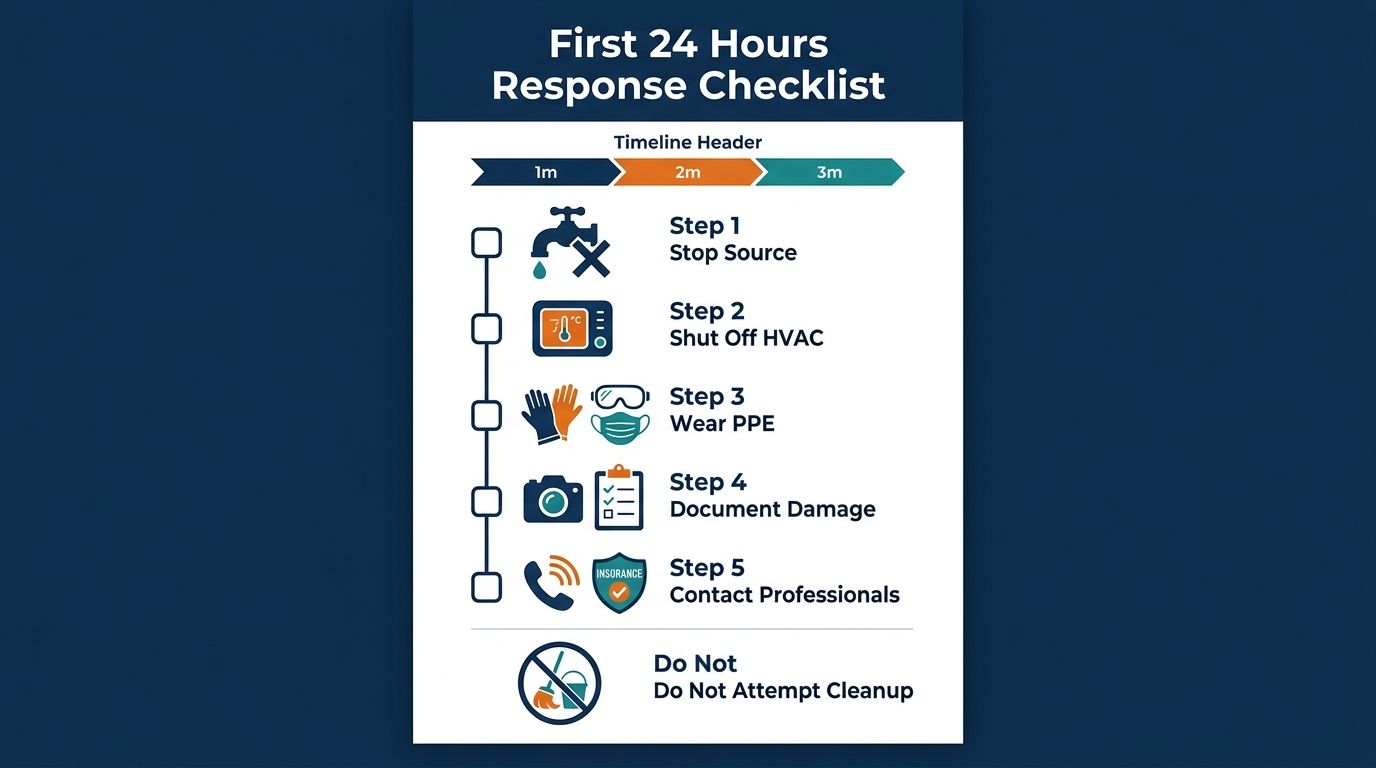
The first 24 hours are about control, distance, and documentation. If the source can be stopped safely, shut it down. If it's a sewer backup, flood ingress, or a leak you can't isolate without entering contaminated water, stay out and call a qualified contractor immediately.
Do these things first
- Keep people and pets out of the affected area. Nobody should be walking through contaminated water or tracking it through the property.
- Shut off HVAC serving the area. You don't want air movement spreading aerosolized contaminants through the building.
- Document everything before cleanup starts. Take photos and video of the source, the spread, and any damaged finishes.
- Preserve receipts and tenant notices. Property managers and HOAs need a paper trail if insurance or reimbursement becomes part of the claim.
- Use protective gear only if you must enter briefly. Gloves, boots, and eye protection are the minimum thinking, not a cleanup plan.
The most common mistakes are the ones homeowners reach for automatically. Bleach-mopping in place, running fans or the furnace, and pulling carpet into the driveway don't fix contamination. They spread it, and in some cases they can make it harder to document the loss properly.
For a practical homeowner checklist, the basement flood guidance from EZ Plumbing is a useful reference point because the same first-response logic applies whether the water came from below grade, a drain, or a sewer line. The job is to stop spread first, not to make the room look better for an hour.
A short do not list
- Do not use a household vacuum.
- Do not run box fans through the area.
- Do not assume the water is harmless because it looks thin or clear.
- Do not leave wet porous material piled on the lawn.
The first day sets the tone for the rest of the job. Good documentation, fast containment, and the right call on source control save time later, and they can keep a claim from turning into a dispute.
How Professionals Remediate a Category 3 Job
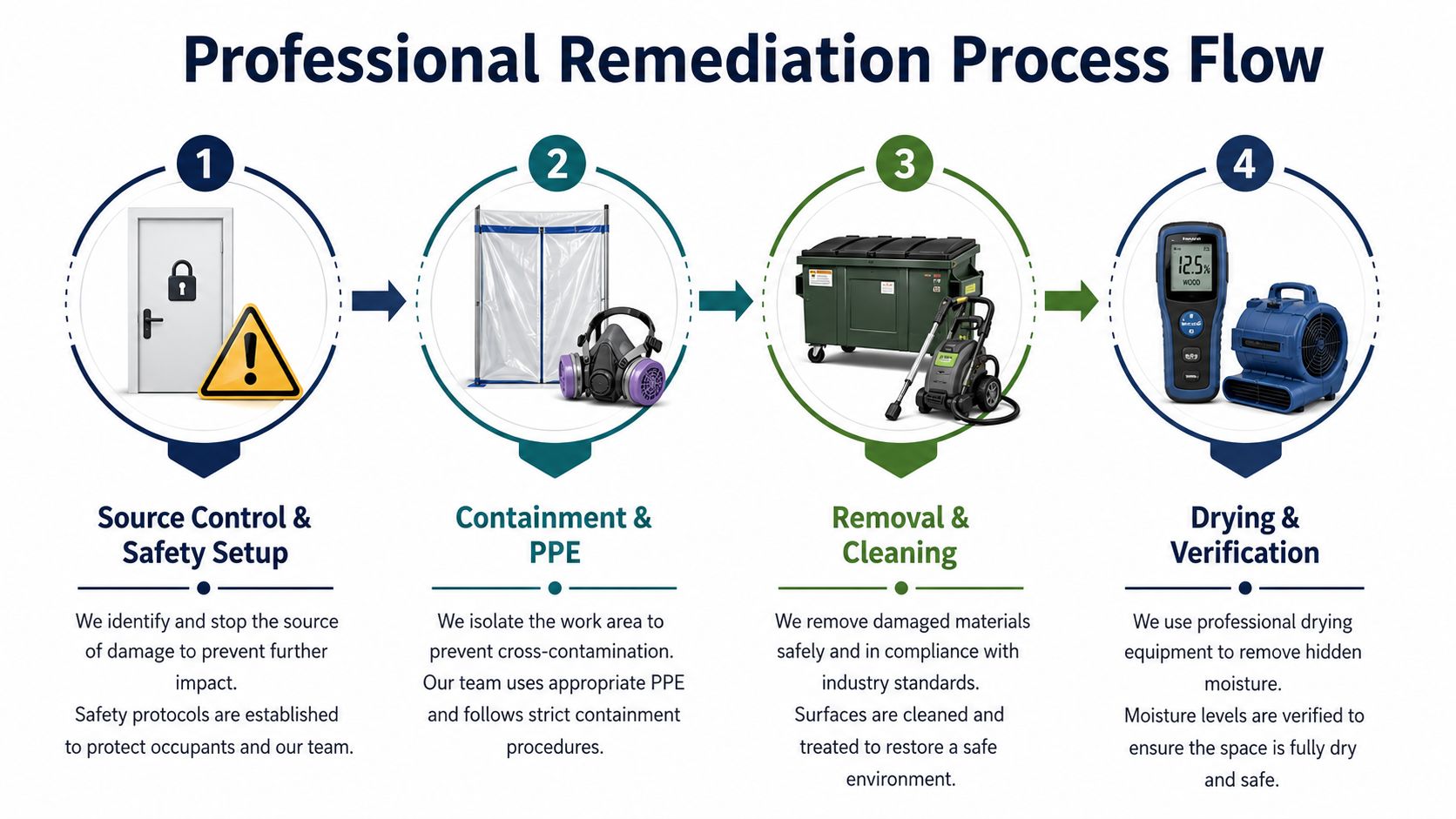
A real Category 3 response starts with source control, because nothing else matters if contaminated water is still entering the building. After that comes site setup, extraction, containment, removal of materials that cannot be cleaned in place, drying, and verification before rebuild begins. That order protects workers, keeps the loss documented, and avoids the common mistake of making a wet room look better without remediating it.
What a serious scope usually includes
A contractor working under the IICRC S500 framework should begin with inspection, moisture mapping, and source tracing. The crew then extracts standing water, sets containment, and removes contaminated porous materials that cannot be reliably cleaned in place IICRC S500 position statement summary. From there, the structure is cleaned, treated where needed, and dried with the right balance of air movers and dehumidifiers.
The wet materials drive the pace of the job. In a Class 3 moisture-load condition, wet porous materials can cover a large share of the floor, wall, and ceiling surfaces, which means high evaporation demand and a drying setup that has to work harder and longer IICRC S500 position statement summary. In practice, that often means more demolition, more equipment, and more time before anyone can talk about rebuild.
What to ask the contractor
If you are vetting a crew in Los Angeles, ask for the written scope and compare it against the actual site conditions. The answers should be specific, not vague.
- Containment plan. You want a barrier strategy that controls spread, not just open doors and fans.
- PPE standard. Higher-risk work should show higher protection.
- Demolition map. The crew should identify what comes out and why.
- Drying verification. You need moisture readings, not a verbal promise.
- Rebuild handoff. The contractor should explain what is ready for reconstruction and what still needs work.
For hardwood floors and finish work after the structure is stable, the Savera Wood Floor Refinishing water damage service is relevant when the floor needs a real salvage-versus-replacement assessment. Hardwood can sometimes be saved, but only if the moisture readings and the condition of the boards support that decision.
Some crews sell “drying” when the job calls for removal. That is a scope problem, not a style difference. A qualified contractor should be able to show where the damage stops, what was taken out, and what readings prove the structure is ready for rebuild. For a broader look at source control and structural drying, EZ Plumbing's water and mold remediation resource gives a practical frame for how those parts fit together.
Typical Costs and How Insurance Handles Category 3
Category 3 work costs more because the scope is bigger. In practice, the bill rises fast once contaminated materials, containment, labor, and rebuild all land in the same job. Industry summaries place cleanup around $7 to $7.50 per square foot, with severe cases often landing around $5,000 to $16,000+ depending on demolition depth, contents handling, and rebuild needs. That range lines up with what happens on site, contaminated material has to come out before drying can even start iPropertyManagement water damage statistics.
Category 3 Water Damage Cost Ranges
| Severity | Scope | Typical Cost |
|---|---|---|
| Light Category 3 | Limited contaminated area, targeted removal, drying, and sanitization | Lower end of the industry range |
| Moderate Category 3 | Multiple materials removed, containment, structural drying, and selective rebuild | Midrange industry cost |
| Severe Category 3 | Broad demolition, contents handling, full remediation, and reconstruction | Roughly $5,000 to $16,000+ iPropertyManagement water damage statistics |
Insurance usually treats this as a major loss event rather than a routine plumbing ticket. The paperwork matters because the source drives coverage. FEMA and NFIP guidance has long warned that 1 inch of water inside a typical home can cause up to $25,000 in damage, and the average U.S. water-damage-and-freezing claim payout was $13,954 from 2018 to 2022 water damage statistics 2026. Those numbers explain why adjusters look closely at origin, contamination path, and scope before they approve anything.
Policies often cover sudden and accidental discharge, plus tear-out and replacement of contaminated materials, but the gap is usually in the source. Floodwater, sewer backup, and pre-existing seepage can fall outside standard coverage unless the policy has the right endorsement. For investors and landlords, the insurance prerequisites for investors are worth reviewing because lenders and carriers often want clear proof of proper coverage and maintenance.
What adjusters usually want to see
- Photos and videos from the first hour.
- Written scope from the mitigation contractor.
- Moisture readings and demolition notes.
- Receipts for emergency actions and temporary protection.
The best claim files read like a clean chain of events. The weakest ones have no source documentation, no proof of containment, and no explanation for why contaminated material stayed in the structure.
LA Specific Guidance Weather Versus Sewage and Choosing Help
Los Angeles property owners get tripped up by one question more than any other, whether roof and storm water are automatically Category 3. They are not automatically Category 3. The IICRC's weather-related position is more specific, top-down water ingress and wind-driven rain are not always Category 3, but they can become Category 3 when the incoming water is contaminated or affects the indoor environment IICRC weather-related position statement.
Why that nuance matters in Los Angeles
That distinction keeps owners from overreacting to a clean roof leak and underreacting to stormwater that picked up contamination on the way in. In hillside homes, older duplexes, and mid-century buildings, the source path can be the whole story. If rainwater enters through a compromised roof opening and then passes through dirty insulation, attic dust, or contaminated cavity space, the remediation scope changes.
LA also has a few recurring failure points. Aging sewer laterals, slab leaks, drainage problems on hillside lots, and floor drain issues in restaurants and multifamily buildings all show up constantly in the field. For recurring drain and line problems, a sewer line inspection is often the right diagnostic step before a small fault becomes a contaminated overflow.
How to vet help fast
A good emergency contractor should be able to show:
- IICRC-aligned scope language. The written plan should match the job's hazard level.
- Proof of insurance and licensing. No exceptions on a contaminated loss.
- Relevant references. Ask for similar sewer, flood, or storm-loss jobs.
- Transparent pricing. You want line items, not fog.
- 24/7 response. In LA, delay is often the most expensive part of the job.
For homeowners, landlords, and property managers, prevention is still cheaper than mitigation. Backflow prevention, sewer line maintenance, hydro jetting where appropriate, floor drain checks, and pre-storm roof and gutter inspections all reduce the odds of a contaminated event. EZ Plumbing is one option for source control work on the plumbing side, especially when the issue starts with a line, drain, or overflow rather than the cleanup itself.
The best local response combines plumbing diagnostics with restoration discipline. That's what keeps a rain event from being misclassified, and what keeps a sewer event from being underestimated.
A Quick Decision Framework for the Moment You Need It
If you're standing in the middle of the loss and need a fast call, use four questions. Is the source contaminated or unknown. Has the water sat for more than 48 hours. Are porous materials wet. Are occupants reporting illness or is aerosolization likely.
If the answer is yes to any of those, treat it as category 3 water damage and bring in a qualified remediation crew. The point isn't panic, it's classification, because speed of response and accuracy of source-path assessment decide whether the first crew does the job right.
For LA homeowners and property managers, the safest move is simple. Document everything, keep people out, and use a licensed, insured contractor with 24/7 emergency response.
If you're dealing with a sewer backup, storm intrusion, or a floor drain overflow in Los Angeles, EZ Plumbing can help with the plumbing source, emergency response, and the documentation needed to move the loss forward. Visit EZ Plumbing to get the right crew on site quickly and keep the damage from spreading further.