
ABS Pipe Explained: Definition, Properties, and Uses
ABS pipe, short for Acrylonitrile Butadiene Styrene, is a rigid black thermoplastic pipe used almost exclusively for drain, waste, and vent (DWV) plumbing systems in residential and commercial construction. According to the Plastics Pipe & Fittings Association (PPFA), it operates reliably up to approximately 140°F (60°C) and carries a self-ignition temperature of around 871°F (465°C), making it a well-characterized material for concealed plumbing applications. If you are looking at a black plastic pipe in a crawl space, under a slab, or running through wall cavities, there is a good chance it is ABS.
Primary DWV applications include:
- Fixture drains connecting sinks, tubs, showers, and toilets to branch drain lines
- Underground and beneath-slab sewer laterals and building drain runs
- Soil stacks and vent stacks running vertically through wall cavities
The black color is not cosmetic. It is the single fastest visual identifier that separates ABS from white or gray PVC in the field, which matters when you are diagnosing a system or specifying compatible cement.
Key Takeaways
ABS pipe is a black thermoplastic rated for gravity-flow DWV use up to 140°F (60°C), governed by ASTM D2661 and accepted under both the IPC and UPC when local code amendments permit.
| Point | Details |
|---|---|
| ABS pipe definition | A rigid black thermoplastic (Acrylonitrile Butadiene Styrene) used for drain, waste, and vent plumbing systems. |
| Key physical limits | Working temperature up to 140°F (60°C); not rated for pressurized water supply or sustained UV exposure. |
| Identification in the field | Black color, smooth exterior, and a barrel stamp showing ASTM D2661, pipe schedule, and manufacturer code. |
| Installation advantage | One-step solvent-weld with ABS-specific cement (ASTM D2235); no primer required, unlike PVC. |
| Ez-plumbing | Licensed C-36 contractor serving Los Angeles since 1989, available for ABS inspections, drain cleaning, and sewer line repair. |
Table of Contents
- What is ABS pipe made of?
- Physical properties that matter on the job
- Where ABS plumbing pipe is actually used
- Code status and standards for ABS pipe
- How to identify ABS pipe in the field
- How does ABS compare to PVC for DWV work?
- Advantages and disadvantages of ABS pipe
- Storage, handling, and basic installation steps
- How long does ABS pipe last, and what causes it to fail?
- Safety considerations and material limits
- When should you call a licensed plumber instead of doing it yourself?
- A note from Ez-plumbing on local code and ABS in Los Angeles
- Ez-plumbing handles ABS inspections, repairs, and code-compliant installations
- Sources
What is ABS pipe made of?
ABS is a terpolymer produced by polymerizing styrene and acrylonitrile in the presence of polybutadiene, and each of those three components does a specific job in the finished pipe.
- Acrylonitrile contributes chemical resistance and thermal stability, giving the pipe its ability to handle household drain chemistry without degrading.
- Styrene provides rigidity and surface hardness, which is why ABS holds its shape under earth loads and maintains smooth interior walls.
- Polybutadiene is the rubbery phase that makes ABS tough. It absorbs impact energy rather than transmitting it as a crack, which is why ABS resists shattering during cold-weather installation or when soil shifts around a buried run.
Manufacturers can adjust the ratio of these three components to shift the balance between stiffness and impact toughness. Pipe-grade ABS is formulated for maximum toughness under load, not for optical clarity or surface finish. There are also cellular-core (foam-core) ABS pipe variants, which use a foamed inner layer between solid outer walls to reduce weight and material cost while maintaining adequate stiffness for DWV applications. Solid-wall ABS carries higher pressure ratings and is the standard for most DWV and underground installations.
Physical properties that matter on the job
ABS pipe’s lightweight construction, smooth interior walls, and strong impact resistance translate directly into faster rough-ins and fewer callbacks. Here is how the key properties break down in practical terms.
| Property | Typical Value / Behavior |
|---|---|
| Max working temperature | ~140°F (60°C) |
| Self-ignition temperature | ~871°F (465°C) |
| Cold-weather impact resistance | High; polybutadiene phase resists brittle fracture |
| Interior surface | Smooth; promotes flow, reduces clog risk |
| Density | Lower than cast iron or copper; lighter than most metal alternatives |
| Chemical resistance | Good against water, mild acids, alkalis; limited against ketones, esters, concentrated acids |
The polybutadiene component deserves particular attention in cold climates or high-impact environments. Rigid PVC can become brittle below freezing, but ABS retains meaningful ductility at lower temperatures, reducing the chance of cracking from ground movement or rough handling during a winter rough-in. That property is one reason ABS has historically been the preferred DWV material in northern U.S. markets.
On the chemical resistance side, ABS handles the dilute acids, alkalis, and surfactants found in typical household drain chemistry without issue. What it does not tolerate well are strong organic solvents, ketones (like acetone), and concentrated acids. For a practical drain-maintenance reference, the drain cleaning guide for LA homeowners covers which cleaning products are safe around plastic DWV piping.
Where ABS plumbing pipe is actually used
ABS pipe covers a wide range of DWV tasks in both residential and light commercial construction. The PPFA confirms ABS performs well under earth loads and is widely accepted for underground installation when installed per manufacturer and ASTM standards.
Common ABS pipe applications include:
- Bathroom and kitchen fixture drains (lavatory, tub, shower, kitchen sink)
- Toilet flanges and closet bends
- Branch drain lines running horizontally to the soil stack
- Soil stacks and vent stacks inside wall cavities
- Underground building drains and sewer laterals beneath slabs and in trenches
- Appliance drains (washing machines, dishwashers, utility sinks)
Two practical scenarios illustrate how these uses come together on a real job:
- Bathroom rough-in. A typical three-fixture bathroom uses ABS for the toilet closet bend and flange, a 2-inch branch drain for the lav and tub, and a 3-inch or 4-inch soil stack. All of it can be solvent-welded in a single session without primer, which keeps the rough-in moving quickly.
- Sewer lateral connection. ABS is commonly used from the building foundation to the point where the lateral meets the municipal main. At that transition, you may encounter a clay or cast-iron main, which requires an approved transition fitting and attention to local code requirements. Always confirm the acceptable transition method with your inspector before backfilling.
Code status and standards for ABS pipe
ABS DWV pipe and fittings are governed by a set of ASTM and related standards that most U.S. model codes reference directly. The PPFA lists multiple ASTM, CSA, and NSF standards commonly applied to ABS piping systems, including:
- ASTM D2661 — Schedule 40 ABS DWV pipe and fittings (the primary U.S. standard)
- ASTM D1527 — ABS plastic pipe, Schedule 40 and 80
- ASTM D2235 — Solvent cement for ABS plastic pipe and fittings
- ASTM D2321 — Underground installation of thermoplastic pipe for sewers and other gravity-flow applications
- ASTM D2468 — ABS plastic pipe fittings, Schedule 40
- NSF/ANSI Standard 14 — Plastics piping system components and related materials
Both the International Plumbing Code (IPC) and the Uniform Plumbing Code (UPC) accept ABS for DWV applications when the pipe meets the applicable ASTM standards. The UPC, which governs much of California and the western United States, has historically been the code under which most Los Angeles installations are inspected.
Code reminder: Model code acceptance does not guarantee local approval. Los Angeles and other California jurisdictions can adopt local amendments that affect which materials and installation methods are permitted. Always verify with your local building department or a licensed contractor before specifying ABS for a permitted project.
How to identify ABS pipe in the field
Visual identification takes about three seconds once you know what to look for. ABS pipe is black, with a smooth exterior and a matte finish. PVC is white or gray. That color difference alone handles most field identifications.
For confirmation, read the pipe stamp printed along the barrel. A properly marked ABS pipe will show:
- The material designation: ABS
- The applicable ASTM standard number (e.g., ASTM D2661)
- The pipe schedule or dimension ratio (e.g., Schedule 40)
- The nominal pipe size
- The manufacturer’s name or code
- NSF or other listing marks where applicable
Pro Tip: If the stamp is faded or the pipe has been painted, make a small cut with a hacksaw. ABS produces a clean, slightly flexible cut and the cross-section is uniformly black all the way through. PVC cuts white. That cut-test is faster and more reliable than trying to read a faded stamp in a crawl space.
If you need to join to an existing run, confirming the material before you buy cement is non-negotiable. ABS solvent cement and PVC solvent cement are not interchangeable, and using the wrong one will not produce a code-compliant bond.
How does ABS compare to PVC for DWV work?
Both materials are widely used for residential DWV, and the right choice often comes down to local code preference, climate, and what is already in the building. For a broader look at pipe material options, the homeowner’s guide to plumbing pipe types covers the full range.
| Factor | ABS | PVC |
|---|---|---|
| Typical color | Black | White or gray |
| Best DWV use | Drain, waste, vent; underground | Drain, waste, vent; some pressure lines |
| Primer required | No — one-step solvent cement | Yes — primer required before cement |
| Cold-weather impact | Higher ductility; resists brittle fracture | Can become brittle below freezing |
| Heat resistance | Up to ~140°F (60°C) | Slightly higher; better for some hot-drain apps |
| UV resistance | Poor; degrades without protection | Moderate; still needs protection outdoors |
| Code acceptance | IPC and UPC (verify local amendments) | IPC and UPC (verify local amendments) |
| Typical cost | Comparable; regional variation applies | Comparable; regional variation applies |
ABS is generally the faster install because it skips the primer step. In freezing climates or where pipe may take mechanical abuse during installation, ABS’s impact toughness is a real advantage. PVC tends to be specified where slightly higher heat tolerance is needed, or where local code or inspector preference favors it.
When you need to connect ABS to PVC, use a listed transition fitting or a mechanical coupling approved for that purpose. Do not attempt to solvent-weld ABS directly to PVC with either material’s cement. There are combination ABS/PVC transition cements available, but the cleanest and most code-defensible approach is a mechanical coupling at the transition point.
Advantages and disadvantages of ABS pipe
Understanding the trade-offs helps you make the right call before the pipe goes in the wall.
Advantages:
- Impact resistance in cold temperatures, reducing cracking risk during installation and in service
- One-step solvent-weld joining with no primer, which speeds up rough-in work
- Lightweight construction; easier to handle and cut than cast iron or copper
- Corrosion-free; no rust, scale, or galvanic degradation over time
- Smooth interior walls that maintain flow capacity and resist buildup
Disadvantages:
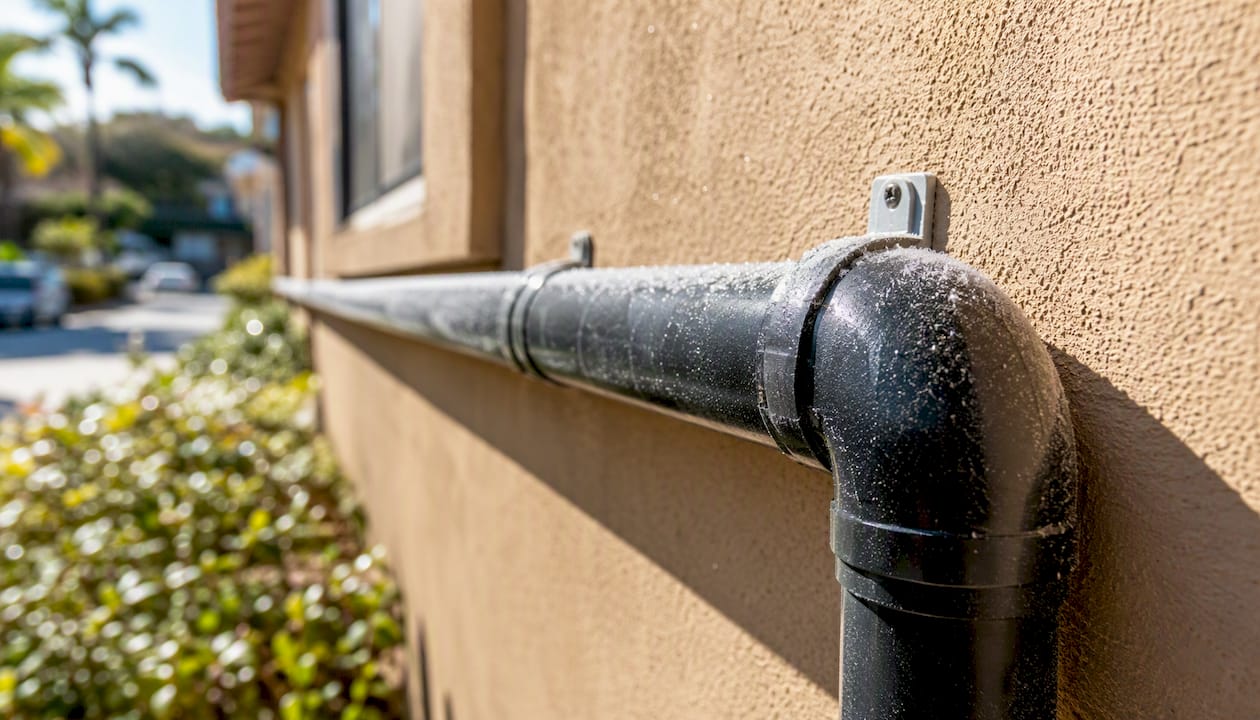
- UV sensitivity; exposed runs degrade and embrittle without paint or shielding
- Lower upper temperature limit compared to some other materials; not suitable for pressurized hot-water supply lines
- Not rated for pressurized water supply applications
- Availability varies by region; some markets stock primarily PVC
For exposed sections, the mitigation is straightforward: paint the pipe with a latex-based paint or route it through a protected chase. The PPFA specifically notes that exposed ABS must be protected from UV to prevent the polybutadiene phase from oxidizing and embrittling over time.
Storage, handling, and basic installation steps
Proper handling before the pipe goes in the ground matters as much as the installation itself.
Storage and handling:
- Store ABS pipe indoors or under cover, away from direct sunlight
- Keep pipe off the ground on level supports to prevent warping
- Avoid dropping or dragging pipe across abrasive surfaces, which can score the barrel and weaken the wall
Basic solvent-weld installation:
- Measure and cut. Use a miter box and fine-tooth handsaw, or a ratchet pipe cutter. Cut square; an angled cut reduces the bonding surface area.
- Deburr and chamfer. Remove all burrs from the cut end with a deburring tool or utility knife. A slight chamfer on the outside edge helps the pipe seat fully into the fitting socket.
- Dry-fit the assembly. Confirm all pieces align and the pipe bottoms out in each fitting socket before applying cement.
- Apply ABS solvent cement. Use cement formulated specifically for ABS (ASTM D2235). Apply a full, even coat to both the pipe end and the fitting socket. Work quickly; the cement sets fast.
- Assemble and hold. Push the pipe fully into the fitting with a slight twist, then hold the joint steady for 30 seconds to prevent push-back as the solvent flashes off.
- Cure before pressure-testing. Follow the cement manufacturer’s cure time before running water or conducting a pressure test. Cure times vary with temperature and humidity.
Pro Tip: In warm Los Angeles weather, ABS solvent cement sets faster than the label’s cold-weather times suggest. Apply cement quickly and seat the joint in one smooth motion. If you hesitate mid-assembly, the cement may skin over before the pipe is fully seated, and that joint will fail inspection.
Using PVC cement on ABS pipe will not create the required chemical bond. This is one of the most common field errors on mixed-material jobs, and it is not visible until the joint leaks.
How long does ABS pipe last, and what causes it to fail?
In buried and concealed applications, ABS DWV systems routinely provide decades of service when installed correctly and kept away from incompatible chemicals and sustained heat. Industry guidance and manufacturer data generally point to service lives in the range of 50 to 100 years for properly installed, concealed ABS systems, though actual performance depends on soil conditions, installation quality, and what flows through the pipe.
Common failure modes to watch for:
- UV embrittlement. Exposed pipe that was never painted or shielded will become chalky and brittle over time, eventually cracking under minor stress.
- Heat softening. Sustained temperatures above the working limit can soften pipe walls, causing deformation or joint failure. This is most common near water heaters or boiler drains where hot water is discharged into a DWV line.
- Solvent attack. Repeated exposure to drain cleaners containing ketones or concentrated solvents can soften and weaken pipe walls over time.
- Mechanical damage. Physical impact from construction activity, ground settlement, or tree root intrusion can crack or displace joints.
For routine maintenance, homeowners should periodically check accessible ABS runs for discoloration, surface crazing, or soft spots, particularly near water heaters and in crawl spaces with any sun exposure. The homeowner tips page at Ez-plumbing covers practical inspection routines for plastic DWV systems.
Safety considerations and material limits
ABS’s fire behavior is often misunderstood. The self-ignition temperature of approximately 871°F (465°C) is well above typical building fire temperatures in the early stages, and the PPFA notes that concerns about ABS contributing to fire spread are often overstated because DWV piping is typically concealed within wall and floor assemblies. ABS tends to soften and collapse rather than sustain combustion, which can actually limit the chimney effect through a pipe penetration.
Key safety and usage limits:
- Do not use ABS for pressurized cold or hot water supply lines. ABS is rated for gravity-flow DWV only.
- Protect all exposed runs from UV. Paint with a latex-based exterior paint or route through a protected chase.
- Avoid contact with ketones, esters, and concentrated acids. These chemicals attack the polymer matrix and can cause rapid wall degradation.
- Follow fire-stopping requirements at penetrations. Where ABS passes through fire-rated assemblies, use listed firestop collars or intumescent materials per local code.
For hot-water system needs, ABS is simply the wrong material according to the distinctions explained in HVAC vs Plumbing Who Handles Your Water… | LC Heating & Air. If you are evaluating options for a water heater installation or a tankless water heater, the supply and discharge piping requirements are different from DWV, and a licensed plumber can specify the correct materials.
When should you call a licensed plumber instead of doing it yourself?
Some ABS work is genuinely within reach for a careful homeowner. Other tasks carry enough risk, code complexity, or permit exposure that calling a licensed plumber is the right call.
DIY-appropriate tasks (with comfort and proper tools):
- Replacing a short trap arm or P-trap under a sink
- Repairing a small exposed section of branch drain with accessible fittings
- Cutting and joining small-diameter ABS in an exposed, non-permitted repair
Call a licensed plumber for:
- Any under-slab work, including slab leak repairs involving DWV lines
- Sewer lateral connections and replacements
- Soil stack replacements or reroutes
- Any work requiring a building permit or code-checked inspection
- Situations where the existing material is unknown or mixed
When you are vetting a contractor for ABS-related plumbing work, ask these questions:
- Are you licensed in California with a C-36 Plumbing Contractor license?
- Are you familiar with the current Los Angeles plumbing code amendments?
- Will you pull the required permits for this work?
- What warranty do you offer on materials and labor?
- Is your company insured for both liability and workers’ compensation?
For sewer line repair or any underground DWV work, a licensed contractor with camera inspection capability can assess the existing pipe condition before recommending repair versus replacement.
A note from Ez-plumbing on local code and ABS in Los Angeles
Ez-plumbing has held a C-36 Plumbing Contractor license (License #583868) and served the greater Los Angeles area since 1989. In that time, we have worked on ABS systems across every era of residential construction, from 1960s tract homes with original ABS drain lines still in service to new commercial builds where ABS DWV is specified alongside PVC supply. Los Angeles operates under the California Plumbing Code, which adopts the UPC with state and local amendments. Those amendments can affect which pipe materials, transition fittings, and installation methods are acceptable on a given job, and they are updated periodically.
The practical takeaway: model code acceptance of ABS is not the same as local approval. Before any permitted ABS installation or repair in Los Angeles, confirm current requirements with the Department of Building and Safety or consult a licensed contractor who works regularly in your jurisdiction. Ez-plumbing’s team stays current on LA-specific code requirements and can advise on the right material and method for your project.
Ez-plumbing handles ABS inspections, repairs, and code-compliant installations
When an ABS drain line backs up, cracks, or needs replacement, the scope of work often extends beyond what a homeowner can safely assess from the surface.
Ez-plumbing provides licensed, code-compliant plumbing services across the greater Los Angeles area, including:
- Drain cleaning and DWV inspection for ABS systems showing slow drainage or recurring clogs
- Sewer line repair and replacement for underground ABS laterals, including camera inspection before any excavation
- Repiping consultations when aging ABS systems need partial or full replacement
Call Ez-plumbing to schedule an inspection or get a quote on ABS-related plumbing work in Los Angeles.
Sources
The following references were used to verify the technical claims and standards cited in this article. Local code always takes precedence over model code guidance, so confirm current requirements with your local building department or a licensed contractor.
- ABS (Acrylonitrile Butadiene Styrene) | PPFA
- Acrylonitrile butadiene styrene
- A Comprehensive Guide to ABS Pipe: Properties and Uses
For final authority on permitted materials and installation methods in your jurisdiction, consult your local building department or a licensed plumbing contractor.