
Hissing Sound in a Wall: What It Means and What to Do
A hissing sound in a wall most often means pressurized water is escaping from a pipe, through a pinhole, a cracked fitting or a loose joint. It can also come from a gas line, a water heater, a high-pressure supply or an electrical fault, and those have different urgency levels. Start by deciding which one you are dealing with. If you smell gas, leave the building first and call 911 from outside. If the hiss follows the water, the checks below will help you confirm it and get a licensed plumber to the right spot.
TL;DR
- A steady hiss inside a wall is most often water escaping under pressure from a small opening in a supply pipe.
- If you smell rotten eggs or sulfur, or hear hissing near a gas line, leave immediately and call 911 and your gas provider from a safe distance. Do not switch anything on or off.
- To tell whether the hiss is a water leak, shut off every fixture, close the main shutoff and watch whether the sound stops, then check your water meter.
- Hissing from an outlet or switch is an electrical problem. Stay clear and call a qualified electrician.
- Hidden leaks damage drywall, framing and flooring quietly, so confirm the source early and book a licensed plumber with leak detection equipment.
Table of Contents
- What a hissing sound in the wall usually is
- Rule out gas and electrical first
- How to tell if the hiss is a water leak
- What the result means
- When the hiss is not a leak at all
- Why a hiss in a Los Angeles wall deserves attention
- What to do right now if you suspect a hidden leak
- How a plumber finds a leak inside a wall
- Our perspective: why we treat every hiss as a diagnosis, not a guess
- Book leak detection in Los Angeles
- Frequently asked questions
- Sources
What a hissing sound in the wall usually is
Hissing is the sound of a fluid or gas moving fast through a small gap. Inside a wall, that narrows the list of suspects considerably. Reference guides on building noise list the possible sources as water leaks, HVAC duct or refrigerant leaks, steam vents, water heaters, pumps and pressure controls, normal water velocity in pipes, animals or insects, and electrical wiring or equipment, according to InspectApedia’s hissing noise diagnosis guide.
In the homes we work in across Los Angeles, the explanations we see most often fall into five groups:
- A pressurized supply line leak. A pinhole in a copper line, a failing galvanized section, a cracked fitting or a weeping joint. The sound is a thin, continuous hiss that may rise and fall slightly.
- A fixture that is still running. A toilet fill valve that never fully closes, an ice maker line or a washing machine valve can hiss for hours.
- High water pressure. Water forced through valves and fittings at high pressure can produce hissing or whistling even without a leak.
- A water heater or its piping. Hissing near the tank, the relief valve or the connected pipes can point to a problem with the unit or a small leak nearby.
- Gas or electrical sources. These are rarer, but they are the ones where the first move is to get away from the problem, not to investigate it.
The rest of this guide follows that order of risk: first the situations that need you to leave or call someone right now, then the water checks you can do safely yourself.
Rule out gas and electrical first
Before you press an ear to the drywall, take a breath and ask three questions. Do you smell sulfur or rotten eggs? Is the hiss near a gas line, gas meter or gas appliance? Is it coming from an outlet, switch or panel?
If you suspect a gas leak
Hissing is one of the recognized warning signs of a natural gas leak, along with a rotten-egg smell, bubbles in standing water, blowing dust and dead vegetation near a line. A gas utility’s safety page says to evacuate immediately and call 911 or the utility, and not to use a landline or operate switches or other possible spark sources. Indiana’s utility regulator gives the same guidance: leave right away, avoid anything that could spark, do not try to find or fix the leak, and contact the gas provider and 911 from a safe distance.
That means no light switches, no garage door opener, no starting the car in an attached garage and no phone calls from inside the house. Walk out, move away, then call. Once the gas provider has made the building safe, a licensed plumber can inspect and repair house piping and appliance connections. Our team handles gas leak detection as part of our plumbing services.
If the hiss comes from an outlet or switch
A hiss, buzz or crackle at an outlet is not a plumbing sound and should not be treated like one. The National Fire Protection Association advises contacting a qualified electrician or your landlord for warm or discolored outlets, burning or rubbery odors, flickering lights, frequent breaker trips and sparks. Do not touch the outlet, and if you can reach the breaker without standing in water, switch off that circuit.
If you are not sure whether the sound is wet or electrical, and water is anywhere near outlets, panels or appliances, keep away from the area and have a qualified professional make it safe before anyone goes in.
How to tell if the hiss is a water leak
If there is no gas smell and the sound is not at an electrical device, you are most likely listening to water. These checks take about an hour in total, need no tools and tell you a lot before anyone opens a wall.
Step 1: Listen at quiet times
Water noise is easiest to hear late at night or early in the morning, when the house is quiet and the street demand on water pressure is lower. Walk along the wall and note where the sound is loudest. Mark that spot lightly with painter’s tape. Note whether the sound is constant, pulses when a neighbor’s irrigation runs, or changes when someone flushes a toilet.
Step 2: Turn everything off and see if the sound stops
Make sure no one is using water. Check that the dishwasher and washing machine are idle, the ice maker is off, and irrigation is not running. If you still hear hissing, the City of Columbia, Missouri explains a simple test: close the home’s main shutoff valve. If the noise stops, the source is inside the house plumbing. If it continues, the leak is probably outside the home or the sound is not water inside your system.
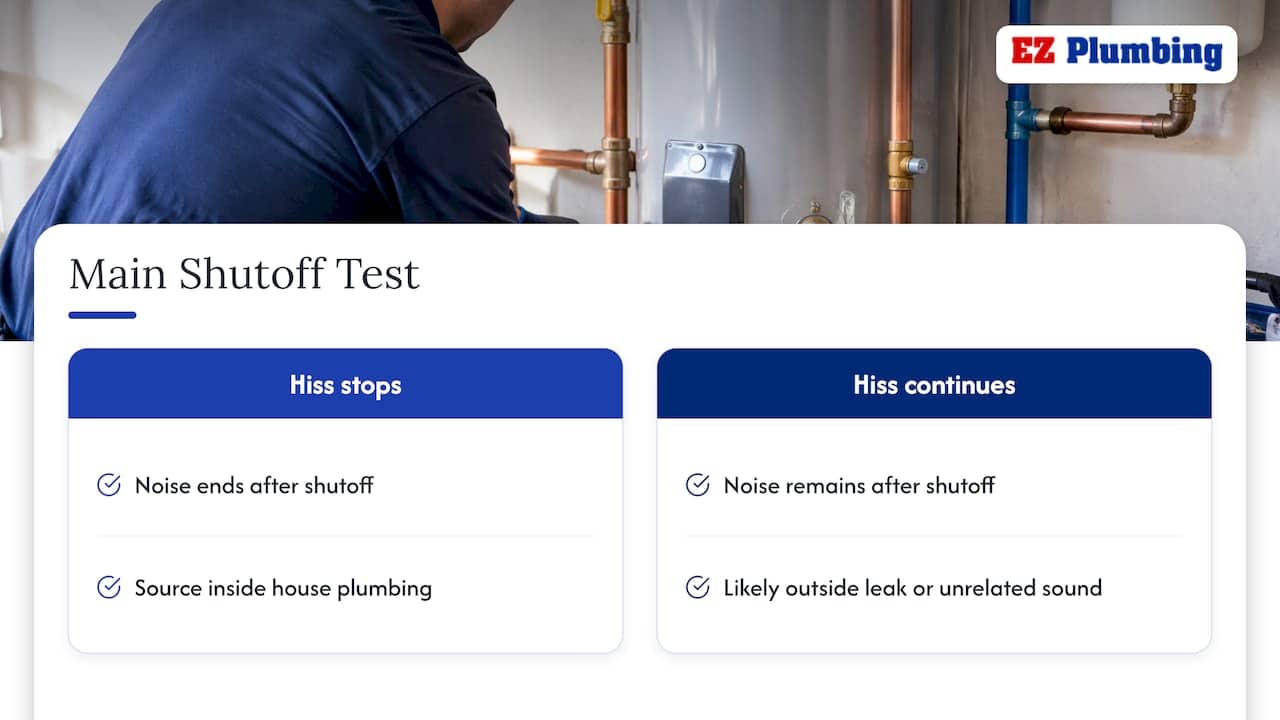
In Los Angeles, many homes have the main shutoff at the front of the property near the meter or at the house wall where the line enters. Know where yours is before you need it. Turn it clockwise to close, and do not force a stiff valve, since older valves can break.
Step 3: Read the water meter
The meter is the most reliable way to confirm a leak you cannot see. The Los Angeles Department of Water and Power says that if you shut off all water indoors and outdoors and the meter’s leak detection gauge still moves, that movement indicates a leak. The EPA’s WaterSense checklist uses a similar approach: take a reading, avoid using water for two hours, and if the reading changes, you probably have a leak. The same checklist notes that moisture or mold on walls, ceilings or floors can indicate a concealed pipe leak.
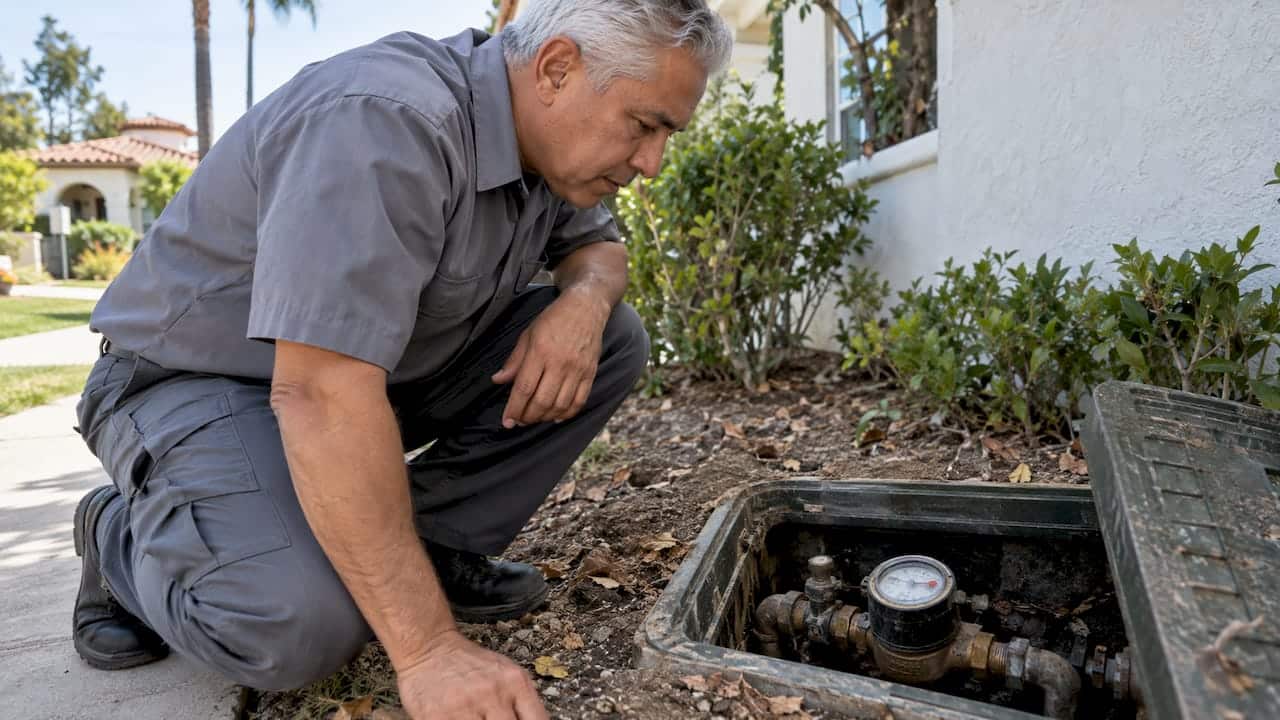
A moving meter confirms that water is flowing somewhere. It does not tell you where. For a walkthrough of reading the dial and low-flow indicator, see our guide on how to read a water meter for leaks.
Step 4: Check the toilets
A running toilet is the most common and cheapest cause of a hiss that moves through a wall. LADWP describes a quick test: put food coloring in the tank, wait without flushing, and if color appears in the bowl, the toilet is leaking and should be repaired right away. If the dye stays in the tank, move on to the next suspect.
Step 5: Look at the water heater and nearby pipes
Hissing near the water heater, its relief valve or the pipes connected to it can signal an unseen leak. A municipal water department lists hissing near water heater pipes or valves among the signs worth investigating. Do not touch a relief valve discharge that is hot, and do not cap a relief valve line. If the tank is leaking or the sound comes with rumbling, popping or scorching water, our water heater repair team can inspect it.
What the result means
| What you find | Likely meaning | Next step |
|---|---|---|
| Hiss stops when the main shutoff is closed, meter moves with all fixtures off | Leak or running fixture in the house plumbing | Isolate fixtures, then book leak detection |
| Hiss stops at the main, meter does not move | Pressure noise or a valve or fixture that only sounds when water is flowing | Check pressure and fixture valves |
| Hiss continues with the main closed | Source outside the water system, or a leak before the shutoff | Check the meter side and call a plumber |
| Hiss with sulfur smell or near a gas line | Possible gas leak | Leave, call 911 and your gas provider |
| Hiss at an outlet or switch | Electrical fault | Stay clear, call an electrician |
| Hiss near water heater | Relief valve, tank or nearby pipe | Have the heater inspected |
When the hiss is not a leak at all
Not every hiss is a failing pipe. A few harmless or easily fixed causes are worth knowing about so you do not panic.
High water pressure. If the hiss is loudest when a faucet is opened a little, or if you also hear hammering when valves close, the pressure entering the home may be too high. A plumber can measure it at a hose bib with a gauge and tell you whether a pressure regulator is needed.
Air in the lines. After water service work or repairs, trapped air escapes through fixtures with a brief hiss and sputter. If it clears after a few minutes of running the taps, it is not a concern.
Air movement. Wind finding its way through a gap can sound like a hiss inside a wall cavity. Gaps around windows are a frequent culprit, and window air leakage causes and fixes explains how drafts develop. If the sound changes with the weather and never with the water, look at envelope gaps rather than pipes.
Pests. Insects and small animals can make rustling or hissing noises in wall cavities. If the sound is irregular and the meter does not move, this is more likely than a pipe.
Why a hiss in a Los Angeles wall deserves attention
Los Angeles has a wide mix of housing eras. Bungalows and Spanish-style homes from the early twentieth century often still contain galvanized steel supply lines that corrode from the inside, narrowing the pipe and thinning the wall until a pinhole opens. Mid-century homes frequently have copper that has aged, and some slab-on-grade homes have lines running under the concrete, where a leak is invisible and silent until the slab shows damp spots or the bill climbs. Our familiarity with these housing eras and with LA’s building codes is a large part of how we locate a leak quickly.
A pressurized leak does not stay small. Water at household pressure keeps pushing through the opening, wearing it larger over time, and the moisture soaks into drywall, insulation and framing. Mold can follow quickly. The CDC’s guidance is to clean and dry or remove wet items within 24 to 48 hours to keep mold from growing, and that same window is a good rule of thumb once you know a wall has been wet.
What to do right now if you suspect a hidden leak
- Rule out gas and electrical hazards using the section above.
- Close the main shutoff if the hiss is loud, if you see staining or bubbling paint, or if the meter is spinning quickly. If you can isolate a single fixture with its own valve, close that instead and see whether the sound and the meter stop.
- Keep people and pets out of any room with standing water, especially where outlets, appliances or the panel could be wet.
- Note the location of the loudest sound, any damp or warm spots, and the meter readings with times. This shortens the search for the technician.
- Do not cut into the wall yourself. An opening in the wrong place causes more damage and can hit electrical wiring or other lines.
- Call a licensed plumber and say what you heard, where, and what the meter did.
If water is actively flowing and you cannot stop it, treat it as an emergency. Our guides on how to stop a leaky pipe and how to seal a leaky pipe cover the temporary measures that hold things until a plumber arrives. For a broader picture of what else to watch for, read our warning signs of plumbing problems.
How a plumber finds a leak inside a wall
Finding a leak without opening half the wall is a matter of narrowing the search with instruments first. A typical visit follows a sequence:
- Pressure testing the supply system to confirm that the pipes lose pressure and to separate hot from cold lines.
- Acoustic listening. The U.S. EPA notes that acoustic equipment detects the noise made by water leaking from a pipe. Sensitive microphones and ground sensors pick up the sound that your ear only partly hears.
- Thermal imaging to show cooler or warmer patches, particularly useful for hot water lines and slab leaks.
- Moisture meters to map the damp area and tell an active leak from old staining.
- Camera inspection where a drain or sewer line is also suspected.
With a spot confirmed, the opening in the wall can be small, and the repair can be targeted. You can read about the tools in more detail in water leak detection equipment explained for homeowners, and about spotting problems early in how to detect water leaks before they cost you. If you already know there is water in a wall, leak in wall: find and fix it fast covers what the repair typically involves.
We also serve neighborhoods across the city with local dispatch, including leak detection in Echo Park and leak detection in Northridge.
Our perspective: why we treat every hiss as a diagnosis, not a guess
We have been a family-owned company since 1989, and in that time the hissing wall call has taught us one thing: the sound is a symptom, and the cause is almost never where the noise seems to be. Water travels along pipes, studs and framing before it makes itself heard, so the loudest spot is often a few feet from the actual opening.
That is why we start by confirming that there is a leak, then locating it, and only then talking about repair. Our technicians are licensed (C-36 License #583868) and insured, we work to code, and we document our jobs for code compliance, so you know what was found and what was done. For homeowners, that record matters when you talk to an insurer, a landlord or a future buyer.
For property managers and HOAs, we see the same pattern at scale: small hidden leaks that run for weeks in shared walls before anyone connects the sound with the water bill. Our maintenance plans for property managers, HOAs and restaurants exist so that those issues get found on a schedule rather than on a weekend. We put our pricing in writing up front, and real local staff answer the phone, including for 24/7 emergency dispatch.
If you hear a hiss and are not sure what you are dealing with, describe it to us. We would rather help you rule out a leak than have you find out about it from a stained ceiling.
EZ
Book leak detection in Los Angeles
If your checks point to a leak, or you cannot tell and the hiss will not go away, we can send a licensed plumber to find the source with detection equipment and explain the repair before work starts. Our leak detection service covers residential and commercial properties across the greater Los Angeles area.

Our published hourly rates are $150 to $280 for residential work and $120 to $240 for commercial work, and you can estimate a job on our rate calculator. If water is flowing and you cannot stop it, or the sound comes with any sign of gas, use our 24/7 emergency plumbing service for gas issues that involve house piping, after you have left the building and called 911.
Frequently asked questions
What could be in my wall making a hissing noise?
Most often it is pressurized water escaping from a pinhole, crack or loose joint in a pipe. Other sources include a running toilet or appliance valve, high water pressure, a gas line, an HVAC duct or refrigerant leak, and electrical wiring. If there is a sulfur smell or the hiss is at an outlet, leave the area and call 911 or an electrician as appropriate.
Why do I hear hissing when no water is running?
Pressurized pipes can hiss when a leak is present even with every tap closed. Close the main shutoff valve: if the noise stops, the leak is inside the house, and if it continues, it is probably outside. Then check the meter with all water off, since movement confirms water is flowing somewhere.
Is a hissing sound in the wall dangerous?
It can be, depending on the source. A gas leak is an evacuation emergency, and an electrical hiss needs a qualified electrician. A water leak is usually not immediately dangerous, but it can damage drywall and framing and lead to mold if the area stays wet for more than a day or two, so it should be confirmed and repaired promptly.
Can I find the leak myself by cutting into the wall?
We advise against it. The loudest point is often not the leak, and cutting blindly can hit wiring or other lines. A plumber can narrow the spot with pressure testing, acoustic listening and thermal imaging, so any opening is small and in the right place.
How much does it cost to have a hissing wall checked in LA?
Our residential plumbing rate is $150 to $280 per hour, and the commercial rate is $120 to $240 per hour, as published on our calculator page. The final amount depends on the size of the property, access to the wall and what is found, and we provide up-front written pricing before the repair begins.
Sources
- InspectApedia: Hissing Noise Problems in or at Buildings
- PSE: What to Do About Natural Gas Leaks
- IURC: Learn to recognize the signs of a gas leak
- NFPA: Electrical safety tip sheet
- City of Columbia: Water Leaks
- LADWP: How to Detect a Water Leak
- EPA WaterSense: Detect and Chase Down Leaks Checklist
- City of Kenedy Water Department
- CDC: Dry Off Wet Items After a Storm
- EPA: Control and Mitigation of Drinking Water Losses
- Window air leakage: causes, costs, and fixes