
Cast Iron Pipe Descaling: What It Is and When It Works
Yes, you can descale cast iron pipes, and for many older Los Angeles homes it is the right way to restore a slow or repeatedly clogging drain without digging up the yard. Descaling removes the hardened, rough-textured buildup (often called tuberculation) from the inside of the pipe wall so wastewater has its full diameter back. It only works when the pipe underneath is still sound, which is why a camera inspection comes first and why the decision between descaling and repair should be made on what the camera shows, not on a sales pitch.
TL;DR
- Descaling scrapes or jets hardened scale from the inside of cast iron drain and sewer lines, restoring flow without excavation when the pipe wall is still solid.
- A camera inspection before and after is what tells you whether descaling is appropriate and whether it worked.
- Pipes that are thinned, cracked, bellied or separated at the joints usually need spot repair, lining or replacement instead.
- Acidic and chemical descalers are a poor match for aging cast iron. Mechanical cleaning and hydro jetting, done by a licensed plumber, are the safer route.
- Cost depends on pipe length, access, severity of scale and the condition found on camera. Our hourly rates are published on our calculator page.
Table of Contents
- What descaling actually removes
- Why cast iron builds up in the first place
- Signs your cast iron pipes may need descaling
- Methods used to descale cast iron
- How a professional descaling job proceeds
- Can descaling damage an old cast iron pipe?
- Descale, repair or replace: how to decide
- What dissolves calcium buildup, and what about CLR?
- What descaling costs in Los Angeles
- Our perspective
- Keeping cast iron lines clear after descaling
- Get your cast iron line inspected
- Frequently asked questions
- Sources
What descaling actually removes
Cast iron does not stay smooth. Over decades, wastewater, grease, soap residue, minerals and the slow oxidation of the iron itself build up on the pipe wall as crusty nodules and layered scale. The pipe may be rated for four inches, but a heavily scaled one can carry a fraction of that. Every paper towel, wipe or bit of food waste that would pass through a clean pipe catches on the rough surface, and clogs begin to return every few months.
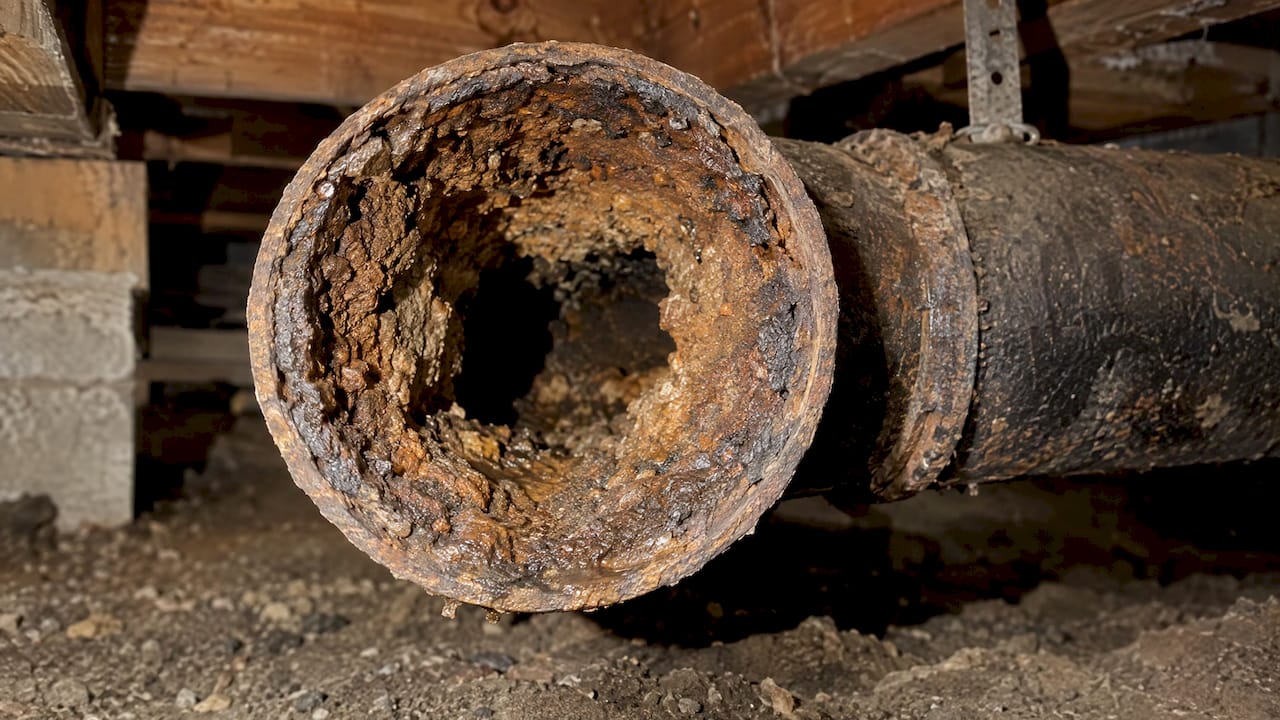
Descaling is the process of removing that deposit. It does not remove the pipe’s own rust-weakened metal, and it does not fix cracks, offset joints or a sagging section of line. It clears what has been added to the inside of the pipe. That distinction matters, because the same deposit that is choking the line is sometimes also the only thing holding a badly corroded wall together.
Why cast iron builds up in the first place
Cast iron’s interior is naturally porous and slightly rough, even when new. In a house that has been standing for sixty or seventy years, that roughness has had a long time to collect material. Three things speed it up.
The first is flow pattern. Horizontal runs under a slab or crawl space move slowly, and solids settle along the bottom of the pipe, where scale grows fastest. The second is what goes down the drain: kitchen grease, hair, soap scum and flushable wipes that do not break down. The third is corrosion. Iron oxidizes when it sits in moist, oxygen-rich conditions, and the rust products form raised nodules that trap more debris.
In Los Angeles, the age of the housing stock makes this a regular conversation. Many pre-war and mid-century homes in neighborhoods such as Echo Park, Highland Park, Silver Lake and parts of the Valley still have original cast iron drain lines inside the house, sometimes joined to newer plastic or clay sections outside. Each material change is a place where debris and roots can find a foothold. For a closer look at how long these lines can be expected to last, see our guide to cast iron pipe lifespan.
Signs your cast iron pipes may need descaling
Scale rarely announces itself with one dramatic event. It shows up as a pattern, and the pattern is what you should pay attention to.
The most common sign is a drain that clears with a snake or plunger and then backs up again within weeks or months. Others include gurgling from tubs and toilets when a sink drains, several fixtures draining slowly at once, a sewer odor that comes and goes, and a toilet that needs a second flush. When more than one fixture is affected, the problem is usually in the shared branch or main line rather than in a single trap.
If you recognize several of these, our article on the signs of sewer line problems walks through what each symptom tends to point to. A slow drain is not an emergency. Sewage coming up through a floor drain or a shower is, and you should stop using water in the house and call for help.
Methods used to descale cast iron
There are three broad approaches, and a good plumber chooses among them based on the pipe’s condition.
Mechanical descaling
A mechanical descaler uses a motorized cable with a cutting head or a set of rotating chains that scrape the wall as the head moves through the line. It is effective on thick, stubborn scale that water alone will not move. It is also the method with the most risk if the pipe is fragile, because the cutting head contacts the pipe wall directly. On a pipe with a sound wall, a skilled operator can restore most of the diameter. On a thinned pipe, the same pass can open a weak spot.
Hydro jetting
Hydro jetting sends high-pressure water through a specialized nozzle that cleans the wall by force and flushes the debris out of the line, instead of just punching a hole through it. It is effective on grease, soft scale and sediment, and it tends to leave the interior cleaner than a cable alone. On heavy, hard scale it may be combined with a mechanical pass first. Because jetting depends on pressure, nozzle selection and technique, the setting should be matched to the pipe. You can read more about this service on our drain cleaning page.
Chemical descalers
Products sold for dissolving mineral deposits are usually acid-based. They are designed for scale in water supply lines and fixtures, not for the interior of an aging sewer pipe. Acids attack iron as well as the deposit, and they can reach joints, seals and fittings you did not intend them to reach. Most homeowners ask about household descaling products because they are looking for an inexpensive first step. Our advice is to avoid pouring them into old cast iron drains. If a pipe is clogged badly enough to consider them, it needs a camera and a professional assessment, not a bottle.
For a broader look at how drain cleaning approaches differ, our guide to effective drain cleaning methods covers the options in plain terms. The same principles of removing buildup and keeping lines clear apply in other countries too, as this overview of descaling drain lines shows.
How a professional descaling job proceeds
A properly done job follows a sequence, and the order is what protects your pipe.
Step one is the camera. A waterproof camera on a flexible cable is run through the line to show the scale, the pipe wall, the joints and any offsets or cracks. This is the diagnostic step, and it should be recorded so you can see it yourself. Our explainer on sewer camera inspection describes what you should be shown and what the footage means.
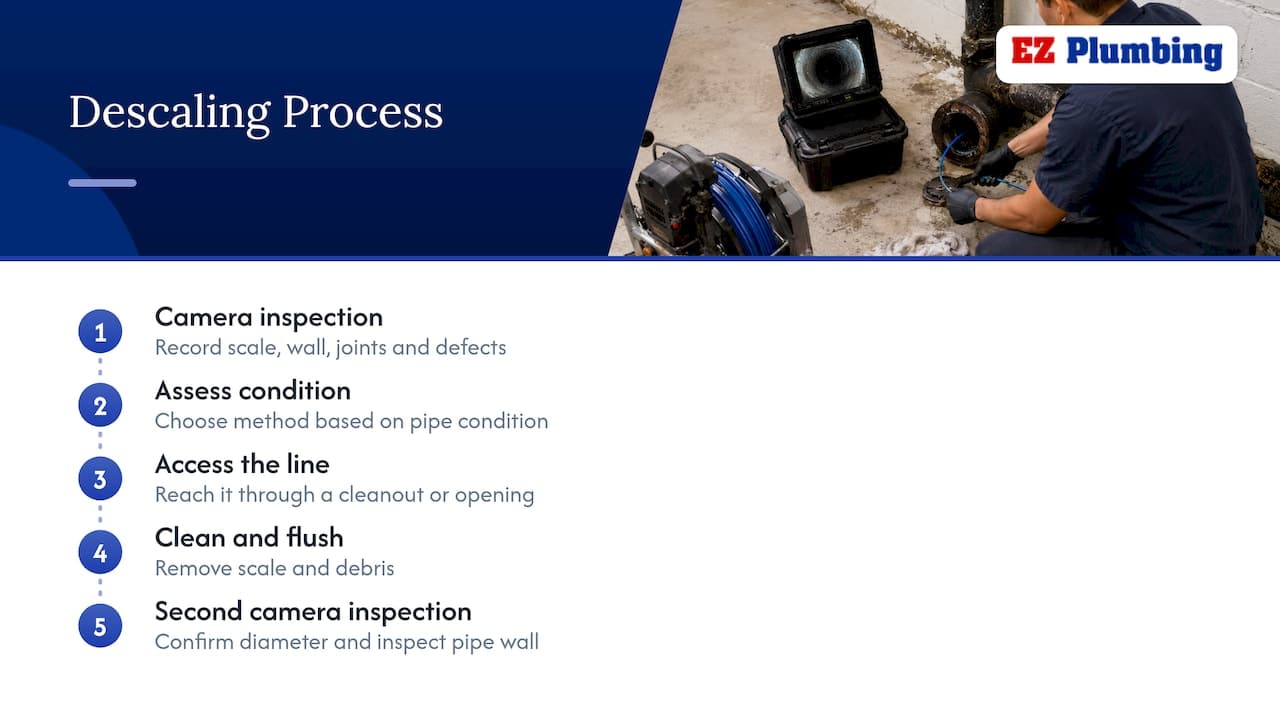
Step two is the decision. Light to moderate scale over a solid wall is a good candidate. Heavy scale over a visibly thin channel, flaking metal, cracks, or sections that have dropped out of line is a different problem. The EPA’s guidance on condition assessment of collection systems describes how inspection, investigation and monitoring are used together to determine a pipe’s structural and operational status. The same logic applies to a single house line: you assess condition first, then choose the intervention.
Step three is access. The plumber needs a cleanout or another opening to reach the line. If there is no accessible cleanout, installing one is often a worthwhile part of the job, because it makes every later inspection and cleaning simpler.
Step four is the cleaning pass. Depending on the scale, this may be mechanical, hydro jetting or both, followed by flushing out the debris so it does not settle further down the line. Debris removal matters as much as the scraping, since loose scale left behind can form a new blockage downstream.
Step five is the second camera run. The follow-up inspection confirms that the diameter is restored and shows the true state of the wall now that the scale is gone. Sometimes the cleaned pipe looks better than expected. Sometimes it reveals thin spots the scale had been hiding. Either way, you leave with facts instead of guesses.
Can descaling damage an old cast iron pipe?
It can, which is why this is the question we hear most. Scale and metal are different layers, and when the metal has thinned, the scale is sometimes bridging the weak spot. Aggressive cutting, or high pressure aimed at a corroded section, can turn a slow line into a leaking one.
Three factors lower that risk. The first is the camera inspection beforehand, which identifies thin or cracked sections so the plumber can avoid them or decide against cleaning altogether. The second is matching the method to the pipe: gentler mechanical heads and controlled jetting pressure for fragile lines. The third is experience. An operator who has worked on many 1940s and 1950s Los Angeles houses recognizes the sound and feel of a pipe that is near the end of its life, and stops.
When the camera shows heavy scale over a thinned channel, descaling is often only a short-term measure. In those cases, repair or replacement is the honest recommendation. Depending on the line, that can mean replacing a failed section, relining, or a full replacement. Our guide to sewer line repair without digging explains the trenchless options, and our sewer line repair service covers the work itself.
Descale, repair or replace: how to decide
The choice comes down to what the camera shows and how you plan to use the property.
| What the camera shows | Typical recommendation |
|---|---|
| Light to moderate scale, solid wall, joints tight | Descaling or hydro jetting, then a follow-up camera pass |
| Heavy scale, wall appears sound | Mechanical descaling with jetting, followed by a maintenance schedule |
| Heavy scale over a thinned channel or flaking metal | Spot repair or relining to be considered; descaling only with great care |
| Cracks, offset joints, sagging or broken sections | Repair or replacement of the affected section |
| Root intrusion at joints | Root removal plus repair of the joint that let them in |
If you are buying a home with original cast iron, or you are planning a remodel that will put more load on the drains, getting a camera inspection before you commit is inexpensive compared with discovering a failed line afterward. Our guide on why drain lines should be maintained and the article on why sewer line maintenance matters explain how regular cleaning keeps scale from reaching the point where repair is the only option.
What dissolves calcium buildup, and what about CLR?
Calcium and magnesium deposits dissolve in acids, which is why descaling products for kettles, faucets and water heaters work. Household products built around that chemistry are common, and CLR is a widely known one. But a faucet aerator and a sewer pipe are very different environments. The deposit inside a cast iron drain is not purely calcium. It is a mix of rust, grease, soap residue and sediment bonded to the iron, and an acid that dissolves part of it also reaches the metal. Because we cannot see how thin an old pipe has become without a camera, we do not recommend using acid-based products inside aging cast iron drains. If hard-water scale is a concern on the supply side, for example in a water heater, our water heater repair team can look at that separately.
What descaling costs in Los Angeles
We do not publish a flat price for descaling, because two cast iron lines of the same length can be entirely different jobs. What we can tell you is what moves the price.
The length and diameter of the line, and whether there is an accessible cleanout, determine how much time is needed. The severity of the scale decides whether one pass is enough or whether the job requires both mechanical and jetting work. The camera work before and after is part of the process. And the condition of the pipe may change the plan entirely if a repair turns out to be needed.
Our published residential rate is $150 to $280 per hour, and our commercial rate is $120 to $240 per hour. You can estimate your own job on our pricing calculator. We provide up-front written pricing before work begins, so you know what you are approving. Work on a sewer line may also require a permit in the City of Los Angeles, and a licensed plumber should handle that paperwork and the inspection.
Our perspective
We have worked on Los Angeles plumbing since 1989, and the cast iron question comes up on a large share of the sewer and drain calls we take. Our position is simple: descaling is a legitimate, effective service when it is done on the right pipe, and it is one of the least disruptive ways to give an older line more years of service.
What separates a good job from a bad one is the camera. We inspect before we touch the pipe, we choose the method to match the wall we see, and we inspect again afterward so you can see the result. If the pipe is a good candidate, we clean it and recommend a maintenance schedule. If it is not, we tell you what we found and show you the footage, along with the repair options and how each affects your yard, your driveway and your budget.
Because we know LA’s housing eras and building codes, we also know what is likely to be under a 1950s Valley ranch house versus a 1920s bungalow near downtown, and where roots, clay laterals and cast iron transitions tend to cause trouble. Our jobs are documented for code compliance, and you speak to real local staff, not a remote call center.
EZ
Keeping cast iron lines clear after descaling
Descaling resets the pipe. What you do afterward decides how long the reset lasts. Keep grease, wipes and food waste out of drains, and run hot water after washing dishes. Have lines inspected periodically if the house still has original cast iron, because scale grows back slowly and a quick jetting every so often is gentler than waiting for a full blockage.
Property managers, HOAs and restaurants face the same buildup on a larger scale, and more often. Grease-heavy kitchens and multi-unit buildings with shared stacks benefit from a scheduled program rather than emergency calls. We offer maintenance plans for these clients, and you can read about them on our commercial plumbing page.
Get your cast iron line inspected
If your drains keep backing up, or you own an older home and want to know what is inside the pipes, we can run a camera through the line, show you the footage and tell you whether descaling, hydro jetting or repair makes sense. Our team is licensed (C-36 License #583868), insured and available 24/7 for emergencies.

Book a camera inspection and drain cleaning through our drain cleaning service, or reach us any time through our emergency plumbing page if sewage is backing up now.
Frequently asked questions
Can you descale cast iron pipes?
Yes, as long as the pipe wall is still sound. Descaling removes the hardened buildup from the inside of the pipe with mechanical cutting heads, hydro jetting, or both. A camera inspection should confirm the pipe’s condition first, since a thinned or cracked pipe may need repair instead.
How much does it cost to descale a cast iron sewer line?
It depends on the length of the line, access, how heavy the scale is and what the camera finds. Our residential plumbing rate is $150 to $280 per hour, and we give you written pricing before work starts. Use our calculator for an estimate.
Is CLR bad for cast iron pipes?
Acid-based descalers can attack iron as well as the deposit, and in an old drain you cannot see how thin the metal has become. For that reason we recommend against using them in aging cast iron lines. A camera inspection and a mechanical or jetting clean is the safer approach.
Can descaling make an old cast iron pipe leak?
It can if the wall is already thin and the cleaning is aggressive. That is why we inspect first, match the method and pressure to the pipe, and check again afterward. If the line is too deteriorated, we will recommend repair or replacement.
How often does cast iron need to be descaled?
There is no fixed interval. A line that was heavily scaled and cleaned properly may stay clear for years with careful habits, while a grease-heavy commercial line may need regular service. A periodic camera check tells you when the next cleaning is due.