
Low Hot Water Pressure: Causes and Fixes for LA Homes
If your hot water runs weak while the cold side is fine, the problem is almost always in the hot side of your plumbing: a clogged aerator or cartridge at one fixture, or sediment, scale or a restriction in or near the water heater. The fastest way to find out is to work out whether the weakness is at one faucet or at every hot tap in the house. That single check tells you whether this is a ten-minute DIY job or a job for a licensed plumber.
Below, we walk through the diagnosis in the order we use it in the field, explain what is specific to Los Angeles homes, and tell you where DIY stops being a good idea.
TL;DR
- If cold pressure is normal and only hot is weak, the cause is in the hot water equipment or hot-only piping, not the city supply.
- One weak faucet usually means a clogged aerator, showerhead or cartridge. Every hot tap weak points to the water heater, its inlet or its valves.
- Hard water scale is a leading culprit in LA, in tanks, tankless heat exchangers and hot-line fittings.
- A tankless heater that slows down in winter may be at its design limit, not broken.
- Descaling heat exchangers, replacing dip tubes and any suspected leak are jobs for a licensed plumber.
Table of Contents
- Start by separating flow from pressure
- One faucet or the whole house?
- The most common causes, ranked by how often we see them
- What is different about Los Angeles
- If you have a tankless water heater
- What you can safely check yourself
- When to call a plumber
- Our perspective: what we see in LA homes
- Get the hot side flowing again
- Frequently asked questions
- Sources
Start by separating flow from pressure
People say “low pressure” for two different things. Pressure is the force in the line, measured in psi. Flow is how much water actually comes out, measured in gallons per minute. A clogged aerator gives you weak flow even when pressure at the pipe is perfectly healthy.
A simple benchmark: a HomeServe guide to slow hot taps (a UK source, so it uses liters) describes normal household flow as roughly 10 to 15 liters per minute, about 2.6 to 4 gallons per minute, and treats a 1-liter jug that takes longer than 6 seconds to fill as a sign of restricted flow. At home, you can run the same test with a 1-gallon jug at the hot tap and then at the cold tap of the same fixture. If hot takes noticeably longer, you have confirmed a hot-side problem.
Inspectapedia’s diagnostic guide makes the same point: good cold flow with poor hot flow at one or more fixtures usually points to a blockage at the water heating equipment or mineral buildup in the hot piping.
One faucet or the whole house?
This is the most useful question you can answer before touching a wrench.
Only one faucet is weak
The cause is almost always local to that fixture. In our experience the usual suspects are:
- The aerator. The small screen at the tip of a kitchen or bathroom faucet collects grit and scale. Unscrew it, rinse it, and soak it in white vinegar if it is crusted.
- The showerhead. Mineral deposits close the nozzles one by one.
- The cartridge or its ports. In a single-handle faucet, debris that lodges in the cartridge can block only the hot side.
- The supply line or stop valve. A kinked flexible line or a stop valve that is not fully open under the sink restricts flow at that fixture only.
This is why a weak hot tap in the kitchen alone is rarely a water heater problem. Check the aerator first, before you assume anything bigger.
Every hot tap is weak
When the drop is house-wide, the restriction sits upstream of all your fixtures. That means the water heater, its cold inlet, its shut-off valve, or the main hot trunk line. A few things to check, safely:
- Confirm the shut-off valve on the heater’s cold inlet is fully open. Valves that were partly closed during a past repair are more common than you would expect.
- Note when the problem began. A sudden drop often points to a failed part. A slow decline over months points to scale.
- Look at the water coming out. Rust-colored water, or white plastic flecks, tell you something about what is going on inside the tank.
Portland’s water bureau notes that white plastic particles in your water can mean the dip tube is breaking down inside the tank. A deteriorated dip tube and the sediment it sheds can partially clog fixtures and inlet screens, and replacing it means draining and opening the heater.
The most common causes, ranked by how often we see them
Sediment and scale in the water heater
Minerals settle out of heated water. In a tank heater they pile up on the bottom and can choke the outlet. In a tankless unit they coat the heat exchanger and narrow its internal channels. A Takagi tankless technical document cites that hard water affects more than 85% of American homes and that water over 3 grains per gallon is classed as hard, with over 14 gpg called extremely hard. The harder the water, the faster flow drops.
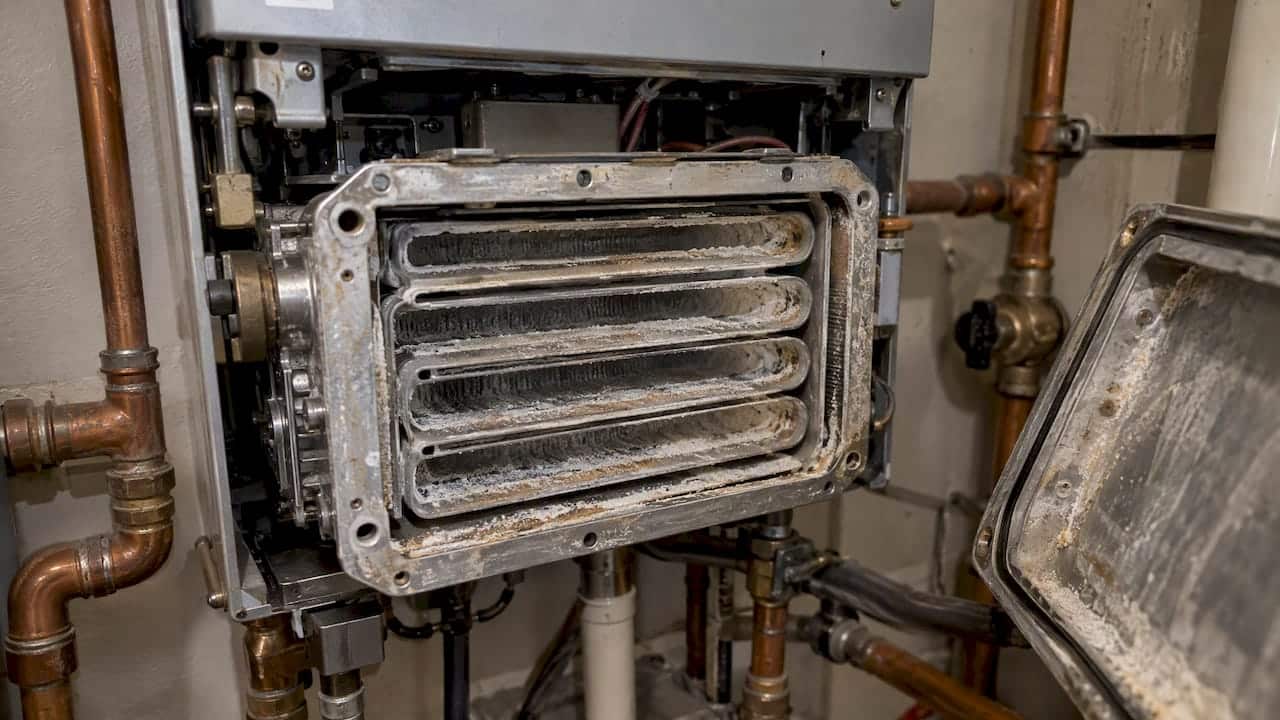
Los Angeles is hard-water territory, and scale does not stay in the heater. It also builds up inside brass elbows and tees on hot lines. If you want the local numbers and what they cost homeowners over time, see our page on hard water in Los Angeles.
Clogged aerators and showerheads
Cheap to fix and easy to rule out, so do it first. If the flow at that fixture recovers after cleaning, you are done.
A partly closed or failing valve
Shut-off valves, mixing valves and thermostatic valves can all restrict hot flow. Old gate valves in particular corrode internally and can stay “open” on the handle while barely passing water.
Corroded galvanized or aging hot lines
LA has a lot of homes built before copper became standard, and some still carry galvanized steel. Galvanized pipe corrodes from the inside and narrows over decades. Hot lines usually go first because heat speeds the process. When the weak flow is on every hot fixture and cold is fine, and the house is old, ask a plumber to evaluate the pipe itself. Sometimes the right answer is repiping, not another round of cleaning.
A hidden hot-line leak
A leak in a hot supply line, including one under a slab, can steal flow from the fixtures downstream. Warning signs include a warm spot on the floor, a water meter that moves when everything is off, or an unexplained rise in your water bill. That is a leak detection job, not something to guess at.
What is different about Los Angeles
Two local factors matter here, and they pull in opposite directions.
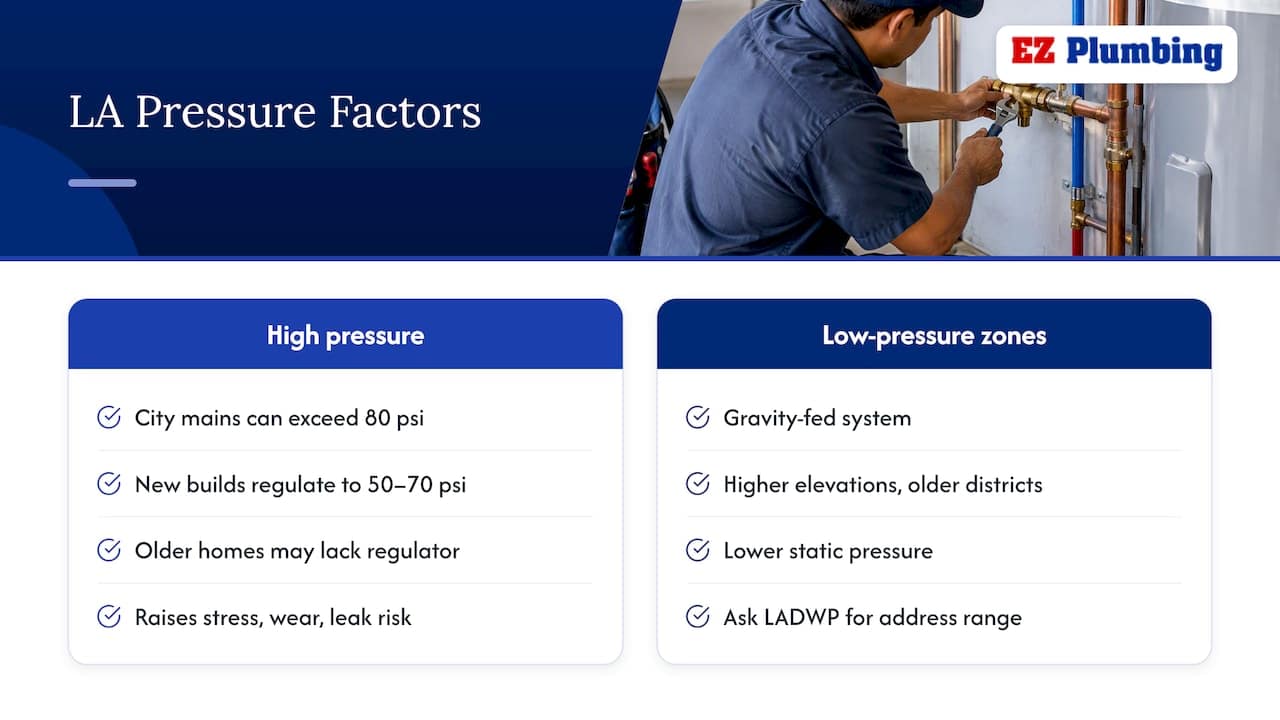
Some LA properties have pressure that is too high, not too low. According to LADWP’s water pressure page, city main pressure can exceed 80 psi, and new construction must then include a pressure regulator, typically set between 50 and 70 psi. Older homes may have no regulator at all, which exposes pipes and fittings to more stress and can speed up wear and leaks. Over years that wear can show up as restrictions and leaks on the hot side as well.
Some properties sit in naturally lower-pressure zones. LADWP’s system is largely gravity-fed, so homes at higher elevations or in older districts can see lower static pressure. Before you decide your internal plumbing is entirely to blame, you can ask LADWP’s Water Distribution Services Section for the pressure range at your address, as the same LADWP page explains. If the cold side is also weak, that call is worth making. Our guide to low water pressure under 45 psi in Los Angeles covers that whole-house scenario, and the one for apartment tenants covers who to call when you do not control the building.
Because the cold side is fine in your case, the supply is probably not the main issue. Still, a high-pressure home with no regulator and a hot-side restriction is a combination we see in older neighborhoods.
If you have a tankless water heater
Tankless units add a twist: low flow is not always a malfunction.
Every tankless heater has a maximum flow rate. As the Hubbell tankless manual puts it, exceeding that rate means the heater cannot fully heat the water. Noritz’s troubleshooting guidance adds that a unit that was sized too small, or one facing colder incoming water, may simply be operating at its limit. Groundwater temperature changes with the seasons, so a shower that felt fine in September can feel thin in January because the heater has to raise the temperature further. Many owners assume something broke when the unit is doing what it was designed to do.
So with a tankless heater, ask:
- Does the problem get worse when two fixtures run at once?
- Is it worse in winter?
- Was the unit sized for the number of bathrooms you have now?
If yes, you may have a sizing question rather than a repair. If the flow dropped gradually and the water is hard, scale in the heat exchanger or a blocked inlet screen is more likely. Our page on tankless water heaters explains what to expect from these systems in LA homes.
Flushing a tankless unit: what to know before you try
A descaling flush is the standard maintenance fix, and we have a step-by-step on cleaning a tankless water heater and on draining one safely. Some realities worth knowing:
- Vinegar works but is slow. A Florida Solar Energy Center study of water heating systems is a good reference for how these systems perform, and practitioners generally allow two hours or more for vinegar, while professional citric or sulfamic acid solutions work faster.
- Air left in the lines after maintenance can cause erratic flow and can harm modern electronic heaters, so purging properly matters.
- A heat exchanger that is badly scaled may regain some flow after flushing but may never return to its original efficiency.
Inspectapedia’s guidance on this is blunt: homeowners can reasonably check aerators and inlet screens, but trying to deep-flush or repair a heat exchanger without the right acid solutions and circulation pump often leaves minerals behind or damages the unit.
What you can safely check yourself
Here is a sequence that costs nothing and takes under an hour.
- Compare hot and cold at the same faucet with a jug and a timer.
- Test several fixtures. Kitchen, bathroom sink, tub, shower, laundry. Write down which are weak.
- Clean the aerator on any weak faucet and run the water into a bucket for a minute to clear debris.
- Check the stop valves under the sink, and the heater’s cold inlet valve, are fully open. Turn them slowly.
- Inspect the showerhead and soak it if there is visible scale.
- Look around the heater for moisture, rust streaks or corrosion at the fittings.
Stop there if the water heater is gas-fired and you notice a gas smell, or if you see water pooling. Leave the area, and treat a gas smell as an emergency by calling the gas utility from outside the home. Do not attempt to open gas connections or rework a heat exchanger yourself.
When to call a plumber
Call a licensed plumber if any of these apply:
- Every hot fixture is weak and the aerators are clean.
- Your water heater is more than a decade old and shows rust or leaking at the base.
- You see rust-colored water or plastic flecks coming from hot taps.
- A tankless heater has stopped delivering after you cleaned the screen, or error codes appear.
- Your water bill is climbing or the meter moves with everything off.
- You suspect galvanized pipe in an older house.
The water heater is typically where the diagnosis ends up, so our water heater repair team starts there: inlet and outlet, valves, sediment, dip tube, and heat exchanger condition. If the heater turns out to be at the end of its life, the options are on our water heater installation page. If the hot water is gone entirely rather than weak, start with these three checks first.
Our perspective: what we see in LA homes
We have been a family-owned LA plumbing company since 1989, and the same pattern keeps repeating: homeowners replace a showerhead, then a faucet, then call us about a water heater that really only needed its inlet screen or a proper descale. Our advice is to diagnose in order and not to spend money on parts until you know where the restriction sits.
Los Angeles housing makes this more interesting than it sounds. A 1920s bungalow with old galvanized lines, a 1960s apartment building with a shared water heater and a recent tankless retrofit in a Silver Lake hillside home all produce “low hot water pressure,” and none of them has the same cause. Knowing the housing era tells us where to look before we open anything.
We also document our work for code compliance and give you written pricing up front, so that you know what you are approving before work begins. And when the answer is simple, such as a clogged aerator, we will tell you that rather than sell you a bigger job.
— EZ
Get the hot side flowing again
If you have run through the checks above and your hot water is still weak, our licensed plumbers can diagnose it. We are a licensed (C-36 License #583868) and insured team serving the greater Los Angeles area, with real local staff answering the phone. Residential rates are published at $150 to $280 per hour and commercial rates at $120 to $240 per hour; you can estimate your job on our rate calculator. If you manage a building, ask about our commercial plumbing services and maintenance contracts. For a sudden loss of flow with leaking or flooding, use our 24/7 emergency plumbing line.
For a wider look at the topic, see our article on what causes low hot water pressure and our whole-house guide on fixing low water pressure.
Frequently asked questions
Why is my hot water pressure low but my cold is fine?
Because the restriction is on the hot side only: a clogged fixture aerator, a blocked inlet or valve on the water heater, scale or sediment inside it, or a narrowed hot line. Since cold is normal, the city supply is probably not the cause. Checking whether one tap or all taps are affected narrows it down quickly.
Why is my hot water pressure low at only one tap?
That usually means debris in that faucet’s aerator, cartridge or stop valve. Unscrew the aerator, clean it and flush the line into a bucket. If hot flow stays weak at that single fixture after cleaning, the cartridge or supply line is the next thing to replace.
How do I increase hot water pressure?
Find and remove the restriction rather than trying to add pressure. Clean aerators and showerheads, open any partly closed valves, and have a plumber flush or descale the water heater if scale or sediment is the issue. Whole-house pressure is a separate matter, and in LA it can be checked with LADWP.
Can a tankless water heater cause low hot water flow?
Yes. Tankless units have a maximum flow rate, and heavy simultaneous use or colder winter groundwater can push them past it. Scale on the heat exchanger can also reduce flow, which is a job for a plumber with the right descaling equipment.
Sources
- HomeServe: Why is my hot water tap running slowly?
- Inspectapedia: How to diagnose and fix poor hot water pressure and flow
- Portland.gov: Maintaining your water heater
- Takagi: Tankless technical document
- LADWP: Water Pressure
- LADWP: Water Pressure (construction services)
- Noritz: Low pressure knowledge base
- Florida Solar Energy Center: Side-by-side testing of water heating systems