
Homeowners: 5 Safe Steps to Relight a Water Heater Pilot Light
If you smell gas near your water heater, stop immediately: leave the house, and call your gas supplier or emergency services from outside. If there is no gas odor, most standing-pilot water heaters can be relit by turning the control knob to PILOT, holding it in while you light the pilot, waiting for the flame to hold, then switching to ON. If the flame will not stay lit after careful attempts, stop and call a licensed plumber.
TL;DR:
- Check the manufacturer label first: electronic ignition models may use status lights or automatic cycles, while manual models require a long reach lighter.
- If you smell gas, avoid switches and phones indoors, leave the house, and call the gas supplier or emergency services from outside.
- A pilot that dies when the knob is released often points to a worn thermocouple; drafts, clogged openings, low pressure, and lockouts are alternatives.
- A steady blue flame with a small yellow tip is normal, but a mostly yellow flame, soot, or repeated lockouts warrant professional diagnosis.
- If the pilot still will not stay lit after careful attempts, stop; repairs involving sealed assemblies, gas valves, or testing require a licensed plumber.
Table of Contents
- How to Relight a Standing Pilot or Electronic Ignition Water Heater
- Why Won’t the Pilot Stay Lit? A Diagnostic Checklist
- Safety Checks Before You Try to Relight the Pilot
- How to Tell If the Pilot Flame Is Healthy
- When It’s Time to Call a Licensed Plumber
- What Homeowners Can Safely Handle, and What We’d Rather You Didn’t
- Get Your Water Heater’s Pilot Light Fixed for Good
- FAQ
- Sources
How to Relight a Standing Pilot or Electronic Ignition Water Heater
Before touching any controls, locate the gas control valve and pilot assembly near the bottom of the tank, and check the access panel or manufacturer label for model-specific notes. Water heaters vary enough between brands that a quick look at this label can save you a wasted attempt, especially on electronic ignition models with status lights instead of a visible flame window.
Relighting steps and ignition methods can vary by model, so follow the instructions for your unit in A.O. Smith’s relight guide.
- Turn the gas control knob to OFF and wait before proceeding, following your model’s instructions for relighting.
- Turn the gas control knob to PILOT and press it down. This step opens gas flow to the pilot burner only.
- While holding the knob in, ignite the pilot: electronic ignition units have a built-in igniter button to press, while manual pilot models usually need a long-reach lighter aimed at the pilot opening.
- Keep holding the knob in for the time your model specifies, so the thermocouple or thermopile heats enough to keep the gas valve open on its own.
- Release the knob slowly and check that the pilot stays lit. If it does, turn the control to ON and replace the access panel.
If the pilot catches but dies the moment you let go of the knob, do not keep repeating the exact same attempt. A failed relight may point to a mechanical problem covered in the next section, not a lighting technique problem.
Pro Tip: Follow the hold time specified for your model. Releasing the knob too soon can prevent the pilot from staying lit.
Electronic ignition models deserve a separate note. Instead of a visible pilot flame, many display status lights or an LED sequence that indicates ignition progress or faults. Some units attempt ignition automatically once the gas control calls for heat, with no manual hold step at all. If yours falls into this category, consult the label inside the access panel for the specific light sequence before assuming the unit has failed.
Why Won’t the Pilot Stay Lit? A Diagnostic Checklist
A pilot that lights but repeatedly goes out is telling you something specific. Working through these causes in order, from most common to least, usually narrows down the problem before you call anyone.
- Worn thermocouple or thermopile: this small sensor generates a weak electrical current when heated by the pilot flame, and that current holds the gas valve open; once it weakens with age, the valve closes almost as soon as you release the knob, which Carrier’s guide to furnace pilot lights describes as the single most common reason a pilot won’t hold, and it’s usually an inexpensive part to replace.
- Clogged pilot orifice or dirty pilot assembly: dust and debris can narrow the small opening that feeds gas to the pilot, producing a weak or oddly shaped flame that struggles to heat the thermocouple properly; this is a delicate fix that often needs the right tools to avoid damaging the assembly.
- Drafts and poor placement: a water heater closet door left open, a nearby window, or stored boxes blocking normal airflow can all create enough draft to blow out a small pilot flame repeatedly.
- Low gas pressure or a partially closed valve upstream: if other gas appliances in the home also seem underpowered, check that the shutoff valve at the water heater and the main gas valve are fully open.
- Faulty gas control valve: when the thermocouple tests fine but the pilot still won’t hold, the valve itself may not be sealing or opening correctly, a failure that combustion safety testing procedures specifically check for by testing the valve’s solenoid closure, per combustion appliance safety testing guidance from the Department of Energy.
- Electronic lockout or FVIR shutdown: newer units use flammable vapor ignition resistant sensors that intentionally shut down and lock out the pilot when they detect combustible fumes or improper venting nearby, a safety feature explained on Rheem’s FVIR overview, and in that case relighting won’t work until the underlying issue is resolved.
- Kinked or clogged flex gas line: a bent or partially blocked flexible connector between the main supply and the control valve can starve the pilot of consistent gas flow, producing the same symptoms as a clogged orifice.
Several of these, like a dirty orifice or a questionable gas valve, are easy to misdiagnose without taking the unit apart, which is part of why our gas water heater troubleshooting guide walks through each symptom in more detail.
Safety Checks Before You Try to Relight the Pilot
A few checks before you touch the control knob can prevent a dangerous situation and save you a wasted attempt.
- Smell test first, every time. If you detect any gas odor near the water heater, stop immediately: do not flip light switches, do not use your phone inside the house, and do not attempt to light anything. Leave the house and call your gas supplier or emergency services from outside, ideally using a neighbor’s phone, since Remove this clause.] Our guide on [what to do if you smell gas covers this protocol step by step.
- Check for blocked airflow. Look for anything restricting air near the burner compartment: stored items, a closed closet door, or a blocked combustion-air vent can all starve the flame or create drafts that blow it out.
- Watch for lockout signs. Repeated failed ignition cycles or a blinking status light pattern on electronic models often indicate an FVIR sensor has detected a venting or vapor problem rather than a simple lighting mistake, as Rheem explains.
- Know when to stop and call for a vent inspection. Soot around the draft hood, a burning smell, or a pilot that locks out repeatedly despite correct technique all point toward a combustion or venting issue that needs professional diagnosis, not another relight attempt. Our venting problems guide covers the warning signs in more depth.
How to Tell If the Pilot Flame Is Healthy
Once the pilot catches and holds, take a moment to actually look at it rather than closing the panel right away.
- A healthy pilot burns steady blue with a small yellow tip at the very top, a flame Carrier notes as the sign of complete, efficient combustion.
- A mostly yellow or orange flame suggests incomplete combustion, often from dirt in the burner or a venting problem, and it warrants a professional look rather than a wait-and-see approach.
- Watch the flame after releasing the knob; on electronic ignition units, confirm the status light settles into its normal operating pattern rather than continuing to flash a fault code.
- If the pilot holds steady but hot water still doesn’t return, the issue may be in the thermostat or main burner ignition sequence rather than the pilot itself, worth checking against our troubleshooting guide for no hot water before assuming the repair is finished.
- Any soot, a lingering burning smell, or a flame that stays yellow after cleaning the pilot area means it’s time to shut the unit down and call a technician rather than keep testing it.
When It’s Time to Call a Licensed Plumber
Some situations call for professional service rather than another attempt at the knob.
- Any gas smell, ever. Evacuate, call your gas supplier or emergency services first, and schedule a technician only after the immediate danger is cleared.
- The pilot won’t hold after careful attempts. The problem may be mechanical, not technique.
- Signs of a faulty gas valve, repeated electronic lockouts, visible soot, or a carbon monoxide alarm going off. These all point to combustion or venting problems that need diagnostic equipment, not guesswork.
- The fix requires parts behind sealed access panels, such as a thermocouple, gas control valve, or anything requiring gas-valve solenoid testing and high-limit control checks, procedures outlined in federal combustion safety testing guidance.
- What a service visit typically includes: a full diagnostic check of the pilot assembly, thermocouple, gas valve, and venting, a written estimate before any repair begins, and code-compliant replacement of any failed component.
What Homeowners Can Safely Handle, and What We’d Rather You Didn’t
A standing pilot that simply needs relighting is a reasonable task for most homeowners to handle carefully, following the manufacturer’s sequence and respecting the gas-smell protocol without exception. Where we draw the line is anything involving a gas valve, a sealed burner assembly, or repeated lockouts, because diagnosing those correctly means pressure testing, solenoid checks, and combustion measurements that go beyond what a homeowner can safely verify at home.
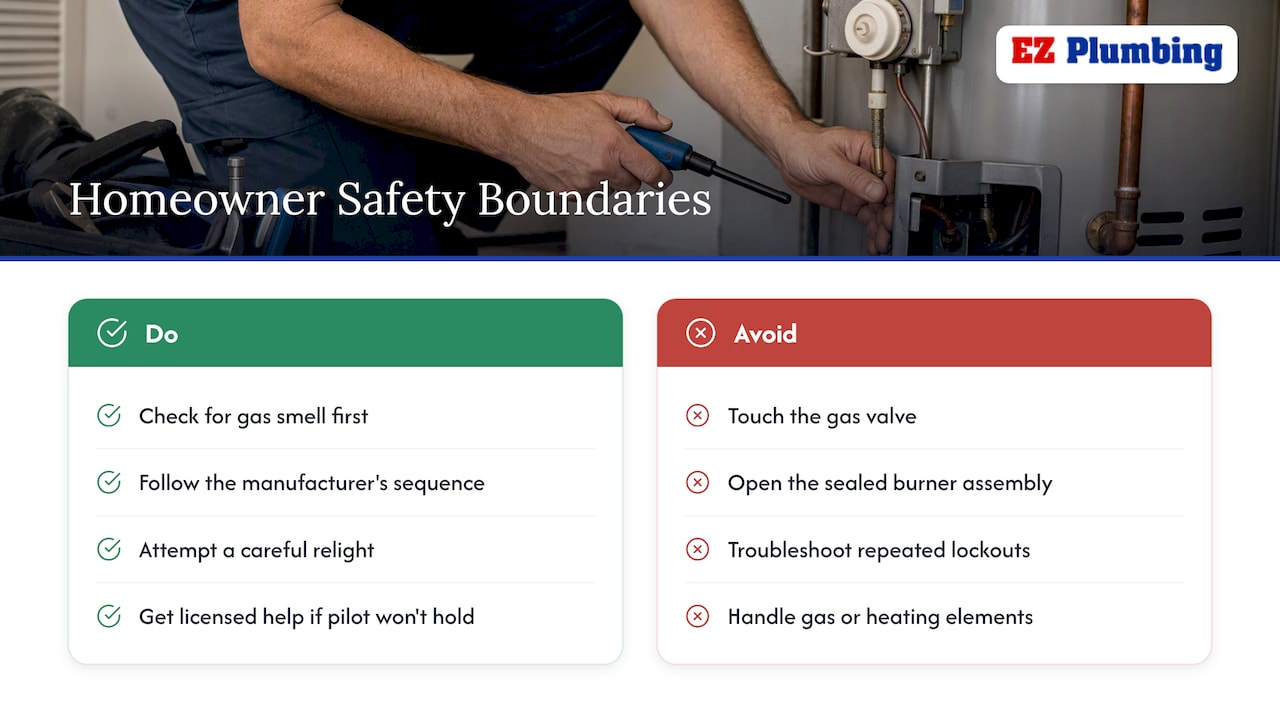
The same logic applies to smaller gas appliances around the house, like a towel rail that won’t heat: a quick visual check is fine, but anything touching the gas or heating element itself is worth a second opinion.
Our approach, in practice, is simple: smell check first, attempt a careful relight, and if the pilot still won’t hold, stop and bring in a licensed technician who can test the parts you can’t safely open up yourself.
— EZ
Get Your Water Heater’s Pilot Light Fixed for Good

A pilot that won’t stay lit rarely fixes itself, and repeated relighting without knowing the cause just delays the real repair. Our water heater repair technicians diagnose thermocouple failures, test gas control valves, and check venting and combustion performance so the fix addresses the actual problem instead of masking it for another week. As a licensed plumbing company serving the greater Los Angeles area, we’re available for emergency calls when a pilot problem leaves you without hot water. Every visit starts with a safety check and diagnosis, followed by a written estimate before any work begins. If your pilot won’t hold after a couple of careful attempts, request water heater service and we’ll get it sorted.
FAQ
Can I relight the pilot light by myself on the water heater?
Yes, in most cases, as long as you don’t smell gas. Follow the manufacturer’s sequence: turn the control to OFF, wait, set to PILOT, light and hold, then switch to ON once the flame holds steady.
How do I know if my water heater pilot light is out?
You’ll typically have no hot water, and looking through the small viewing window near the bottom of the tank will show no flame at all. On electronic ignition models, a status light or error code often signals the same thing instead of a visible flame.
Will a water heater leak gas if the pilot light goes out?
Not necessarily: the gas control valve is designed to shut off gas flow to the pilot once the thermocouple cools, which is why relighting usually works safely. If you ever smell gas near the unit, treat it as an emergency and evacuate rather than assuming it’s related to the pilot alone.
How do I reset a pilot light on a hot water heater?
“Resetting” usually just means relighting it: turn the gas control to OFF, wait at least 10 minutes, then set it to PILOT and hold the knob while igniting the flame. Hold for the time specified by the manufacturer before releasing and turning the control to ON.
Sources
- Rheem
- Combustion Appliance Safety & Efficiency Testing
- Furnace Pilot Light: How It Works, Problems & Fixes
- How To Relight A Water Heater’s Pilot Light | A.O. Smith