
Flat Rate Pricing for Plumbers: A Practical Guide
You're probably here because two plumbers gave you two completely different numbers, and neither one explained the difference in plain English.
That's normal in Los Angeles. A homeowner in a hillside house in Echo Park gets a leak under the kitchen sink and one company throws out a low number over the phone, another says they need to inspect first, then somebody arrives and starts talking about trip charges, access, and “possible additional work.” By the time the wrench comes out, you're not comparing plumbers anymore. You're trying to decode billing systems.
My advice is simple. For most routine residential service, flat rate pricing for plumbers is the cleaner model. It gives you one approved price before the work starts. It also gives you a better way to judge whether a quote is honest, padded, or designed to trap you after the technician is already inside.
Table of Contents
- The Two Quotes That Started This Whole Conversation
- How Plumbers Actually Build a Flat Rate
- Flat Rate Versus Hourly Billing in Real LA Jobs
- What Flat Rate Plumbing Costs In Los Angeles Right Now
- How to Read a Flat Rate Plumbing Estimate Without Getting Burned
- What Happens When the Job Changes Mid-Way
- When Flat Rate Pricing Is the Smart Move for Homeowners
- Your Quick Checklist Before You Approve Any Flat Rate Quote
The Two Quotes That Started This Whole Conversation
A homeowner in Echo Park gets two quotes for the same leaking kitchen shutoff valve. One plumber says $185 to start on the phone. The second plumber looks at the valve, checks the cabinet access, and writes up a flat-rate repair at $385.
In Los Angeles, that gap usually means one of two things. The first shop is using a low entry number to get in the door, or the second shop already priced the full repair, including parts, labor, and warranty risk.
Here is what happens in practice. The $185 quote often turns into a service call charge, then labor, then parts, then a little extra if the stop valve is seized, corroded, or tucked behind a garbage disposal. The final invoice lands around $300-plus, and now the “cheap” plumber is no longer cheap. The $385 flat-rate quote looked higher, but it was honest about the scope from the start.
That difference is what started this whole conversation.
For defined residential service work, flat rate pricing gives you a number you can approve before the wrench turns. Industry guidance on plumbing flat-rate models describes the same setup: one stated price for a known repair, with separate handling when the scope is still unknown (BuildFolio plumbing flat rate pricing guide).
In LA, the right question is not “Which quote is lower?” The right question is “Did both plumbers price the same scope?”
Push on that point hard. If one quote covers replacing one accessible angle stop under a clean kitchen sink in Mar Vista, and the other quote assumes drywall opening, supply line replacement, and shutoff isolation in a 1920s Los Feliz house, those are not competing bids. They are different jobs.
Use this quick LA decision test:
- Legitimate scope change: bad access, frozen valves, outdated galvanized piping, no working fixture shutoff, tenant-occupied scheduling limits, or evidence the leak is coming from the stub-out in the wall instead of the valve body
- Likely upsell: “you should probably replace everything while we're here,” vague safety language with no defect shown, or a sudden jump in price without a new problem you can see
If the plumber finds a real change in conditions, the price should change. If the job did not change, the number should not change.
That is the standard you want.
How Plumbers Actually Build a Flat Rate
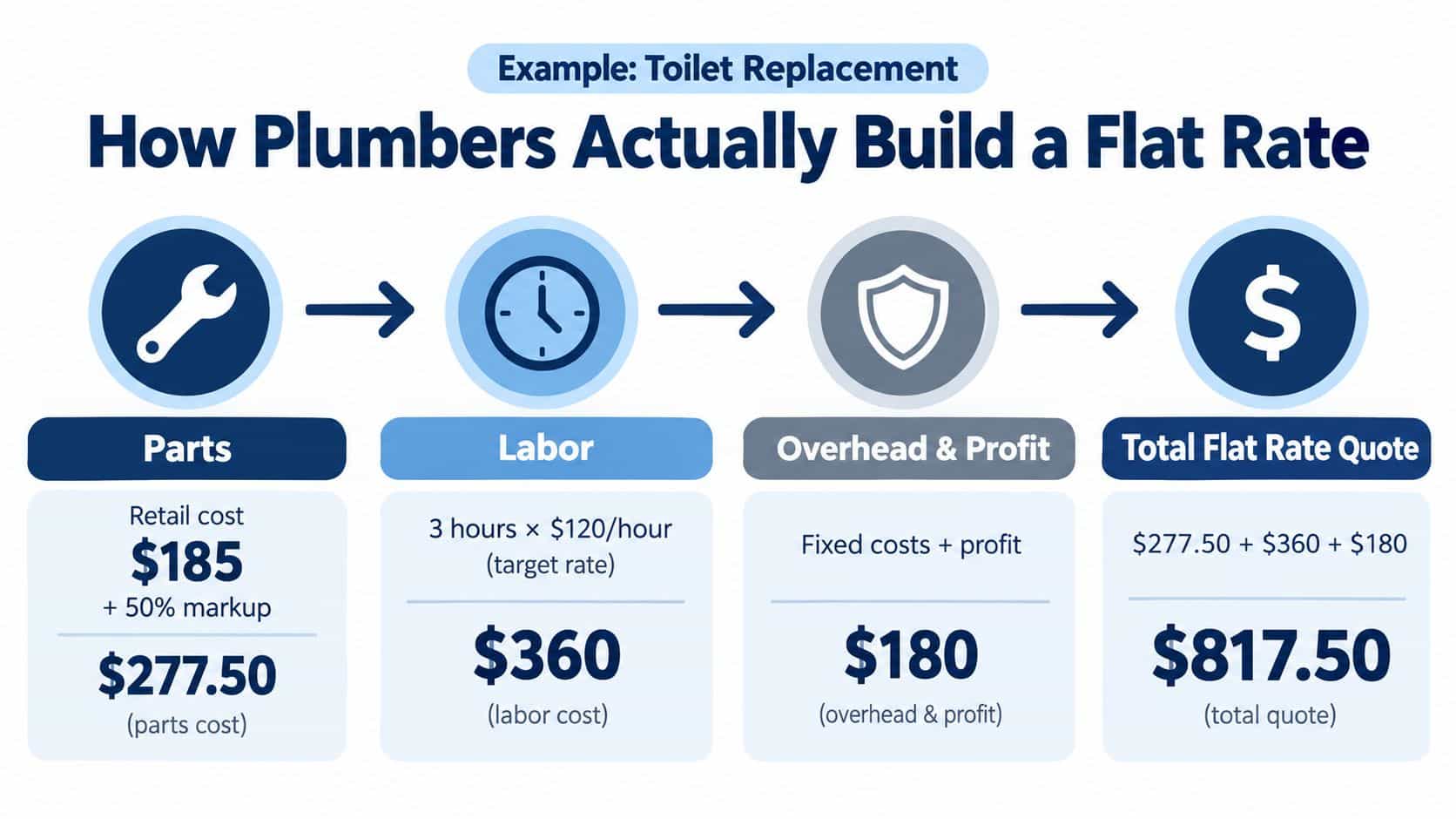
A real flat-rate quote starts long before the technician gives you a number at the door. In Los Angeles, a serious shop prices the job from a price book, then adjusts for the house in front of them. A condo toilet swap in Playa Vista and a 1930s bath reset in Hancock Park do not carry the same risk, even if the fixture looks similar.
The backbone is simple. Parts, labor, overhead, warranty exposure, and job difficulty. Industry guidance on plumbing price books lays out the same model and shows common national task ranges for routine work such as toilet replacement, faucet replacement, drain clearing, and hydro jetting (Subcontractor Hub plumbing flat rate pricing guide).
In LA, I would add a fifth factor that homeowners should ask about directly. Access.
The inputs that actually drive the number
Parts and standard materials
This includes the visible item and the small stuff that always gets used. On a toilet job, that means the supply line, seal or wax ring, closet bolts, shims, caulk, disposal, and often a new stop if the old one is stiff or leaking.Labor at the company's real cost
You are not paying just for wrench time. You are paying for the licensed tech, travel time in LA traffic, stocked truck inventory, payroll burden, and the time spent on jobs that do not bill cleanly.Overhead
Dispatch, insurance, fuel, permits where needed, software, warehouse costs, and callbacks all get built into the book price. Shops that run organized service departments price this in on purpose. If you want to see why service companies standardize routing and quoting this way, the OnRoute dispatching guide for 2026 gives useful context.Warranty risk
A company that warranties a repair prices the chance of coming back. That is normal. A cheap quote with no clear warranty often gets expensive later.Access and house conditions
This matters more in Los Angeles than many plumbers admit upfront. Third-floor condo parking, no elevator, brittle shutoffs in an older Valley house, tight powder room clearances in West Hollywood, and cast iron or galvanized tie-ins in prewar homes all change the work.
Why one “simple” job gets three very different prices in LA
Take a toilet replacement.
A clean, first-floor swap in Mar Vista with a working shutoff, solid flange, easy haul-out path, and homeowner-supplied standard toilet should price near the bottom of a shop's book. The same toilet in Los Feliz or Silver Lake can jump fast if the shutoff does not hold, the flange is damaged, the floor is uneven, or the old closet bend shows signs of age once the bowl is pulled.
That price jump is legitimate only if the condition changed the scope.
Use this LA decision tree when the number moves:
- Fair scope change: failed angle stop, broken flange, hidden leak at the base, no usable shutoff, access that requires extra removal, or a code issue exposed only after the fixture comes out
- Questionable upsell: “while we're here” replacement bundles, vague talk about future risk with no visible defect, or a big add-on charge for materials that should have been part of a standard install
Ask one direct question. What new condition did you find that was not visible when you wrote the first price? If they cannot answer that in one sentence, push back.
What a disciplined flat-rate entry should spell out
A solid quote should tell you four things without forcing you to guess:
- What is included: removal, install, test, cleanup, haul-away
- What materials are included: standard connectors, seals, bolts, and trim items
- What assumptions the price depends on: working shutoff, accessible piping, sound mounting surface, no concealed damage
- What triggers a change order: hidden defects, failed valves, broken flanges, wall or floor damage, code corrections discovered after opening the work
That last line is where homeowners in LA get burned. If the estimate says “replace toilet” and says nothing about assumptions, the company left itself room to argue later.
My advice is simple. Approve flat-rate plumbing quotes only when the scope is written tightly enough that you can tell the difference between a real field change and a sales move. That is how good shops price jobs, and it is how you keep control of the bill.
Flat Rate Versus Hourly Billing in Real LA Jobs
Flat rate and hourly both have a place. The mistake is pretending one should cover every job.
For routine residential work, flat rate usually serves the homeowner better. For exploratory work, hourly can be more honest. The trick is knowing which bucket your job falls into before anybody starts cutting pipe.
Side-by-side on common calls
| Job Type | Flat Rate Outcome | Hourly Outcome | Better Model |
|---|---|---|---|
| Water heater swap | One approved price for removal, install, and standard materials if scope is defined | Final bill can rise with extra time, supply runs, or code corrections | Flat rate if the unit and conditions are confirmed |
| Sewer camera inspection | Clear price for the inspection visit if access is straightforward | Billing can stretch if the crew spends time locating access or clearing entry first | Depends on access and whether prep work is needed |
| Mainline rooter service | Homeowner knows the price before cable work starts | Customer watches the clock while the line is worked and reworked | Flat rate for standard stoppages |
Why residential shops moved this way
Industry summaries say the shift from hourly billing to flat rate happened because contractors found they could raise revenue per visit and reduce customer disputes over time spent on the job. Those same summaries report flat rate pricing can increase the average ticket size by roughly 20% to 35% compared with hourly billing, and benchmarked residential service calls in 2026 often fall in the $250 to $450 range, with top-performing shops reaching about $500 to $700 per visit (Housecall Pro guide to pricing plumbing jobs).
That lines up with what homeowners already feel. They hate uncertain totals. They don't want to pay for supply house runs, truck restocking, or a technician learning on their time.
When hourly still wins
Hourly is the better answer when the plumber can't see enough to define the job. Examples include:
- Slab leak investigations: The repair path may not be known until testing narrows the source.
- Wall-open leak tracing: Nobody should promise a fixed repair number before they know what's behind the finish.
- Complicated sewer work: If the line condition, depth, or access are still unclear, a fixed number can be fake precision.
A plumber who says, “I can't give you a real flat rate yet because I don't know what we'll find,” may be the honest one in the room.
What Flat Rate Plumbing Costs In Los Angeles Right Now
You get one quote for a toilet replacement in Van Nuys at $395. Another plumber quotes $645 for a similar job in Santa Monica. Both say “flat rate.” Both can be legitimate.
Los Angeles pricing swings hard because the city is really a stack of smaller markets with different labor friction, parking headaches, permit habits, and housing stock. A clean swap in a newer Valley home is one thing. A job in an older duplex in Koreatown with no shutoff access, no parking, and brittle angle stops is another.
National pricing templates are still useful as a baseline, but LA regularly lands above the middle of the pack, especially on work that gets slowed down by access or old infrastructure (Housecall Pro flat rate pricing template overview).
Typical 2026 ranges you can use as a gut check
Use these numbers as a screening tool, not a promise. The low end usually reflects straightforward access in neighborhoods like parts of the Valley or Lakewood-style tract housing. The high end shows up more often on the Westside, in hillside homes, in older Pasadena and Glendale properties, and anywhere parking or building access wastes half the appointment.
| Job | LA Low | LA Mid | LA High | National Avg |
|---|---|---|---|---|
| Diagnostic or service call | $75 | $150 | $300 | $75 to $150 |
| Drain clearing | $185 | $275 | $375 | $100 to $300 |
| Toilet replacement | $350 | $500 | $650 | $350 to $650 |
| Kitchen faucet replacement | $325 | $425 | $550 | $325 to $550 |
| Hydro jetting | $600 | $900 | $1,200 | $600 to $1,200 |
| Water heater installation | $1,200 | $2,500 | $3,500 | $1,200 to $3,500 |
The national averages are the anchor. The LA columns reflect what homeowners run into once local conditions are priced in, as noted earlier.
Where LA homeowners should expect the number to jump
Here's the simple decision tree I'd use.
If the plumber is charging more because the property is harder to work in, that can be fair. If they are charging more because they discovered a real hidden defect after opening things up, that can also be fair. If the price jumps for vague reasons like “extra labor,” “code stuff,” or “materials” without a specific explanation, push back.
Legitimate reasons for a higher flat rate usually include:
- difficult parking, long carry distance, stairs, or gated access
- older shutoff valves or supply stops likely to fail during a standard replacement
- damaged flanges, closet bolts, basket strainers, or supply lines found during removal
- after-hours dispatch or same-day emergency scheduling
- sewer and drain jobs that require heavier equipment, roof access, or jetting instead of a basic cable
Weak reasons include broad language with no scope change attached to it. “This house is old” is not a line item. “Toilet reset now requires flange repair because the cast iron flange cracked during removal” is.
Neighborhood matters more than homeowners think
A flat rate in Sherman Oaks, Torrance, or Whittier often stays closer to the middle if access is easy and the home has been updated. The same repair in Venice, Hollywood Hills, or a dense Mid-City fourplex can run higher fast. The labor is the same. The job conditions are not.
Emergency timing pushes rates up too. After-hours plumbing calls are routinely priced well above standard daytime appointments, especially when the shop has to pull a technician off the board and stock the truck for a one-off visit (CloseCrew plumbing service price calculator overview).
My blunt read on “good” and “bad” LA pricing
A low quote is only good if the scope is complete. If one plumber is hundreds cheaper, check what got left out. Supply lines, haul-away, flange repair, disposal fees, permit handling, and warranty terms are the usual places shops hide the full total.
A high quote can still be justified. It needs a written reason tied to access, materials, fixture quality, or a known complication.
If you want a local benchmark before booking, EZ Plumbing posts a Los Angeles plumbing pricing guide that shows how one local contractor groups common upfront service categories.
How to Read a Flat Rate Plumbing Estimate Without Getting Burned
A flat rate quote should make the job clearer, not foggier. If the estimate gets vague, the billing usually gets expensive.
Most bad plumbing estimates fail in the same spots. They hide what parts are included, they leave room for “miscellaneous materials,” or they skip what happens if the scope changes after demolition or removal. That's where homeowners lose control.
What should be on the page
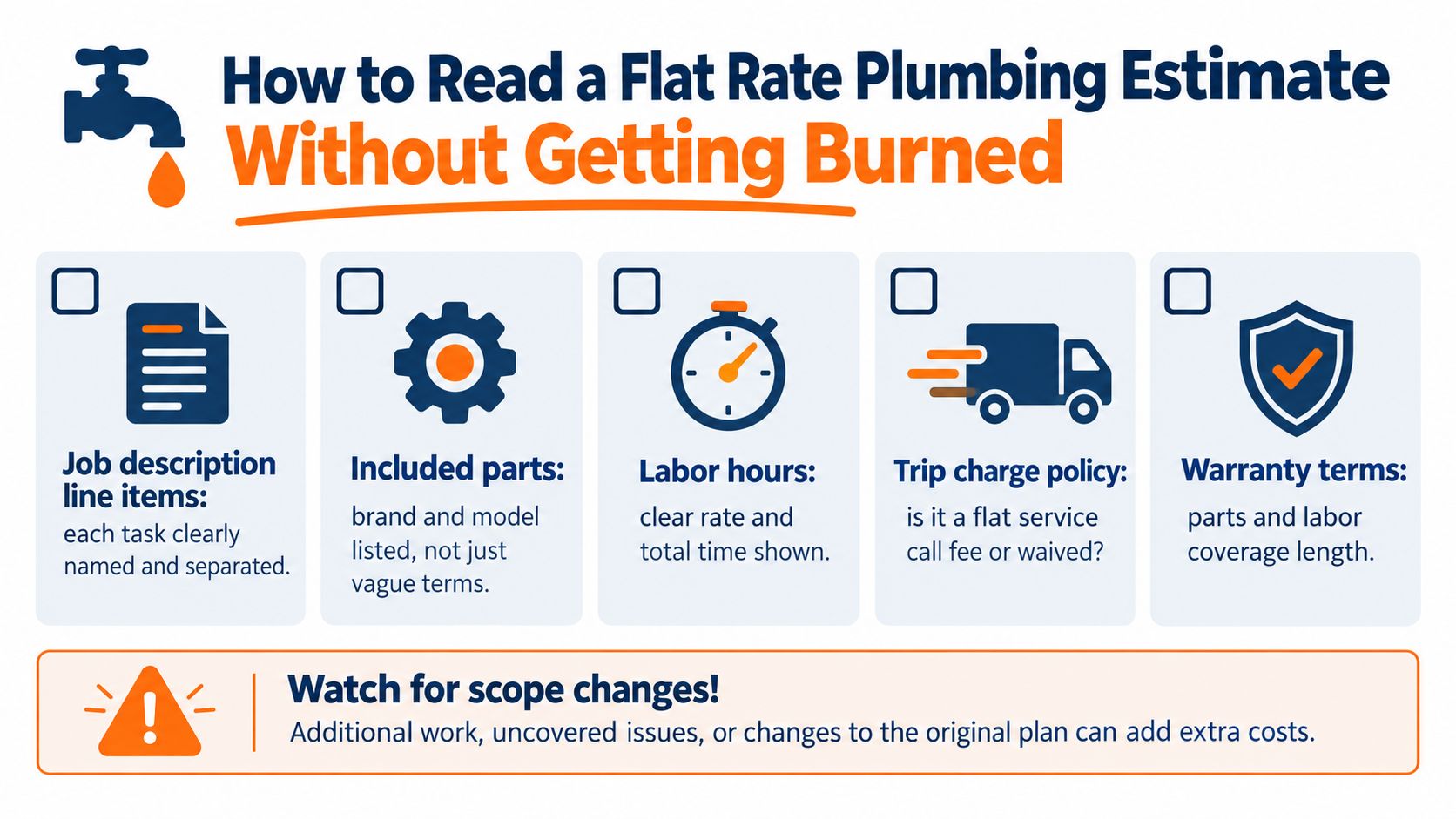
At a minimum, your estimate should show these five things in writing:
- Named job line items: “Replace toilet” is better than “bathroom repair.”
- Included parts: Brand, model, and key accessories when possible.
- Labor treatment: Whether labor is built into the flat rate and whether the service call is separate or applied to the repair.
- Trip or diagnostic policy: Is the initial charge waived if you approve the repair?
- Warranty terms: Parts and labor should be addressed separately if the company offers both.
The red flags I'd push back on immediately
If you see any of these, stop and ask questions before approving anything:
- “Miscellaneous materials” with no explanation: That line gets abused constantly.
- No fixture model listed: If they're installing a faucet or toilet, the quote should tell you what you're buying.
- No disposal language: Old toilets, heaters, and disposals don't vanish for free.
- Permit silence on permit-type work: If the job may trigger permit or code issues, the estimate shouldn't pretend otherwise.
- No exclusions: Every real flat rate has assumptions behind it.
Ask this exact question: What is not included in this price?
That one sentence exposes weak estimates fast. A good technician answers directly. A weak one talks around it.
How to compare two quotes fairly
Don't just compare the bottom line. Normalize the estimates.
First, check whether both plumbers are quoting the same fixture quality and the same scope. One might include haul-away and a new supply line, while the other does not. One may include diagnostic time, while the other adds it later.
Then compare the structure:
| Estimate Check | What You Want |
|---|---|
| Scope | Clear task description |
| Parts | Brand or model listed |
| Fees | Service call, permit, and disposal addressed |
| Change terms | Written re-approval language |
| Warranty | Specific coverage terms |
For a homeowner-level guide to what a proper written estimate should help you understand, this LA plumbing estimates article is worth reading before you sign anything.
What Happens When the Job Changes Mid-Way
This is the part most plumbing articles skip. It's also where people feel cheated.
A flat rate quote is supposed to lock the price once approved. Strong customer-facing explanations of flat rate pricing note that these quotes usually include parts, labor, diagnostic time, and sometimes warranty, and that the price is locked after approval. What they don't explain well is the gray area that matters most to homeowners: hidden corrosion, code violations, and access issues that show up only after the work starts (Roto-Rooter overview of flat rate pricing).
Legitimate scope changes
These are real. They happen.
- A toilet comes off and the flange is cracked or rotten
- A shutoff valve won't isolate and now the repair needs a stop replacement first
- A new water heater triggers code upgrades that weren't visible until the install is verified
- The line is inaccessible without additional removal work
Those are not upsells. Those are changed conditions.
Manufactured upsells
You should get tough.
- The plumber quotes low, starts work, then claims “standard materials” never included the obvious parts needed to finish.
- The technician suddenly pushes unrelated upgrades that don't block the repair.
- The company uses vague fear language instead of showing you the issue.
If the added work doesn't directly prevent completion of the approved repair, it's not a scope change. It's a separate recommendation.
What to demand before extra work starts
Use this language: “Stop work and write the change order. Show me what changed, why the original price no longer applies, and what my options are.”
You want three things in writing:
- Original approved scope
- New condition discovered
- Revised price before additional work begins
If they can't produce that clearly, don't approve the add-on on the spot. A professional company pauses and re-approves. A sloppy one keeps moving and explains the bill later.
When Flat Rate Pricing Is the Smart Move for Homeowners
Flat rate isn't automatically better. It's better when the job is repeatable, visible, and easy to define before work starts.
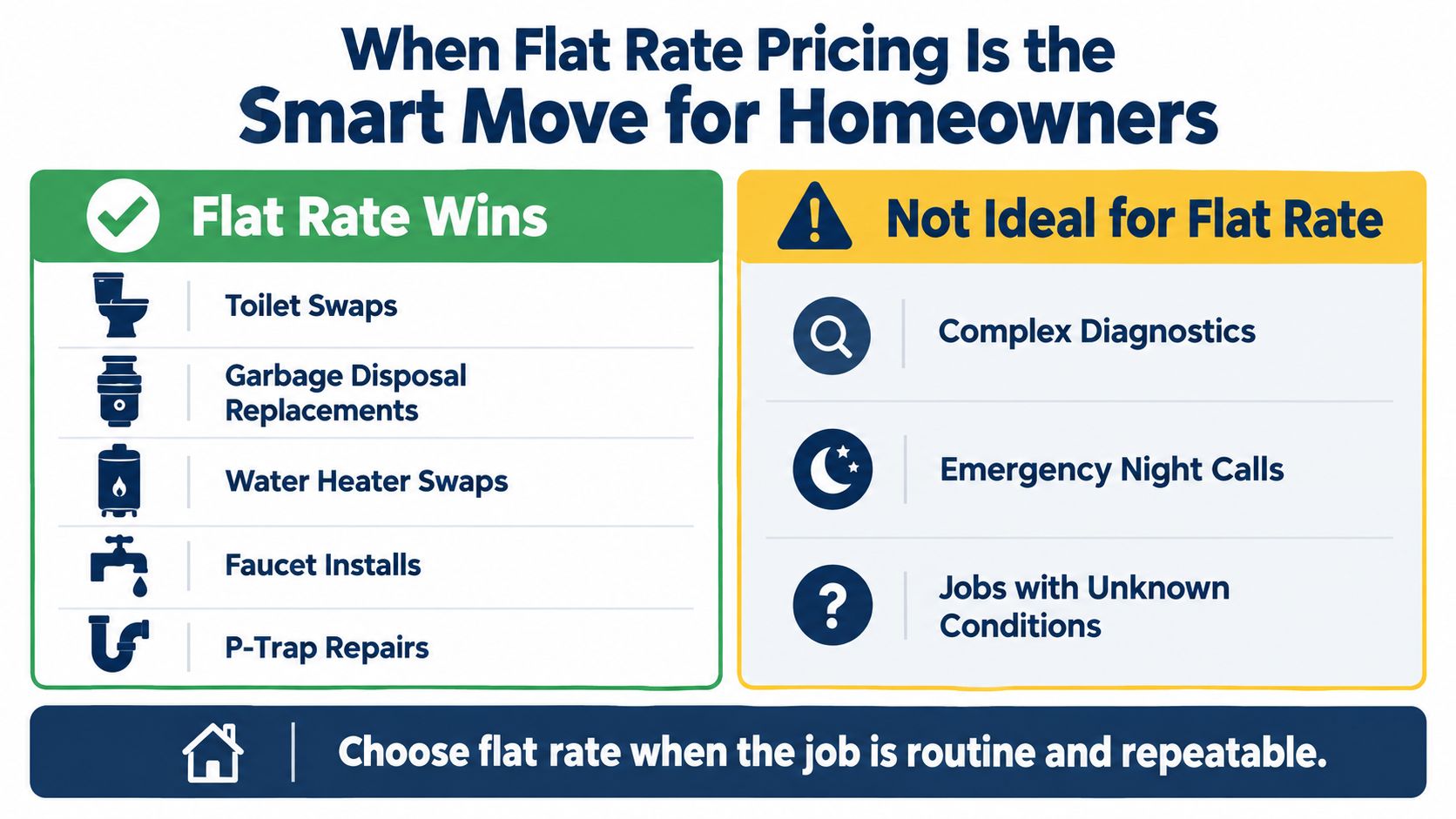
That includes a lot of everyday service work in Los Angeles. Toilet swaps, faucet installs, garbage disposal replacement, angle stop replacement, standard drain clearing, and many water heater swaps fit the model well. If the plumber does that same task every week, they should be able to price it cleanly.
Where flat rate wins
For homeowners and property managers, flat rate is the smart move when:
- The task is routine: Toilet replacements, faucet installs, P-trap repairs, disposal swaps.
- You need budget certainty: You want approval control before any work starts.
- You're coordinating access: Tenants, HOA rules, parking windows, and lockbox entry all favor cleaner dispatch and faster quoting.
- You're managing repeated service tickets: Multi-unit properties often benefit when common repairs are pre-priced.
Where it doesn't fit well
There are jobs where a fixed price can become fake confidence:
- Complex diagnostics
- Emergency night calls where conditions are still unclear
- Jobs with concealed damage or unknown access
- Exploratory sewer or leak investigation work
Here's a quick visual summary before you decide which billing model to accept.
My LA-specific recommendation
If you own a single-family home and the issue is visible and common, insist on flat rate first. If you manage multiple units in Koreatown, Mid-City, Pasadena, or DTLA, ask for a flat rate schedule for recurring service calls and a separate process for unknown-condition work. Don't accept the hybrid trap where the company quotes flat rate for the easy part and flips to hourly the second the job gets inconvenient.
That structure usually protects the contractor more than it protects you.
Your Quick Checklist Before You Approve Any Flat Rate Quote
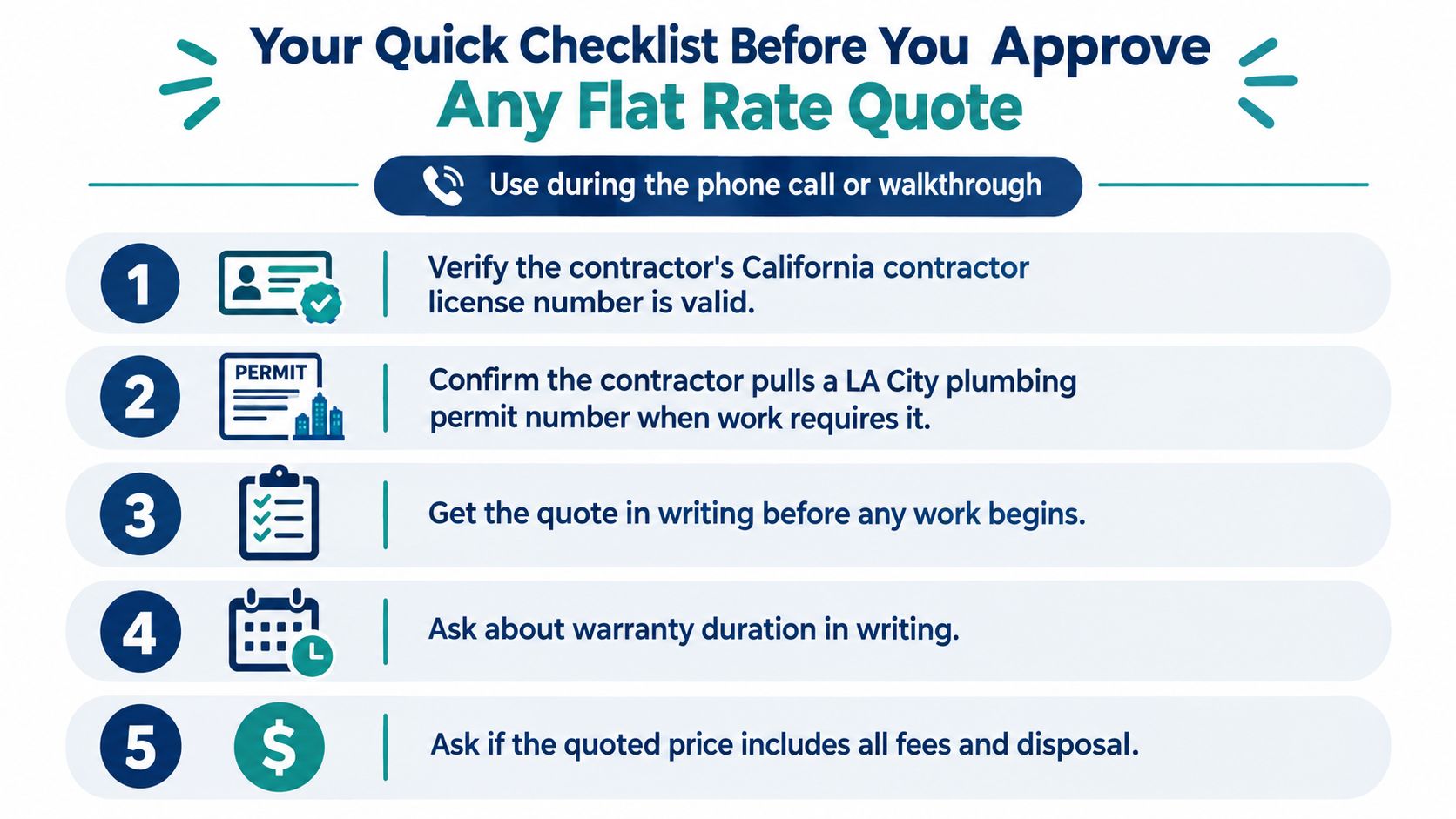
This is the list I'd keep open on my phone during the call or walkthrough. It's simple, and it catches most of the nonsense before it turns into an invoice fight.
The five checks that matter most
- License first: Ask for the California contractor license number before work begins. Don't skip it.
- Permit clarity: If the work may require a permit, ask who pulls it and whether permit handling is included in the quote.
- Written approval only: Never approve a flat rate verbally if the scope isn't written down.
- Warranty in plain language: Ask how labor coverage differs from manufacturer parts coverage.
- All fees disclosed: Disposal, trip charge, after-hours pricing, and access-related extras should be addressed before the work starts.
Questions that expose weak quotes fast
Ask these directly:
- What exactly is included in this price?
- What specific condition would cause this price to change?
- Are disposal, haul-away, and trip charge included?
- What parts brand and model are you installing?
- Will you stop and get written approval before any added work?
Those five questions do more work than another three quote requests.
Extra checks for LA property managers and HOAs
If you're not managing one house but a building or portfolio, add three more:
- Response time expectations: Don't assume “priority service” means anything unless it's written.
- Per-door or per-visit pricing: The billing basis needs to be clear on multi-unit work.
- Separate common-area pricing: Boiler-room, recirc, and shared-system work often needs a different pricing structure than in-unit calls.
The one thing never to sign
Never sign a blank authorization form. Never sign a work order that says the final price will be determined later unless you've intentionally agreed to hourly or exploratory billing. Once that paper is signed, the dispute gets harder.
Bottom line: Flat rate pricing for plumbers works best when the company defines the job, writes the scope clearly, and commits to re-approval before any change.
If you want a practical homeowner list you can use alongside this one, read these questions to ask a plumber before hiring. It helps you screen whether the company is organized before they ever step through the gate.
If you want upfront pricing without the usual guessing game, EZ Plumbing provides written plumbing quotes for Los Angeles homes, HOAs, and property managers, including standard service work where flat rate pricing makes sense. If you need a second opinion on a quote or want a technician to explain what's included before work starts, visit EZ Plumbing.