
How Much Does Sewer Line Repair Cost in Los Angeles
A sewer line replacement averages $3,319 nationally, with typical homeowner costs between $1,388 and $5,323. At $60 to $250 per linear foot, a 40-foot line can land around $2,000 to $10,000 or more before restoration, depending on access, excavation, and pipe material.
You may be asking because the toilet backed up overnight, several drains turned slow at once, or a camera inspection found roots, cracks, or a collapsed section. In Los Angeles, the number on the estimate can feel disconnected from the length of pipe in the ground. Two homes may have similar sewer laterals, but one line runs through open soil while the other passes beneath a driveway, mature landscaping, or a narrow side yard.
That's why “how much does sewer line repair cost” doesn't have one dependable answer. The work might involve clearing a blockage, repairing one damaged section, lining an existing pipe, or excavating and replacing the entire run. Permits, access pits, equipment, labor, and surface restoration can matter as much as the pipe itself.
This guide breaks the estimate into understandable pieces, compares trenchless and open-cut methods, and gives you a practical way to judge whether a quote reflects the actual conditions at your property. If you're preparing estimates for several properties or need a consistent way to organize labor and material assumptions, Exayard plumbing estimating software can help structure the numbers before the work begins.
Table of Contents
- Introduction What Los Angeles Homeowners Actually Pay
- Understanding What Sewer Line Repair Really Means
- Complete Cost Breakdown From Diagnostics to Restoration
- Key Factors That Influence Your Final Price in Los Angeles
- Comparing Trenchless and Open Cut Repair Methods
- How to Get an Accurate Quote Timeline and Insurance Tips
- Making a Confident Decision and Next Steps With EZ Plumbing
Introduction What Los Angeles Homeowners Actually Pay
A homeowner in Los Angeles often notices the problem in stages. The kitchen sink drains slowly, then the downstairs toilet gurgles, and later a sewage smell appears near the front yard. By the time wastewater backs up, the question changes from “Can this wait?” to “How much will this cost, and what am I paying for?”
A national benchmark places average sewer line replacement at $3,319, with a typical range of $1,388 to $5,323, according to HomeAdvisor's sewer main repair cost guide. The same benchmark cites $60 to $250 per linear foot, with an average near $150 per linear foot. That per-foot range helps explain why a 40-foot line can move into the $2,000 to $10,000 range before difficult access or restoration changes the invoice.
Those figures are planning references, not promises. A short, accessible failure may need only a localized repair. A longer line beneath a concrete driveway may require excavation, permits, disposal, and rebuilding the surface. Trenchless work can reduce visible digging, but it still requires specialized equipment and access points.
Why neighbors receive different estimates
Think of the sewer lateral as a private road from your house to the public sewer main. A clear, shallow road across open ground is inexpensive to reach. A road buried under concrete, trees, utilities, or a steep hillside takes more time and care, even if both roads are the same length.
The camera inspection is the starting point because it identifies the pipe material, location, and type of failure. Without that information, a contractor can offer only a broad allowance. A useful estimate should tell you whether you're paying for a spot repair, partial replacement, trenchless lining, pipe bursting, or full excavation.
The rest of this guide follows the same path an estimator would use at your kitchen table. First identify the work, then read the invoice line by line, examine Los Angeles-specific cost drivers, compare methods, and ask for a quote that includes restoration rather than leaving it as a surprise.
Understanding What Sewer Line Repair Really Means
A sewer line carries wastewater from your home to the public sewer system. On a typical property, the section between the house and the city connection is the private sewer lateral, while the larger pipe in the street is the city main. Responsibility depends on the location and local rules, so don't assume every problem under the street belongs to the homeowner or that every problem in the yard belongs to the city.
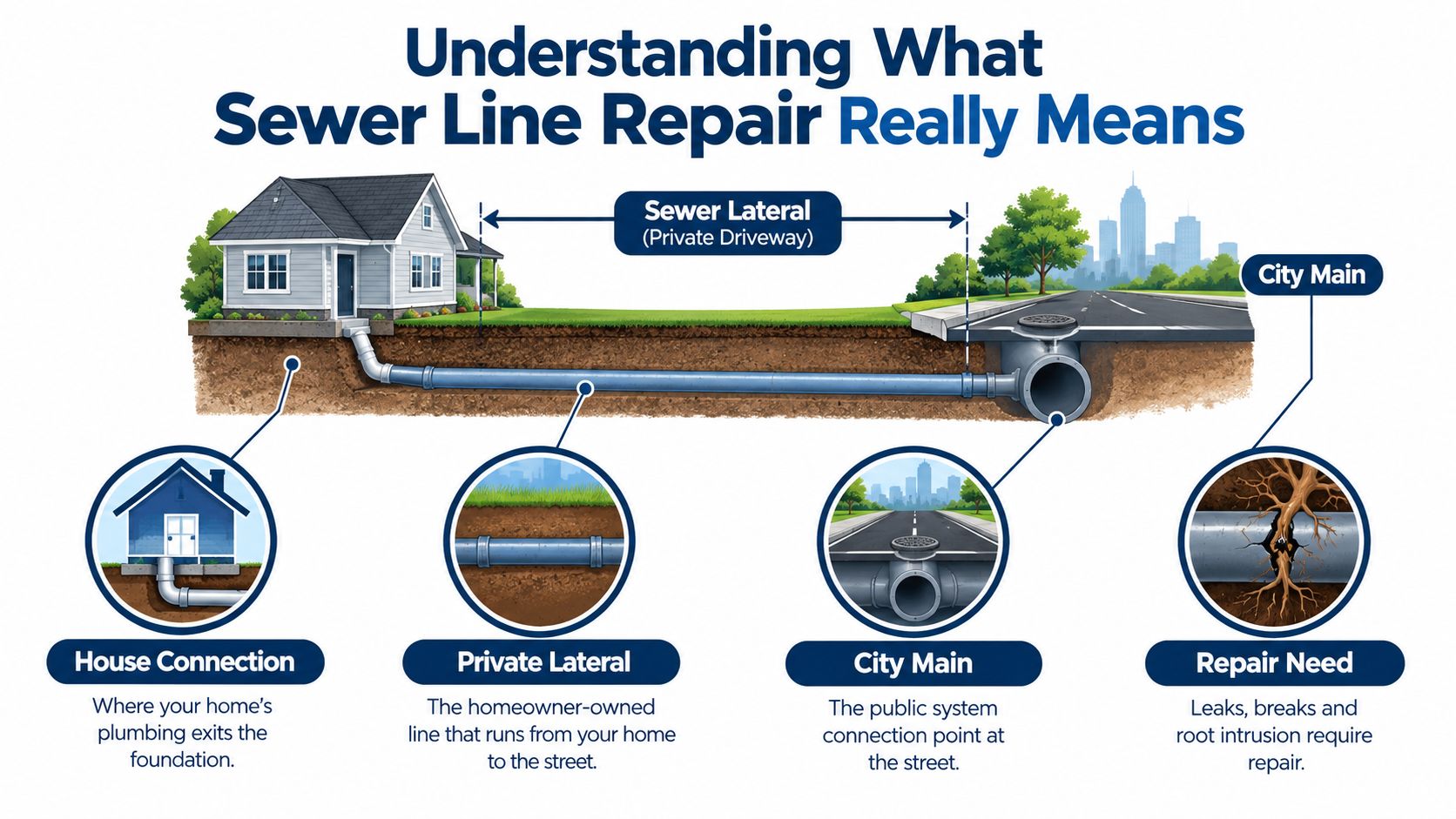
A simple analogy helps. Your home is connected to the city main by a private driveway. If one pothole appears near the garage, a contractor may repair that section. If the driveway has failed in several places, resurfacing or rebuilding the entire route may make more sense.
The main types of sewer work
- Cleaning: A plumber removes grease, debris, or roots that are blocking flow. Cleaning can restore drainage without repairing the pipe, but it won't correct a cracked or collapsed line.
- Spot repair: The contractor reaches one damaged section and replaces or repairs only that area. This can be sensible when the rest of the pipe is structurally sound.
- Partial replacement: Several affected sections are replaced while usable portions remain in place. The camera findings and pipe material usually determine whether this is practical.
- Full replacement: The entire private lateral is replaced because the pipe has widespread deterioration, repeated failures, or a material that no longer provides reliable service.
- Trenchless rehabilitation: A contractor may install a cured-in-place pipe liner, commonly called CIPP, or use pipe bursting to install a new pipe along the existing route. Both methods reduce surface excavation, but neither works for every pipe.
What the camera inspection tells you
A sewer camera can show root intrusion, separated joints, cracks, bellies, obstructions, and collapse. It also helps locate the damaged section from the surface, which matters when a contractor needs to dig only one access point instead of opening the full route.
Ask for the inspection video and a plain-language explanation of the findings. You want to know whether the problem is isolated or recurring, whether the host pipe can support a liner, and whether the proposed repair addresses the cause rather than only the symptom.
Practical rule: Don't compare two sewer quotes until you know whether both contractors are pricing the same scope of work.
Complete Cost Breakdown From Diagnostics to Restoration
A sewer estimate is easier to evaluate when you treat it like a small construction budget rather than a single plumbing charge. Recent 2026 pricing guidance places repairs across a broad range of about $150 to $3,800, while the cited average for replacement is $3,319. It also commonly places per-foot pricing between $50 and $250, which is why an average alone can mislead a homeowner choosing between repair and replacement. Empire Home Protection's 2026 cost guidance also highlights how driveway cuts, landscaping, and deep excavation can expand an otherwise simple project.
What each line item means
| Cost Component | What It Covers | Why It Varies |
|---|---|---|
| Diagnostics | Camera inspection, locating the line, and identifying the failure | Access to cleanouts, blockage severity, and how much of the line needs review |
| Permits and inspections | Required applications, inspections, and possible public right-of-way coordination | Los Angeles requirements vary with the work location and affected surfaces |
| Pipe and fittings | Replacement pipe, connections, cleanouts, liners, or bursting materials | Pipe material, diameter, method, and total length |
| Labor | Skilled plumbing, excavation, installation, testing, and cleanup | Crew size, depth, soil, working space, and project complexity |
| Equipment and mobilization | Excavation machinery, trenchless equipment, pumps, hauling, and disposal | Equipment access, haul distance, and whether specialized machinery is needed |
| Surface restoration | Concrete, asphalt, pavers, soil, plants, or other disturbed finishes | The surface above the line, matching requirements, and restoration scope |
A camera inspection is valuable because it turns an unknown repair into a defined scope. If the contractor can't identify the affected section or explain why the proposed method fits the pipe, the estimate remains provisional. For a closer look at what an inspection should reveal, review this sewer line inspection resource.
Permits can become important when work approaches a sidewalk, street, or other public area. Even when the pipe repair itself is straightforward, the city may require specific inspections or restoration standards. Ask whether permit handling is included, listed separately, or left for you to arrange.
Restoration is where many budgets change
The pipe may be underground, but the bill often reflects what's above it. A front-yard line under bare soil is easier to access than a line beneath a driveway or a carefully maintained yard. Concrete removal, excavation, hauling, replacement, and finish matching can all appear as separate charges.
If a backup has already affected floors, walls, or belongings, sewer repair is only part of the problem. A separate resource on sewage cleanup pricing in Marion County illustrates why cleanup and plumbing repair should be treated as different scopes, even though they may arise from the same incident.
Before approving work, check that the estimate states who handles surface restoration, what materials are included, and whether temporary protection or final cleanup is covered. A low pipe-only quote may not be low after the property is returned to its original condition.
Key Factors That Influence Your Final Price in Los Angeles
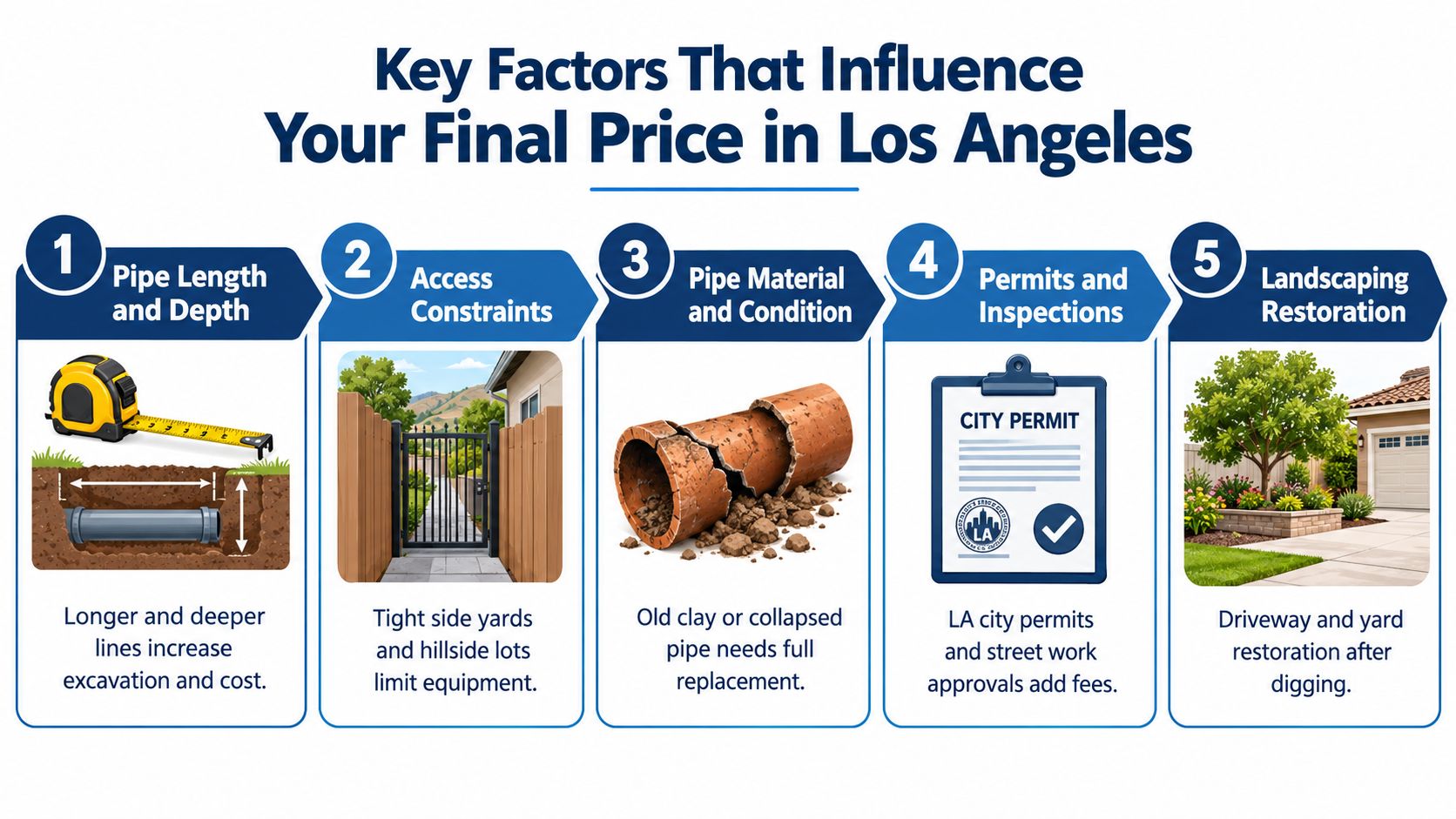
Los Angeles properties create very different working conditions within a small geographic area. A shallow lateral in an open front yard is a different job from a line that runs below a driveway, beside a foundation, or through a narrow hillside lot. The pipe length establishes part of the scope, but access and restoration often determine how difficult the work becomes.
The property conditions an estimator checks
Length and depth affect excavation, material, labor, and restoration. A longer line requires more installation work. A deeper line requires more digging, shoring considerations, spoil handling, and careful access.
Gate width and equipment access can change the method. A compact side yard may not accommodate standard excavation equipment. A contractor may need to move soil manually, create access pits, or recommend trenchless work to avoid opening the entire route.
Pipe material and condition influence whether repair is realistic. A single root intrusion in an otherwise stable pipe may support a targeted repair. A brittle, cracked, or collapsed line may call for replacement, especially when failures appear in multiple locations.
Trees and roots deserve attention in older Los Angeles neighborhoods. Roots can enter joints or cracks, but removing roots alone doesn't restore damaged pipe walls. The estimate should distinguish between clearing the obstruction and correcting the defect that allowed it inside.
Utilities and structures add coordination. Water, gas, electrical, drainage, retaining walls, garages, and foundations can restrict digging. Contractors must expose the line carefully and protect surrounding property.
Scheduled work versus emergency work
An active sewage backup may require immediate containment and a temporary solution before permanent repair. Emergency access can limit your ability to gather comparable quotes or schedule restoration trades. Planned work gives you more time to review the camera footage, compare methods, and confirm what the contractor will rebuild.
HOAs and multi-unit properties add another layer. Access may require notices, coordination with residents, approval for common-area work, and scheduling around occupied units. Property managers should request a scope that separates work inside the private lateral from any shared or public connection.
Sewer pricing has also moved over time. National averages for clearing a clogged sewer line rose from $246 in 2020 to $295 in late 2024, while full replacement rose from $5,054 in 2020 to $6,633 in late 2024, an increase of roughly 31% for full replacement over that period, according to HomeServe's historical cost guide. Those figures don't price your Los Angeles property, but they show why older estimates may no longer reflect current labor and material conditions.
Comparing Trenchless and Open Cut Repair Methods
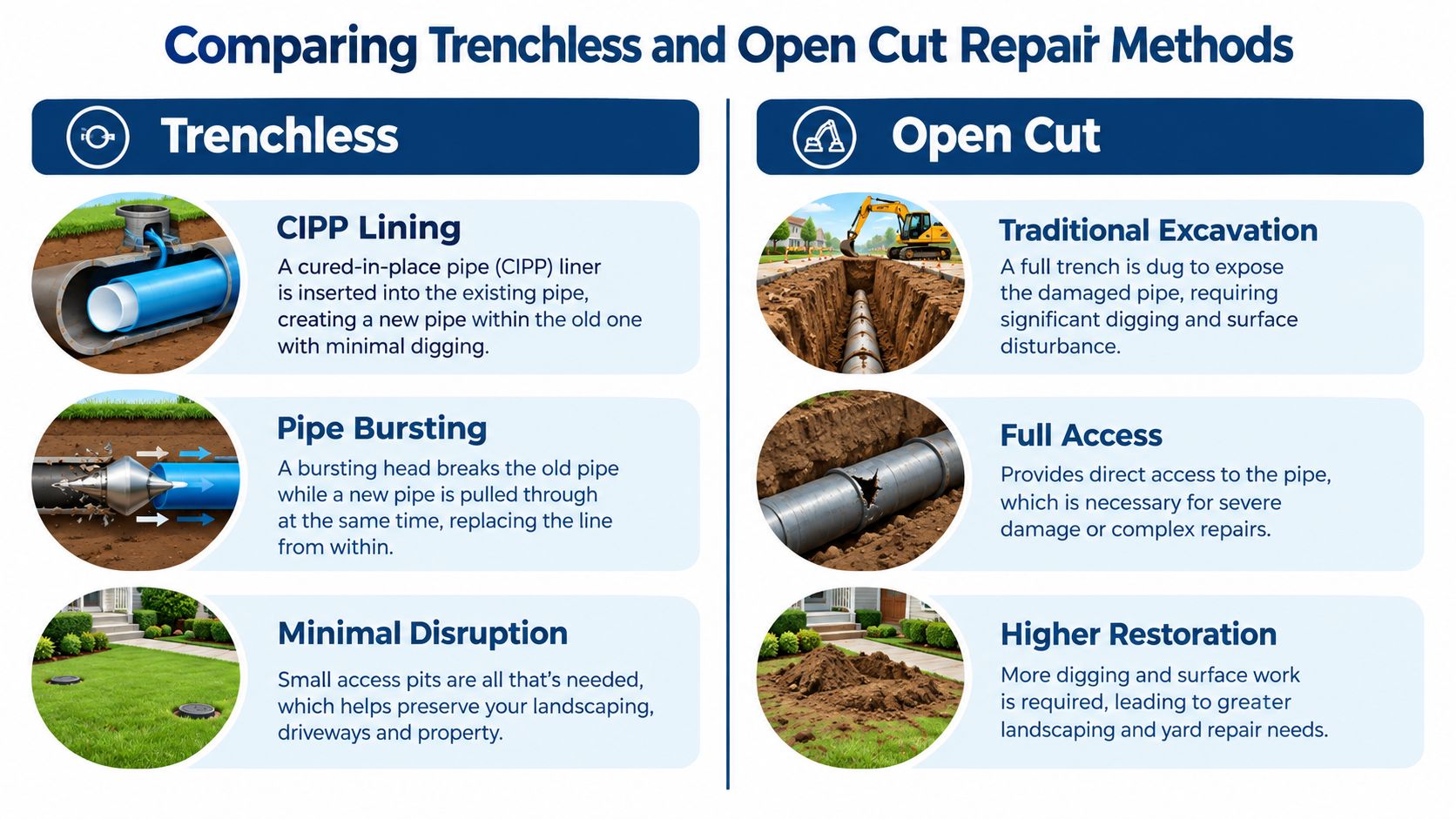
Trenchless and open-cut work solve the same basic problem through different routes. Trenchless methods use limited excavation and specialized equipment to repair or replace the line through access points. Open-cut work exposes the pipe directly by excavating along the route.
Trenchless options
CIPP lining places a resin liner inside an existing host pipe and cures it in place. It can preserve much of the yard or hardscape, but the existing line must have suitable shape, access, and structural conditions.
Pipe bursting breaks the old pipe outward while pulling a new pipe through the established route. It can replace a badly deteriorated line without opening the entire surface, but it needs suitable access pits and a route that the equipment can follow.
Residential pipe lining commonly falls around $80 to $250 or more per linear foot, while pipe bursting or more complex trenchless replacement can run about $100 to $350 or more per linear foot in higher-cost markets, based on trenchless sewer repair pricing guidance. A 40 to 60-foot residential line can therefore reach the several-thousand to low-five-figure range, with one benchmark citing about $4,000 to $15,000 and noting that difficult projects can exceed $20,000 after depth, length, region, and restoration are considered.
For a homeowner, the appeal is often the surface saved rather than a lower pipe-work price. Preserving a driveway or mature landscape can reduce the reconstruction burden, but trenchless installation still involves mobilization, access pits, preparation, and testing.
Open-cut excavation
Open-cut replacement exposes the pipe so the crew can see and address the entire damaged area. It works well when the line has collapsed, the route has poor geometry, the pipe needs a changed grade, or the contractor must correct a problem that lining or bursting can't solve.
The method can be cost-effective on a short run through accessible soil. It may also be the more practical choice when the surface is unfinished and restoration is limited. Its disadvantage appears when the route crosses concrete, asphalt, landscaping, walls, or other finished features.
| Situation | Method that may fit | Main cost question |
|---|---|---|
| One localized defect, stable surrounding pipe | Spot repair | Can a targeted excavation solve the actual defect? |
| Long line beneath finished hardscape | Trenchless lining or bursting | Does avoiding broad restoration offset specialized equipment costs? |
| Collapsed or badly deformed pipe | Open cut or pipe bursting, if feasible | Can the chosen method restore flow and grade reliably? |
| Short line through open soil | Limited excavation | Is full-length trenchless work unnecessary for a small failure? |
The key point is that trenchless isn't automatically cheaper. A short, accessible spot repair may cost less than lining the entire run. Trenchless becomes more compelling when the line is long, difficult to reach, or likely to need repeated repairs, especially when open excavation would disturb expensive surfaces. This overview of trenchless sewer repair can help you understand the method before comparing proposals.
The video below provides another visual explanation of how sewer repair methods differ.
How to Get an Accurate Quote Timeline and Insurance Tips
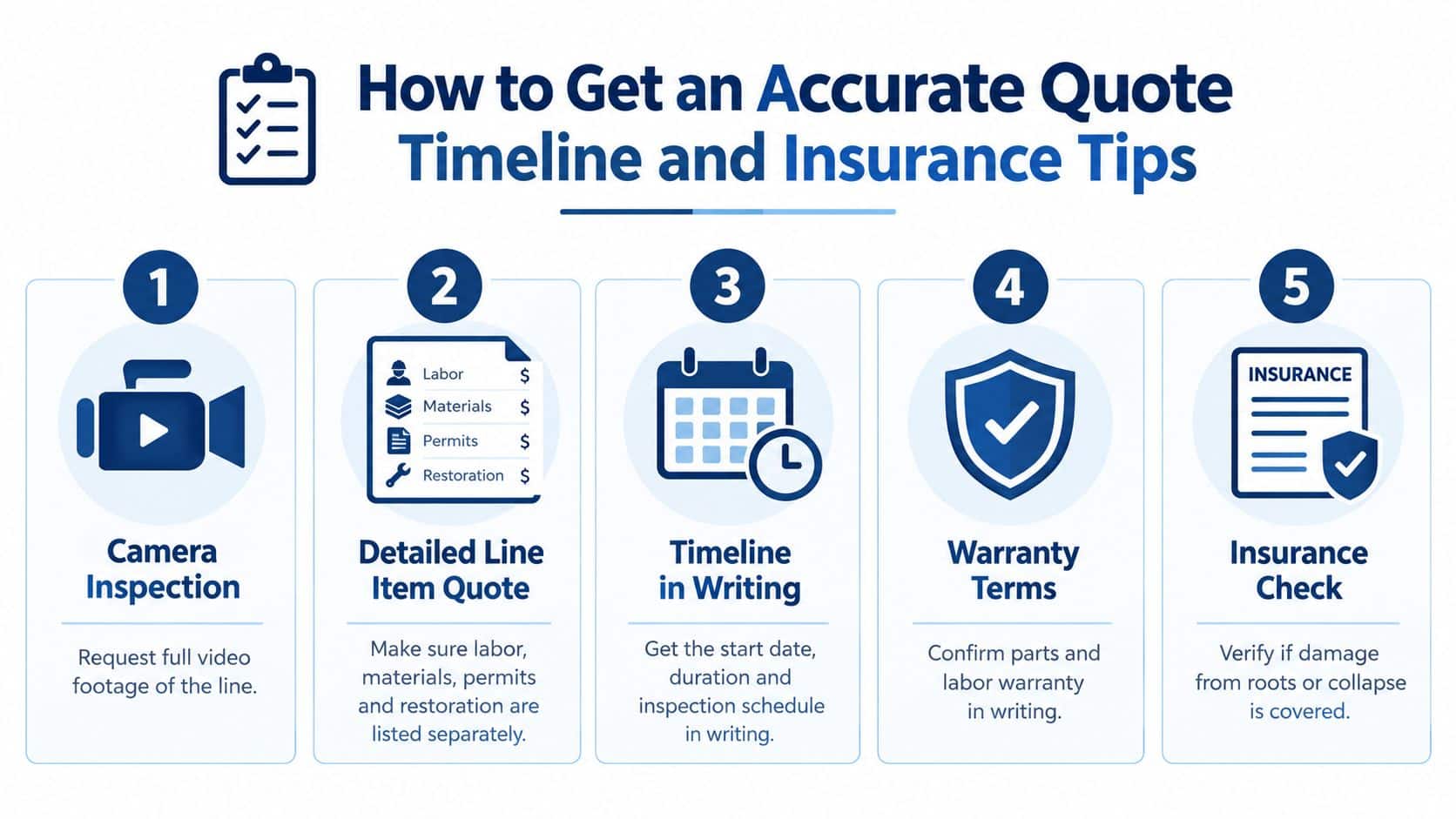
A useful sewer quote should let you compare scope, not just totals. Ask each contractor to inspect the line, identify the damaged location, describe the proposed method, and separate pipe work from restoration. If one estimate includes a driveway rebuild and another stops after backfilling, the lower number doesn't represent the same job.
What to request before signing
- Camera footage and findings: Request the full video when available, along with the location and description of each defect.
- A written method recommendation: The quote should explain why it proposes spot repair, open cut, lining, or bursting.
- A complete line-item scope: Look for labor, materials, equipment, permits, disposal, testing, cleanup, and surface restoration.
- A schedule: Ask when the diagnostic work occurs, when repair begins, how long the active work should take, and when inspections or restoration are planned.
- Warranty terms: Confirm what parts and labor are covered, how long the terms last, and whether exclusions apply to recurring roots or unrelated pipe sections.
Traditional excavation is often presented with a lower per-foot starting point, but restoration can change the total. A benchmark places straightforward excavation and replacement around $100 to $250 per linear foot, rising above $250 per foot when digging is deep, access is tight, or the route crosses driveways, trees, or structures. For a 40 to 60-foot residential line, that can translate to about $8,000 to $20,000 or more before major surface restoration, as described by NuFlow's comparison of traditional and trenchless replacement.
Timeline and coverage questions
Emergency work may begin with stopping active wastewater flow and protecting the home. Planned work allows more time for inspection, permits, method selection, and restoration coordination. Your contractor should distinguish the time needed to diagnose the problem from the time needed to complete permanent repair.
Insurance coverage depends on your policy and the cause of damage. Ask your insurer whether service-line coverage or a related endorsement applies, and don't assume that cleanup, pipe replacement, root intrusion, or surface restoration receive the same treatment. Keep the inspection video, written diagnosis, photographs, invoices, permit documents, and restoration receipts.
For property owners managing a shared building, clarify who owns the affected section and whether the HOA, landlord, tenant, or utility has responsibility. This guide to sewer line repair responsibility can help frame that conversation, but your governing documents and local requirements control the final answer.
Making a Confident Decision and Next Steps With EZ Plumbing
The right decision starts with the camera, not the advertised method. A localized defect in a sound pipe may justify a spot repair. A long line beneath difficult hardscape may favor trenchless work. A collapsed, badly deteriorated, or repeatedly failing line may need full replacement.
Recent guides place trenchless methods such as CIPP lining and pipe bursting around $3,000 to $12,000, while open-cut replacement can reach $6,000 to $25,000 or more, but those ranges still depend on pipe condition and restoration. Recent sewer repair cost guidance also supports the practical distinction that a short, accessible failure may be cheaper to repair locally, while trenchless work becomes more attractive for long or hard-to-reach lines.
Use this decision check at the kitchen table:
- Choose spot repair when the camera shows one isolated failure and the surrounding pipe remains reliable.
- Consider trenchless work when the route is long or difficult to excavate and the pipe's condition and geometry support lining or bursting.
- Consider open-cut replacement when the pipe has collapsed, needs grade correction, or cannot support a trenchless method.
- Demand a restoration scope whenever the line runs beneath a driveway, sidewalk, patio, landscaping, or structure.
The lowest upfront number isn't always the lowest total cost. Compare the complete project, including access, permits, testing, cleanup, and the surface you'll need to live with after the crew leaves.
EZ Plumbing provides sewer line diagnostics, camera inspections, repair, and replacement support for Los Angeles homes, HOAs, property managers, and commercial properties. Visit EZ Plumbing to request a camera inspection and same-day estimate, with the proposed method and restoration scope explained before work begins.