
Hydro Jetting Sewer Line Explained and When to Use It
A slow kitchen sink is annoying. A slow kitchen sink, a gurgling toilet, and a shower that backs up on the same day point to something more serious. Many Los Angeles homeowners call a plumber, get the line opened with a drain snake, and feel relieved, only to face the same problem again later.
That pattern usually means the technician created a passage through the blockage but left buildup on the pipe walls. Hydro jetting sewer line service takes a different approach. Instead of making a narrow opening, it uses directed water to clean the inside of the line, provided the pipe is strong enough and the equipment is set correctly.
This guide will help you decide when hydro jetting makes sense, when snaking is the better first move, why a camera inspection protects older Los Angeles homes, what affects the price, and what to ask before hiring a contractor. For broader prevention ideas, homeowners can also review this guide to why sewer line maintenance matters for homeowners.
Table of Contents
- Introduction Why Sewer Lines Keep Clogging Again
- What Hydro Jetting Is and How It Cleans Pipes
- Hydro Jetting Versus Snaking and Other Alternatives
- Signs Your Sewer Line Needs Hydro Jetting
- How the Hydro Jetting Process Works Step by Step
- Cost Safety and How Often to Schedule Service
- Hiring a Qualified Hydro Jetting Contractor in Los Angeles
Introduction Why Sewer Lines Keep Clogging Again
A recurring sewer problem may begin with a small change. The bathroom sink drains more slowly, the toilet gives a hollow gurgle after the washing machine runs, and later water rises in the shower while another fixture is in use.
A snake can restore flow quickly, especially when one fresh obstruction is the likely cause. It may, however, leave grease, mineral scale, sludge, or root growth attached to the pipe walls. Those deposits continue catching debris, so the line appears repaired while the same restriction remains.
Los Angeles homes need a careful diagnosis because buried sewer laterals may run near mature tree roots. Older properties may also have clay or cast iron lines with aging joints, corrosion, or other weaknesses. Hydro jetting can remove substantial buildup, but power alone doesn't make a service safe. The technician should inspect the pipe first, then match pressure, water flow, nozzle style, and operating technique to its condition.
A camera inspection works like checking the inside of a wall before drilling. It can show whether the problem is removable buildup or a damaged section that needs a different response. That step matters especially in older Los Angeles homes, where aggressive cleaning may expose an existing weakness rather than solve it.
The U.S. EPA describes hydro jetting as “the most popular cleaning method for gravity sewers” and “widely used throughout the world” in its wastewater collection-system guidance (U.S. EPA technology review). The method has an established role, but that does not mean every residential line needs it. The pipe's condition and the type of blockage should guide the decision.
For practical prevention context, review why sewer line maintenance matters for homeowners. The key distinction is simple: clearing a path restores flow, while properly matched jetting cleans more of the pipe interior.
What Hydro Jetting Is and How It Cleans Pipes
A sewer line may start draining again after a blockage is opened, yet grease, scale, or sediment can still cling to its walls. Hydro jetting cleans that interior with controlled water flow. It works like pressure washing inside a pipe, but the technician controls the equipment from an access point rather than standing inside the line.
The system has four working parts:
- Water: Provides the stream that loosens grease, sediment, scale, and other deposits.
- Pump: Creates the pressure needed to move water through the hose and nozzle.
- Hose: Carries water into the sewer line and lets the technician position the nozzle.
- Nozzle: Directs angled jets that move the tool forward, scour the pipe walls, and flush loosened material toward an access point.
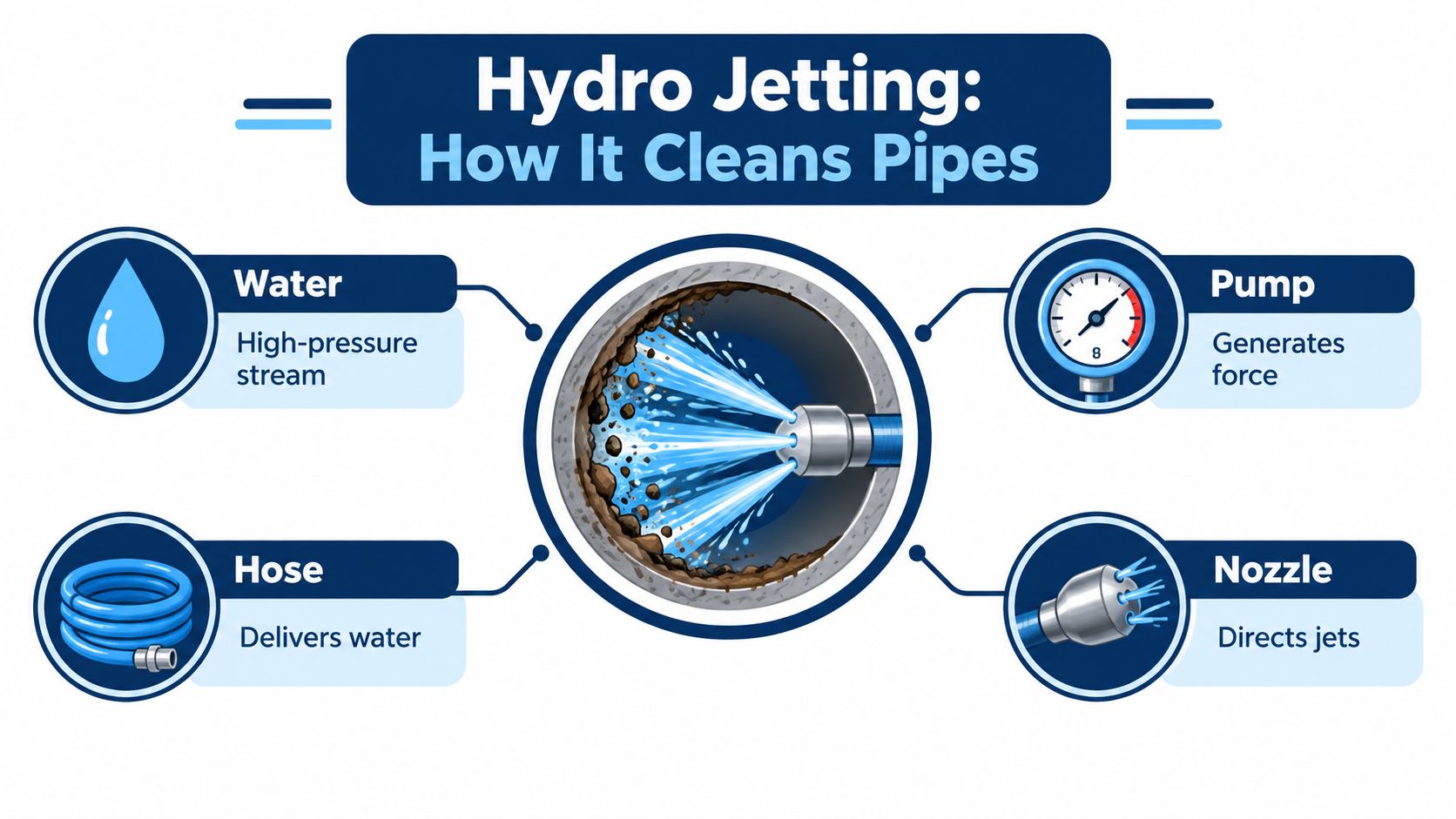
How the cleaning action works
A drain snake uses a rotating cable and cutting head. It can break a path through a blockage, while hydro jetting directs water at both the obstruction and nearby pipe surfaces. The result is a cleaning action that can reach more of the pipe's interior circumference.
The EPA technology appendix describes jetting as directing a high-pressure water stream at blockage or debris inside the pipe (EPA technology appendix). With the right nozzle and settings, the water can loosen grease and sediment, rinse away residue, and help address root intrusion when the pipe can safely withstand the work.
Equipment size varies with the line and the access available. Compact machines suit smaller drains, while larger tanker-jetters serve major collection systems, as described in EPA collection-system guidance. The same basic method can therefore be adapted for residential, commercial, and municipal piping.
Pressure is only one part of the system. Older equipment histories record pressures up to 2,000 psi, and more advanced jet-stream systems have reached up to 5,000 psi (EPA technology appendix). Those figures show equipment capability, not a target for a Los Angeles home. A careful technician matches pressure, water flow, nozzle design, and movement speed to the pipe's condition, using the lowest effective combination rather than treating maximum pressure as the goal.
Hydro Jetting Versus Snaking and Other Alternatives
The simplest way to compare the methods is to ask what remains after water starts flowing again. Snaking usually opens a route through a clog. Hydro jetting is intended to clean deposits from the pipe wall and flush loosened material out of the line.
That distinction matters with a kitchen line coated in grease or a sewer lateral affected by sediment and roots. A snake may be appropriate for a localized obstruction near one fixture, especially when the pipe is fragile or the cause is still unknown. Hydro jetting becomes more useful when the same line repeatedly slows or backs up because buildup continues to narrow the passage.
| Feature | Hydro Jetting | Drain Snaking |
|---|---|---|
| Primary action | Uses directed water streams to scour the pipe interior and flush debris | Uses a rotating cable to break through or retrieve an obstruction |
| Best fit | Recurring blockages, grease, scale, sediment, and suitable root intrusion | A single localized clog or a line that needs an opening restored |
| What may remain | Structural defects and severe pipe damage still require repair | Wall buildup can remain after the channel is reopened |
| Main trade-off | Requires careful equipment selection and a sound pipe | Usually offers a narrower cleaning action |
| Inspection need | Camera inspection is especially important before high-pressure cleaning | Diagnosis is still useful, particularly with recurring problems |
Choosing the least aggressive effective option
Chemical drain cleaners aren't a substitute for diagnosing a sewer-line problem. They may not reach a distant restriction, and repeated use can create handling and pipe-material concerns. Mechanical cutters, augers, and specialty tools may make more sense for a discrete obstruction or a line that can't safely accept jetting.
The decision also depends on access and the kind of debris involved. A contractor may recommend snaking first, camera inspection first, repair first, or hydro jetting after inspection. A useful overview of related exterior maintenance is available through Cultivate House Detailing gutter tips, which helps clarify how drainage concerns can extend beyond the buried sewer line.
For a more focused comparison of the two primary methods, see hydro jetting versus snaking. The practical question isn't whether hydro jetting is more powerful. It's whether the pipe needs a thorough cleaning and can safely receive it.
Decision rule: If the problem is a one-time obstruction, start with diagnosis and the simplest suitable tool. If the problem is recurring wall buildup, ask whether a camera-guided cleaning would address the cause.
Signs Your Sewer Line Needs Hydro Jetting
A single slow sink doesn't automatically point to the main sewer line. The pattern across the property tells you more than one fixture's behavior.
Multiple fixtures backing up at once often suggest a restriction farther downstream. Slow drainage throughout the house can indicate that the main line is losing capacity, while a foul sewage odor may point to accumulated organic material, a damaged section, or a leak. Gurgling after flushing or draining happens when water and air move around a restriction instead of traveling freely.
Los Angeles conditions can add pressure to an already aging system. Mature trees may send roots toward joints or cracks, and older clay or cast iron pipes may have scale, corrosion, offset joints, or other conditions that change the risk calculation. These clues don't prove hydro jetting is appropriate, but they justify a professional diagnosis rather than repeated spot clearing.
Patterns that deserve a camera inspection
Look for combinations rather than isolated symptoms:
- Recurring backups: The same line blocks again after it has been cleared.
- Whole-house slowdown: Several drains respond poorly at the same time.
- Persistent odors: Sewage smells return after routine cleaning or trap checks.
- Gurgling sounds: Toilets or drains make noise when another fixture releases water.
- Unusual yard changes: A lush patch or wet area near the sewer route may deserve investigation.
- Pest activity: Rodents or insects near a suspected sewer leak can add another warning sign.
Guidance for exterior drain cleaning experts can be useful for understanding surface drainage, but underground sewer symptoms need a plumber who can inspect the actual line.
The inspection step matters most when the pipe is old, the access point is uncertain, or previous work has revealed damage. Independent operator guidance warns against blind jetting, and it recommends matching pressure and nozzle selection to CCTV findings (operator guidance on hydro jetting). If the camera shows a collapse, severe corrosion, or a disconnected joint, cleaning isn't the primary repair. The line may need stabilization, repair, or replacement instead.
How the Hydro Jetting Process Works Step by Step
A professional visit should feel controlled, not improvised. The technician needs to identify the access point, understand the blockage, inspect the pipe, select a suitable nozzle, and verify the result.
1. Locate a usable access point
The technician may work through a sewer cleanout or another appropriate opening. Access affects how far the hose can travel, how debris exits, and whether the line can be cleaned without unnecessary disruption.
2. Inspect the line with a camera
A sewer camera shows whether the restriction is grease, sediment, roots, scale, a foreign object, or structural damage. It also reveals the material and condition of the pipe. This is the point where a careful contractor decides whether jetting is suitable, not after the pump is already running.
3. Match the nozzle and operating envelope
Hydro jetting isn't defined by pressure alone. Municipal and industrial guidance commonly places effective sewer jetting around 100 to 340 bar, approximately 1,450 to 4,930 psi, with low-to-moderate water volumes (European sewer-cleaning guidance). The same guidance notes that 120 bar is usually sufficient for plastics and many pipe materials, while 60 bar can remove soft debris.
Those figures are operating references, not a universal home setting. Nozzle angle, flow, pipe size, material, blockage type, and hose withdrawal speed all affect cleaning performance. A deteriorated line may need a gentler approach, or no jetting at all.
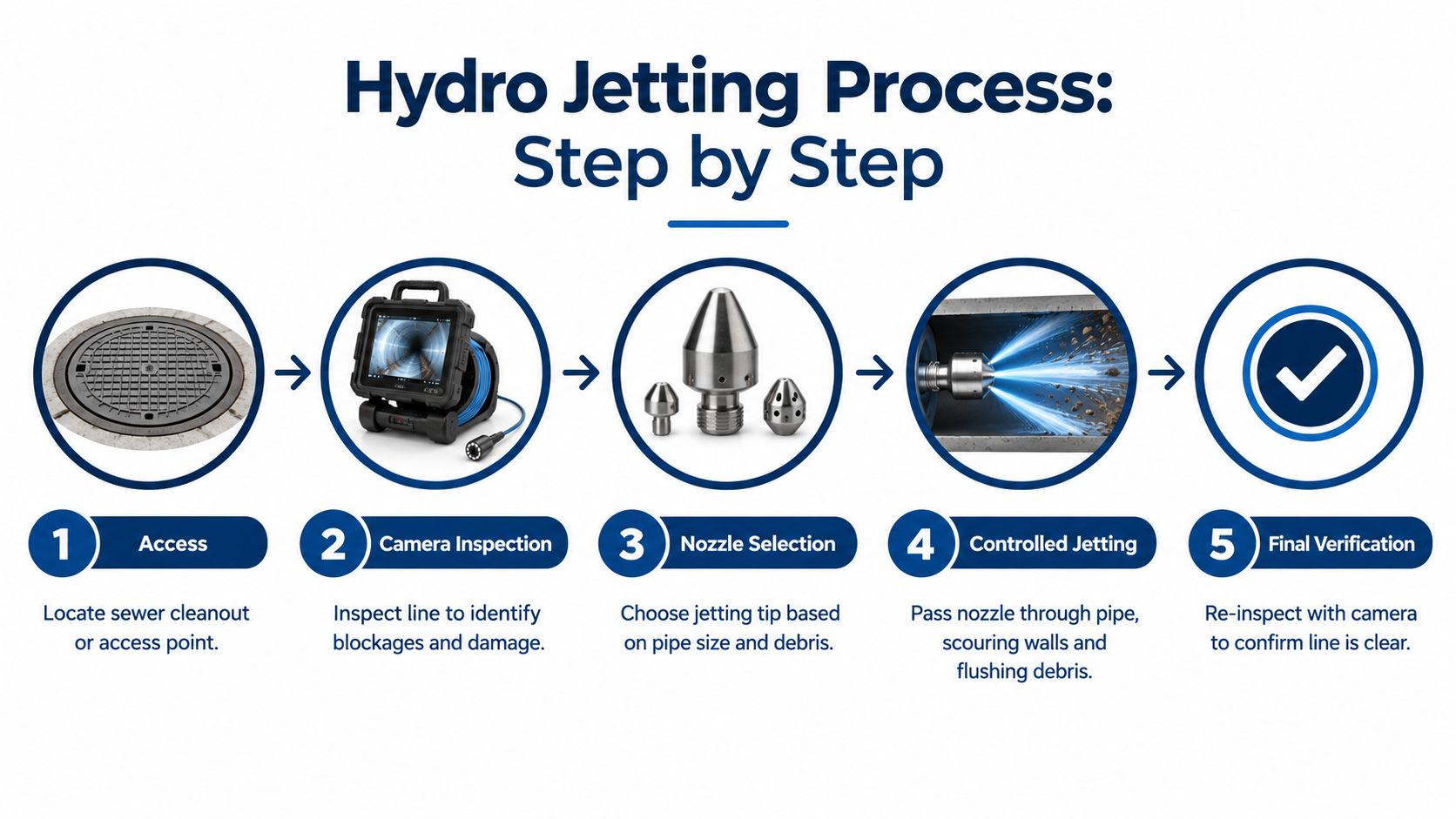
4. Make controlled passes
The nozzle should keep moving. NCPI cleaning guidance summarizes nozzle jet angles from 6° to 90°, stationary dwell times commonly limited to 60 seconds to 5 minutes, and minimum standoff distances as small as 1/4 inch to 1 inch from the pipe wall (NCPI cleaning-method guidance). Sewer-cleansing experiments report nozzle velocity or rewind rates of roughly 100 to 200 mm/s, reinforcing why movement matters.
A moving jet distributes its cleaning action. Holding a powerful stream against one weak location can increase the chance of damage without improving the overall result.
5. Verify and document the outcome
A final camera pass confirms whether the line is open and identifies conditions that cleaning can't correct. Good workmanship includes discussing what the footage shows, how the line was cleaned, and whether future repair or maintenance deserves consideration.
Cost Safety and How Often to Schedule Service
A hydro jetting estimate reflects the whole plumbing job, not only the pump and hose. Access, blockage severity, line length, pipe condition, cleanup, and camera inspection can change the price. A short branch line with an open access point differs greatly from a buried main sewer line with difficult access and heavy root intrusion.
A consumer pricing guide places typical hydro jetting at $350 to $600 on average, with severe clogs reaching $1,200 or more (consumer hydro jetting cost guidance). Use those figures as broad reference points, not as a guaranteed Los Angeles quote. Ask whether the estimate covers inspection, equipment setup, cleaning, post-service verification, and extra access work.
Safety comes before scheduling
Older wastewater infrastructure shows why maintenance matters, but age alone does not determine whether jetting is safe. A camera inspection should guide the pressure, water flow, nozzle, and hose speed. The system must match the pipe's condition, rather than treating maximum pressure as the goal.
If footage shows a collapse, separated joint, or advanced deterioration, repair may be safer than cleaning. Hydro jetting can remove grease, scale, and roots. It cannot rebuild missing pipe walls or reconnect a damaged joint. For technical background on sewer-cleaning methods and system conditions, see the EPA technology appendix.
Frequency depends on the cause
There is no universal calendar for every Los Angeles home. One plumbing source suggests that many homes may benefit from jetting every 1 to 2 years, while also explaining that no fixed schedule applies to every property. The same cost and frequency guidance supports using the interval as a starting point, not a rule.
Your schedule should follow the camera findings and what enters the line. Heavy kitchen grease, recurring root intrusion, older pipe surfaces, and past backups may justify closer monitoring. A clean, structurally sound line without recurring symptoms may not need routine jetting at that interval.
For local options, review drain cleaning services in Los Angeles. A qualified technician can compare the inspection results with your blockage history and recommend cleaning, monitoring, or repair.
Hiring a Qualified Hydro Jetting Contractor in Los Angeles
A qualified contractor should explain the diagnosis before discussing the machine's maximum output. Ask these questions before approving work:
- Will you inspect first: Confirm that a camera inspection comes before high-pressure cleaning when the line's condition is unknown.
- How will you set the equipment: Ask how pipe material, blockage type, nozzle angle, pressure, flow, and hose speed affect the plan.
- What does the estimate include: Request a written breakdown covering access, inspection, cleaning, verification, and possible follow-up repairs.
- Are you licensed and insured: Verify credentials appropriate for the work and property type.
- What happens if the pipe is damaged: A reputable contractor should explain alternatives rather than promising that jetting will solve every sewer problem.
- Can you document the result: Before-and-after camera footage can make the recommendation easier to evaluate.
Los Angeles properties vary widely, from older single-family homes to apartment buildings, HOAs, restaurants, and commercial facilities. Local experience helps a technician account for access limitations, mature landscaping, aging materials, and the practical need to minimize disruption. EZ Plumbing offers camera-guided hydro jetting for blocked drains and sewer lines, along with sewer diagnostics and repair services for residential and commercial properties.
The first call should produce a plan, not pressure. Describe which fixtures are affected, how often the problem returns, whether a snake has already been used, and whether you know the location of a cleanout. Those details help the contractor decide whether an inspection, a simpler clearing method, or a full hydro jetting evaluation belongs first.
EZ Plumbing can inspect your sewer line with a camera, match hydro jetting to the pipe's condition, and explain repair or maintenance options clearly. Visit EZ Plumbing to request service for recurring backups, grease buildup, root intrusion, or persistent slow drainage in Los Angeles.