
Drain Cleaning Los Angeles: A Homeowner’s Guide to Costs &
In Los Angeles, professional drain cleaning usually costs $110 to $345 for common jobs, and the average cost is $227. If the clog is deeper, affects multiple fixtures, or needs hydro jetting because of grease or roots, the price goes up from there.
If you're reading this with a sink full of dirty water, a shower that won't drain, or a toilet making that ugly gurgling sound, you probably want two things right now. You want the water moving again, and you want a straight answer on whether this is a minor clog or the start of a bigger sewer problem.
In LA, it's often the second one. Older pipes, root intrusion, grease, and long-neglected lines turn “simple” clogs into repeat calls. That's why cheap promos can be a bad deal. A low upfront price sounds good until the same drain backs up again next week.
Table of Contents
- That Sinking Feeling A Clogged Drain in Los Angeles
- What to Do Right Now Before Your Plumber Arrives
- Drain Cleaning Methods Explained Snaking vs Hydro Jetting
- Understanding Drain Cleaning Costs in Los Angeles
- Why Los Angeles Homeowners & Property Managers Trust EZ Plumbing
- Get Your Drains Flowing Again Schedule Service Now
That Sinking Feeling A Clogged Drain in Los Angeles
It usually starts small. The kitchen sink takes longer to empty. The tub holds water around your feet. One toilet bubbles when you run the washing machine. Then one morning, water comes back up where it absolutely shouldn't.
That's the moment people panic, and I get it. A clogged drain feels like a small problem right up until it becomes a mess on the floor.
In Los Angeles, these calls often have local causes behind them. Southern California sewer lines deal with tree roots, grease buildup, mineral deposits, and even sagging or collapsing pipe sections. Tree roots are identified as the number one cause of sewer line blockages in Southern California, especially where older clay sewer pipes give roots an easy path to moisture, according to this Southern California drain cleaning cost guide.
Why LA homes get stubborn clogs
A lot of LA housing stock isn't new. Older homes in established neighborhoods often have aging drain systems that have seen decades of cooking grease, soap residue, hair, and paper moving through the same line. Add mature landscaping and shifting soil, and the blockage you notice in one fixture may be a warning from the main line.
A slow drain is annoying. Multiple slow drains at once usually mean the problem is deeper than the fixture.
That's the mistake homeowners make when they reach for the cheapest fix available. If a snake opens a small path through a clog but leaves the buildup on the pipe walls, the relief is temporary. The water may flow for now, but the line still isn't clean.
Don't ignore the pattern
Watch for these signs:
- One drain is slow: Often a local blockage near that fixture.
- Several fixtures act up together: More likely a branch line or sewer issue.
- Gurgling sounds: Air is fighting to move past a restriction.
- Bad odors: Wastewater may be sitting in the line.
- Water backup at the lowest drain: That can point to a main line problem.
If that sounds familiar, treat it as a plumbing issue that needs proper diagnosis, not just quick relief. This is exactly why clearing blocked drains prevents costly damage. Waiting usually means more cleanup, more disruption, and a more expensive repair path.
What to Do Right Now Before Your Plumber Arrives
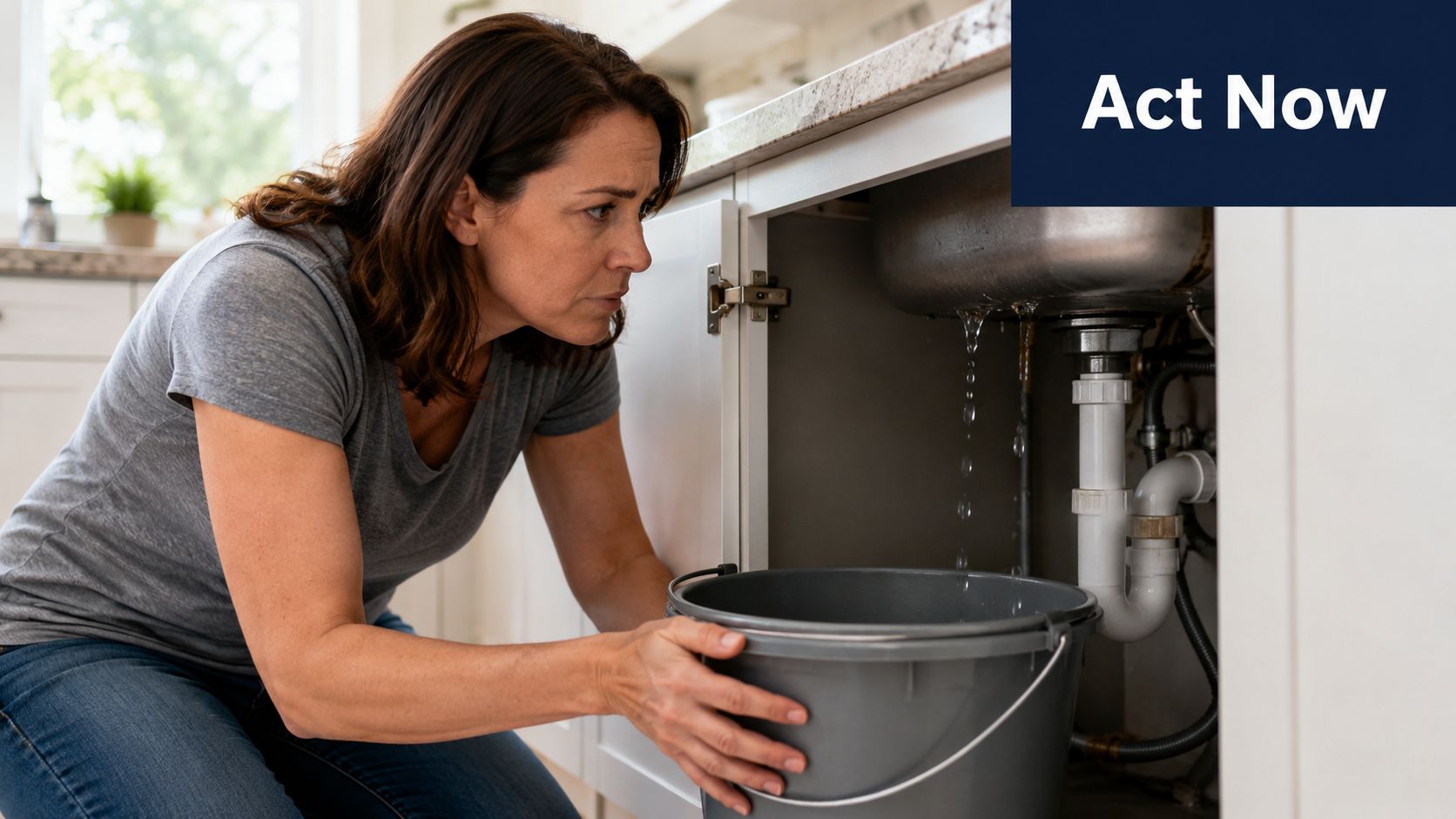
First, stop adding water to the system. Don't keep testing the sink. Don't run the dishwasher. Don't flush “one more time” to see if it clears. If the line is blocked, more water only gives it one place to go, and that's back into your home.
Do these things immediately
- Stop water use in the affected area: If the kitchen line is clogged, keep the sink, dishwasher, and garbage disposal off.
- Shut off fixtures if needed: If water is leaking or backing up fast, isolate the fixture or the home's water supply. If you're not sure where to start, this shut off valve guide gives a clear overview of common valve locations.
- Remove standing water safely: Use a bucket, towels, or a wet vacuum if you have one.
- Move items out of the splash zone: Rugs, toiletries, cleaning supplies, and anything stored under sinks should come out now.
Don't make it worse
A few things cause more trouble than they solve:
- Chemical drain cleaners: They can sit in the pipe, create fumes, and complicate the plumber's work.
- Aggressive plunging on a backup: If the main line is blocked, force can push dirty water out somewhere else.
- Running other fixtures: A laundry drain, bathroom sink, or extra flush can load the same blocked line.
Practical rule: If more than one drain is involved, stop all nonessential water use until the line is checked.
If you can do one more useful thing before help arrives, note what happened first. Did the shower slow down before the toilet gurgled? Did the kitchen sink back up when the dishwasher ran? That sequence helps narrow down where the blockage is sitting.
Drain Cleaning Methods Explained Snaking vs Hydro Jetting
A lot of confusion in drain cleaning Los Angeles comes from one bad assumption. People think all drain clearing is the same. It isn't.
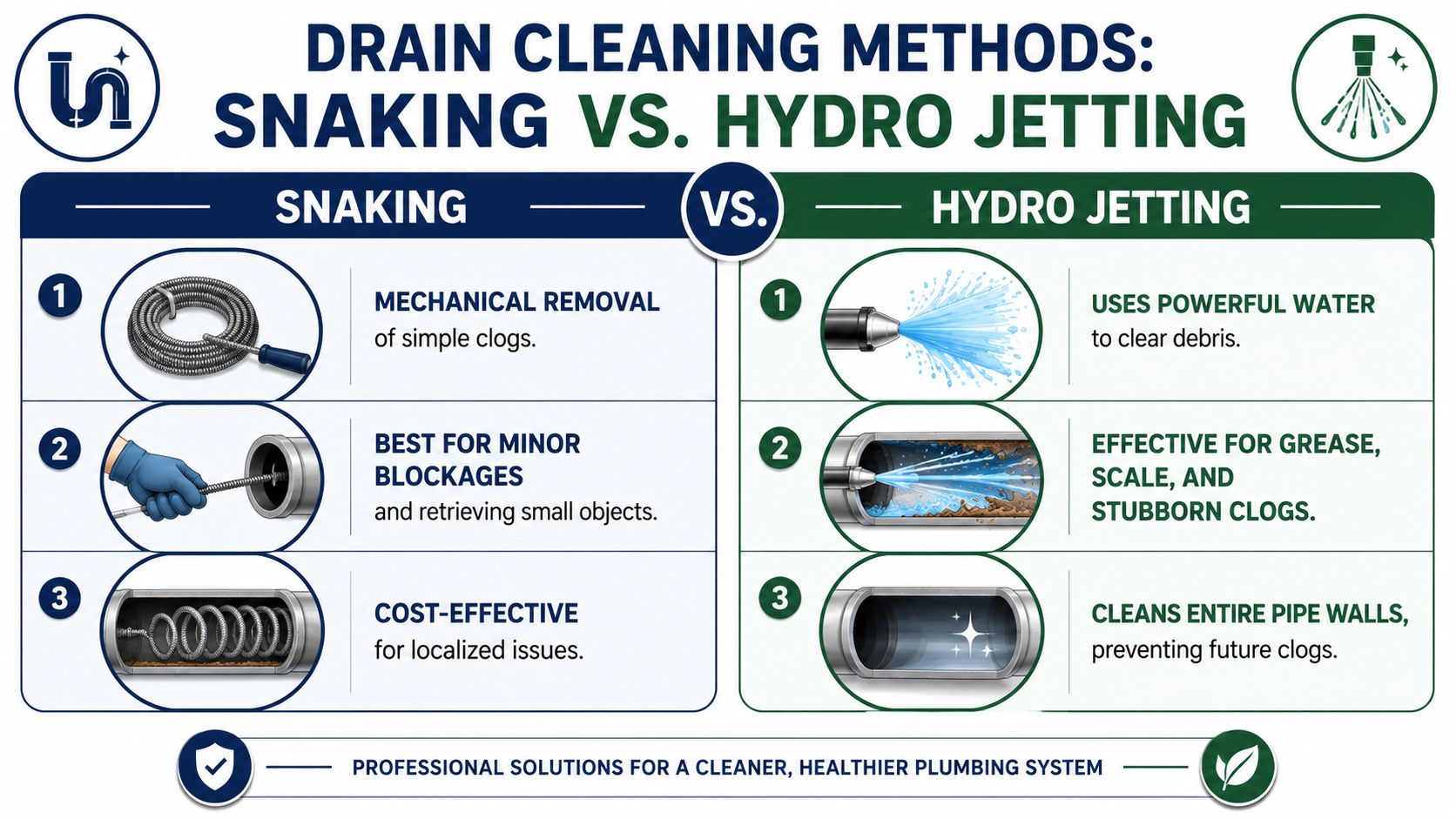
Mechanical snaking and hydro jetting are different tools for different conditions. One opens a path. The other cleans the pipe.
What snaking actually does
A snake, also called an auger, is a mechanical cable fed into the drain to break through or retrieve an obstruction. It's useful for simple clogs. Hair near a tub trap, a wad of paper in a toilet line, or a small local blockage can often be handled that way.
That's why snaking stays common. It's fast, and for the right job, it works.
But here's the problem in older LA properties. According to this Los Angeles drain cleaning page, 68% of LA sewer clogs in properties built before 1950 stem from layered grease and debris that snaking cannot remove. That same source also notes that cheap promo offers often ignore when hydro jetting is necessary.
A snake can punch a hole through buildup and restore some flow. It usually does not scrub the pipe walls clean.
If the clog is caused by years of grease coating the inside of the pipe, snaking is like poking a tunnel through mud.
For homeowners trying to understand the difference before approving work, this homeowner's guide to hydro jetting gives a useful overview.
Here's a visual walkthrough of the process and why the method matters:
When hydro jetting is the right call
Hydro jetting uses high-pressure water to scour the inside of the line. This isn't a glorified rinse. The technical standard for professional sewer cleaning says the process must restore the pipe's carrying capacity to a minimum of 95% of its original condition, using water blasting at a minimum pressure of 1200 psi and nozzles producing a 15 to 45-degree angle to remove grease, sand, rocks, and root intrusion, according to these sewer line cleaning specifications.
That matters because proper cleaning is about more than reopening flow for today. It's about removing the material that keeps catching new waste tomorrow.
Hydro jetting is usually the better recommendation when you have:
- Recurring kitchen drain clogs
- Older pipes with grease buildup
- Multiple fixtures slowing at once
- Root intrusion in a sewer line
- A line that's been snaked before and still backs up
Snaking vs Hydro Jetting At a Glance
| Feature | Mechanical Snaking (Auger) | Hydro Jetting |
|---|---|---|
| Primary use | Breaks through or retrieves a blockage | Scours and cleans the full interior of the pipe |
| Best for | Simple, localized clogs | Grease, sludge, scale, roots, and recurring backups |
| Result | Restores a path for flow | Restores much more of the pipe's carrying capacity |
| Typical value | Lower upfront cost | Better long-term cleaning for the right pipe condition |
| Limitation | Often leaves residue on pipe walls | Requires proper assessment and professional equipment |
If a company only talks about the cheapest option, be careful. The right method depends on what's in the pipe.
Understanding Drain Cleaning Costs in Los Angeles
Customers often ask the cost question before anything else, and they should. You need a real number, not vague sales talk.
What the local price range looks like
In Los Angeles, the average cost for professional drain cleaning is $227, and most homeowners pay between $110 and $345 depending on the severity of the clog, according to Angi's Los Angeles drain cleaning cost guide.
That same source gives a more useful breakdown:
- Simple clogs in sinks, showers, or toilets: $100 to $275
- Moderate blockages affecting multiple fixtures or requiring deeper access: $150 to $500
- Main sewer line cleaning for standard clearing: $200 to $500
- Hydro jetting for heavy grease buildup or tree root intrusion: $350 to $1,100+
Those numbers are a solid baseline for drain cleaning Los Angeles. They also explain why a very low teaser price often doesn't reflect the actual job.
What pushes the price up or down
The bill changes for a few practical reasons.
First is where the clog is. A bathroom sink trap is easier than a sewer line that needs access through a cleanout, roof vent, or more difficult point in the system.
Second is what's causing it. A simple soft blockage is one thing. Grease-packed pipe walls or root intrusion are another.
Third is the cleaning method. Snaking generally costs less because it uses simpler equipment and less time. Hydro jetting costs more because the work is more involved and the result is more complete when the pipe condition supports it.
Cheap drain cleaning can be expensive if it only buys you a few days of flow.
A fourth factor is access and diagnostics. If the plumber has to locate the proper entry point, work around poor access, or check a long run of line, that affects labor and setup.
If you're pricing sewer work specifically, it helps to understand what's included in cleaning sewer lines. Ask direct questions. Is the quote for a fixture drain only, a branch line, or the main sewer? Is the company proposing a temporary opening or a full cleaning method?
That's how you compare apples to apples.
Why Los Angeles Homeowners & Property Managers Trust EZ Plumbing
Homeowners don't need a lecture when drains back up. They need a plumber who shows up, finds the actual cause, and uses the right method for that line. Property managers need the same thing, but at building scale.
What homeowners need from a drain company
A good drain contractor does three things well.
- Responds fast: Backups don't wait for business hours. Homes need 24/7 emergency availability and same-day scheduling when possible.
- Diagnoses before guessing: The symptom might be a toilet or sink, but the cause may be farther down the line.
- Works within code: Cleanouts matter. According to this overview of UPC Section 707.4 cleanout requirements, horizontal drainage pipes and building sewers must have cleanouts spaced no more than 100 feet (30,480 mm) apart, with additional cleanouts at changes of direction greater than 45 degrees, and at least 18-inch vertical clearance in front of the cleanout for access.
That last point is easy to overlook, but it matters in the field. Proper access determines whether a line can be cleaned efficiently and safely, especially when roots or heavy blockage require real equipment.
Why property managers and HOAs need a different approach
Most drain content talks only to single-family homeowners. That misses a big part of Los Angeles.
In multi-unit buildings, repeat clogs often come from shared lines and common-area waste systems, not from one resident doing something careless. According to this Los Angeles drain cleaning page focused on building issues, 54% of repeat clogs occur in common areas, and 71% of HOAs in Burbank, Glendale, and Pasadena lack proactive drain maintenance plans, leading to $12K to $18K average emergency repair costs per incident.
That's the issue for HOAs and property managers. Emergency response matters, but predictable maintenance matters more.
Shared waste lines need scheduled attention. Waiting for the next backup is not a maintenance plan.
One local option in this space is EZ Plumbing, a licensed and insured contractor serving Los Angeles since 1989, with service for homes, HOAs, property managers, and commercial properties. The practical value isn't branding. It's having one vendor that can handle emergency calls, hydro jetting, sewer diagnostics, and routine service across neighborhoods from Santa Monica and Beverly Hills to Pasadena, Glendale, Burbank, and the San Fernando Valley.
For a homeowner, that means fewer repeat calls. For a property manager, it means less chaos, clearer communication, and fewer surprises when a shared line starts failing.
Get Your Drains Flowing Again Schedule Service Now
Friday night is when a slow drain turns into a real problem. One sink starts gurgling, the tub stops clearing, and then wastewater shows up where it should not. In Los Angeles, especially in older homes and multi-unit buildings, waiting usually means more mess, more damage, and a bigger invoice.
Call for service as soon as the problem moves beyond one fixture or keeps coming back. That pattern usually points to buildup or a blockage farther down the line, not something a bottle of drain cleaner will fix for long. Cheap, temporary fixes are a bad deal. They buy a little time, leave the underlying restriction in place, and often make the next backup worse.
Ask for two things: an inspection and a cleaning method that matches the condition of the pipe. A snake can break through a localized clog. Hydro jetting is often the better choice when grease, sludge, or scale is coating the pipe wall and causing repeat backups. That is how you avoid paying for the same drain problem twice.
Give clear details when you call. Say which fixtures are affected, whether sewage or gray water is backing up, how long it has been happening, and whether the line has clogged before.
For homeowners, that helps the plumber arrive ready. For property managers and HOAs, it also creates a record, sets expectations for scope, and supports a maintenance plan instead of another one-time patch.
For service, call (818) 908-2710. If the backup is urgent, say that in the first sentence.
Recent EZ Plumbing Jobs in Los Angeles
Real, recent work from our crews — updated automatically as jobs complete.