
Camera for Sewer Lines Explained for LA Homes
A slow kitchen drain, a toilet that gurgles after someone showers, or a cleanout that keeps backing up can make any Los Angeles homeowner suspect the worst. You might pay for another cleaning, only to find the same problem returning because nobody confirmed what was happening inside the line.
A camera for sewer lines turns that guesswork into a view of the pipe itself. It can show whether roots are entering an older clay joint, grease is narrowing the passage, or a damaged section needs attention. It can also show when the problem is smaller than you feared, which matters before anyone recommends digging.
Table of Contents
- Why Seeing Inside Your Sewer Line Changes Everything
- How a Camera for Sewer Lines Works
- Types of Sewer Cameras and When Each One Fits
- Key Specs to Understand Before You Buy or Hire
- What a Sewer Camera Can Find and Where It Stops
- Costs Rental Options and What to Expect on Inspection Day
- Making the Right Call for Your Los Angeles Property
Why Seeing Inside Your Sewer Line Changes Everything
A homeowner in an older Los Angeles neighborhood may have a sewer lateral that runs beneath a driveway, landscaping, or a finished patio. If a drain slows down repeatedly, a technician can clear the immediate obstruction, but cleaning alone doesn't always explain why it keeps returning. A camera inspection can reveal the pattern behind the symptom.
That distinction protects your budget. If the camera shows a root mass at one joint, the next step may focus on that section. If it shows grease coating a longer run, cleaning and maintenance may make more sense. If it shows an offset, crack, or collapsed area, repeated cable work won't correct the underlying damage.
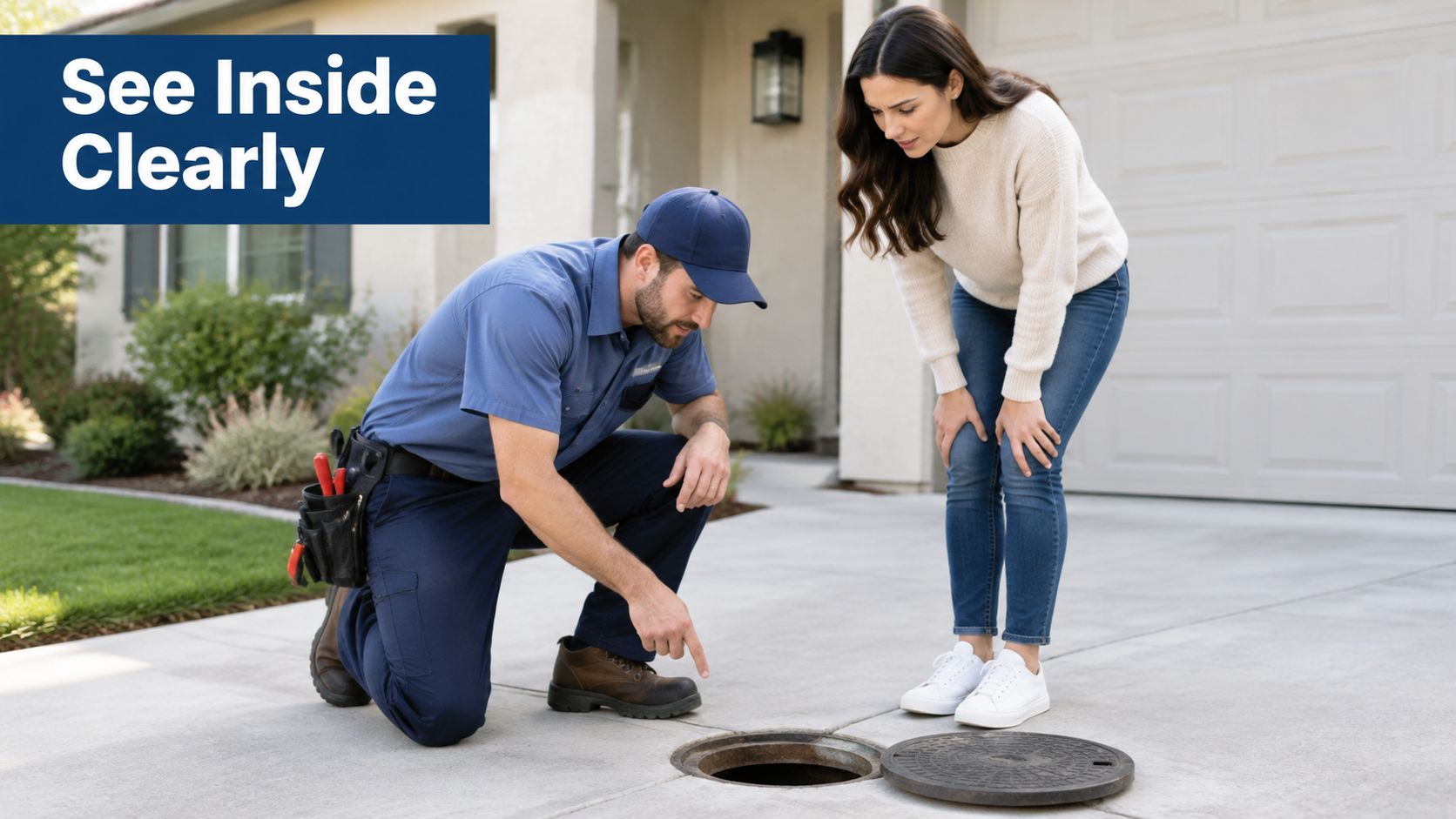
When an inspection earns its place
A camera is especially useful when:
- The same blockage returns: Repeated backups suggest an obstruction or defect that deserves visual confirmation.
- You're buying or selling: Recorded footage can clarify the condition of a private sewer lateral before a repair dispute develops.
- The property has older piping: Clay and cast iron lines can develop different problems, so the pipe material changes what the technician looks for.
- A multi-unit property has complaints: A shared main may require a crawler or a more systematic inspection rather than a quick look through one apartment's cleanout.
Los Angeles homes also face mature landscaping and long private laterals. Roots can enter through joints, while age-related movement can create offsets or low sections where waste settles. A camera doesn't prevent those conditions, but it helps identify the location and character of the problem before the crew chooses a remedy.
For broader maintenance context, homeowners can also review why sewer line maintenance matters for homeowners. The practical question is simple: do you need another temporary clearing, or do you need evidence that explains the recurring failure?
Field rule: Don't approve excavation based only on a symptom. First ask what the footage shows, where the defect is located, and whether the camera reached the full area in question.
How a Camera for Sewer Lines Works
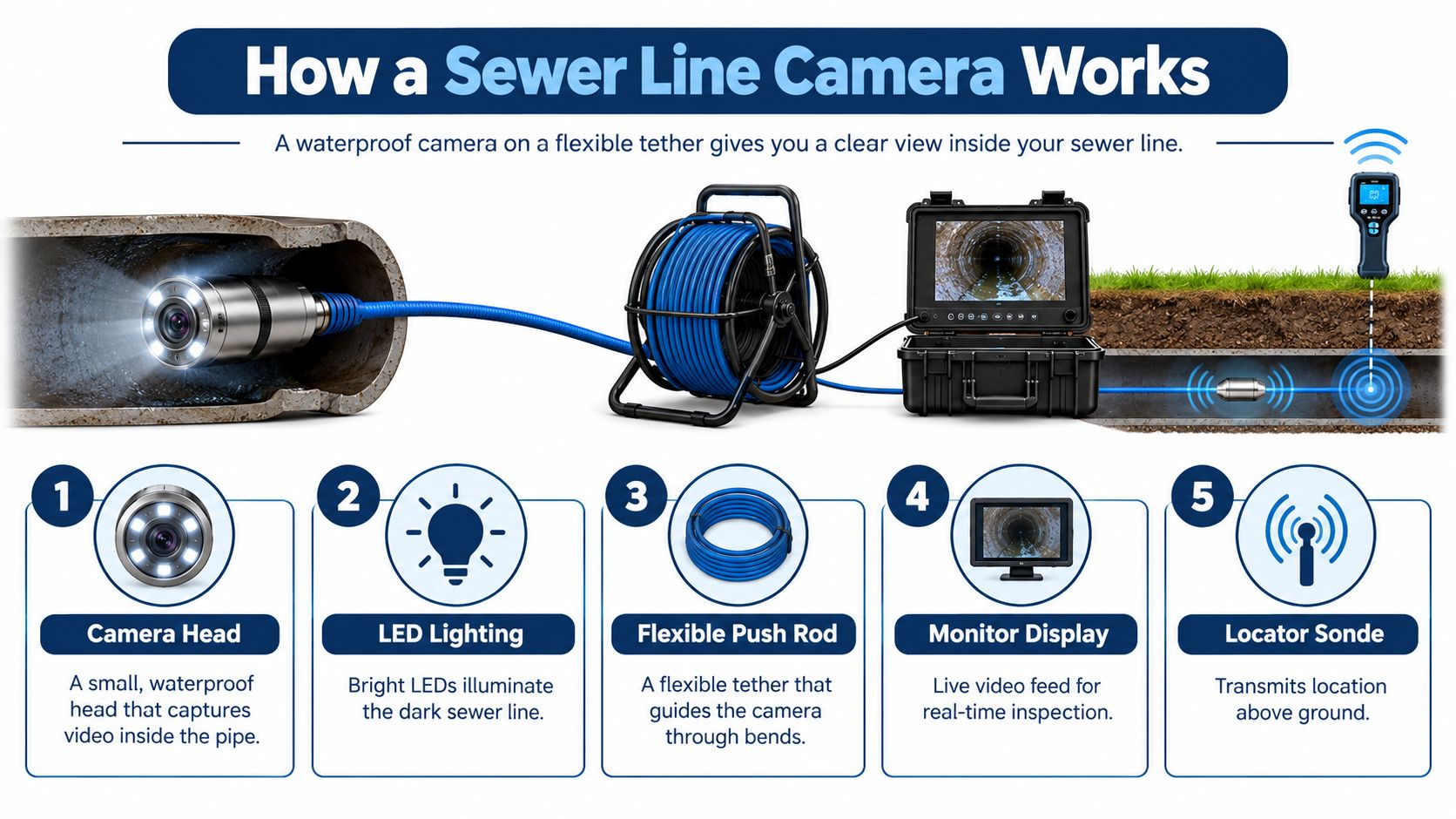
A backup has left water standing in the yard, but the trouble may be several feet underground. A sewer camera gives the technician a view without immediately opening the soil. The camera head works like a waterproof flashlight on a flexible tether, entering through a cleanout while a cable carries the image to a monitor.
The inspection in plain steps
- The technician finds access. A cleanout allows entry without opening the yard or floor right away. The technician checks whether the line is passable and whether cleaning is needed before inserting the camera.
- The camera head travels through the pipe. A small waterproof housing contains the lens and built-in lights. The operator pushes a semi-rigid rod through a residential lateral or controls a wheeled crawler in a larger main. Older clay pipes, tight bends, and root intrusion can stop a push camera before it covers the entire run.
- The monitor shows a live view. The operator watches the pipe wall, joints, water level, debris, and direction changes. Recording the inspection preserves evidence for repair planning or property records.
- A sonde helps locate the defect. Some camera heads transmit a signal. Using a compatible locator above ground, the technician can mark the camera's position and connect an underground image to a spot on the property.
- The operator interprets the footage. Video requires judgment. A trained technician distinguishes roots from ordinary debris, recognizes an offset joint, and looks for patterns that suggest a low section or structural concern. In a multi-unit property, one cleanout may show only part of a shared main, so access and camera reach affect the conclusion.
Municipal CCTV standards commonly specify pan-and-tilt movement, remote focus, and remote iris control. One specification calls for 360° rotation, up to 270° tilt, a focal range from 150 millimeters in front of the lens to infinity, and at least 300 meters of reach from one access point. These features show why camera movement and cable reach matter, though a residential inspection may use simpler equipment.
For facility teams managing larger wastewater systems, pipeline inspection fits within broader maintenance planning. Resources on how to cut downtime in water plants place camera work alongside other reliability tasks.
Homeowners can review what a local sewer camera inspection involves before scheduling service.
The camera sees the pipe's inside surface. It does not measure soil voids, prove a slope failure, or confirm that surrounding support remains sound. The footage becomes useful evidence, while the operator's interpretation and, sometimes, another diagnostic method determine what the inspection can establish.
Types of Sewer Cameras and When Each One Fits
The right tool depends on the pipe, the distance, and the level of detail you need. A compact push camera may be ideal for a single-family home's lateral, while a wheeled crawler gives a property manager better control in a larger shared main.
A borescope is a different tool again. It generally works through a small opening or exposed section and provides a close look at a limited area. It can help with localized access problems, but it isn't a substitute for traveling through a long sewer run.
| Camera Type | Best For | Reach and Maneuverability | Limitation to Know |
|---|---|---|---|
| Push rod camera | Residential laterals, cleanouts, and short diagnostic checks | A flexible, semi-rigid rod can navigate many household bends | It may stop at tight turns, heavy buildup, or a damaged section |
| Wheeled crawler | HOA, commercial, and municipal mains | Motorized wheels provide stable movement through larger pipe | It needs suitable pipe dimensions, access, and often more setup |
| Borescope | A localized view through a small opening or exposed pipe | Compact head reaches confined spaces | It doesn't provide the same travel distance or sewer-line coverage |
Push cameras for the typical house
A push rod system is often the practical first choice for a single-family home. The technician feeds the camera from a cleanout, watches the monitor, and records the path through the lateral. This setup is portable and useful when the question is, “What's causing the backup between the house and the street?”
Its weakness is force. The rod can bend around ordinary turns, but roots, collapsed material, standing water, or a sharply misaligned joint can stop progress. If the camera can't reach the suspected section, the inspection report should say so rather than imply that the unseen portion is clear.
Crawlers for shared and larger lines
A crawler carries the camera instead of relying on a person to push the cable through the pipe. That makes it better suited to larger mains where stable travel, controlled speed, and detailed documentation matter. An HOA or commercial property may need access from a manhole or another mainline opening, not just an individual unit's cleanout.
The equipment and preparation are more involved. The crew may need to manage flow, clear debris, and coordinate access points. For a multi-unit building, ask whether the proposed inspection covers the shared main or only the branch serving one unit.
Borescopes for confined views
A borescope can answer a narrow question, such as whether a visible section contains damage or whether an opening leads to the suspected cavity. It isn't normally the right answer for mapping a full residential sewer lateral. Treat it as a targeted viewing instrument, not a universal sewer camera.
Key Specs to Understand Before You Buy or Hire
A camera that works well in a new, straight pipe may struggle in an older Los Angeles lateral with tight bends, clay joints, or root growth. Before you buy or hire one, match the equipment to the pipe's diameter, access points, layout, and suspected problem.
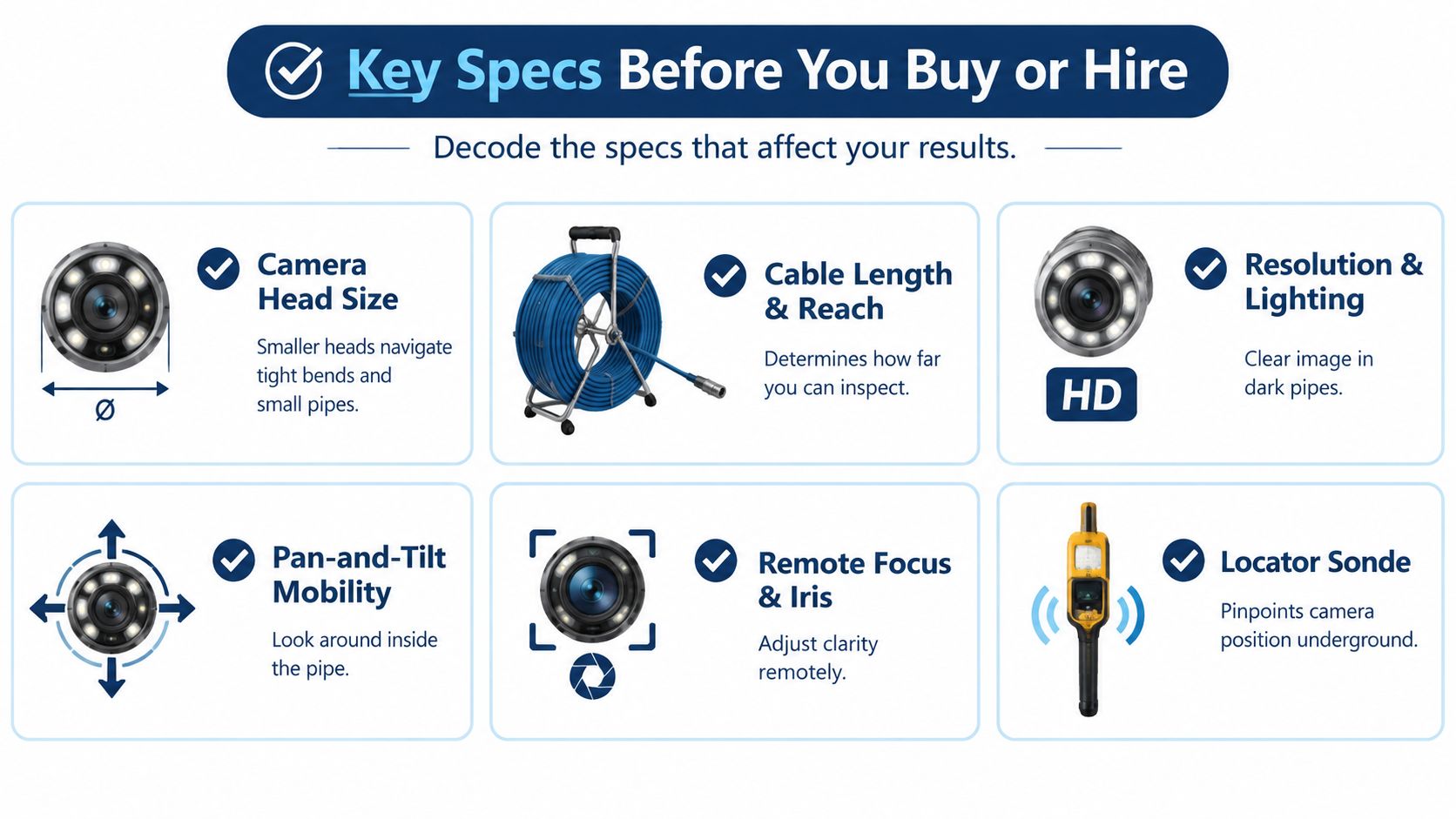
Start with the camera head and cable
Camera-head size determines whether the unit can enter the narrowest part of the line and turn through its bends. A head suited to a larger, straighter pipe may stop in a small residential branch. Smaller heads generally reach tighter spaces, though some systems trade lighting strength or pushing power for that compact size.
Cable length is not the same as usable reach. Each bend, rough joint, buildup, and change in direction uses some of that distance. Measure from the cleanout or other access point to the area you want examined. Then ask how far the cable can realistically travel through this specific layout. A long cable cannot help if the head stops at a root mass or sharply offset clay joint.
Prioritize a view you can trust
Lighting and resolution determine whether the recording shows a fine crack, roots entering at a joint, or only a bright reflection from standing water. Clear footage helps the operator distinguish between cleaning, localized repair, and a larger excavation decision.
Pan-and-tilt movement lets the operator check the crown, invert, and sidewalls instead of viewing only the space directly ahead. A fixed or limited-mobility camera can miss damage above or beside its viewing path. Specifications used for professional inspections may call for full rotation, substantial tilt, remote focus, and iris control. The CCTV inspection specification from Halifax Water illustrates the level of camera control that can support a more complete inspection.
Do not overlook locating
A locator sonde sends a signal from inside the pipe. A compatible receiver above ground detects that signal, allowing the technician to mark the camera or suspected defect beneath soil, paving, or landscaping. Confirm that both the sonde and receiver are included. The camera may transmit a signal, but it cannot be traced from the surface without the receiver.
Ask these questions before hiring or renting:
- What is the smallest pipe the camera can enter? Older homes may have narrow branches and tight transitions.
- How far can it travel in this layout? Ask about practical distance, not only total cable length.
- Can it record the inspection? Saved footage gives you something concrete to review during repairs or a property transaction.
- Can it locate a defect above ground? This matters before opening a driveway, walkway, or planted area.
- Will the operator explain what the image proves? Clear footage still requires careful interpretation, especially when roots, standing water, or a shared multi-unit main limit the view.
What a Sewer Camera Can Find and Where It Stops
Inside a reasonably passable line, the camera can reveal a surprising amount. It may show tree roots entering through a clay joint, hardened grease narrowing the channel, cracked pipe walls, offset sections, corrosion on metal, or a belly where water and solids collect.
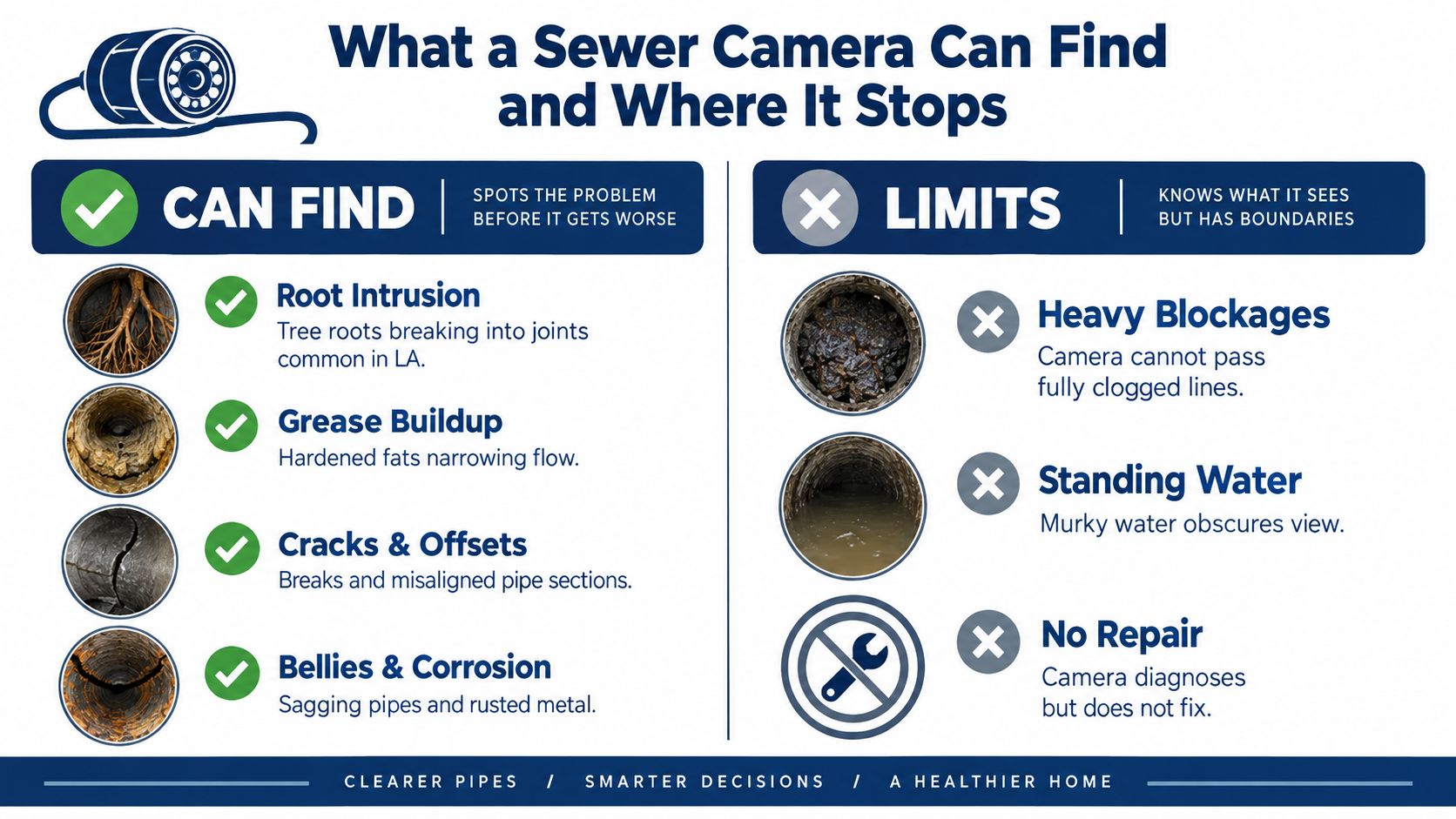
What the footage can show
Consider an older Los Angeles home with mature trees between the foundation and the sidewalk. A camera may show roots concentrated at one joint rather than throughout the line. That difference affects the repair conversation. Targeted work might address the entry point, while widespread deterioration could require a different plan.
A clay lateral can also develop offsets as sections shift. Cast iron brings other concerns, including corrosion and scale. Grease can disguise the pipe wall, so cleaning may be necessary before the operator can make a dependable structural observation.
Homeowners dealing with recurring root growth can learn more about roots in sewer lines, including why a repeated symptom deserves more than another surface-level clearing.
The boundaries matter more than the sales pitch
A camera only sees the interior path it can reach. A completely blocked section may prevent passage, murky standing water can obscure the wall, and a large buildup can hide a defect behind it. The camera also diagnoses. It doesn't remove the obstruction or repair the pipe.
The less visible boundary is structural interpretation. Footage may suggest slope drift, a void outside the pipe, or a support problem, but the video alone may not fully prove what is happening beyond the pipe wall. A trained operator looks for recurring water patterns, changes in pipe position, joint movement, and the relationship between the defect and the surrounding property.
A clean-looking interior doesn't automatically prove that the soil outside the pipe is stable.
That caution becomes more important in apartment buildings, HOAs, and commercial properties. A camera in one branch may say little about the shared main. Ask for the inspection limits, access points used, sections not reached, and any recommendation for complementary testing.
Costs Rental Options and What to Expect on Inspection Day
The cost decision isn't just about the equipment. It also concerns access, interpretation, locating, recording, cleanup, and what happens if the camera can't pass the suspected problem.
Renting versus hiring
A rental can make sense for a simple, accessible line when you already know where the cleanout is and only need a basic view. You carry the responsibility for setting up the equipment, managing sanitation, navigating the cable, recording useful footage, and deciding what the image means.
Hiring a licensed plumbing professional usually makes more sense when the line is backing up, the property has older piping, excavation may follow, or the inspection involves a shared main. An experienced operator can combine cleaning, camera work, locating, and repair planning instead of leaving you with an unclear video and no decision path.
Don't choose a rental by cable length alone. A long cable won't help if the head can't make the bends, the line is too dirty to see, or the operator can't locate the defect above ground.
What happens during the visit
- Access and preparation: The technician identifies the cleanout or entry point and checks whether the camera can enter safely. If grease or debris blocks the view, cleaning may come first.
- Live inspection: The camera travels while the operator watches the monitor. The technician notes joints, roots, cracks, offsets, water, and any point where travel stops.
- Location marking: If the equipment has a sonde and locator, the technician can mark the camera's position from the surface.
- Documentation: Ask for recorded footage, still images when useful, the direction of travel, and a plain-language explanation of findings.
- Decision discussion: The recommendation should connect the visible condition to a proportionate next step, such as monitoring, cleaning, targeted repair, or broader investigation.
Clear the area around the cleanout before the appointment, open gates, secure pets, and gather any prior drain-cleaning or repair information. For an HOA or commercial property, arrange access to relevant manholes, utility rooms, and affected tenant areas.
Ask whether the quoted inspection includes locating, recording, cleaning if needed, and a follow-up pass after repair. Those details prevent a low initial quote from becoming an incomplete diagnosis.
Making the Right Call for Your Los Angeles Property
Camera findings become useful when they lead to a specific decision. Don't treat every visible imperfection as a reason for full replacement, and don't treat every temporary clearing as proof that the line is healthy.
Use this practical filter:
- Monitor: The pipe is open, the footage is clear, and the finding is minor without a pattern of recurring symptoms.
- Clean and maintain: Grease, soft debris, or limited root growth is narrowing an otherwise serviceable passage.
- Repair a section: The camera locates a crack, offset, root entry, or other localized defect that explains the failure.
- Investigate further or replace: The line has widespread deterioration, repeated structural defects, an inaccessible section, or evidence that the surrounding support may be compromised.
LA conditions should shape the maintenance plan. Older clay lines deserve attention around joints and root-prone landscaping. Cast iron requires careful interpretation of corrosion and scale. Multi-unit properties need a scope that distinguishes private branches from shared mains, because a tenant's backup may originate beyond the unit's own plumbing.
Use the video as documentation. A buyer can ask for footage before accepting a repair recommendation. An HOA board can compare a proposed project with the actual locations shown. A property manager can keep the recording with the building's maintenance history and verify whether the completed work addressed the identified section.
After cleaning or repair, a follow-up camera pass can confirm that the camera reaches the target area and that the original obstruction or damaged section has been addressed. That extra verification is particularly valuable when the first inspection stopped at a blockage or when excavation changed the line.
EZ Plumbing provides sewer camera inspection in Los Angeles, using a waterproof camera through a cleanout or drain access point to identify conditions such as roots, grease, cracks, bellied sections, and offset joints. The company serves residential, HOA, property-management, and commercial properties, with emergency response and same-day scheduling available.
For a clear diagnosis, ask EZ Plumbing to inspect and locate the problem before you authorize digging or repeated drain cleaning. Visit EZ Plumbing to schedule sewer camera service for your Los Angeles home, building, or commercial property.