
Stop Scale Costs: Los Angeles Homeowners, Hard Water Up to 16.3 gpg
Los Angeles water is generally hard, with hardness varying significantly depending on your neighborhood’s supply source. It’s safe to drink under LADWP standards, but that hardness will still scale your water heater and fixtures over time. Your first move should be checking your specific Water Quality Area against LADWP’s published tables, then testing your own tap.
TL;DR:
- Los Angeles water hardness varies widely by neighborhood, ranging from about 8.6 gpg in the San Fernando Valley to over 16 gpg in East Los Angeles and Harbor areas.
- Scale buildup from hard water predominantly affects water heaters, fixtures, and appliances, leading to decreased efficiency and potential damage over time.
- Water off-the-shelf in LA is safe to drink despite its hardness, which is not regulated as a health risk but can cause maintenance issues.
- Accurate testing and zone-specific numbers are essential for proper softener sizing; generic city averages are insufficient for household needs.
- Treatment options include ion-exchange softeners, salt-free conditioners, and point-of-use reverse osmosis, each suited for different levels of hardness, maintenance, and use cases.
Table of Contents
- Does Los Angeles Have Hard Water? Zone-By-Zone Numbers
- What Hard Water Does to Pipes, Appliances, and Laundry
- Is Hard Water Safe to Drink in Los Angeles?
- How to Test Your Home’s Water Hardness
- Treatment Options: Softeners, Conditioners, and RO Systems
- How to Choose the Right System for Your Home
- Costs, Installation, and Permits for LA Homes
- What Years of LA Plumbing Calls Have Taught Us About Hard Water
- Get Your Water Tested and Your System Sized Right
- Where to Verify LA’s Water Quality Data Yourself
- Sources
Does Los Angeles Have Hard Water? Zone-By-Zone Numbers
Yes, and the variation across the city surprises most homeowners. Los Angeles blends water from several sources, including the Colorado River Aqueduct, the Los Angeles Aqueduct from the Eastern Sierra, and local groundwater, so hardness shifts depending on which supply feeds your specific block. Colorado River water runs notably harder than the Sierra snowmelt that fills the northern aqueduct, and that blend ratio changes by Water Quality Area.
LADWP’s own hardness data shows the San Fernando Valley averaging around 8.6 gpg (147 ppm), while East Los Angeles and Harbor-area zones run closer to 16.3 gpg (279 ppm). That’s nearly double the mineral load from one side of the city to the other. A third-party assessment from HardWaterHQ pegs the citywide average closer to 10.5 gpg (about 180 ppm), which is a reasonable planning number if you don’t yet know your exact zone, but not a substitute for it.
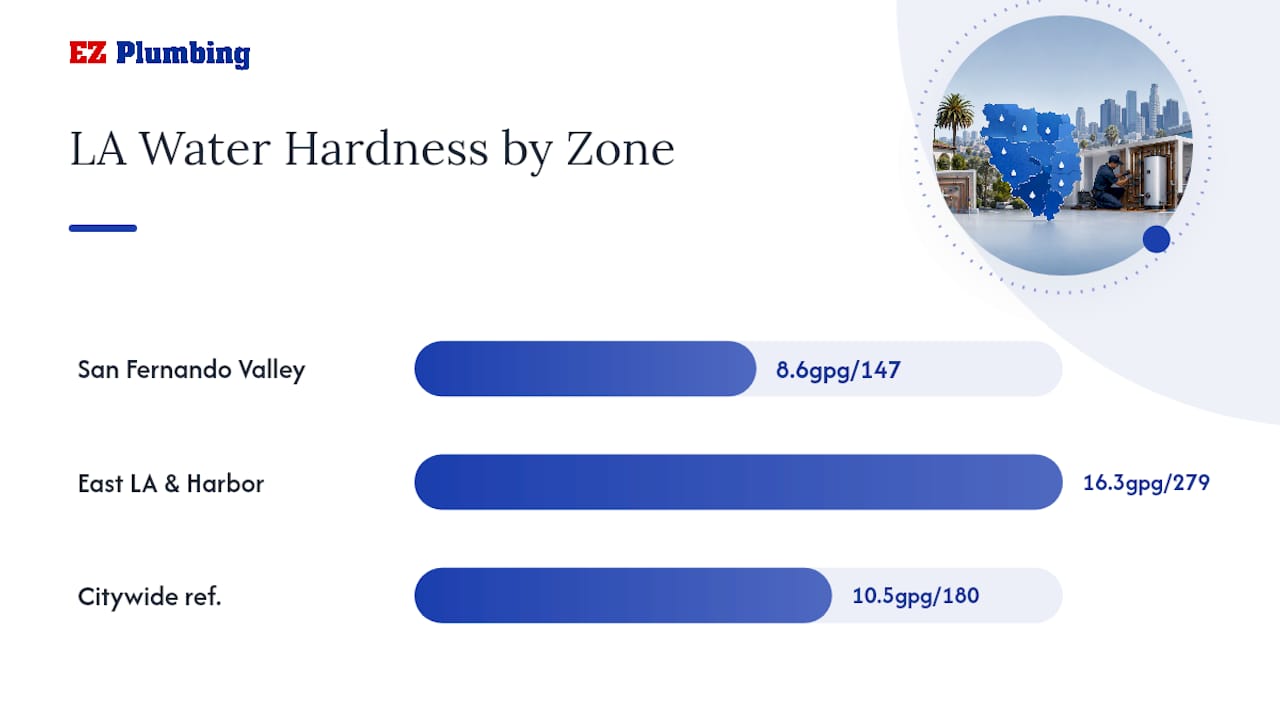
Here’s how hardness typically breaks down using the standard classification scale water treatment professionals use:
One grain per gallon equals 17.1 milligrams per liter of calcium carbonate, which is the same as parts per million. Most Los Angeles neighborhoods fall in a range where scale buildup can be a significant maintenance issue rather than a minor annoyance.
The practical takeaway is that a citywide average tells you almost nothing useful for sizing equipment. A softener sized for 8 gpg will underperform in a home actually receiving 16 gpg water, and one sized for 16 gpg is oversized (and overpriced) for a home at 8 gpg. Pull your specific Water Quality Area number before you buy anything.
What Hard Water Does to Pipes, Appliances, and Laundry
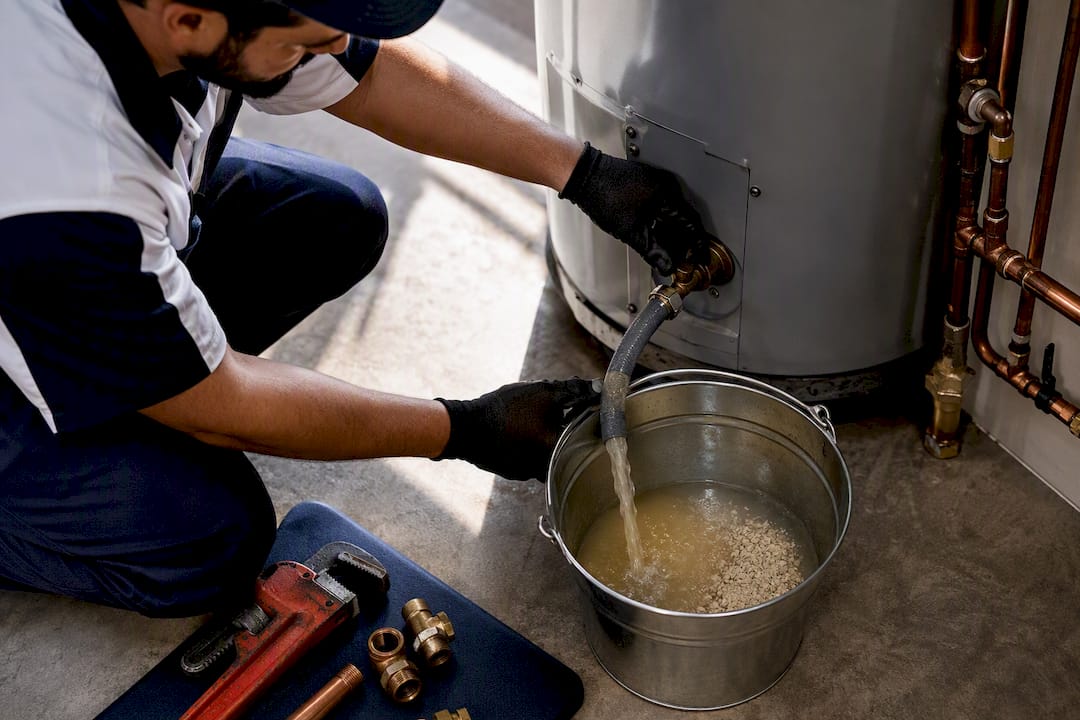
Calcium and magnesium don’t just pass through your plumbing. They precipitate out as scale wherever water sits, heats, or slows down, and that process is cumulative. A water heater is usually the first casualty because heat accelerates mineral precipitation, coating the tank’s interior and burying the heating element under an insulating layer that forces the unit to work harder for the same output.
The visible signs show up well before a major failure:
- Cloudy drinking glasses that stay spotted even after a full dishwasher cycle
- White or chalky deposits crusting around faucet aerators and showerheads
- Soap and shampoo that won’t lather properly, leaving a filmy residue on skin and hair
- Stiff, gray-looking laundry, even with a full detergent dose
- Visible scale rings inside a kettle, coffee maker, or humidifier reservoir
Fixtures with narrow internal passages, like shower valves and low-flow aerators, clog first because scale has less room to accumulate before it restricts flow. Calcium buildup inside plumbing lines can eventually narrow pipe diameter enough to reduce water pressure throughout a home, not just at one fixture.
Pro Tip: If your water heater has failed twice in under eight years, or you’ve noticed a slow, steady drop in shower pressure across multiple fixtures, that’s usually scale, not a coincidence. It’s worth having a licensed plumber run a camera inspection before you replace anything a second time.
Tank-style heaters typically lose a measurable share of efficiency once scale accumulates past a quarter inch, since the layer acts as insulation between the burner or element and the water itself. Routine water heater maintenance that includes periodic flushing slows this process, but it doesn’t eliminate it if the water feeding the tank stays at 12 or 16 gpg year-round.
Is Hard Water Safe to Drink in Los Angeles?
Yes. Hardness minerals are not a contamination issue, and LADWP water meets state and federal drinking water standards, backed by daily sampling across roughly 300 monitoring locations. Calcium and magnesium are naturally occurring minerals, not pollutants, and the EPA doesn’t regulate hardness as a contaminant under its national drinking water standards because it isn’t classified as a health hazard.
That said, treatment choices carry their own trade-offs worth understanding before you install anything:
- Ion-exchange softeners add sodium to your water as part of the mineral-swap process, and the increase is proportional to how hard your incoming water is.
- LADWP recommends consulting a physician before relying on softened water as a primary drinking source if you’re on a sodium-restricted diet.
- A common workaround is softening only the hot water line and water heater feed, leaving cold drinking water untreated.
- Point-of-use reverse osmosis at the kitchen sink removes both hardness minerals and sodium from drinking water without adding sodium to your whole-house supply.
That combination, a whole-house softener for appliances and plumbing paired with a kitchen RO unit for drinking and cooking water, tends to satisfy homeowners who want scale protection without the sodium trade-off. It’s a compromise worth considering rather than an either/or decision.
How to Test Your Home’s Water Hardness
Guessing at your hardness number is the single most common mistake homeowners make before buying treatment equipment, and it leads directly to undersized or oversized systems. Here’s the sequence that gets you a reliable number:
- Look up your LADWP Water Quality Area first. LADWP publishes hardness ranges by zone, and this gives you a baseline before you test anything yourself.
- Buy a calibrated hardness test strip and follow the timing exactly. Dip the strip in a cold tap sample, count the color-change squares according to the package instructions, and don’t guess at partial color shifts, since a few seconds’ difference in dip time can throw off the reading.
- Run the test at more than one fixture if your home is older. Galvanized pipe sections and mixed plumbing materials can shift readings slightly between a kitchen tap and a bathroom line.
- Send a sample to a certified lab if you’re sizing equipment for a large household or commercial property. Strip tests are useful for a general read, but a lab report gives you a precise gpg figure that matters when an installer is calculating regeneration cycles.
- Compare your result against the LADWP zone average. A wide gap between your reading and your zone’s published range can indicate galvanized pipe corrosion adding false hardness signals, or a private well blending into your supply.
The nearly two-fold spread LADWP’s own data shows between the softest and hardest zones in the city, from about 8.6 gpg in parts of the San Fernando Valley to 16.3 gpg in East Los Angeles and Harbor-area zones, is exactly why a single test result matters more than a citywide guess. Exact gpg numbers directly determine how a softener’s regeneration valve gets programmed. Get the number wrong and you’ll either waste salt regenerating too often or let hard water slip through untreated.
Treatment Options: Softeners, Conditioners, and RO Systems
Three technologies dominate the Los Angeles market, and they solve different problems. Understanding which one actually removes hardness versus which one just manages its symptoms will save you from buying the wrong equipment.
Ion-exchange water softeners work by swapping calcium and magnesium ions for sodium ions as water passes through a resin bed. This is the only technology on this list that actually removes hardness minerals rather than managing their effects, which is why it remains the standard recommendation for homes above 7 to 10 gpg. The system needs periodic regeneration, flushing the resin bed with a brine solution to recharge it, which means an ongoing salt supply and a drain line to discharge the used brine. Weighing the pros and cons of a softener against your household’s water use is worth doing before committing, since larger households with high hot-water demand see faster payback than a one- or two-person home.
Salt-free conditioners use a different mechanism entirely. Instead of removing calcium and magnesium, they alter the mineral structure through a process called template-assisted crystallization, which keeps minerals from adhering to pipe walls and heating elements. That’s a meaningfully different outcome from softening: your water will still test as hard on a strip, but scale formation on surfaces slows down. Homeowners drawn to conditioners usually want to avoid sodium addition and ongoing salt costs, and independent comparisons of Los Angeles treatment options confirm conditioners deliver lower maintenance and a smaller environmental footprint, but without the “soft water” feel on skin and hair that ion exchange produces.
Reverse osmosis systems push water through a semipermeable membrane fine enough to block dissolved minerals, along with many other contaminants. RO is built for point-of-use application, typically a single kitchen tap, because whole-house RO systems are slow, wasteful of water, and expensive to scale up. It’s the right call for drinking and cooking water, not for protecting your water heater or washing machine.
- Ion-exchange softeners require a drain connection and periodic salt refills but deliver the most complete hardness removal.
- Salt-free conditioners need no drain, no salt, and minimal maintenance, but don’t reduce measured hardness numbers.
- Point-of-use RO handles drinking water quality but isn’t practical for whole-house scale protection.
Pro Tip: If you have a tankless water heater, check compatibility before choosing a system. Untreated hard water is especially rough on tankless units because their heat exchangers have narrow passages that scale faster than a traditional tank. Most manufacturers require some form of scale protection to keep the warranty valid.
Brine discharge from ion-exchange regeneration cycles is worth a mention here too, since it factors into the environmental side of this decision, covered in more detail further down.
How to Choose the Right System for Your Home
Start with the number, not the sales pitch. Your measured hardness in gpg, your household’s daily hot water demand, and how much space and drain access you have near your water main should drive this decision more than any single product’s marketing.
Work through these factors before you get a quote:
- Measured hardness matters more than a citywide average. A 10-person household at 16 gpg has entirely different needs than a couple at 8 gpg.
- Drain and space access rule out some options immediately. Condos and older homes without an accessible drain near the water main often steer toward salt-free conditioners or compact softener models.
- Environmental priorities push some homeowners toward salt-free technology, particularly if a septic system or older sewer connection is part of the picture.
- Budget for both equipment and ongoing costs, since a softener’s salt and water use adds a recurring expense a conditioner doesn’t carry.
When you’re comparing installers, ask direct questions and expect direct answers:
- What gpg reading did you measure at my home, and what post-treatment number should I expect?
- How often will the system regenerate, and how much salt will that use per month?
- Is this equipment NSF or WQA certified, and can you show me the certification?
- What’s covered under warranty, and what maintenance is my responsibility versus yours?
Treat evasiveness as a warning sign. An installer who won’t test your water before quoting, won’t put an estimate in writing, or dodges questions about brine discharge and drain requirements isn’t someone you want handling a system that ties into your home’s plumbing. Checking for NSF or WQA Gold Seal certification on any equipment you’re considering is one of the fastest ways to separate legitimate manufacturers from inflated marketing claims.
Costs, Installation, and Permits for LA Homes
Whole-house softener systems for a typical single-family home generally run from equipment cost plus professional installation, with salt-free conditioners often landing in a similar range for equipment but lower on ongoing maintenance since there’s no salt to buy. Point-of-use RO systems for a kitchen sink are the least expensive option upfront and carry modest annual filter-replacement costs.
Installation timelines vary based on your home’s setup:
- A straightforward softener installation with existing drain access can often be completed same-day once parts are on hand.
- Homes needing new drain lines, electrical work, or tight space modifications may need a longer install window.
- Older homes with galvanized or otherwise deteriorated plumbing sometimes need supplementary repairs before a softener can be connected safely.
Los Angeles has specific rules around brine discharge that matter here. Some municipal sewer connections restrict or regulate softener discharge due to salinity concerns for wastewater treatment and groundwater recharge. A licensed installer should handle permit requirements and confirm your discharge method complies with local rules before installation begins, not after. If a company doesn’t mention permits or discharge compliance at all during your consult, that’s worth asking about directly.
What Years of LA Plumbing Calls Have Taught Us About Hard Water
The pattern we see across Los Angeles jobs breaks down into a few recognizable categories. Older single-family homes, especially those built before the 1970s with original galvanized plumbing, tend to show the most dramatic scale accumulation because decades of hard water have had time to compound inside pipes that were never great to begin with. Condos and multi-unit buildings present a different challenge entirely: limited mechanical space forces creative equipment placement, and shared plumbing infrastructure means one unit’s hard water problem often mirrors the whole building’s.
Tankless water heater installs have become a growing share of scale-related service calls, and for good reason. A tankless unit’s heat exchanger is far less forgiving of scale than a traditional tank, so protecting the incoming water supply isn’t optional in most of Los Angeles’s harder zones.
One thing experience keeps confirming: partial softening, treating just the hot water line rather than the whole house, works better than most homeowners expect when budget or space is tight. It protects the appliances that suffer most from scale while sidestepping the sodium and space trade-offs of a full system. A licensed, insured, and code-compliant contractor evaluates each home’s plumbing condition before recommending anything, because the right fix depends on what’s already inside your walls, not just what’s coming out of your tap.
— EZ
Get Your Water Tested and Your System Sized Right
Guessing at your home’s hardness number, or buying whatever equipment a big-box store happens to stock, is how homeowners end up with an oversized softener eating salt they don’t need or an undersized one that lets scale through anyway. Water testing, checking your Water Quality Area against LADWP’s published ranges, and sizing equipment to your household’s real hot water demand, not a generic citywide estimate, are important steps to ensure proper treatment equipment choice.
The process is straightforward: a technician tests your water on-site, reviews your plumbing setup and drain access, and walks you through options that fit your space and budget, whether that means a full ion-exchange softener, a salt-free conditioner, or a hybrid approach with a hot-water-only softener and a kitchen RO unit. If your water heater has already taken damage from years of scale, our water heater installation services can address that at the same time, and our tankless water heater team can confirm compatibility if you’re considering that upgrade. For homeowners also dealing with backflow compliance questions tied to new plumbing equipment, this backflow testing checklist is a useful reference. Call to schedule an in-home water test and get a straight answer on what your house actually needs.
Where to Verify LA’s Water Quality Data Yourself
For homeowners who want to check the numbers firsthand, LADWP’s water quality FAQ page publishes zone-by-zone hardness tables and answers to common testing questions directly from the utility. NSF International’s consumer resource pages explain how product certification works and let you verify whether a specific softener or filter model carries a legitimate NSF or WQA rating before you buy. Both are worth a direct look before any major treatment purchase.
Sources
- Water Quality FAQs – Los Angeles
- Los Angeles, CA Water Quality 2026: Hardness, Contaminants & Filters — HardWaterHQ
- NSF consumer resources
Recommended
- Calcium Buildup in Water: A Los Angeles Homeowner’s Guide
- Pros and Cons of Water Softeners: A Homeowner’s Guide
- Galvanized Pipe Corrosion in Los Angeles Homes
Recent EZ Plumbing Jobs in Los Angeles
Real, recent work from our crews — updated automatically as jobs complete.