
Signs of a Burst Pipe Every Homeowner Should Know
You're walking past the hall closet in your Los Angeles home when you hear a faint hiss. The carpet feels damp near the baseboard, or you find a puddle beside the water heater with no obvious source. Nothing dramatic has happened yet, but water is moving somewhere it shouldn't.
That moment matters. A burst pipe can release water fast enough to create visible warning signs within minutes, and a half-inch supply line at full pressure is commonly estimated to discharge about 4 to 8 gallons per minute, or roughly 240 to 480 gallons per hour. That volume can turn a small split into serious interior damage in less than a day. (Shipshape's burst-pipe response guidance)
The practical response isn't complicated, but the order matters. Recognize the warning, shut off the water, protect yourself from electrical hazards, document what happened, and call for help before the wall, cabinet, slab, or subfloor absorbs more water. These are the warning signs of plumbing problems in your home that deserve immediate attention.
Table of Contents
- The Moment You Notice Something Wrong
- Visible and Audible Signs of a Burst Pipe
- What to Do in the First Ten Minutes
- Hidden Signals Your Water Bill and Meter Can Reveal
- When to Call a Licensed Plumber
- Burst Pipe Versus Slow Leak and Why the Distinction Matters
- Prevention and Maintenance Habits That Actually Work
- Key Takeaways Every Homeowner Should Remember
The Moment You Notice Something Wrong
A homeowner often notices a burst pipe through an ordinary detail, not a geyser. You hear rushing behind a bedroom wall after every faucet is closed. A narrow strip of carpet darkens beside a closet. The floor near the water heater feels wet, even though the tank and fittings look dry. In a slab-foundation house, you may notice warm flooring, a damp baseboard, or water emerging from a joint several feet away from the actual break.
The unsettling clue is the meter. Every fixture and appliance is off, yet the flow indicator keeps moving. That means water is leaving the supply system somewhere, whether the failure is a sudden split, a failed connection, or a concealed leak beneath the floor. A meter that stops after the system settles can point toward normal residual flow, but continued movement warrants a controlled inspection.
Practical rule: Water where it has no business being is more important than whether the visible amount looks small.
A burst pipe rarely gives homeowners a clean view of the break. Water travels through insulation, drywall, cabinets, framing, and soil before it appears. By the time a ceiling stain forms, the source may be above it. By the time a puddle reaches a hallway, the line may have been leaking inside a wall or under a slab.
Make the first observation count
Don't start by tearing into the wall or running a shop vacuum. Look at what changed, confirm that every fixture is off, listen for active flow, and check whether the meter continues to register use. Then find the main shutoff before the leak grows.
The difference between a controlled cleanup and a major reconstruction often comes down to how long the plumbing remains pressurized. If water is actively flowing, treat it as an emergency even when the stain is modest. Turn off the supply, keep clear of unsafe electrical areas, and contact a licensed plumber who can locate the failure without turning a hidden problem into a larger opening.
Visible and Audible Signs of a Burst Pipe
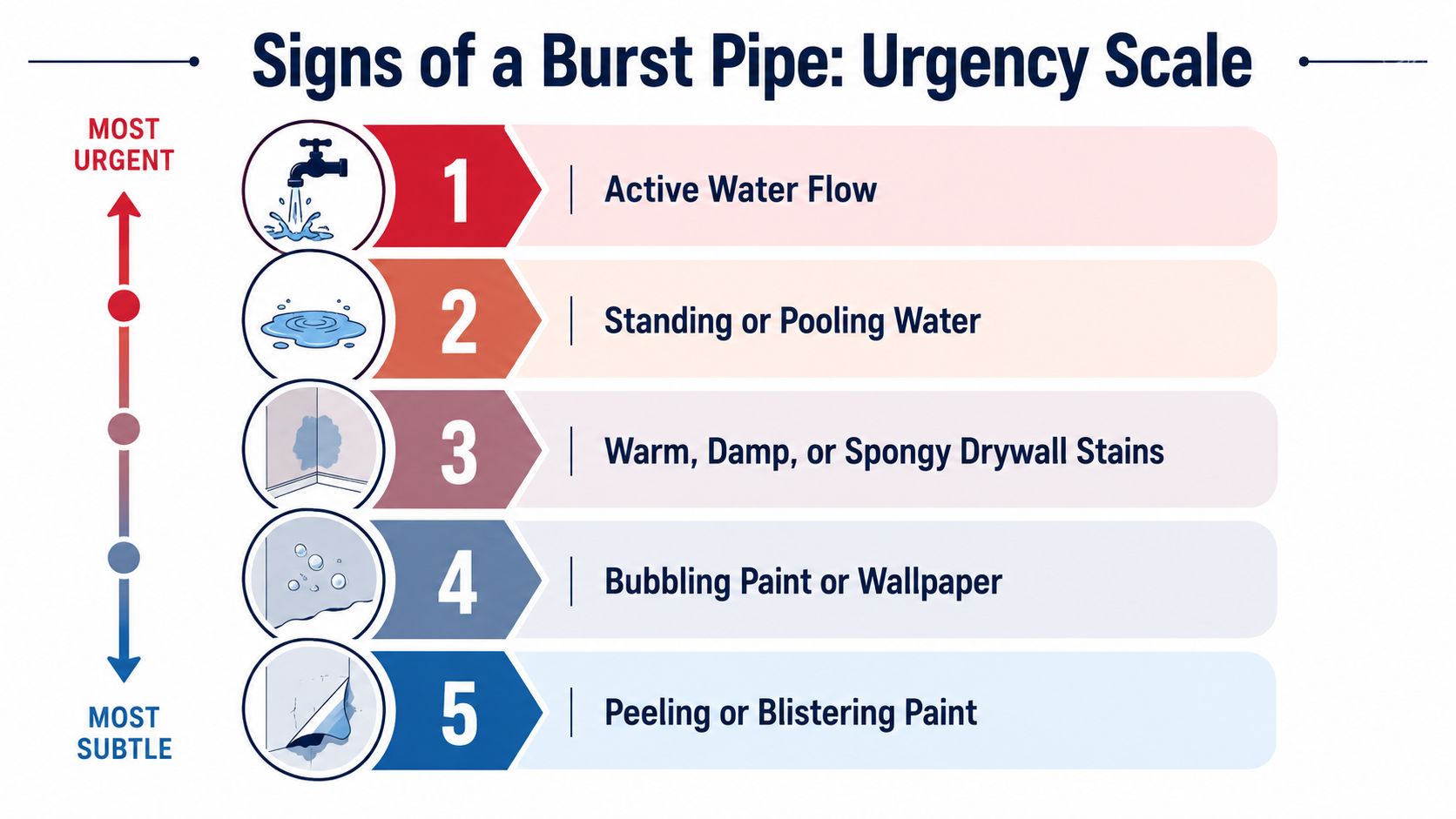
The most urgent signs are the ones that show active water movement. A stream from a wall, water pooling across a floor, or a ceiling that feels wet and spongy indicates that the system may still be feeding the leak. Shut off the main supply immediately, and don't wait for the water to spread far enough to reveal the pipe itself.
Start with the physical evidence
Use the surface pattern to estimate what may be happening inside the plumbing.
- Active flow or standing water: A split supply line, failed joint, or broken valve may be releasing water under pressure. Shut off the main and keep people away from wet electrical equipment.
- Warm, damp, or spongy drywall: Moisture has likely moved through the wall or ceiling cavity. A sudden pressure loss combined with wet drywall strongly supports an active line leak rather than ordinary condensation. (Roto-Rooter explains pressure loss and burst-pipe indicators)
- Bubbling paint, peeling wallpaper, or warped baseboards: Water is trapped behind the finish or wicking through the lower wall. Stop the supply before attempting cosmetic repairs.
- Wet flooring or a warm patch over a slab: A concealed hot-water leak or slab leak may be traveling beneath the surface. Don't keep using the plumbing to “test” it.
Sound often arrives before sight. Hissing or rushing behind a wall suggests pressurized water escaping through a breach. Dripping, gurgling, banging, or vibrating lines can indicate movement, a failed connection, or stress in the piping. If the noise continues with all fixtures closed, shut off the supply and investigate professionally.
Pressure changes add useful context
A sudden drop in pressure is a high-signal warning because an open breach diverts water away from the fixtures. Faucets may sputter, a shower may weaken to a trickle, or a toilet may refill slowly. If several fixtures change at once, suspect a supply-side problem rather than a single clogged aerator.
A musty, sulfurous, or earthy smell points to water sitting in a wall cavity, under flooring, or beneath a slab. Odor alone doesn't prove a burst, but odor paired with pressure instability, meter movement, or damp materials deserves prompt inspection. Frost, condensation, bulging sections, and unusual banging on exposed piping are especially important in colder foothill locations because freezing water expands and can split a pipe. (Alk Emergency Plumbers covers freeze-related warning cues)
What to Do in the First Ten Minutes
The first ten minutes should be orderly, not frantic. Your priorities are to stop incoming water, remove pressure, prevent electrical contact, and give the plumber useful information.
Close the correct valve. If the leak is isolated under a sink or behind a toilet, use that fixture's stop valve. For a supply-line failure, close the main shutoff, often near the front curb in the meter box or where the line enters the home. Turn the valve clockwise until it stops. If you're unsure where it is, keep a record of the location for the future and use this guide to shut off the main water supply.
Protect the water heater. Turn off its energy source, gas or electric, so the unit isn't left heating an empty tank if the supply drains. If you smell gas, don't operate switches or create sparks. Leave the area and call for emergency help.
Release residual pressure. Open one or two faucets downstream of the shutoff. This lets water in the lines drain and reduces pressure at the damaged section. Don't open every fixture if doing so would spread water into unaffected rooms.
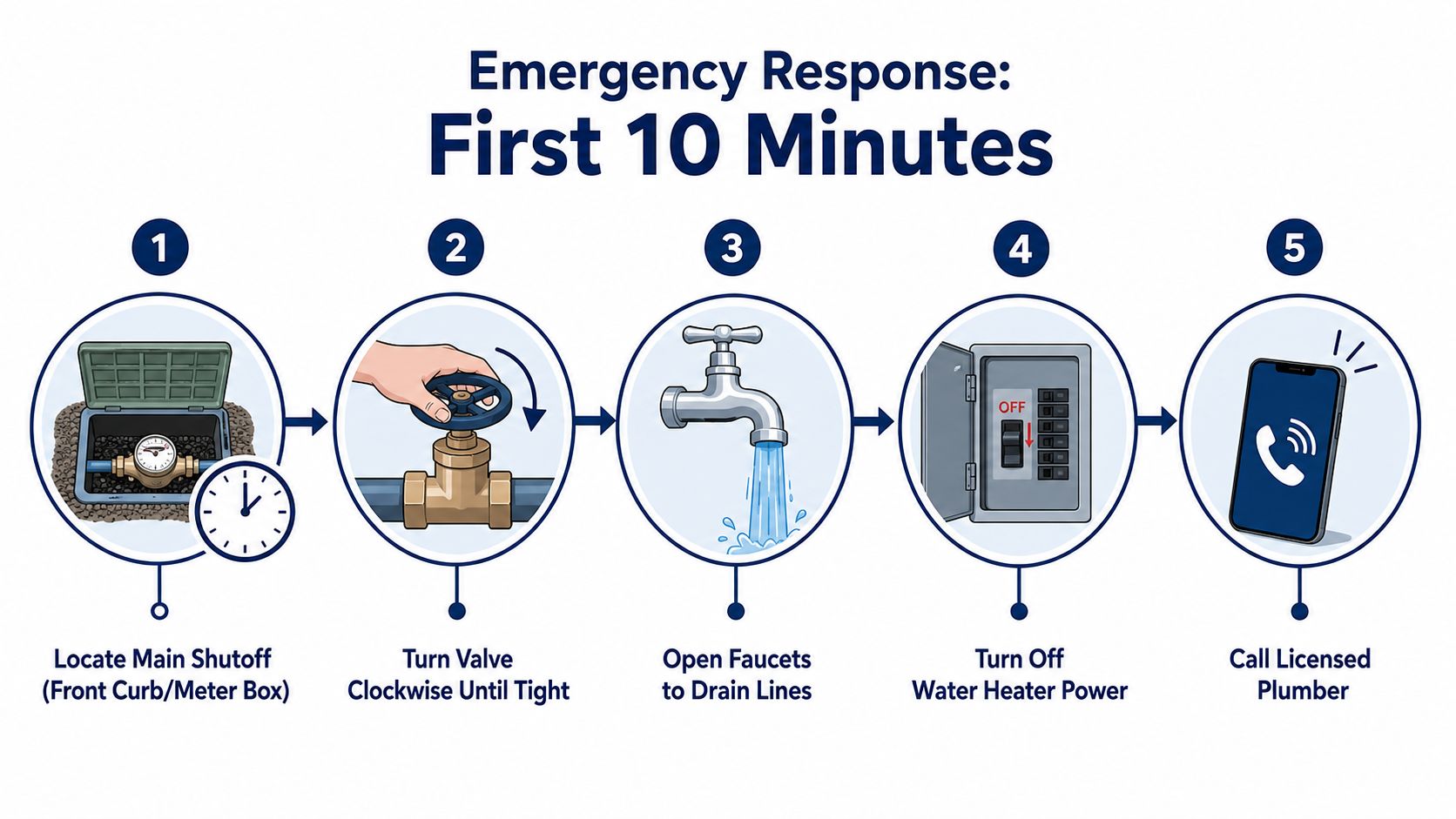
Make the area electrically safe. If water is near outlets, switches, appliances, or the electrical panel, turn off the affected circuit only if you can do so without stepping into standing water. If reaching the panel requires crossing wet flooring, leave it alone and wait for qualified assistance.
Record the condition. Take timestamped photos and video of the source, wet surfaces, damaged belongings, and the meter position. Move electronics, rugs, documents, and irreplaceable items to dry ground, but don't disturb dangerous areas.
Don't seal the wall, repaint, or close the cavity before the source and moisture path are documented. For a separate, homeowner-friendly overview of what to do when a pipe bursts, SouthRay Kitchen & Bath provides another useful emergency checklist.
A short demonstration can also help you recognize the shutoff and drainage sequence:
Hidden Signals Your Water Bill and Meter Can Reveal
A higher LADWP bill can be the first warning that water is moving where it should not. Compare it with your household's own recent pattern, not a generic neighborhood average. If occupants, irrigation, laundry, and fixture use have stayed similar, treat the increase as a reason to test the meter.
Start with a quiet house. Turn off faucets, washing machines, dishwashers, ice makers, irrigation, and other water-using appliances. After the system settles, watch the meter's flow indicator, often a small triangle or rotating dial. Any continued movement suggests water is passing through the supply line. For a step-by-step process, see our guide on how to read a water meter for leaks.
The test confirms flow, not location. It cannot tell you whether the leak is beneath a slab, inside a wall, or outdoors. A bill increase combined with hissing, weak fixtures, or damp materials raises the priority for targeted leak detection. In Los Angeles homes, that combination deserves attention because a concealed slab leak can stay out of sight while affecting flooring or soil below the foundation.

Smart monitoring has a different job
Smart leak detectors, automatic shutoff valves, and whole-house pressure monitors can flag sustained high flow, pressure changes, or unusual acoustic patterns before water reaches a finished surface. Kamstrup's flow monitoring information describes equipment focused on flow behavior and leak detection, rather than waiting for a puddle. (Kamstrup's flow monitoring information)
Use these devices as early warnings, not as a diagnosis. An alert may show unexpected household usage, but it cannot reliably identify the failed fitting or determine whether a slab needs opening. Azbil's smart-meter documentation also describes analysis of flow and noise data for conditions such as broken pipes, freeze risk, tampering, and leak-prone areas. (Azbil's smart-meter documentation)
Homeowners researching dealing with hidden water leaks should check the bill, test the meter, respond to alerts, and arrange leak detection if the evidence persists. A concealed leak under a mid-century Los Angeles slab may produce no obvious indoor stain before damaging flooring or soil below the foundation.
When to Call a Licensed Plumber
Call a licensed plumber immediately when water is actively flooding, sewage is backing up, pressure has disappeared across multiple fixtures, water is near electrical equipment, or the leak continues after you close the shutoff. A failed valve, a broken service line, or a leak on the street side of the property may remain pressurized even after a homeowner closes an interior valve.
The dispatcher will usually need a concise description, not a perfect diagnosis. Be ready to explain:
- Where water appears: Give the room, wall, ceiling, slab area, or exterior location.
- What the meter is doing: Say whether the indicator continues moving with every fixture off.
- Whether pressure changed: Mention sputtering faucets, a weak shower, or multiple affected fixtures.
- What safety risks exist: Report standing water near outlets, panels, appliances, or gas equipment.
- What you already closed: Identify the fixture stop, main valve, water-heater supply, or circuit breaker.
What the emergency visit should accomplish
A competent emergency visit starts with isolation and verification. The plumber should confirm whether the shutoff stopped flow, trace the likely route using pressure and access points, and inspect exposed fittings before opening finished surfaces. Depending on the location, the temporary repair may involve replacing a failed section, securing a joint, isolating a branch, or arranging a controlled follow-up for wall, floor, or slab access.
Los Angeles homes need local judgment. Slab construction changes how technicians trace leaks, older galvanized piping can fail in sections rather than at one visible point, and hillside properties may experience pressure behavior that complicates a quick visual diagnosis. A licensed contractor familiar with local construction can separate a fixture failure from a service-line or under-slab problem more efficiently than a general handyman.
People researching how licensing works in other markets can use this guide to find an Ottawa plumber, but the licensing and response requirements are location-specific. In Los Angeles, verify the contractor's license, insurance, scope of work, and plan for drying or permanent repair before authorizing anything beyond emergency stabilization.
Burst Pipe Versus Slow Leak and Why the Distinction Matters
A true burst usually changes the plumbing system quickly. Water may pool, pressure may fall throughout the house, and the meter can continue registering flow while fixtures are closed. A slow hidden leak behaves differently. It may leave a faint odor, a recurring damp spot, mineral staining, or a gradual bill increase without producing immediate flooding.
The distinction changes the first call and the repair strategy. A confirmed burst needs same-hour containment and prompt diagnosis because the pressurized line can keep feeding the affected area. A slow leak still matters, especially under a slab or inside a wall, but the plumber may use acoustic equipment, pressure testing, thermal imaging, or targeted access to locate the source before selecting a spot repair or a larger replacement.
| Indicator | Burst Pipe | Slow Leak |
|---|---|---|
| Water pattern | Sudden pooling, active flow, or rapid spread | Dampness, staining, odor, or intermittent moisture |
| Pressure behavior | Abrupt pressure loss across several fixtures | Pressure may remain normal or change subtly |
| Meter behavior | Continuous movement while all fixtures are off | Repeated movement or a persistent low-flow signal |
| Likely locations | Failed supply line, split joint, ruptured branch, or damaged service line | Wall cavity, slab, aging fitting, fixture connection, or irrigation run |
| First response | Close the main valve, protect electrical areas, and call promptly | Record the pattern, test the meter, and schedule leak detection |
| Repair approach | Emergency isolation, section replacement, and moisture control | Targeted detection, spot repair, or planned repiping where needed |
A burst can become a slow leak after pressure is reduced, and a slow leak can become a larger rupture when corrosion, movement, or pressure stress worsens. That's why the meter and bill checks matter even when the house looks dry. Indirect evidence gives you a chance to act before the failure becomes visible.
Prevention and Maintenance Habits That Actually Work
Los Angeles plumbing prevention should match the house in front of you. A slab-foundation home, an older property with galvanized lines, and a foothill house with exposed exterior piping don't carry the same risks. Generic advice such as “watch for leaks” isn't enough unless you know where to look and what condition is abnormal.
Use a repeatable home check
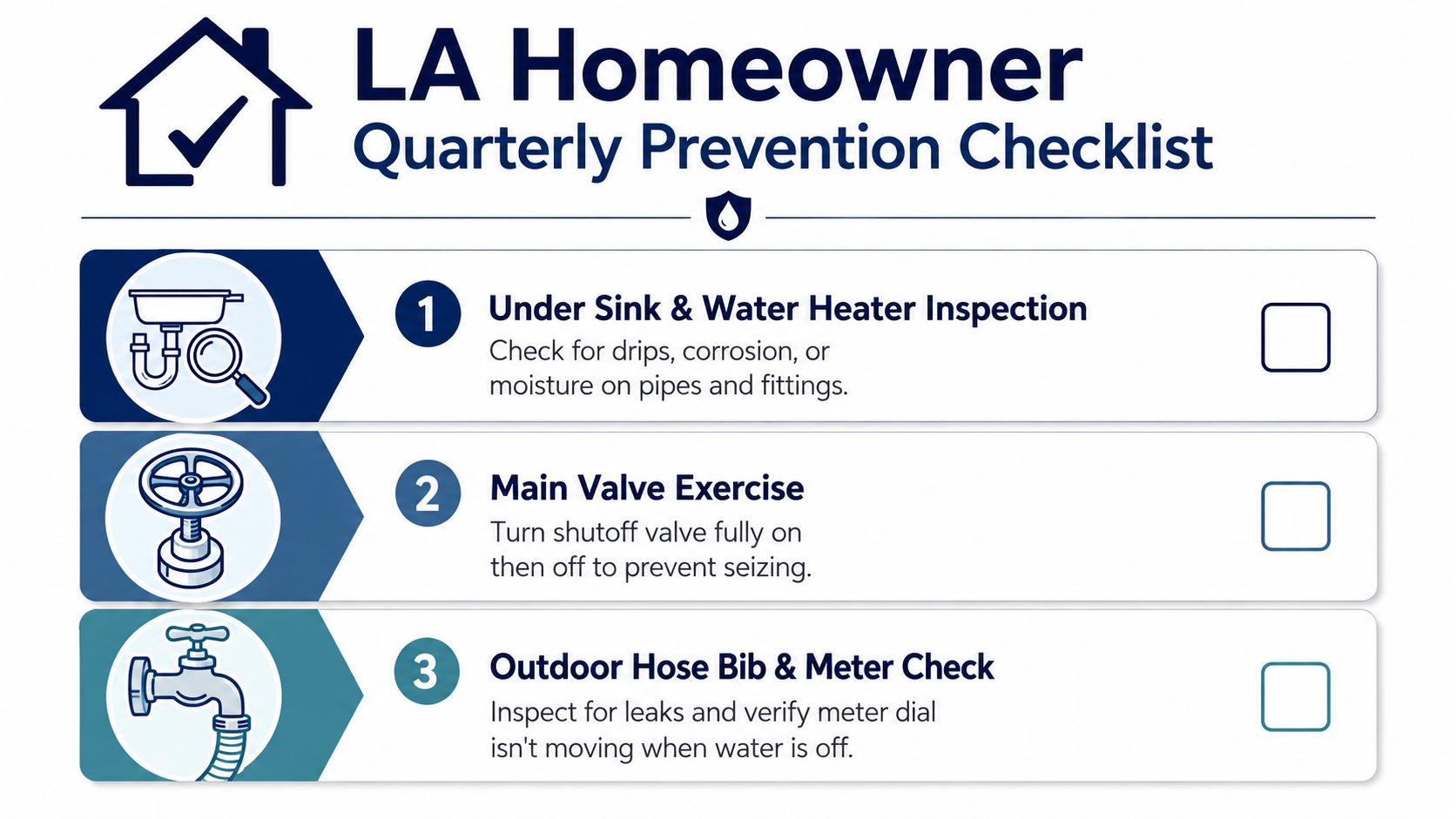
A practical quarterly inspection can stay short and specific:
- Inspect under sinks and around the water heater: Look for drips, white mineral scaling, green or dark corrosion, damp insulation, and staining at fittings.
- Exercise the main shutoff: Turn it carefully through its operating range, then return it to the open position. A valve that never moves can seize when you need it.
- Check angle stops and hose bibs: Corroded stops and exterior connections deserve replacement before they fail under pressure.
- Watch the meter: With all water use off, confirm that the indicator isn't moving. Persistent movement calls for leak detection.
- Use a pressure gauge: A hose-bib gauge can reveal excessive pressure. Pressure above 80 psi accelerates pipe fatigue, so have a plumber evaluate the pressure-regulating valve and overall system. (Shipshape's burst-pipe response guidance)
Match the check to the season
In spring, inspect cabinets and hose bibs after heavy use. Summer is a good time to check irrigation and outdoor lines. Before the first colder spell, protect exposed piping in foothill areas and look for frost or condensation. During winter nights, keep vulnerable areas from becoming cold pockets and pay attention to unusual pipe movement or noise.
Older galvanized lines may show internal deterioration long before a dramatic break. Pressure-regulating valves can protect fixtures and pipe joints from excessive force, but they won't repair already weakened piping. In a pre-1960s home, recurring corrosion, discolored water, or repeated repairs may justify a repipe assessment rather than another isolated patch.
The highest-payoff habit is knowing exactly where the main shutoff is. Find it in daylight, make sure the handle turns, and tell everyone in the household how to reach it. When water is spreading across a floor, searching for the valve is the last delay you can afford.
Key Takeaways Every Homeowner Should Remember
The most important signs of a burst pipe are practical, observable changes:
- Water where it shouldn't be: Shut off the main supply and stay away from wet electrical areas.
- A meter that keeps moving: Confirm every fixture and appliance is off, then arrange leak detection.
- Sudden pressure loss: Treat weak, sputtering fixtures across the house as a supply-line warning.
- Hissing, rushing, or dripping behind a wall: Stop the water before opening finishes.
- Musty, sulfurous, or earthy odor: Look for hidden moisture beneath flooring, inside walls, or under a slab.
A burst pipe demands containment first. A slow leak still deserves action when the bill, meter, pressure, smell, or sound keeps pointing to unexplained water use. Don't wait for a ceiling to sag or a floor to buckle before making the call.
Keep the main shutoff accessible, test it during routine maintenance, and inspect exposed connections around sinks, water heaters, hose bibs, and older piping. If water is moving where it shouldn't, or indirect signals keep building, call a licensed plumber instead of waiting to see what happens next.
EZ Plumbing provides licensed, insured plumbing service in Los Angeles, including 24/7 emergency response, burst-pipe repair, leak detection, water-heater service, and targeted sewer and water-line work. When you're seeing these warning signs, visit EZ Plumbing to schedule service or request help before a manageable leak becomes structural damage.