
Backflow Preventer Testing Cost: LA Property Owner Guide
A standard annual backflow test for one residential device typically costs $65 to $175 nationally, with a 2025 average around $165. Los Angeles pricing generally sits within or slightly above that band because local labor rates, travel, access conditions, and compliance filing requirements affect the final invoice.
That range only describes the starting point. A property owner can receive a straightforward single-device bill, or face a much larger annual expense after a failed test, a separate retest, difficult access, multiple assemblies, or paperwork that wasn't included in the advertised price. The practical way to budget is to treat backflow testing as a recurring compliance service with a per-device cost, not as a one-time plumbing visit.
Table of Contents
- What Backflow Preventer Testing Costs
- Breaking Down a Backflow Testing Quote
- Residential Versus Commercial Pricing Tiers
- Hidden Cost Escalators That Inflate Your Bill
- Why Annual Compliance Is Non-Negotiable in Los Angeles
- How to Get an Accurate Quote and Schedule Service
What Backflow Preventer Testing Costs
A backflow test for one accessible residential assembly is usually a modest service charge, but the invoice can change quickly once the job involves failed testing, difficult access, or multiple devices. Published national guides place simple annual testing in the $65 to $175 range, with straightforward testing and report filing often described around a $100 to $125 national average. Broader guides show a wider $25 to $350 per-device range, with pricing affected by device type, labor conditions, and repairs found during the visit. Treat those figures as budgeting references, not a guaranteed Los Angeles rate.
Los Angeles property owners should ask what the quoted price includes before scheduling. A contractor may perform the field test and return the report for the owner to submit, while another may handle the water provider's filing. Travel across the Los Angeles basin, parking, locked gates, buried or cramped assemblies, and access to irrigation or fire-service equipment can all raise the charge.
Single devices and recurring annual budgets
For a single-family home with one accessible irrigation or domestic-water assembly, the annual service generally includes the certified tester's visit, calibrated gauge equipment, recorded readings, and the compliance report, provided the device passes and no repair is required. A failed test changes the job from a routine visit into a repair and retest process. The owner may pay for parts, labor, a return appointment, and additional paperwork.
The expense returns each year. Homeowners, landlords, and HOA boards should place the testing date and expected per-device charge on the annual maintenance calendar rather than treating the first invoice as a one-time plumbing purchase.
Commercial properties scale by assembly
Commercial pricing follows the number and complexity of assemblies. Published guides place a small retail space or restaurant at roughly $100 to $200 per assembly. Larger buildings, apartment complexes, industrial sites, and fire-suppression systems can reach $200 to $500 or more per assembly. These figures describe national pricing and may not include every local filing or access charge.
A property with domestic, irrigation, and fire-service assemblies has several billable devices, not one testing expense. Each assembly requires its own connection, readings, result, and compliance record. A failed device can also create a separate return visit, so the most useful quote states the per-device rate, retest policy, repair billing, and report-submission fee in writing. That detail exposes the cost escalators that a low advertised starting price can leave out.
Breaking Down a Backflow Testing Quote
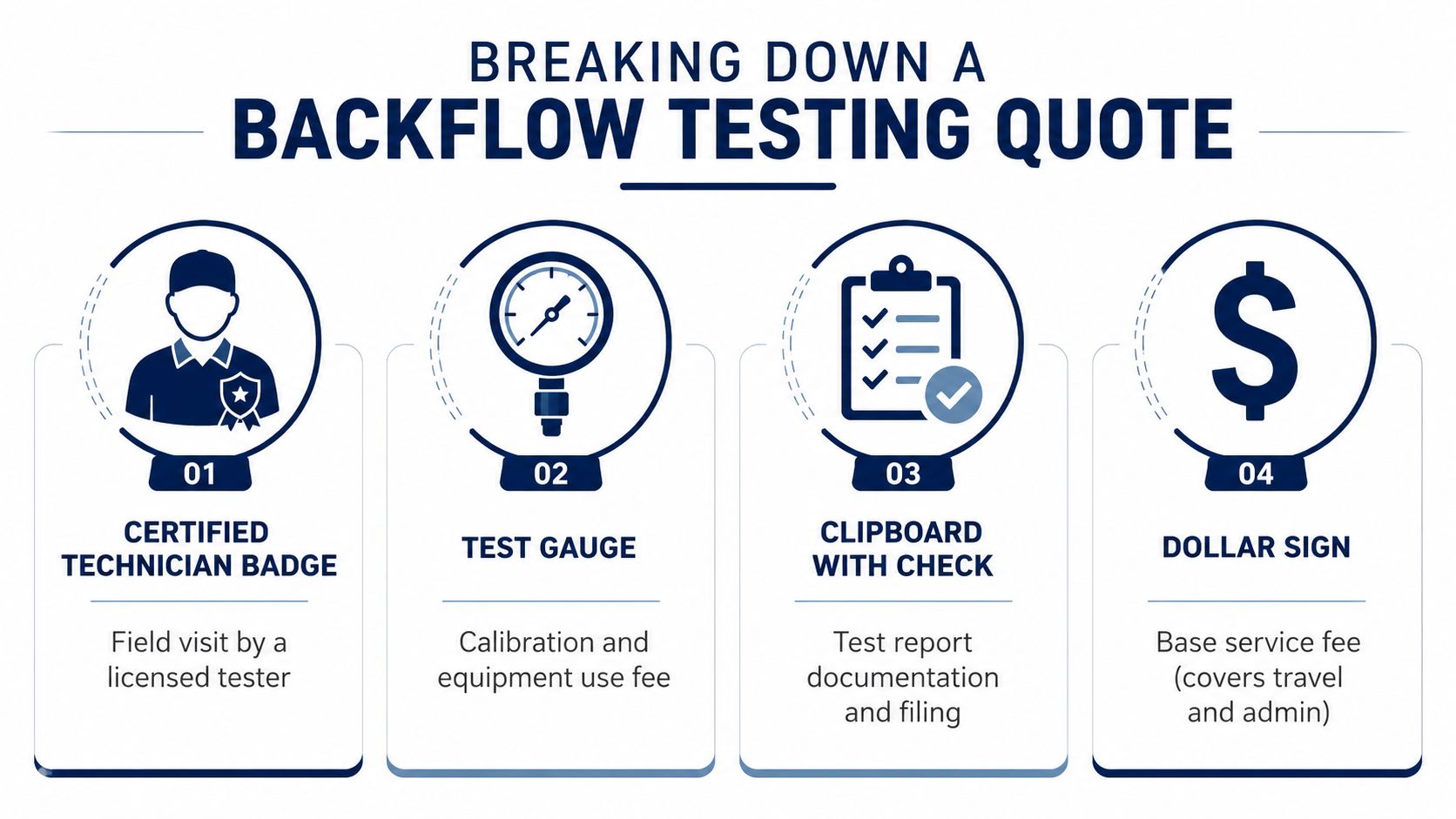
A legitimate quote should tell you what happens before, during, and after the field visit. The technician's time is only one part of the service. The contractor also needs appropriate test equipment, a current calibration process, accurate device identification, and a report that reaches the correct water authority in the required format.
Four line items worth checking
Certified technician: Confirm that the person performing the compliance test holds the certification accepted by the applicable Los Angeles water provider. A general plumbing license alone doesn't automatically answer that question.
Test gauge and field equipment: The technician connects a differential-pressure test kit to the assembly's test cocks and records the device readings. Ask whether equipment use and calibration are included in the service price.
Documentation and filing: The quote should state whether the contractor completes the official report and submits it to the water authority, or hands you paperwork to file yourself. Filing isn't an administrative afterthought. An accurately tested device can still create a compliance problem if its report isn't submitted correctly.
Travel and administrative fees: Some contractors bundle dispatch, travel, and report handling into one price. Others list them separately, particularly for remote sites, multiple addresses, locked enclosures, or district filing charges.
For a useful overview of the field procedure and the components being checked, review this guide on how to test a backflow preventer. Then ask three direct questions before approving work: Is report filing included? Is a retest included after failure? What access or district fees could be added?
Practical rule: A low base price isn't necessarily a low total price. Compare the scope of each quote, not just the first number on the page.
Residential Versus Commercial Pricing Tiers
Device count usually shapes the annual budget more than building size. A single-family property may have one assembly, while an apartment community or commercial campus may have separate devices for domestic water, irrigation, fire suppression, and process lines.
Use the table for early budgeting, not as a site-specific quote. Vault installations, locked enclosures, large service lines, and difficult access can change the labor involved.
Backflow Testing Cost by Property Type
| Property Type | Typical Device Count | Per-Device Cost Range | Estimated Annual Total |
|---|---|---|---|
| Single-family residential | One device | $65 to $175 for a standard test | $65 to $175 before repairs or extra fees |
| Small multi-unit property, 2 to 10 units | Several devices, depending on water services | $65 to $175 for straightforward residential-scale devices | Scales with each assembly |
| Large residential complex | Multiple domestic, irrigation, or fire assemblies | $200 to $500 or more per larger or complex assembly | Can exceed $1,000 when several assemblies require testing or follow-up |
| Commercial or industrial site | Multiple assemblies across service lines | $100 to $200 for a small retail or restaurant assembly, $200 to $500 or more for larger systems | Per-device charges accumulate across the property |
The larger residential and commercial figures reflect the added time, handling, and equipment required for complex assemblies. 2-inch to 4-inch RPZ assemblies commonly fall near the higher end, with published guidance placing testing around $200 to $350 in one regulated market.
A property manager should inventory every device instead of estimating from unit count alone. A large apartment property may have separate domestic, irrigation, and fire assemblies, and each one can generate its own testing charge, repair exposure, and compliance paperwork.
Assembly type also affects the protection method and testing process. Review this explanation of how a backflow preventer works before requesting bids. Give the contractor each device's location, size, assembly type, and access conditions. That information produces a more reliable quote than just describing the property as an apartment building.
Budget for the devices individually, then ask whether the contractor offers a reduced rate for testing several assemblies during one scheduled visit. A lower per-device charge may apply, but difficult access or a failed assembly can still raise the final invoice.
Hidden Cost Escalators That Inflate Your Bill
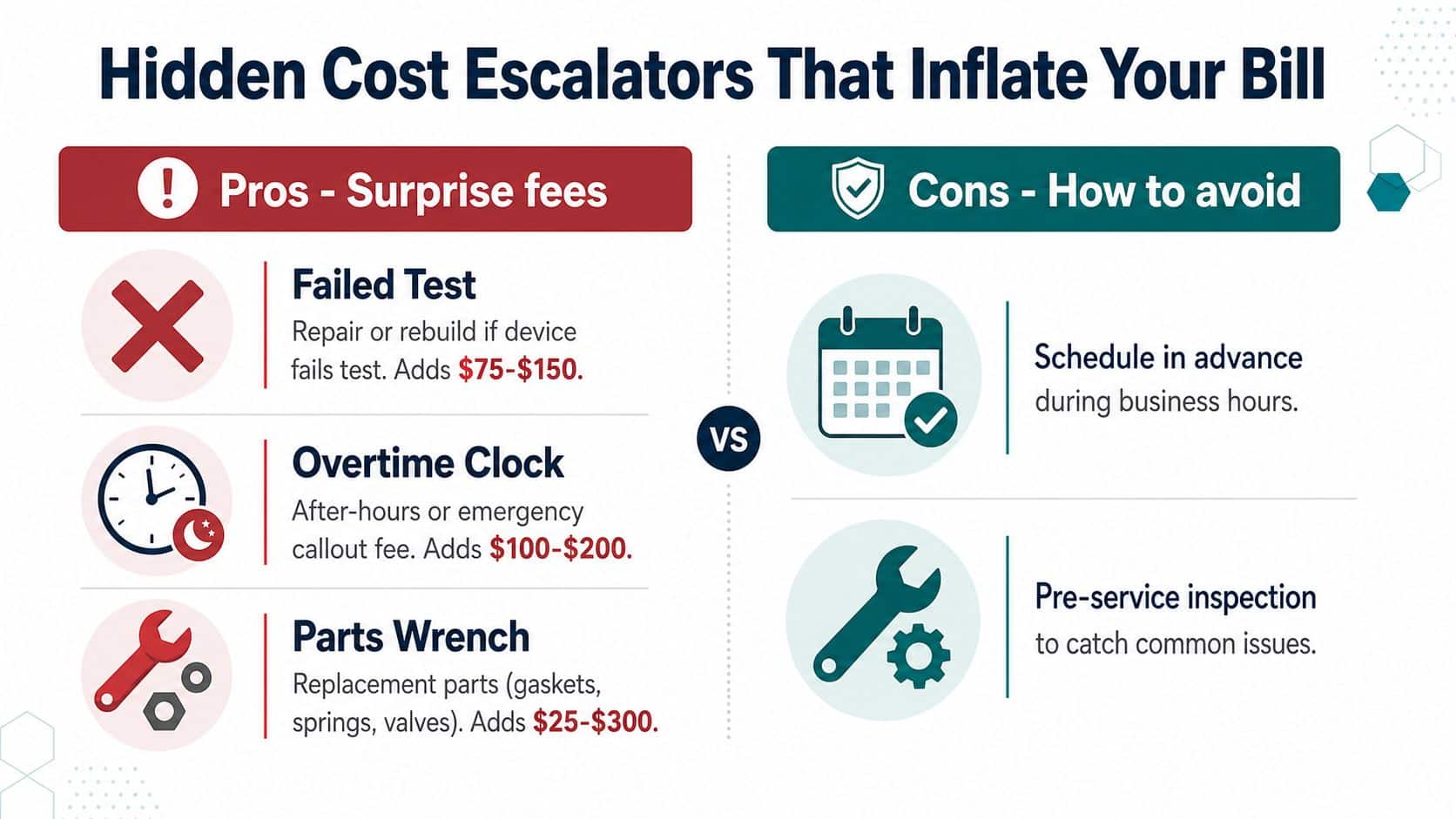
The initial test price is often the least surprising part of the invoice. The bigger budget problems appear when the assembly fails, the site contains several devices, or the quote excludes report handling and retesting.
Failed tests create a second service event
A failed test doesn't automatically mean the entire device must be replaced. The technician may find a worn internal component, a fouled check, a leaking test cock, or another repairable defect. The cost depends on the device, the failed component, access, and whether the contractor can complete the repair during the original visit.
The retest is the part owners often miss. One published pricing guide places residential retests around $35 to $110 and commercial retests around $60 to $200, while larger or complex assemblies can require $200 to $500 or more per assembly. Those figures are listed in this backflow testing pricing reference. Ask for the retest policy before work begins, because some contractors include recertification after their repair and others bill every follow-up visit separately.
Multiple devices multiply the exposure
A property with several assemblies doesn't just pay one base service charge. Each device requires identification, testing, documentation, and often a separate result in the water provider's system. Annual totals can rise above $1,000 on properties with many devices, particularly when repairs or retests are added, as the same pricing reference explains.
Site organization can reduce wasted technician time, but it won't eliminate the per-device work. Keep an inventory showing each assembly's location and service line. If water-use monitoring is part of a broader property-management program, owners may also find it useful to review sub metering from Axis Meter Solutions separately from backflow compliance. Submetering and backflow testing serve different purposes, but both benefit from accurate fixture and service-line records.
Paperwork can be a separate charge
Some quotes include report preparation and filing. Others list administrative handling or district fees separately. The water provider may also charge its own filing fee, which isn't the same as a contractor's administrative charge.
Before approving the job, request a written breakdown showing the test, filing, travel, repairs, and retest treatment. That simple request exposes most of the cost differences between competing bids.
Why Annual Compliance Is Non-Negotiable in Los Angeles
Backflow testing protects the public drinking-water system from contamination moving backward through a cross-connection. A device can look intact from the outside while an internal check valve, relief valve, spring, or seal has deteriorated. A visual inspection can't confirm that the assembly will perform under pressure.
Los Angeles requirements vary by water provider and property setup, so the notice from the supplying utility should control the due date, approved tester requirements, and submission process. For properties with testable assemblies, annual compliance is a recurring operational obligation, not an optional maintenance suggestion. New Jersey offers a clear example of this regulatory approach, where guidance explicitly requires annual testing of all testable backflow prevention devices and describes professional testing as a reportable service. The related cost discussion is available in this annual backflow test cost guide.
The cost of delay is operational, not just financial
When an owner misses a deadline, the property may receive a warning or compliance notice. Continued noncompliance can lead to escalating enforcement, fines, or interruption of water service, depending on the water provider's rules and the seriousness of the issue. The exact consequence isn't identical across Los Angeles, so property managers should read the notice rather than rely on a generic assumption.
A failed device also needs a repair or replacement decision and a compliant follow-up test. Scheduling close to the deadline leaves little room for parts, access coordination, tenant notices, or a second visit.
Schedule compliance work before the deadline, not on the deadline. The extra planning time gives the owner a chance to resolve a failed test without turning ordinary maintenance into an emergency call.
For a property-level review of the inspection process, use the backflow prevention inspection service information and confirm the applicable filing requirements with your water provider. Treat the annual test as a risk-management line item that protects water service, occupants, and the property's compliance record.
How to Get an Accurate Quote and Schedule Service
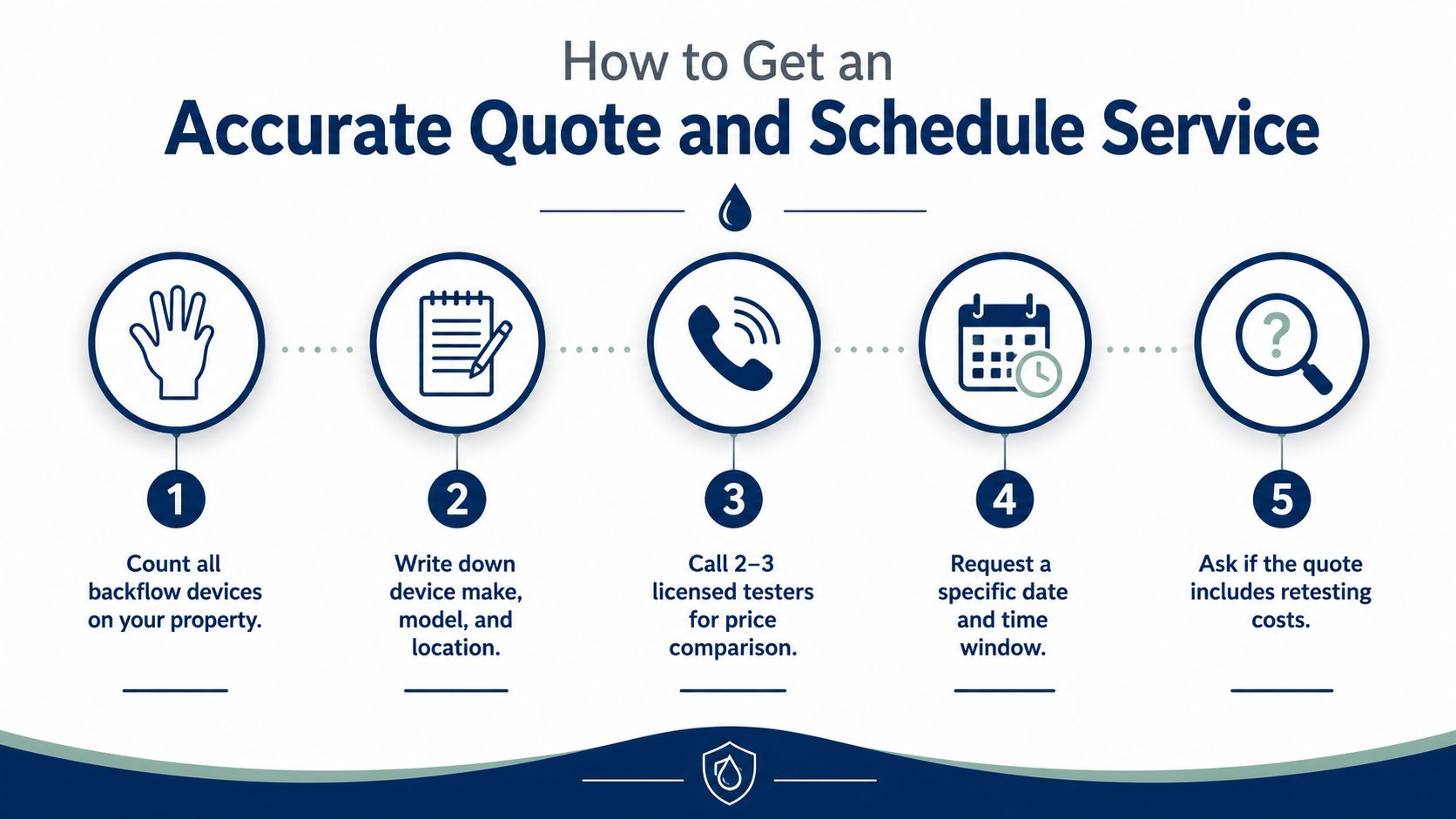
A dependable quote starts with a usable property record. A request for “a backflow inspection” leaves the contractor guessing about device count, assembly type, access conditions, and filing requirements, all of which can change the final bill.
Prepare the property record
Gather the water provider notice and previous test reports. List the number of assemblies, each location, visible make or model, approximate size, and the service protected by each device. Identify access conditions, such as a locked cage, below-grade vault, vegetated enclosure, parking structure, or another area that may require extra coordination.
Ask every licensed tester to quote the same scope:
- Does the price include every listed device?
- Is the compliance report submitted directly?
- Are district filing charges included or passed through?
- What happens if a device fails?
- Is the retest billed separately?
- Will the technician provide copies of completed reports?
Schedule during normal business hours, leaving time for repairs and a follow-up test. Coordinate shutoff notices, tenant access, fire-system procedures, and site personnel before the appointment. For properties evaluating whole-house filtration alongside compliance testing, reviewing compare water filter systems separately can prevent scope confusion during scheduling.
EZ Plumbing quotes and coordinates backflow testing for Los Angeles homes, HOAs, multi-unit properties, and commercial sites. Licensed and insured technicians handle field service and compliance details. Send the device inventory and water-provider notice with your request so the estimate reflects the actual scope, including possible retest or paperwork charges.
Contact EZ Plumbing to schedule backflow preventer testing in Los Angeles and review device count, access, filing, repair, and retest requirements. The team serves single-family properties, HOA communities, and commercial sites, helping owners complete recurring compliance work before a missed deadline affects water service.