
Same Day Water Heater Repair: Fast and Reliable Service
You wake up, turn the tap, and get nothing but cold water. The shower is waiting, the dishwasher is queued up, and the day is already moving. When a water heater fails at that moment, same day water heater repair stops being a convenience and becomes a practical way to keep a home, rental, or building functioning.
What matters most in that first hour is not panic, it's sorting the problem correctly. Some failures can be fixed with a targeted part swap, a reset, or a hydraulic refill. Others point to a tank that's leaking, corroded, or no longer worth putting money into. The difference decides whether you need a technician today, a replacement today, or a safe shutdown until help arrives.
Table of Contents
- Introduction to Same Day Water Heater Repair
- When to Call for Same Day Water Heater Repair
- Emergency Safety Steps Before Service
- Common Causes and Diagnostic Steps
- Timelines and Cost Expectations
- Repair Versus Replacement Guidance
- What to Expect from Same Day Service
- Why Choose EZ Plumbing and Next Steps
Introduction to Same Day Water Heater Repair
A water heater often fails without much warning. One hour the house has hot showers and working sinks, the next hour the tank is quiet, water is pooling where it should not, or the output never gets fully hot. That is the reason same day water heater repair exists as a dispatch model, not just a sales phrase. In major Los Angeles County markets, providers often build their schedules around short response windows instead of an open-ended queue, and one established local service says most water-heater issues can be handled the same day with regional arrival times of 60 to 120 minutes in West LA, the Westside, Pasadena, and the San Gabriel Valley, and 90 to 180 minutes in Ventura, San Bernardino, and Riverside areas, with same-day replacement possible in many regions when a failed tank is called in by 12 PM on a weekday (Ventahvac water heater service).
That timing matters because the problem is not only comfort. A leaking unit can damage flooring and nearby finishes, and a no-hot-water call can affect a single-family home just as hard as a multifamily property where several occupants depend on one system. The best same-day calls are the ones where the homeowner can describe the symptom clearly, because that helps the technician bring the right parts and start work without wasting a trip.
The decision point is simple. If the symptom points to a repairable fault, same-day service can stop the damage and restore hot water. If the tank is failing as a whole, the visit should shift to replacement quickly so the house is not left waiting while a short-term fix is forced onto a unit that is already done.
Practical rule: the faster you can describe the symptom, the faster a plumber can decide whether the unit is repairable today or whether the visit needs to pivot to replacement.
When to Call for Same Day Water Heater Repair
A water heater can look fine and still be on the edge of failure. If the tank is actively leaking, there is no hot water, you smell gas near the unit, the T&P valve is discharging, or the system has an electrical fault, that is a same-day call. Those are the jobs that should be handled as urgent service, with the unit shut down safely before a plumber starts work (Plumbers911 Chicago water heater repair FAQs).
What counts as a same-day call
The decision comes down to three things, normal use, safety, and damage risk. If the heater has stopped serving the home, is creating a hazard, or is sending water where it should not go, call for same day water heater repair. If the issue is small, inconsistent, or mostly cosmetic, a scheduled visit may be enough. That boundary matters because “same day” often means a slot on the calendar, not a guarantee that every part of the job will be finished before the day ends (Angi water heater repair questions).
There is also a difference between a repairable failure and a unit that is done. A bad thermostat, failed element, or valve issue can often be corrected on the spot. A tank with heavy corrosion, repeated leaking, or a clear structural failure usually pushes the visit toward replacement instead of a short-term patch. Homeowners get better results when they treat the call as triage, not just a request for hot water.
Why early scheduling changes the outcome
Call time affects what the technician can do. Early in the day, there is more room to route the truck, confirm parts, and decide whether repair or replacement makes sense before the schedule fills up. When the call comes in late, the same problem can turn into a delay because the crew no longer has the parts or time to finish the work that day.
That is why early notice matters on failed tanks and major shutdowns. One regional provider notes that same-day replacement may be possible in many areas when a failed tank is reported by midday on a weekday, which shows how much the dispatch window depends on truck inventory and routing as much as the repair itself.
If the heater is leaking, fully cold, or shutting off again after a reset, make the call right away. A delayed response narrows the options, especially when the job needs parts that are not already on the truck. For a quick symptom guide before the plumber arrives, see this water heater broken guide.
Emergency Safety Steps Before Service
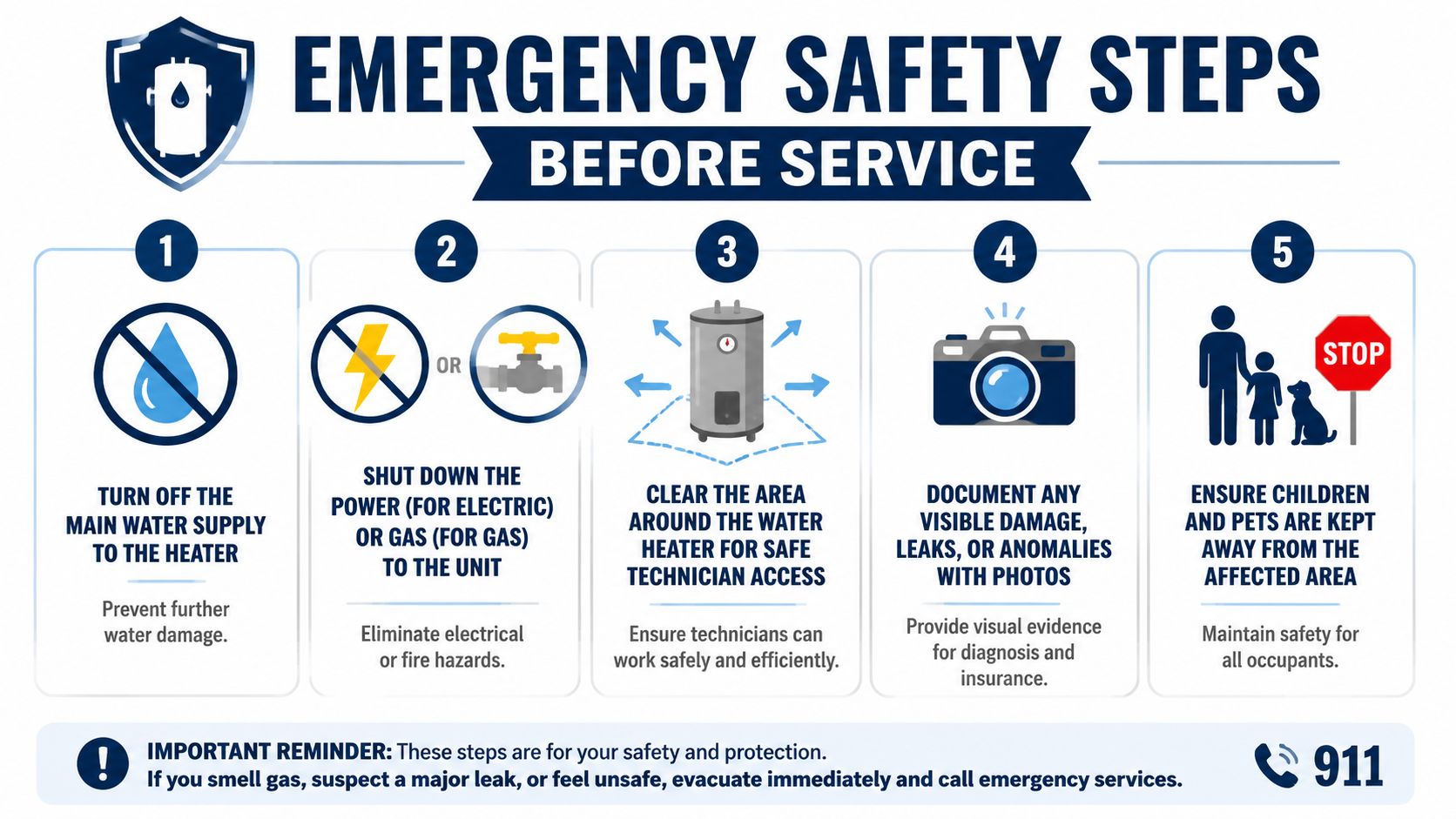
The safest first move is to make the area boring. No one should be standing next to a wet electrical connection, a hot flue area, or a leaking tank trying to “see what happens next.” If the floor is wet, if there's a gas smell, or if the water heater is in a closet with tight access, you want the unit isolated before a technician arrives.
- Shut off the water supply to the heater so the leak doesn't keep feeding itself.
- Turn off power or gas to the unit, depending on the fuel type.
- Clear the area around the heater so the plumber can get in, test, and replace parts without delay.
- Take photos of visible leaks, corrosion, valve discharge, or panel damage.
- Keep children and pets away from the utility area until the problem is secured.
For an additional reference point on common outage symptoms and shutoff guidance, see this water heater troubleshooting resource.
A shutoff doesn't solve the failure, but it does buy you control. That matters in apartments, rentals, and commercial spaces where one unit's leak can affect more than one occupant.
Common Causes and Diagnostic Steps
A no-hot-water call starts with the simplest question, not the biggest one. Is the heater receiving power or gas? Is the unit full of water? Is the safety device tripped? Those checks matter because replacing a whole water heater for a reset issue wastes time and money.
The technician's first pass
State Water Heaters' service guidance starts with power supply checks, then the high-limit ECO reset, then thermostat verification, and then element tests, with 120°F as the target hot setting (State Water Heaters service guidance). That sequence is useful because it separates a control problem from a failed heating component. A tripped ECO can shut a unit down without any tank damage, while a bad element can leave one side of an electric heater dead and the rest of the system intact.
Why fill procedure matters before re-energizing
Manufacturer instructions for A. O. Smith units say to open the cold-water supply, bleed air through the nearest hot faucet until a constant flow is established, and then check all piping and connections for leaks before returning the heater to service (A. O. Smith installation and service instructions). That sequence prevents dry-firing on electric units and helps expose leaks before the system is pressurized and heating again.
| Symptom | Likely diagnostic path |
|---|---|
| No hot water | Check power or gas, ECO, thermostat, then elements |
| Partial hot water | Look at one failed element, thermostat setting, or fill issue |
| Unit won't restart | Confirm shutoff status, reset logic, and safety controls |
A targeted diagnostic is the difference between a same-day repair and a costly guess. If the tank is sound, the right component can often bring it back that same visit.
Timelines and Cost Expectations
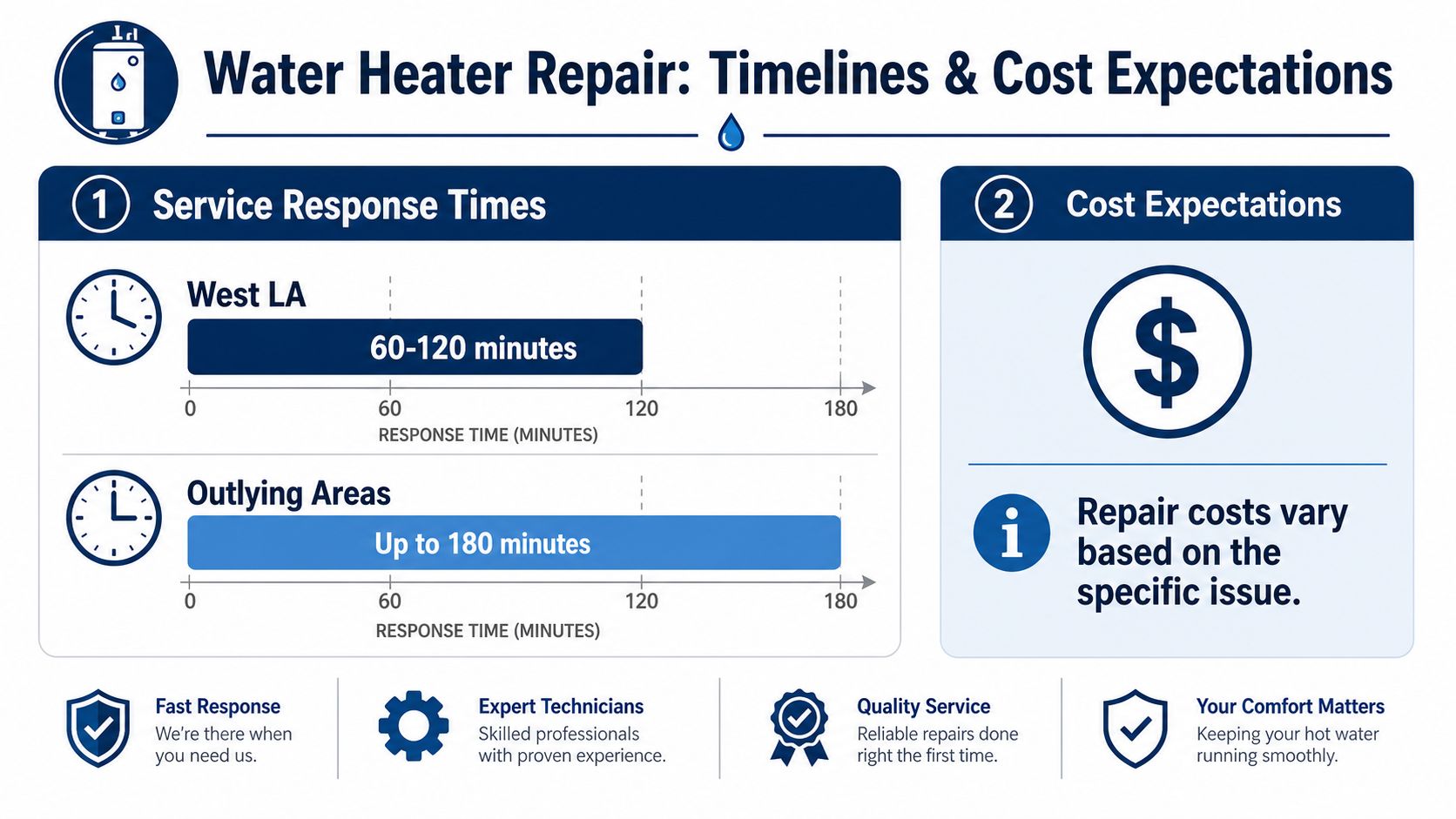
Homeowners typically encounter dual pressures: the loss of hot water and the need to make a rapid financial decision. In Los Angeles, same-day service often depends on how close the technician is to the call, how many jobs are already on the board, and whether the issue can be repaired on the spot. A local provider notes shorter response windows in Westside neighborhoods and longer windows in outlying areas, reflecting dispatch and travel time.
What repair usually costs compared with replacement
Local pricing guides show a wide spread because the work itself varies so much. Los Angeles water heater pricing data puts typical repairs at an average of $662, with a common range of $229 to $1,121, while small parts may cost $50 or less. Replacement generally starts around $850 to $1,800 or more, depending on the unit, so a repair quote only makes sense when the tank still has usable life left. For a practical look at the signs that push a job toward replacement, see these water heater replacement indicators.
What that means in practice
A same-day visit is usually a good investment when the failure is isolated and the tank is still structurally sound. A bad thermostat, a failed element, or a control issue can leave the heater unusable without meaning the whole unit is done. If the tank is leaking, rusted through, or failing in a way that points to the shell itself, repair money can disappear fast without solving the underlying problem.
For a homeowner, the decision boundary is straightforward. Same-day repair is for systems that can be restored safely with a part, a reset, or a correction in the field. Replacement becomes the better call when the unit is tired, the damage is inside the tank, or the repair cost starts closing in on what a new heater provides.
Repair Versus Replacement Guidance
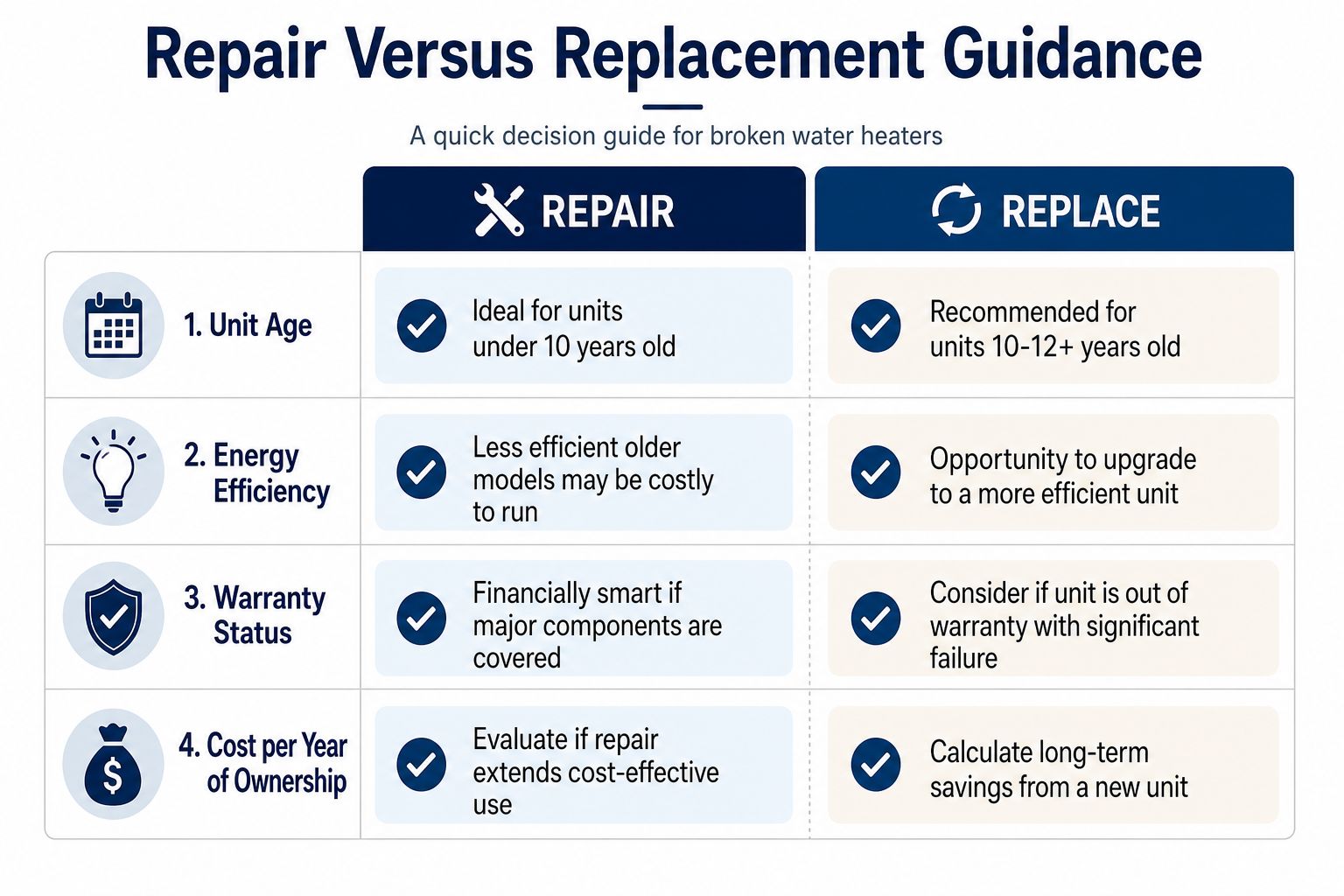
The right decision usually shows up in the symptoms before the estimate does. A thermostat, element, valve, or control problem can make a water heater look worse than it is. A leaking or rusted tank tells a different story, because no part swap fixes a shell that's failing from the inside.
When repair makes sense
Repair is usually the smarter move when the unit is still structurally sound, the failure is isolated, and the heater's age and service history don't point to repeated breakdowns. If the problem is a reset, a thermostat, or a heating element, a same-day fix can restore hot water without forcing a full system change. For a practical checklist on replacement warning signs, see these water heater replacement indicators.
When replacement is the unavoidable call
Replacement becomes hard to avoid when the tank is leaking, the failure is recurring, or the repair does not align with the remaining useful life of the unit. That's especially true when the fix addresses symptoms but not the underlying wear. In those jobs, same-day service may still happen, but the service may end with a replacement recommendation rather than a repair invoice.
How to think about the cost per year of ownership
A cheaper repair is not always the better value. If a unit needs repeated service or can't hold temperature reliably, the “savings” disappear quickly. The best decision is the one that gets hot water back today without buying a second problem next month.
What to Expect from Same Day Service
Same-day water heater work starts with a quick triage call. A dispatcher needs the symptom, fuel type, access details, and whether there is active leaking so the technician can arrive prepared. If the unit is still dripping or the water has gone cold without warning, those details help decide whether the visit should be treated as a repair call, a replacement call, or a safety check first.
The homeowner also helps the clock by giving clear access notes. A side yard gate, a locked closet, a garage panel, or a tight attic space can change how long the visit takes and what parts the tech should bring. If you are looking for same-day plumbing service near me, choose a provider that asks those questions before dispatching anyone.
The visit usually moves in this order
The technician arrives, identifies the failure, and checks whether the heater is still worth repairing. A bad thermostat, a failed element, a control issue, or a valve problem can often be fixed on site if the unit is otherwise in sound condition. A leaking tank changes the answer fast, because a shell that is rusting or split from the inside does not get saved by a part swap.
If the problem is repairable and the truck carries the needed part, the work can usually be finished during the same visit. If the part is not on hand, the plumber may confirm the diagnosis, make the unit safe, and set up a return visit or a parts run. That delay is not a sales tactic, it is a practical boundary between a true same-day repair and a job that needs a different fix.
After the repair, the plumber tests the system, checks temperature recovery, and looks for leaks, unusual noises, or unstable operation. A proper closeout matters because a heater that powers on is not the same as a heater that holds temperature and runs safely. When the issue points to a short repair path, the goal is to restore hot water and avoid pushing a failing unit into another breakdown.
Why Choose EZ Plumbing and Next Steps
Los Angeles homeowners and property managers usually need two things at once, a fast response and clear decision-making. EZ Plumbing is a licensed, insured plumbing contractor serving Los Angeles since 1989, with coverage across Beverly Hills, Santa Monica, West Hollywood, Pasadena, Glendale, Burbank, and the San Fernando Valley. Its service model includes 24/7 emergency response, same-day scheduling for planned repairs, and water heater repair and performance tuning for both tank and tankless systems, which matters when the problem is urgent but not every problem calls for full replacement.
The practical value for a water-heater call is straightforward. A dispatcher can identify whether the issue sounds like a leak, a no-hot-water outage, or a gas-related concern, then send a technician who can evaluate repair versus replacement on site. For property managers, that kind of triage reduces back-and-forth. For homeowners, it shortens the time between the first cold shower and a real answer.
If you're trying to move now, have the model, fuel type, and any visible symptoms ready before you call. Photos of leaks, a note about whether the breaker has tripped, and a clear description of when the hot water stopped all help the technician bring the right parts. Call (818) 908-2710 or schedule online at ez-plumbing.com if you need same-day evaluation or emergency dispatch.
A CTA for EZ Plumbing.