
Hot Water Not Lasting Long: 2026 Fixes & Expert Tips
You step into the shower expecting a normal morning, and the water goes cold before you've even finished rinsing shampoo. Or the kitchen sink stays hot, but the shower turns lukewarm halfway through. In Los Angeles, that pattern usually isn't random. It's a clue.
Most homeowners jump straight to “the water heater is dying.” Sometimes that's true. Often, it isn't. Hot water not lasting long usually comes down to a short list of causes, and the fastest way to solve it is to check them in the right order. In this area, hard water changes that order. Sediment and anode rod wear deserve attention earlier than most generic guides suggest.
The good news is that you can sort this out logically. Some checks are safe for a homeowner. Others involve electricity, gas, pressure, or code issues and need a licensed plumber. Knowing where that line is matters just as much as finding the actual fault.
Table of Contents
- Why Your Hot Shower Suddenly Ends
- The Most Common Culprit Sediment and Anode Rods
- Checking Your Water Heaters Key Components
- System-Wide Problems Beyond the Heater Tank
- Your Troubleshooting Roadmap When to Call EZ Plumbing
- Lasting Hot Water and Professional Solutions
Why Your Hot Shower Suddenly Ends
A common Los Angeles call goes like this: the first few minutes are fine, then the shower turns cold fast, but the bathroom sink still seems warm. Another version is a family that suddenly can't get two back-to-back showers out of a tank that used to manage it without drama.
Those details matter. If hot water fades everywhere in the house, the heater itself moves to the top of the list. If the problem happens only at one fixture, the tank may be doing its job and the trouble may be inside the valve or that branch of piping. If pressure also changed, that points the diagnosis in a different direction, and it's worth comparing symptoms with common causes of low hot water pressure before replacing anything.
Practical rule: Don't diagnose a water heater from one shower alone. Test the kitchen sink, another lavatory, and timing between fixtures.
The fastest approach is simple:
- Check whether the problem is whole-house or fixture-specific. Run hot water at more than one fixture.
- Notice whether hot water is short, weak, or interrupted. “Runs out” and “goes cold suddenly” are not always the same problem.
- Look for warning signs at the heater. Water at the base, rust, burnt wiring smell, unusual noises, or burner issues change the urgency.
- Stop if electricity or gas is involved and you're unsure. A wrong move around a water heater can damage the unit or create a safety hazard.
Addressing this issue doesn't require becoming a plumber. The proper order of operations is all that's necessary. Start with the most common and most local causes first. Leave the high-risk testing for the parts of the job that require tools, meters, and licensing.
The Most Common Culprit Sediment and Anode Rods
In Los Angeles, hard water is rough on storage water heaters. Before you assume a major failure, look at what happens inside the tank over time.
Why Los Angeles water heaters lose capacity fast
Sediment buildup is the most prevalent cause of hot water running out prematurely. Industry data indicates that approximately 50% of water heater efficiency losses stem from mineral accumulation, and in hard-water areas like Los Angeles, sediment can reduce a standard 50-gallon tank's effective capacity by up to 15 gallons, which strips away nearly 30% of heated water storage according to this industry discussion of sediment-related hot water loss.
That loss doesn't stay theoretical. A sediment layer settles at the bottom of the tank and acts like insulation between the burner or heating element and the water you want heated. The heater runs longer, recovers slower, and delivers less usable hot water.
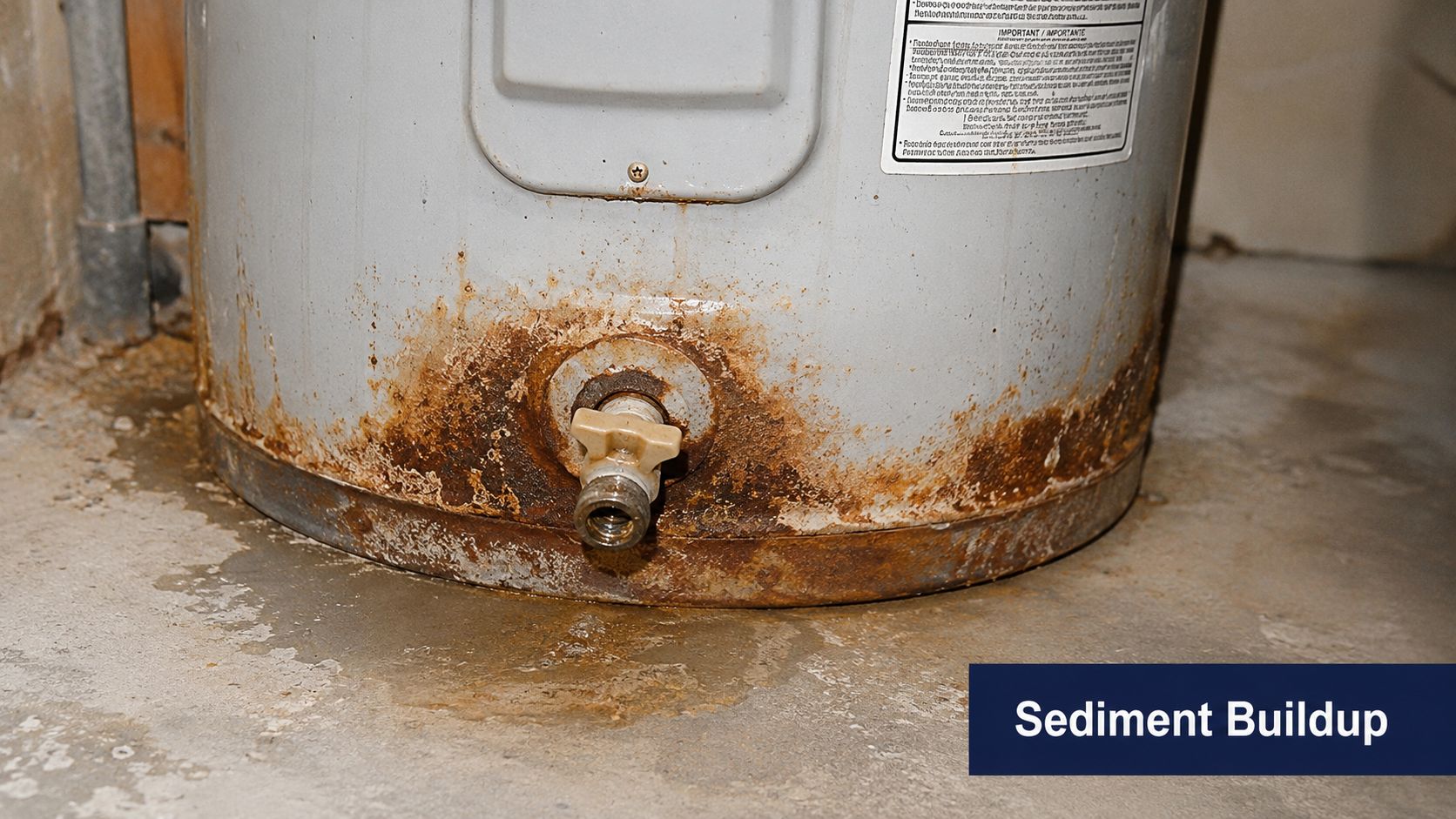
If your heater rumbles, pops, or seems to recover poorly after one shower, sediment is a strong first suspect. It's also one of the few common causes that many homeowners can address safely if the tank is otherwise sound and there's no sign of leakage or severe corrosion.
How to flush a tank safely
Flushing isn't glamorous, but it often tells you a lot. Done carefully, it can improve performance and show whether you're dealing with simple accumulation or a tank that's farther gone.
- Shut off the energy source. Turn off power at the breaker for an electric unit. Set a gas unit to the appropriate off setting before draining.
- Close the cold water supply. This stops the tank from refilling while you're trying to empty it.
- Connect a garden hose to the drain valve. Route it to a safe drain location where hot water won't cause damage.
- Open a nearby hot water faucet. That breaks vacuum and helps the tank drain.
- Open the drain valve slowly. If flow is weak, sediment may be clogging the valve opening.
- Briefly reopen the cold water supply to stir the tank. Short bursts help suspend loosened sediment so it can wash out.
- Close the drain, disconnect the hose, and refill fully. Then restore power or relight the unit only after the tank is properly full.
If the drain valve won't flow, leaks after use, or the tank shows rust at the seams, stop there. That's no longer simple maintenance.
When the anode rod matters more than another flush
Homeowner guides talk about sediment all day and barely mention the anode rod, which is a mistake in Southern California. The rod is the sacrificial metal component designed to corrode first so the steel tank doesn't.
In hard-water conditions, it can wear out much faster than people expect. Once it's depleted, the tank loses a key line of defense against internal rust. That can reduce useful storage and lead to a heater that seems to “lose capacity” even before sediment becomes the obvious story.
Here's the trade-off:
- If the unit has gone a long time without maintenance but still looks structurally sound, flushing is the logical first move.
- If the tank is aging early in a hard-water area, the anode rod deserves serious attention.
- If corrosion is visible around fittings or the base, don't keep forcing DIY maintenance. You may be dealing with a tank close to failure.
A lot of short-hot-water complaints start here. It's the highest-probability place to save time, money, and frustration.
Checking Your Water Heaters Key Components
If flushing didn't change much, the next step is to look at the parts that control how the heater stores, heats, and delivers water.
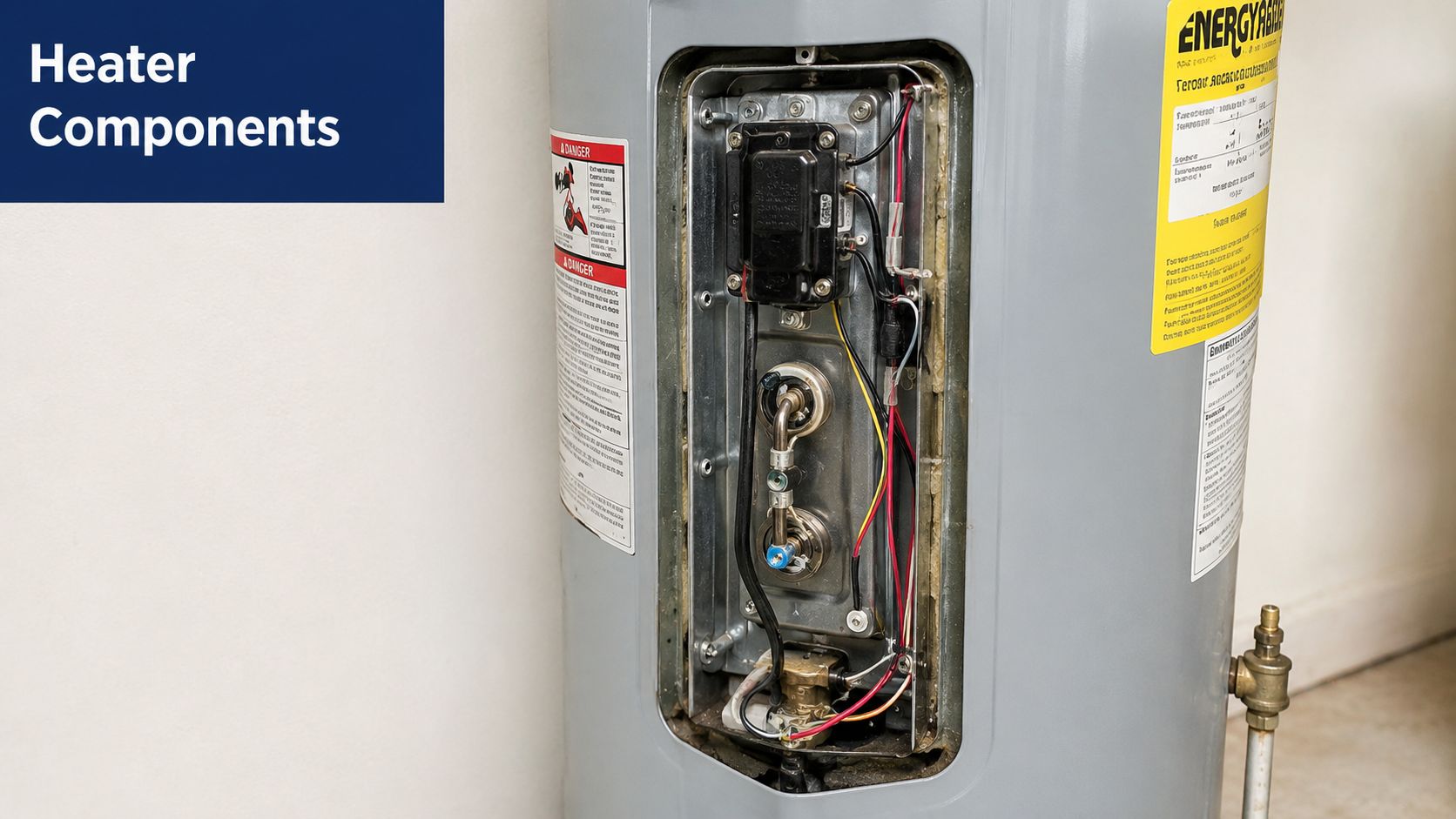
Start with the symptom pattern
A heater can fail in ways that look similar from the shower but mean different things inside the tank.
If you get a little hot water, then quick cooling, think about parts that affect full-tank heating or hot/cold separation. A failed dip tube can let incoming cold water mix too high in the tank, so hot water delivery feels short even though the heater is technically on. This issue is less obvious than a dead heater because you still get some warmth, just not enough.
If you get inconsistent hot water, especially after the unit should have had time to recover, thermostat or heating problems move up the list. If you get no meaningful hot water at all, the diagnosis shifts harder toward power, controls, gas ignition, or complete element failure.
A useful side check for owners of on-demand systems is to review proper tankless water heater cleaning and descaling because scale inside a tankless unit can create delivery symptoms that feel like a source problem.
Electric heater checks that actually narrow it down
Electric heaters have a reputation for “just not keeping up,” but the failure usually lives in a small group of components. Heating element failure accounts for approximately 50% of electric water heater service calls, and a functioning 4,500-watt element should read between 10–16 ohms on a multimeter. A reading of zero or infinity indicates a burned-out element, as described in this electric water heater diagnostic reference.
That matters because a partially failed electric heater often still makes some hot water. Homeowners mistake that for “undersized heater” when it's really one dead element.
What the parts do
- Upper thermostat and upper element handle the first stage of heating and help prioritize initial hot water availability.
- Lower thermostat and lower element do much of the work maintaining the tank's full volume of heated water.
- A failed lower element often shows up as short-duration hot water. You start warm, then run out much sooner than normal.
For homeowners with a multimeter and the right comfort level, testing resistance can confirm a burned-out element. But safety is not optional. The circuit must be off at the breaker, and verification matters more than assumption.
A visual check alone isn't enough. Corrosion on an element can look minor while the internal resistance has already failed.
One mistake destroys brand-new parts fast. If an electric tank isn't fully refilled before power is restored, the new element can burn out immediately. That's one reason many people save little by doing a rushed replacement.
Here's a quick symptom-to-part comparison:
| Symptom | More likely issue |
|---|---|
| A few minutes of hot water, then fast cooling | Lower element or dip tube |
| No meaningful hot water | Power issue, thermostat, or multiple component failure |
| Heater trips or wiring looks scorched | Electrical fault requiring professional service |
For readers who want a visual walkthrough of common electric heater parts, this overview helps show how the components are laid out and accessed:
Gas heater issues that mimic a bad tank
Gas models fail differently. If the burner is dirty, combustion is poor, or the control side has a problem, the heater may recover too slowly between uses. To a homeowner, that often feels exactly like “hot water not lasting long.”
Look for patterns rather than trying to force a diagnosis from one symptom:
- Normal first use, poor recovery later can point to burner performance.
- Intermittent heating may involve controls or ignition-related problems.
- Sooting, gas odor, or pilot trouble are firm stop signs for DIY work.
Gas appliances cross a clear safety line. Cleaning exterior areas and observing behavior is one thing. Opening gas controls or trying to repair burner or ignition components without training is another.
System-Wide Problems Beyond the Heater Tank
A lot of water heaters get blamed for problems they didn't create. The tank may be heating correctly, while the plumbing system, fixture controls, or usage pattern steals the result before it reaches you.
When the heater is fine but the house isn't helping
Start with demand. If someone is showering while the dishwasher runs and a load of laundry is pulling hot water, the heater can be overwhelmed even when nothing is technically broken. That isn't a mysterious failure. It's a supply-and-demand mismatch inside the house.
The same goes for distribution issues. Leaks, restrictions, and pressure-related stress can all change how hot water behaves at fixtures. This visual summarizes several system-side causes that homeowners overlook.
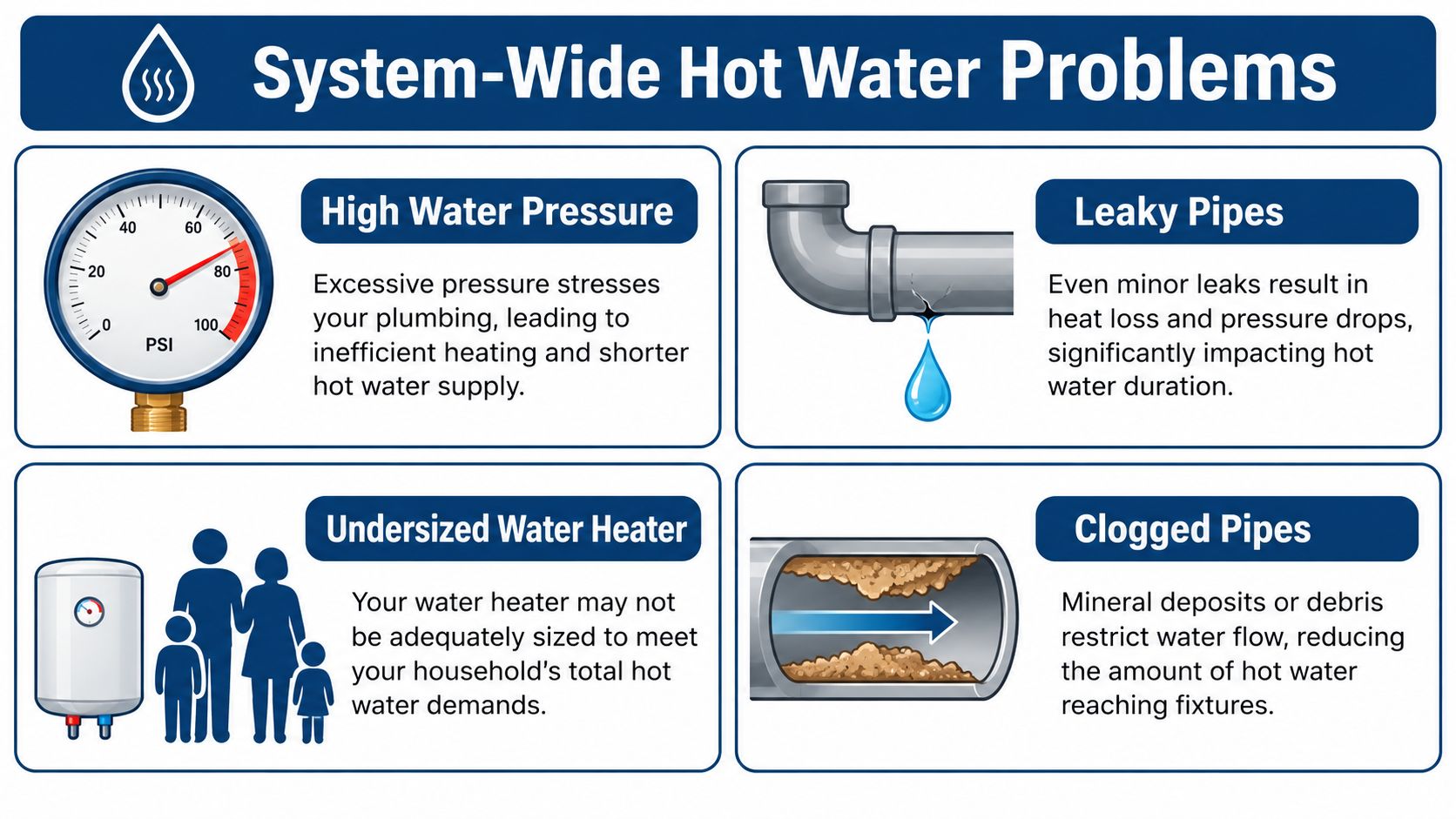
If one bathroom struggles while the rest of the house behaves normally, think local first. If the whole house comes up short only during heavy use, think demand before disassembling equipment.
The shower valve problem people mistake for a bad heater
This one gets missed all the time. Modern single-handle shower valves blend cold and hot water internally, and when the thermostatic element fails, it can inject too much cold water and cause a cold shock mid-shower even if the tank is still full, as noted in this discussion of failed shower mixing valves.
That's why “the shower goes cold but the sink is still hot” is such an important clue. The heater may not be the problem at all.
Signs that point toward the shower valve instead of the tank:
- Only one shower has the issue
- Kitchen and lavatory hot water remain normal
- The temperature shifts suddenly instead of fading gradually
- Adjusting the shower handle doesn't restore stable heat for long
If one fixture misbehaves while the rest of the house still has solid hot water, stop blaming the tank until the valve is checked.
A failed anti-scald or thermostatic valve usually isn't a smart DIY repair unless you already know the trim and cartridge family you're dealing with. Recalibration, cartridge replacement, and code-safe temperature setting are better handled by a plumber.
Tankless quirks that feel like a supply problem
Tankless systems add their own behavior. Mineral scale can restrict heat transfer. Ignition issues can cause intermittent hot water. Some homes also notice the familiar “cold water sandwich,” where a brief burst of cool water arrives between hot draws.
Those aren't the same as a failing storage tank, and the fix isn't the same either. If you have a tankless unit, diagnose the unit type first before applying tank-style advice.
Your Troubleshooting Roadmap When to Call EZ Plumbing
By this point, the goal is simple. Don't chase every possibility at once. Start with the highest-probability causes, eliminate the safe DIY items, and stop before the job crosses into electrical, gas, or code-sensitive work.
In Southern California, over 40% of premature water heater failures under 8 years are linked to anode rod depletion, and that's why local troubleshooting should give the rod more attention than many generic guides do, as noted in this discussion of hard-water anode rod wear. For plumbers and service businesses trying to explain issues like this clearly online, these strategies for plumbers to dominate local search are useful because they show how local education can match real homeowner problems instead of generic advice.
Hot Water Diagnostic Checklist
| Symptom | Likely Cause | DIY Fix Difficulty | When to Call EZ Plumbing |
|---|---|---|---|
| Hot water duration has slowly shortened across the whole house | Sediment buildup | Moderate | Call if the drain valve won't clear, the tank leaks, or corrosion is visible |
| Heater seems too young to be losing performance in a hard-water area | Anode rod depletion | Moderate to advanced | Call if the rod is seized, access is limited, or the tank shows rust |
| You get some hot water, but it runs out fast on an electric unit | Failed lower heating element or thermostat issue | Advanced | Call before testing or replacing parts if you're not comfortable using a multimeter and isolating power safely |
| Water goes cold in one shower, but other fixtures stay hot | Failed mixing valve or anti-scald valve | Moderate to advanced | Call if the valve needs recalibration, cartridge identification, or trim removal |
| Hot water disappears mainly during multiple simultaneous uses | Household demand exceeding available supply | Easy | Call if the pattern persists even when fixtures are used one at a time |
| Gas unit has poor recovery, burner issues, odor, or ignition trouble | Burner or gas control problem | Unsafe for DIY | Call immediately for gas-related diagnosis and repair |
| Tankless unit alternates hot and cold unexpectedly | Scale, ignition issue, or unit-specific fault | Moderate to advanced | Call if descaling doesn't apply, errors repeat, or ignition is inconsistent |
| Water is pooling under the heater | Tank or connection leak | Stop DIY | Call immediately. A leaking heater can fail without much warning |
A few rules keep people out of trouble:
- Safe homeowner checks include fixture comparison, usage timing, visual inspection, and basic flushing if the tank is stable.
- Borderline tasks include anode rod work, cartridge diagnosis, and tankless service. These depend on tool access and experience.
- Professional-only work includes gas controls, active leaks from the tank body, scorched wiring, and live electrical diagnostics if you're unsure.
EZ Plumbing handles water heater repair, tankless service, gas-related plumbing work, and emergency calls in Los Angeles. If the issue has moved past simple maintenance, that's the point to stop troubleshooting and schedule a proper diagnosis.
Lasting Hot Water and Professional Solutions
A common desire is a straightforward answer. The solution generally stems from a combination of maintenance, correct diagnosis, and not ignoring early symptoms.
Is the heater too small for the house
Sometimes, yes. But don't assume that first. A tank that used to meet the household's routine and no longer does often has a maintenance or component problem before it has a sizing problem.
Is turning up the thermostat a good fix
Usually not as a first move. It can mask the underlying issue and create scalding risk, especially if a shower valve is already blending improperly. Temperature changes should be deliberate, not a guess.
What maintenance matters most in Los Angeles
Hard-water maintenance matters more here than in many generic guides. Regular flushing helps. Anode rod inspection matters. Paying attention to recovery time, strange sounds, rust, and fixture-specific temperature swings catches problems earlier. A solid maintenance routine is easier to follow if you understand the basics of water heater maintenance.
The best repair is the one you make before the tank starts leaking.
If your hot water still isn't lasting, or the symptoms involve gas, electricity, leaks, or a stubborn fixture-side problem, get it checked correctly. That saves time, avoids repeat failures, and protects the heater you already have.
If your shower keeps turning cold, the tank is leaking, or you want a licensed diagnosis before replacing parts, contact EZ Plumbing. They serve Los Angeles with scheduled water heater repairs and 24/7 emergency plumbing support for homes, HOAs, property managers, and commercial properties.