
What Is a Plumbing Submittal? A Contractor’s Guide
A plumbing submittal is a mandatory compliance document prepared by a contractor to prove that proposed plumbing materials and equipment meet project specifications and code requirements before procurement or installation begins. The package typically includes product data sheets, shop drawings, performance specifications, installation instructions, and third-party certifications such as NSF/ANSI 61. Without an approved submittal, no licensed contractor should order fixtures, valves, or piping systems for a project. Understanding the plumbing submittal process protects your schedule, your budget, and your legal standing on every job.
What is a plumbing submittal package and what does it include?
A complete plumbing submittal package is a structured collection of documents that proves every proposed product aligns with the engineer’s design intent and applicable codes. Each document type serves a specific verification purpose, and a missing item can stop the review clock entirely.
The standard components of a plumbing submittal include:
- Product data sheets: Manufacturer cut sheets for fixtures, pumps, valves, and piping that confirm model numbers, dimensions, pressure ratings, and material composition.
- Shop drawings: Scaled drawings showing exact placement, routing, and coordination of plumbing systems within the building structure, including clearances and connection points.
- Third-party certifications: Documents such as NSF/ANSI 61 listings for potable water products, confirming independent laboratory verification of safety and performance.
- Performance specifications: Technical data confirming flow rates, pressure drop, temperature ratings, and other measurable criteria required by the project specifications.
- Installation instructions: Manufacturer-issued guidance confirming that the product can be installed per the design requirements.
Beyond the document types, contractors must also understand the distinction between submittal categories. Action and informational submittals serve different purposes on a project. Action submittals legally require formal approval before procurement can proceed. Informational submittals go on record but do not hold up field progress. Misclassifying a submittal type causes unnecessary project stoppages and misaligns expectations between the contractor and the design team.
Pro Tip: Read the project’s specification Division 22 (Plumbing) front to back before assembling your package. The spec will list every required certification, submittal type, and format requirement. Skipping this step is the single fastest way to trigger a resubmission.

How does the plumbing submittal review process work in 2026?
The review process follows a defined sequence that every contractor must respect to protect the project schedule. Submitting early and submitting completely are the two variables entirely within your control.
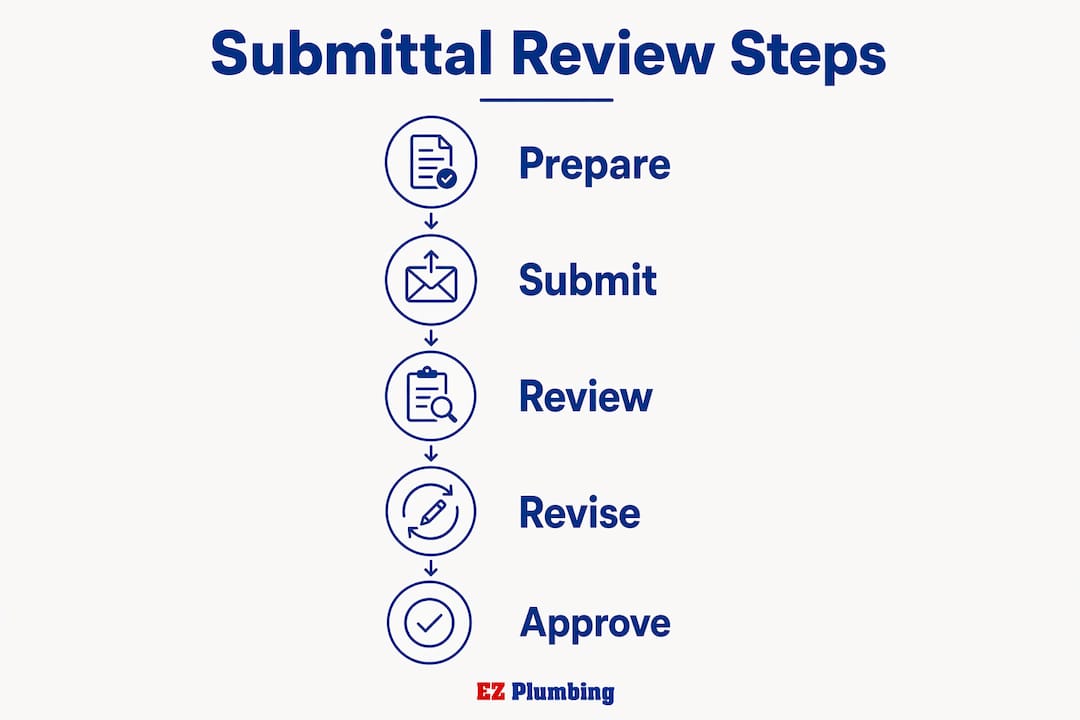
The typical review workflow runs as follows:
- Contractor assembles the package by gathering all required product data, shop drawings, certifications, and coordination information per the specification requirements.
- General contractor or construction manager reviews the package internally before forwarding it to the design team, checking for completeness and obvious non-conformances.
- Architect or engineer of record receives the package and begins the formal review period, verifying that proposed materials align with design intent and code compliance.
- Design team issues a review status from four standard designations: Approved, Approved as Noted, Revise and Resubmit, or Rejected.
- Contractor acts on the status. Approved and Approved as Noted allow procurement to proceed. Revise and Resubmit requires corrections and a full resubmission.
The review period runs 14–21 business days under standard contract terms. That timeline only begins once a complete, compliant package lands with the design team. A package missing required certifications or coordination data gets returned without review, and the full 14–21 day clock resets upon resubmission. On a tight schedule, a single incomplete submittal can cost three to five weeks of procurement lead time.
One point contractors frequently misunderstand: the engineer’s role is verification, not re-engineering. An engineer’s stamp confirms that the proposed materials conform to the design intent. Responsibility for means, methods, and field coordination stays with the contractor. The stamp does not transfer liability for installation decisions.
What are common reasons plumbing submittals get rejected?
Rejection is almost always preventable. The most consistent causes trace back to incomplete documentation and insufficient attention to specification requirements before submission.
| Common Rejection Cause | How to Avoid It |
|---|---|
| Spot-checking fixture schedules instead of reviewing tag-by-tag | Cross-reference every fixture tag against the schedule and spec section individually |
| Assuming manufacturer-wide NSF/ANSI 61 compliance | Verify the specific model listing on the NSF database for each product |
| Missing coordination information with mechanical, electrical, or structural systems | Include clash detection notes and coordination drawings showing clearances with other trades |
| Incomplete product data sheets with missing pressure or temperature ratings | Use the full manufacturer cut sheet, not a marketing brochure or abbreviated spec sheet |
| Wrong submittal type classification | Confirm with the spec whether each item is an action or informational submittal before packaging |
Failing to cross-reference fixture schedules tag-by-tag is a primary cause of rejection and one of the most avoidable errors in the entire process. A contractor who spot-checks five fixtures out of forty and misses a specification deviation on fixture 23 will face a full resubmission. That error delays procurement, pushes installation, and compresses the schedule for every trade that follows.
The certification issue is equally serious. NSF/ANSI 61 certification is product-specific, not manufacturer-wide. A manufacturer may hold NSF listings on certain valve models but not others in the same product line. Assuming brand-level compliance without checking the specific model on the NSF International database leads directly to rejection and a full restart of the review cycle.
Pro Tip: Before submitting, run your package against the specification’s submittal requirements checklist line by line. If the spec requires a specific certification number, include the certificate document, not just a reference to it.
Submittal packages that lack coordination information between trades are another consistent source of rejection. Shop drawings that show plumbing routing without addressing conflicts with HVAC ductwork, structural beams, or electrical conduit give the engineer no basis for approval. Include coordination drawings that demonstrate you have resolved or flagged these conflicts before the package reaches the design team.
Why are plumbing submittals critical for project management and compliance?
Plumbing submittals do more than satisfy a paperwork requirement. They function as a quality control gate, a legal record, and a coordination tool that protects every party on the project.
- Quality control gate: Submittals catch non-conforming products before they arrive on site. Returning a wrong fixture after delivery costs far more than correcting a submittal before ordering.
- Legal documentation: An approved submittal creates a written record of the materials and methods agreed upon before installation. That record protects contractors in disputes over substitutions, change orders, or warranty claims.
- Conflict detection: Submittals catch conflicts between plumbing layouts and other building systems before installation begins, reducing the risk of costly rework that disrupts the entire construction schedule.
- Inspection benchmark: Building inspectors and commissioning agents use approved submittals to verify that installed equipment matches what was reviewed and approved. A discrepancy between the approved submittal and the installed product can trigger a stop-work order.
- Trade coordination record: The submittal package documents how plumbing systems interface with mechanical, electrical, and structural systems, giving all trades a shared reference point.
Experienced construction managers treat submittals as a critical quality control gate and a legal record that establishes consensus on materials before delivery and installation. Plumbing submittals are often undervalued compared to HVAC or structural submittals, but they carry the same legal weight and the same potential for costly rework if handled carelessly. For commercial plumbing projects in particular, the submittal record becomes part of the project closeout documentation that owners and facilities managers rely on for years after construction.
Key Takeaways
A complete, accurate plumbing submittal is the single most effective tool for protecting your project schedule, your budget, and your legal standing before a single fixture is ordered.
| Point | Details |
|---|---|
| Definition and purpose | A plumbing submittal proves proposed materials meet specifications and codes before procurement begins. |
| Review timeline | The 14–21 business day review clock only starts when a complete, compliant package is received. |
| Certification specificity | NSF/ANSI 61 compliance must be verified at the individual model level, not assumed by brand. |
| Submittal types matter | Action submittals require formal approval before ordering; informational submittals do not delay procurement. |
| Submittals as legal record | Approved submittals document agreed materials and protect contractors in disputes and inspections. |
What I’ve learned from watching submittals derail good projects
After working on plumbing installations across the greater Los Angeles area, the pattern is consistent: the projects that run smoothly are the ones where the submittal package was treated as seriously as the installation itself. The projects that struggle almost always trace back to a submittal that was rushed, incomplete, or assembled without reading the specification carefully.
The most common mistake I see is treating submittals as a formality rather than a technical document. Contractors pull a cut sheet, attach a certification they assume is current, and submit without verifying the model-level details. That approach works until it doesn’t, and when it fails, it fails at the worst possible moment in the schedule.
The distinction between action and informational submittals is also underused as a planning tool. Knowing which items require formal approval before ordering lets you sequence your submittal submissions to protect your procurement lead times. Submit your action submittals first, and you protect the critical path. Submit them all at once without that prioritization, and you may wait three weeks for approval on an item that didn’t need it.
Continuous communication with the design team before submission also changes outcomes. A quick coordination call to confirm certification requirements or clarify a spec ambiguity takes thirty minutes. A resubmission cycle takes three to five weeks. The math is straightforward. For commercial plumbing insights on how submittals interact with system coordination, the investment in preparation always pays off.
— EZ
How Ez-plumbing supports compliant plumbing installations in Los Angeles
Ez-plumbing holds a C-36 Plumbing Contractor License (#583868) and serves the greater Los Angeles area with installations that align with current code requirements and submittal standards.
Whether you need a water heater installation that meets NSF-certified product requirements or a full commercial fixture installation backed by proper documentation, Ez-plumbing brings the technical knowledge to get it done right the first time. Our team understands the product certification requirements, coordination demands, and code compliance standards that drive approval on Los Angeles projects. Contact Ez-plumbing to discuss your project requirements and confirm that every installation meets the specifications your submittal package committed to.
FAQ
What is a plumbing submittal in simple terms?
A plumbing submittal is a document package a contractor prepares to prove that proposed plumbing products meet the project’s design specifications and code requirements before ordering or installing anything.
What documents are included in a plumbing submittal?
A standard plumbing submittal includes product data sheets, shop drawings, third-party certifications such as NSF/ANSI 61, performance specifications, and manufacturer installation instructions.
How long does the plumbing submittal review process take?
The review period is typically 14–21 business days, but the clock does not start until the design team receives a complete, compliant package.
What is the difference between an action and an informational submittal?
An action submittal requires formal approval before procurement can proceed, while an informational submittal is filed for record-keeping and does not hold up field work.
Why do plumbing submittals get rejected?
The most common causes are missing or unverified third-party certifications, incomplete product data, and failure to cross-reference every fixture tag against the specification schedule.