
What Is a Plumbing Trap? A Homeowner’s Guide
A plumbing trap is a curved section of pipe installed beneath sinks, showers, and tubs that holds standing water) to create a seal blocking sewer gases from entering your home. Without that water barrier, hydrogen sulfide and methane from the sewer system would flow freely through your drain lines and into your living space. Every fixture in your home has one, and understanding how it works puts you in a much better position to catch problems early and keep your home smelling clean.
What is a plumbing trap and how does it block sewer gases?
A plumbing trap works through a simple but reliable principle: water is heavier than gas. The curved shape of the pipe holds a small pool of water after every use, and that pool physically blocks any gas trying to travel backward through the drain line. The industry term for this pool is the “trap seal,” and it is the only thing standing between your bathroom and the sewer system beneath your street.
The trap seal depth must measure between 2 inches and 4 inches to perform reliably. Less than 2 inches and the seal is too shallow to resist backpressure. More than 4 inches and sediment builds up, drainage slows, and turbulence can actually disrupt the seal during heavy flow.
Venting plays an equally critical role. When water drains through a pipe, it creates negative pressure behind it. Without a vent, that suction pulls the trap water along with the draining water, a process called siphonage. The IRC 2021 P3101.2 mandates vent protection for every fixture trap precisely because siphonage is one of the most common ways a trap seal fails. A properly vented system equalizes pressure so the water stays put.
Evaporation is the other main threat. A floor drain in a utility room or a guest bathroom sink used only a few times a year can dry out completely within weeks. Once the water is gone, the seal is gone, and sewer odors move in immediately.
Pro Tip: Run water for 30 seconds in any drain you use less than once a week. That simple habit refills the trap seal and keeps sewer gases out.
- Siphonage pulls trap water out during drainage when venting is absent or undersized
- Evaporation dries out traps in seldom-used fixtures over days or weeks
- Backpressure from the sewer side can push gases through a weakened seal
- Cracked or corroded trap bodies allow water to leak out, destroying the seal entirely
What are the common types of plumbing traps?
Plumbing trap types) include the P-trap, S-trap, drum trap, and J- and Q-shaped traps, each with a different geometry and code status. Knowing which type is under your fixture tells you a lot about whether your plumbing is up to current standards.
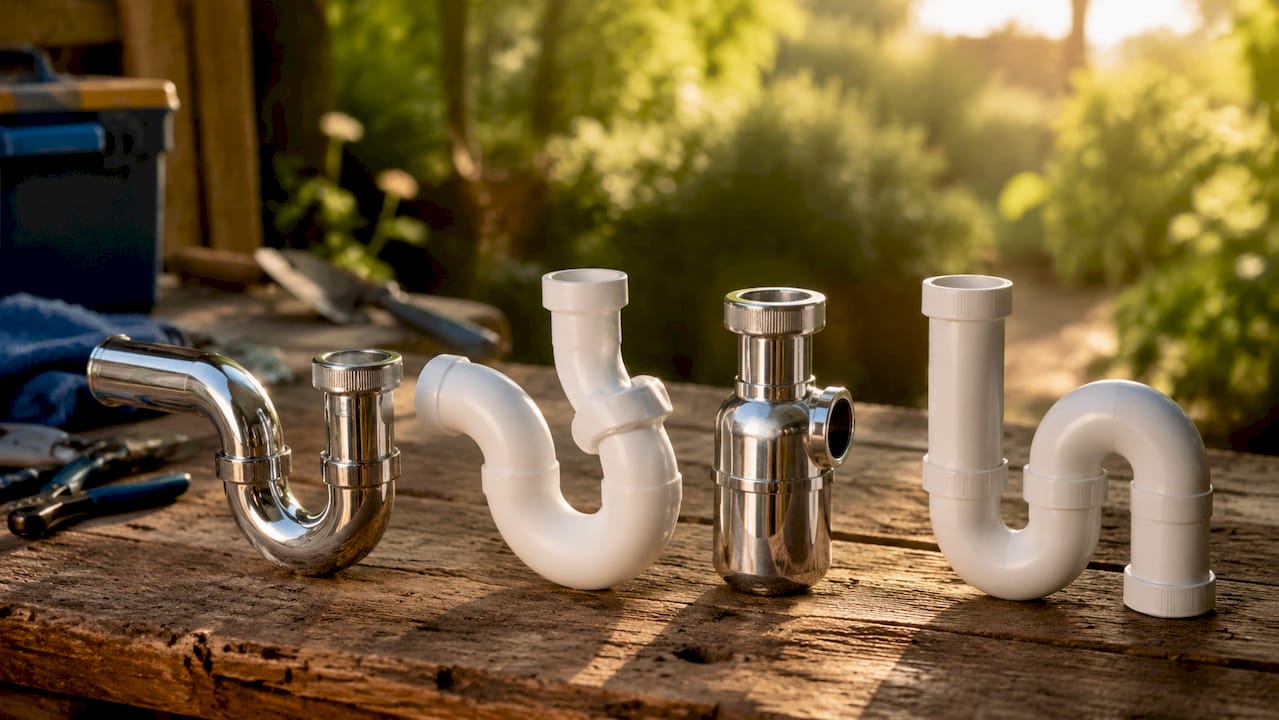
The P-trap is the standard in all modern residential construction. Its shape resembles the letter P on its side, with a horizontal outlet that connects to a wall vent. That geometry makes it naturally resistant to siphonage because the vent is positioned correctly relative to the water seal. If you look under any sink installed in the last 30 years, you are almost certainly looking at a P-trap.
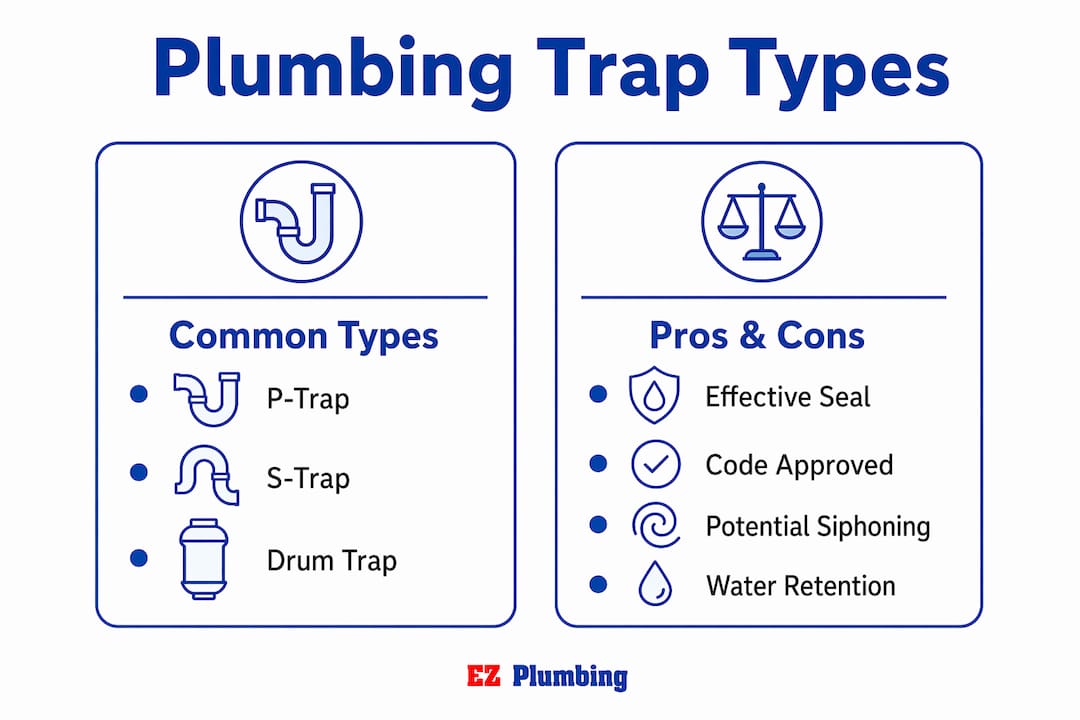
The S-trap curves downward and then back up before exiting through the floor. Older homes, particularly those built before the 1970s, often have S-traps under bathroom sinks. The problem is that S-traps are prone to self-siphonage. When water drains, the downward curve creates enough suction to pull the entire seal out with it. Most modern plumbing codes discourage or outright prohibit new S-trap installations for this reason. If you have one, it is worth discussing a replacement with a licensed plumber.
Drum traps are large cylindrical traps once common under bathtubs. They hold more water than a P-trap, but they also collect hair, soap scum, and debris at a much higher rate. They are rarely installed today and are not permitted under the International Plumbing Code for new construction.
| Trap type | Code status | Main advantage | Main drawback |
|---|---|---|---|
| P-trap | Standard, fully approved | Vent-compatible, reliable seal | Requires wall vent access |
| S-trap | Discouraged or banned for new installs | Fits floor drain configurations | Self-siphoning, seal loss risk |
| Drum trap | Not permitted for new construction | Large water volume | Collects debris, hard to clean |
| J-trap / Q-trap | Rarely used, limited code acceptance | Compact fit in tight spaces | Limited venting compatibility |
The purpose of a P-trap goes beyond just holding water. Its geometry is specifically designed to work with a vent stack, which is why it outperforms every other trap shape in long-term reliability.
What do plumbing codes require for trap installation?
Plumbing codes set specific rules for trap installation because a poorly placed trap fails just as reliably as a missing one. The 2024 International Residential Code and the International Plumbing Code both define minimum and maximum dimensions that every trap must meet.
The 2–4 inch seal depth requirement applies to the standing water inside the trap’s liquid-seal zone, not the total depth of the trap assembly or the fixture height. That distinction matters because homeowners sometimes confuse the two when inspecting their own plumbing. The seal zone is the lowest curved section of the trap where water actually rests.
The trap arm, which is the horizontal pipe connecting the trap to the vent, also has a maximum length. Exceeding that length increases the risk of self-siphonage and seal loss during drainage events. The vertical distance from the fixture outlet down to the trap weir cannot exceed 24 inches under most code interpretations. Beyond that distance, the water gains too much velocity and can pull the seal out on its way down.
| Code requirement | Specification | Reason |
|---|---|---|
| Minimum trap seal depth | 2 inches | Prevents gas backflow through shallow water |
| Maximum trap seal depth | 4 inches | Limits sediment buildup and flow turbulence |
| Max vertical drop to trap weir | 24 inches | Prevents velocity-driven siphonage |
| Vent protection | Required for every fixture trap | Equalizes pressure to maintain seal |
| S-trap new installations | Prohibited under most codes | Self-siphoning design causes seal failure |
Improper installation produces predictable consequences. A trap arm that is too long causes gurgling after every use. A trap set too far below the fixture outlet creates siphonage on every drain cycle. A missing vent means the seal fails the first time someone flushes a nearby toilet. These are not edge cases. Ez-plumbing sees these conditions regularly in older Los Angeles homes where original plumbing was installed before modern code requirements took effect.
How can homeowners maintain traps and prevent sewer odors?
Failing trap seals produce four recognizable symptoms: a persistent sewer smell near a drain, slow drainage, standing water in the basin, and a gurgling sound after water drains. Any one of these signals a problem worth investigating before it gets worse.
The fix for a dried-out trap is straightforward. Run water into the drain for 30 seconds to refill the seal. For drains you use infrequently, such as a basement floor drain or a guest bathroom sink, mineral oil added on top of the water slows evaporation significantly. The oil floats on the water surface and reduces the rate at which the seal dries out between uses. This is a practical tip that most homeowners have never heard, and it works well in dry climates like Los Angeles where evaporation rates are higher than average.
If refilling the trap does not eliminate the odor within a day, the cause is likely something other than a dry seal. Persistent odors after rewetting point to a plumbing leak, a damaged trap body, or a blocked vent. A cracked P-trap under a sink will drain continuously, making it impossible to maintain a seal no matter how much water you run. A blocked vent stack causes siphonage on every drain cycle, pulling the seal out faster than normal use can replace it.
- Check all infrequently used drains first. Run water into floor drains, utility sinks, and guest bathroom fixtures at least once a month.
- Add a small amount of mineral oil to drains you cannot run water through regularly. This extends the seal life by several weeks.
- Look under sink cabinets for moisture, white mineral deposits, or visible cracks in the trap body. These indicate a leaking trap that needs replacement.
- Listen for gurgling after flushing toilets or running nearby fixtures. Gurgling in a sink after a toilet flush is a classic sign of a venting problem, not just a trap issue.
- Call a licensed plumber if odors persist after refilling. Blocked vents and damaged traps require professional diagnosis and repair.
Pro Tip: In Los Angeles homes with older cast iron or galvanized drain lines, corrosion inside the trap body can cause pinhole leaks that slowly drain the seal. A camera inspection of the drain line quickly confirms whether the trap itself or the pipe behind it is the source of the problem.
You can also check for warning signs of plumbing problems beyond the trap itself. Slow drains throughout the house, multiple gurgling fixtures, and odors in more than one room suggest a systemic issue with the vent stack or the main sewer line rather than a single failed trap.
Key Takeaways
A plumbing trap’s water seal is only as reliable as the venting system behind it. Shape alone does not determine performance.
| Point | Details |
|---|---|
| Trap seal depth matters | The seal must hold 2–4 inches of water to reliably block sewer gases per plumbing code. |
| Venting is not optional | Every fixture trap requires vent protection to prevent siphonage from draining the water seal. |
| P-traps are the standard | P-traps are code-approved and vent-compatible; S-traps are prohibited for new installations. |
| Evaporation causes odors | Infrequently used drains dry out quickly; monthly rewetting or mineral oil prevents seal loss. |
| Persistent odors need a pro | Odors that return after refilling indicate a leak, damaged trap, or blocked vent requiring inspection. |
What most homeowners get wrong about plumbing traps
Homeowners consistently focus on the trap shape when they smell sewer gas, and that focus leads them to the wrong fix. I have seen this pattern repeatedly in Los Angeles homes. A homeowner replaces a perfectly functional P-trap because they assume the shape is the problem. The odor returns within a week because the actual cause was a blocked vent stack on the roof.
The trap is only half the system. The vent is the other half, and the two work together. A correctly shaped trap with no vent will fail every time. An older S-trap connected to a properly sized vent will outperform a P-trap with a blocked vent in real-world conditions. That is not an argument for keeping S-traps. It is an argument for inspecting the whole system before replacing parts.
The other misconception I see regularly is that sewer odors always mean a plumbing emergency. Most of the time, a dry trap is the cause, and running water for 30 seconds solves it completely. The cases that require immediate attention are persistent odors in multiple rooms, odors that return within hours of refilling, and odors accompanied by gurgling or slow drains throughout the house. Those patterns point to venting failures or sewer line issues that go well beyond a single trap.
Maintenance is genuinely simple if you stay consistent. Run water in every drain monthly. Check under sinks twice a year for moisture or corrosion. Address gurgling sounds immediately rather than waiting to see if they resolve on their own. The sewage smell in your bathroom is almost always preventable with routine attention.
— EZ
Ez-plumbing can help when maintenance is not enough
When a dry trap is not the issue, the problem usually requires a professional eye. Ez-plumbing serves homeowners and renters across the greater Los Angeles area with licensed drain cleaning, leak detection, and full plumbing inspections. C-36 License #583868 means every job meets California code requirements and LA municipal standards.
If you are dealing with persistent sewer odors, slow drains, or gurgling fixtures that do not resolve after refilling your traps, Ez-plumbing’s drain cleaning services cover everything from hydro-jetting to camera inspection of drain lines. For homes where the issue goes deeper, Ez-plumbing also provides leak detection in Los Angeles to identify hidden leaks that continuously drain trap seals. Call Ez-plumbing to schedule a diagnostic visit and get a clear answer on what is actually causing the problem.
FAQ
What is a plumbing trap, exactly?
A plumbing trap is a curved pipe section installed beneath drains that holds standing water) to block sewer gases from entering a building. The standing water creates an air seal that prevents hydrogen sulfide and other sewer gases from traveling backward through the drain line.
Why does my drain smell even though I have a P-trap?
A P-trap that has dried out, cracked, or lost its seal due to siphonage will allow sewer odors through even if the trap is physically present. Persistent odors after refilling the trap indicate a possible blocked vent, damaged trap body, or plumbing leak requiring professional inspection.
How deep should the water in a trap seal be?
The trap seal depth must measure between 2 inches and 4 inches per the International Residential Code. Less than 2 inches fails to block gas reliably, and more than 4 inches causes sediment buildup and drainage problems.
Are S-traps still allowed in homes?
S-traps are prohibited for new installations under most modern plumbing codes because their geometry causes self-siphonage, which drains the water seal during normal use. Existing S-traps in older homes are not always required to be replaced immediately, but a licensed plumber can assess whether yours is causing odor or drainage problems.
How do I prevent a floor drain trap from drying out?
Run water into the floor drain at least once a month to refill the seal. Adding a small amount of mineral oil on top of the water slows evaporation and extends the time between refills, which is especially useful for utility rooms and basement drains that see little regular use.