
How to Maintain a Water Heater: 2026 Expert Guide
If your shower has started going lukewarm sooner than it used to, your water heater sounds like it's popping in the garage, or your tenant just reported rusty-looking hot water in a Los Angeles unit, the heater is asking for attention. It's often overlooked until there's no hot water, a leak under the tank, or a utility bill that suddenly feels off.
That's the problem with water heaters. They can work for a long time without obvious issues while sediment builds up, parts wear down, and small warning signs get ignored. In Los Angeles, hard water makes that process show up faster, especially in older homes, rentals, and HOA buildings where one missed maintenance cycle can turn into multiple complaints at once.
Learning how to maintain a water heater isn't about turning a homeowner into a full-time plumber. It's about handling the safe, basic work that prevents avoidable breakdowns, and knowing when to stop and call for service.
Table of Contents
- Why Your Water Heater Needs Regular Attention
- Safety First Your Pre-Maintenance Checklist
- Core Maintenance for Your Tank Water Heater
- Descaling and Caring for Your Tankless Water Heater
- Year-Round Optimization and Inspection
- Troubleshooting and When to Call a Plumber in Los Angeles
Why Your Water Heater Needs Regular Attention
A neglected water heater usually gives warnings before it fails. You might hear rumbling when the burner fires. You might notice hot water runs out earlier. You might see a little moisture at a fitting and assume it can wait. It usually can't.
That neglect costs money, too. The U.S. Department of Energy says water heating accounts for about 18% of a home's energy use and is the second-largest energy expense in many homes, so keeping the unit maintained has a direct impact on operating cost according to the Department of Energy's water heating guidance.
In the field, the biggest mistake is treating maintenance like an optional add-on instead of basic property protection. A water heater sits in the background until scale, corrosion, or pressure issues force it into the foreground. Then you're dealing with emergency cleanup, tenant complaints, or a cold shower at the worst time.
Practical rule: If a water heater is making new noise, heating slower, or showing even a small drip, it's already telling you maintenance is overdue.
Los Angeles properties have a few patterns that make regular attention even more important. Hard water leaves mineral deposits behind faster. Garage installations often get ignored because they're out of sight. Multi-unit buildings spread one plumbing issue into several resident complaints almost immediately.
For homeowners thinking long term, it also helps to understand the maintenance side of replacement timing. EZ Plumbing has a useful overview on how long a water heater lasts, and the main takeaway is simple: lifespan depends heavily on upkeep, water quality, and catching problems early.
Water heater maintenance also fits into the bigger picture of protecting a house from expensive damage. If you're looking at home systems as a whole, this Utah homeowner's guide to water prevention is a solid reminder that leaks, drainage, and plumbing maintenance all connect.
Safety First Your Pre-Maintenance Checklist
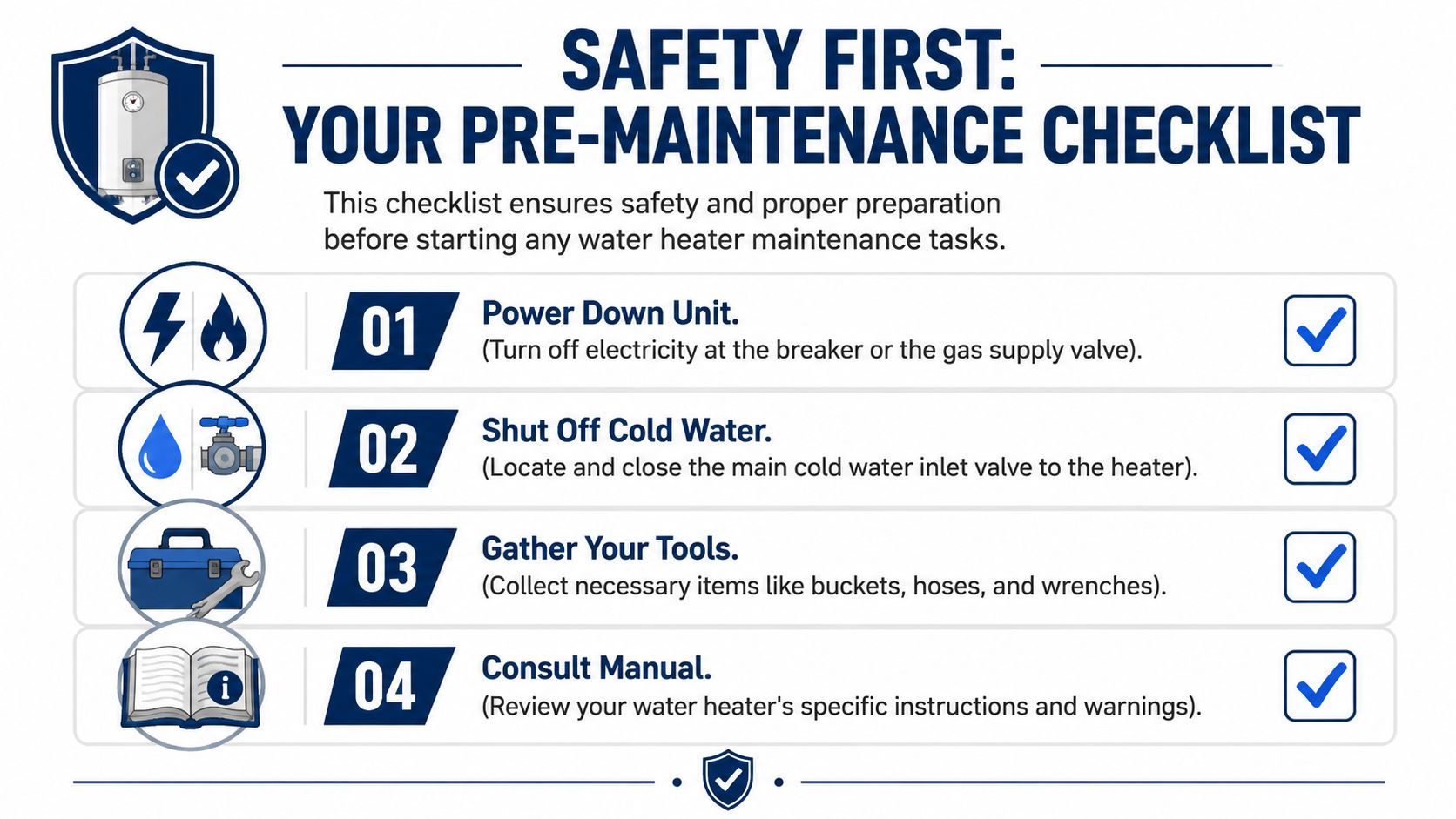
Before touching a drain valve, relief valve, or service panel, slow down and prep the area. Most water heater mistakes happen before the actual maintenance starts. Someone forgets to cut power to an electric heater. Someone opens a valve on hot water without gloves. Someone starts draining a tank without checking where that water is going.
Identify the heater and shut it down correctly
Start by confirming what you have. A tank water heater stores hot water in a cylinder. A tankless water heater heats water on demand and usually has service valves underneath. The maintenance steps are different, and so are the risks.
For an electric tank, turn off power at the breaker first, as an electric unit must be completely refilled before power is restored. Running heating elements dry can damage them. Lowe's includes that point in its water heater maintenance guidance.
For a gas tank, set the control to the appropriate off setting for maintenance and close the gas supply if the task calls for it. If you smell gas at any point, stop immediately and call a licensed plumber.
Gather tools before you open anything
Don't start with half the gear. Basic maintenance goes smoother when everything is next to the unit.
- Garden hose: Long enough to reach a safe drain point.
- Bucket and towels: For drips at the drain valve or relief valve discharge.
- Work gloves: Hot water and metal edges can both bite.
- Safety glasses: Important when testing valves or disconnecting fittings.
- Adjustable wrench: Useful for fittings and access points.
- Flathead screwdriver: Sometimes needed for access panels or controls.
- Owner's manual: Model-specific instructions matter more than guesswork.
If you're not sure what the temperature and pressure relief valve looks like, this guide on the pressure relief valve on a water heater is worth reading before you begin. That valve is a safety device, not a casual test point to experiment with.
Hot water maintenance is simple only when the shutoffs work, the drain path is controlled, and the heater type is correctly identified.
Check the work area
A tight closet, blocked garage corner, or storage piled against the unit changes the job. Make sure you can reach the cold-water shutoff, the drain valve, and the power or gas control without stretching around boxes or paint cans.
Use this quick go or no-go list before moving forward:
| Check | What you want to confirm |
|---|---|
| Power or gas | Properly shut off and clearly identified |
| Cold-water valve | Accessible and turns freely |
| Drain route | Hose reaches a safe location |
| Floor condition | No slip hazard, enough lighting |
| Manual access | Model instructions available |
If any of those are a problem, maintenance gets riskier fast. That's the point where a service call makes more sense than pushing through.
Core Maintenance for Your Tank Water Heater
A tank water heater in Los Angeles usually gives warning signs before it fails. You may hear popping during recovery, notice slower hot water delivery after a few busy mornings, or see chalky buildup around the drain and fittings. In many LA homes and multifamily buildings, hard water is the reason.
What sediment does in Los Angeles homes
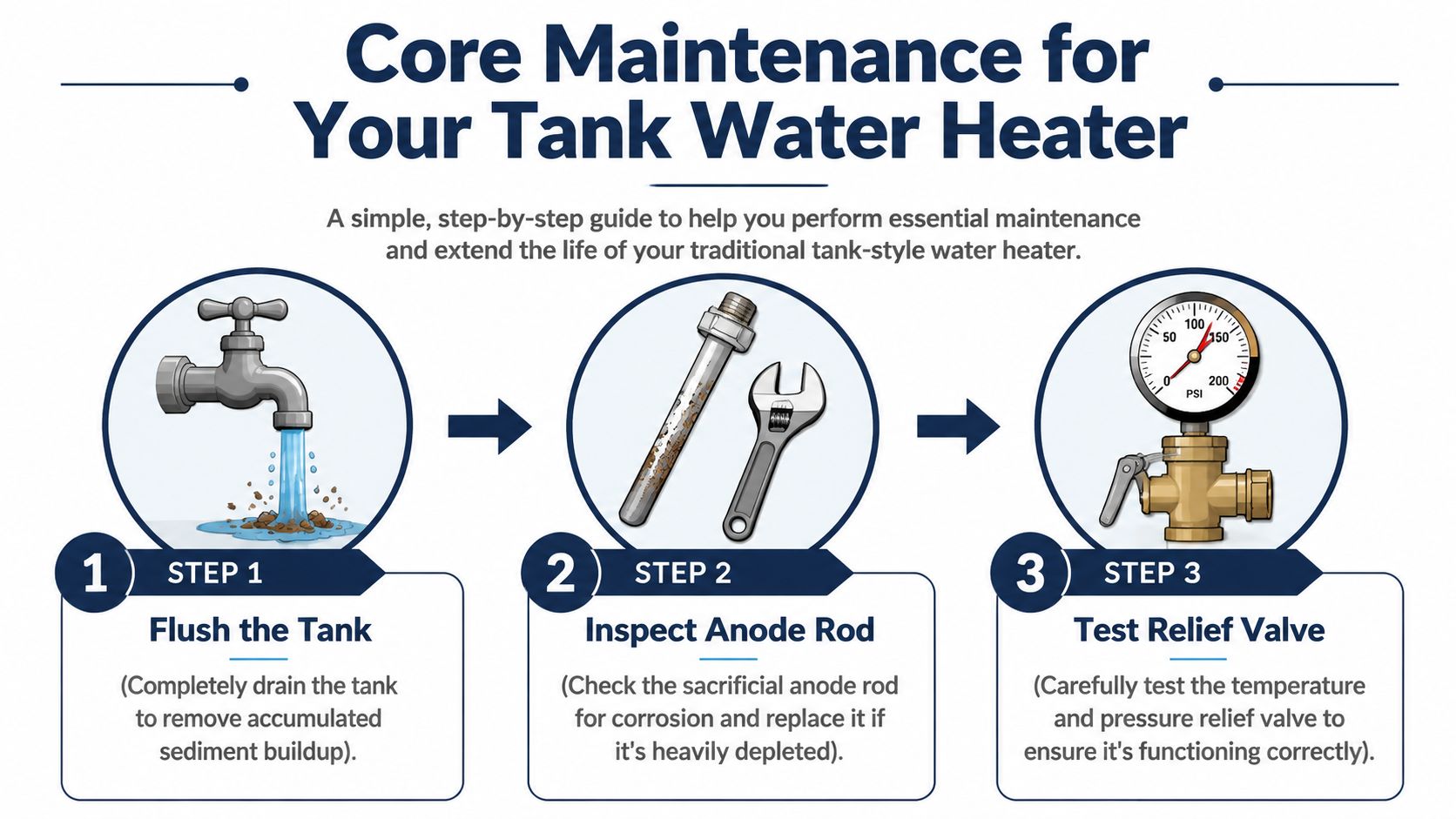
Mineral sediment settles at the bottom of the tank and creates a few problems at once. It slows heat transfer, makes gas burners or electric elements work longer, and often causes the rumbling or popping owners hear during a heating cycle. On older units, it can also clog the drain valve enough that a simple flush turns into a repair visit.
A standard drain and flush helps remove loose sediment before it hardens into a thicker layer. Home Depot recommends regular flushing in its water heater maintenance guide, and that advice fits what we see in the field. In hard-water pockets across Los Angeles, routine flushing is usually more effective than waiting until the heater starts making noise.
That matters even more in rentals, HOA buildings, and vacant properties. A heater that sits unused for stretches can still collect sediment, and neglected valves often seize up right when someone tries to put the unit back into service.
How to flush the tank safely
For a standard tank heater, flushing is the main maintenance task a careful homeowner or property manager can handle.
- Shut off power or gas first. For electric units, turn off the breaker. For gas units, follow the manufacturer's shutdown procedure.
- Close the cold-water inlet valve at the top of the heater.
- Connect a garden hose to the drain valve near the bottom of the tank.
- Run the hose to a safe drain location where hot water will not damage flooring, baseboards, planters, or walkways.
- Open a nearby hot water faucet inside the home to relieve vacuum and help the tank drain.
- Open the drain valve and let the tank empty.
- Briefly reopen the cold-water inlet to stir up remaining sediment, then continue draining until the discharge looks clearer.
- Close the drain valve, disconnect the hose, and refill the tank.
- Confirm the tank is completely full before restoring power to an electric unit.
That sequence is straightforward on a newer heater with working shutoffs. It gets less predictable on an older unit in a garage, closet, or condo utility room. Plastic drain valves can crack. Mineral buildup can block flow. A shutoff that has not been touched in years may not close all the way.
If the drain trickles, spits debris, and stops, don't force it. That usually means sediment is packed at the bottom, and pushing harder can leave you with a valve that will not reseal.
Here's a helpful visual walkthrough before you try it:
How to check the anode rod and T and P valve
Flushing helps, but it is only part of tank maintenance. The two other components worth attention are the anode rod and the temperature and pressure relief valve.
The anode rod is designed to corrode first so the steel tank lasts longer. In Los Angeles hard water, rods often wear down faster than owners expect. If the rod is heavily deteriorated, coated with mineral buildup, or reduced far beyond its original diameter, replacement is usually the right call. On many heaters, accessing it takes overhead clearance and a good amount of torque, which is why this is often better handled by a plumber in tight closets or attic installs.
The T&P valve is a safety device that releases excess temperature and pressure. Test it carefully and only if the discharge pipe is properly installed and routed to a safe termination point. If the valve leaks after testing, does not move cleanly, or shows corrosion, stop and schedule service. A relief valve that does not reseal is not a DIY experiment.
A solid tank-heater check also includes:
- Looking for active leaks: Check top connections, the drain valve, access panels, and the relief valve discharge line.
- Inspecting venting on gas units: Loose joints, corrosion, scorch marks, or soot call for professional service.
- Checking the base of the heater: Rust streaks, dampness, or white mineral crust usually mean the unit has been leaking for a while.
- Listening during a heating cycle: Sharp popping and rumbling usually point back to sediment.
If you are comparing maintenance demands between systems, our page on tankless water heater service and installation explains how upkeep differs from a standard storage tank.
For homeowners and property managers who would rather not risk a stuck drain valve, failed shutoff, or leaking relief valve, EZ Plumbing handles tank and tankless water heater maintenance and repair in Los Angeles. That is often the safer choice for older heaters, rental turnovers, HOA properties, and vacant homes where one small mistake can lead to water damage and an emergency call.
Descaling and Caring for Your Tankless Water Heater
Tankless heaters don't collect sediment in a big storage tank, but they're not maintenance-free. In Los Angeles, hard water tends to leave mineral scale inside the heat exchanger, and that buildup narrows water passages, affects flow, and makes the unit work harder.
Why tankless units need a different approach
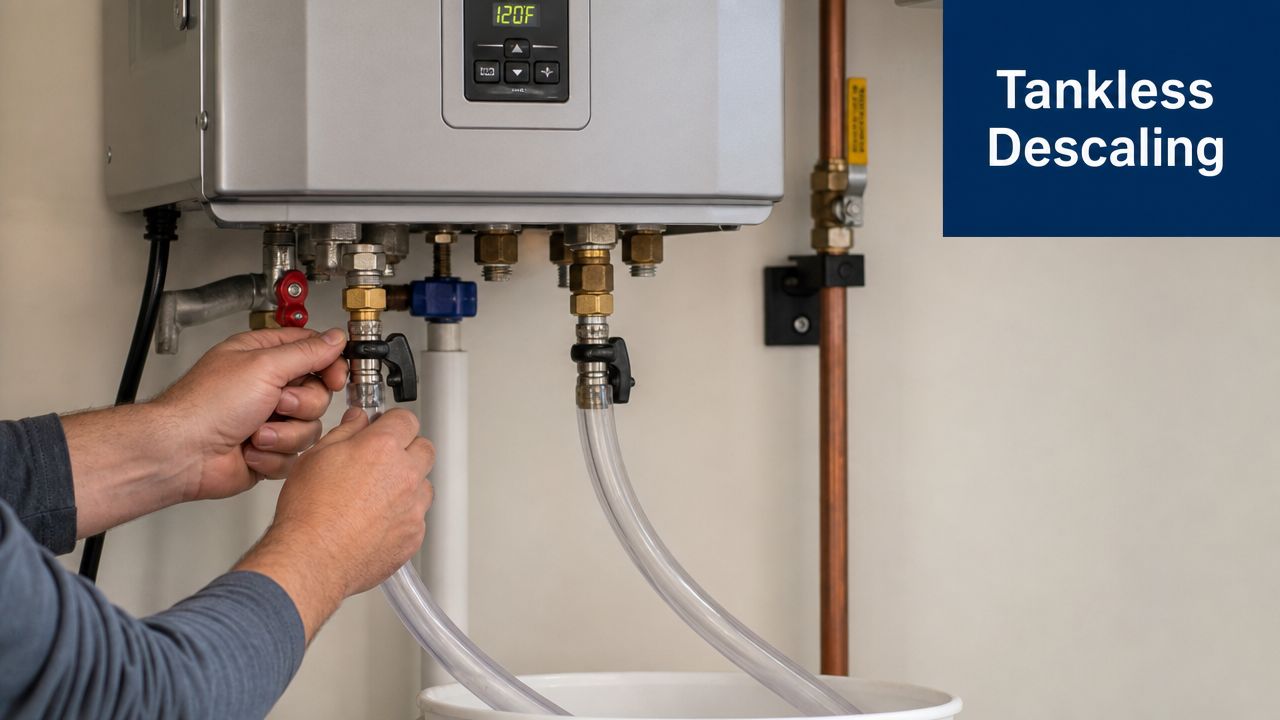
A tank heater gets flushed by draining stored water out of the vessel. A tankless heater is maintained by circulating descaling solution through the heat exchanger using service ports, hoses, and a small pump. That's the main difference, and it matters because the equipment setup is more specialized.
When tankless owners skip maintenance, the complaints are usually familiar. Water temperature starts fluctuating. Hot water delivery gets less consistent. The unit may show error behavior or reduced performance. Those are scale symptoms until proven otherwise.
If you're comparing system types or thinking about upgrading, EZ Plumbing's page on tankless water heaters gives a useful overview of what these systems involve in a residential setting.
A practical descaling setup
A proper tankless descaling setup usually includes:
- A small circulation pump
- Two service hoses
- A bucket
- A manufacturer-appropriate descaling solution
- Access to the service valves
The basic flow is simple. Shut down the unit, isolate it with the service valves, connect hoses to the hot and cold service ports, place both hose ends into the bucket with descaling solution, and let the pump circulate the solution through the heater. After that, flush the system with clean water, remove the setup, reopen the valves, and return the unit to service according to the manufacturer instructions.
That said, not every tankless installation is equally DIY-friendly. Some are mounted in cramped spaces. Some have older or poorly labeled valves. Some have venting or gas-related issues that show up while you're already in there.
Use this quick comparison before deciding whether to do it yourself:
| Situation | DIY may be reasonable | Call a plumber |
|---|---|---|
| Easy service-port access | Yes | Not always necessary |
| Heavy scale symptoms | Sometimes | Often smarter |
| Unclear valve layout | No | Yes |
| Gas or vent concerns | No | Yes |
| Recurring performance issues after descaling | No | Yes |
Tankless units reward consistent care, but they also punish improvisation. If you don't have isolation valves, can't identify the service ports, or aren't sure the unit is returning to normal operation afterward, stop before turning a maintenance job into a no-hot-water call.
Year-Round Optimization and Inspection
In Los Angeles, a water heater can look fine for months and still be building up scale, sweating at a fitting, or cooking itself at a higher setting than the building needs. That is why the in-between checks matter, especially in apartments, HOA buildings, and homes that sit vacant part of the year.
Keep the temperature steady
Set the water heater to 120°F unless the manufacturer or a specific building use requires something different. That setting is a good balance for most households and rental properties. It helps limit scald risk, avoids unnecessary energy use, and reduces the temptation to chase performance problems by turning the dial up.
If tenants or family members keep raising the temperature because hot water runs out too fast, treat that as a warning sign. In my experience, the usual causes are sediment, scale, undersized equipment, or a part that is starting to fail. A hotter setting can hide the problem for a while and create a safety issue at the tap.
For tank units, simple heat-loss control also helps. Insulating the first few feet of hot water pipe is often worthwhile. An insulation blanket can help on some older tanks, but only if it does not cover controls, warning labels, or any draft hood or venting components on a gas unit.
Build a simple inspection habit
A quick walk-by inspection catches a lot. For a single-family home, that might mean checking the heater every month or two. For a property manager or HOA, it should be part of the regular building checklist, right alongside exterior drains, lighting, and HVAC service.
Look for these conditions:
- Moisture or staining at the base: Even a small amount can point to a slow leak or condensation issue.
- Rust, white crust, or green buildup at fittings: In Los Angeles, hard water often leaves mineral deposits before a leak becomes obvious.
- Drips at shutoff valves or supply lines: Small leaks can go unnoticed for a long time in garages, closets, or utility rooms.
- Moisture near the temperature and pressure relief valve discharge: That can signal pressure trouble or a valve that is no longer sealing properly.
- Changes in venting on gas units: Loose, damaged, or disconnected vent parts need prompt professional attention.
- New sounds: Rumbling, hissing, or banging usually means something changed inside the unit.
Vacant and seasonally used properties need extra attention. A heater in a guest unit, vacant rental, or part-time residence can sit idle long enough for a minor drip to turn into cabinet damage, flooring damage, or mold. Before a unit is reoccupied, inspect the area, check for visible corrosion or leakage, and confirm the heater is operating normally before anyone depends on it.
For landlords and HOA managers, consistency matters more than complexity. A scheduled inspection program beats reactive maintenance every time. If you already organize service intervals across a property, this complete guide to landlord HVAC care is a useful model for building a repeatable maintenance calendar.
Keep the area around the heater clear, too. Do not stack paint, cardboard, cleaning supplies, or storage bins against it. Clear access makes leaks easier to spot, gives technicians room to work, and is especially important around gas-fired units.
Troubleshooting and When to Call a Plumber in Los Angeles
Some water heater problems are maintenance problems. Others are repair problems pretending to be maintenance problems. Knowing the difference saves time and keeps people safe.
Common symptoms and what they usually mean
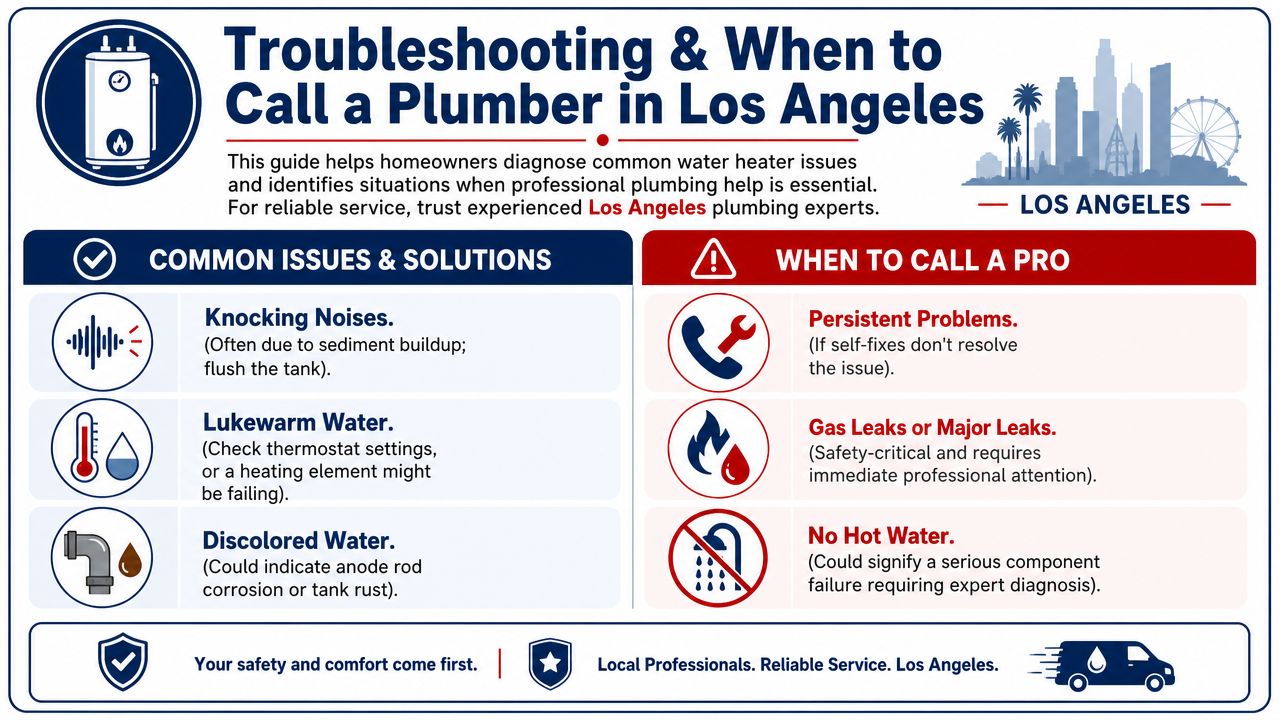
If the heater is knocking or rumbling, sediment is a likely cause on tank units. A flush may help if the drain valve works and the unit is otherwise in decent condition.
If the water is lukewarm, start with the thermostat setting and basic maintenance history. On electric units, failed elements are common. On gas units, burner or control issues can be involved. On tankless units, scale buildup can also show up as weak hot-water performance.
If you see discolored hot water, think about corrosion inside the system. The anode rod may be depleted, or the tank may be aging past what maintenance can solve. If discoloration is persistent, don't assume a simple flush will take care of it.
Here's a quick triage table:
| Symptom | Possible cause | Reasonable first step |
|---|---|---|
| Popping or rumbling | Sediment in tank | Flush if safe to do so |
| Lukewarm water | Thermostat, heating component, scale | Check settings, then diagnose further |
| Water around base | Loose fitting or tank leak | Inspect carefully, then call if source is unclear |
| Rusty hot water | Anode or tank corrosion | Schedule professional evaluation |
| No hot water | Component failure or control issue | Call a plumber |
Call a licensed plumber right away for gas smell, venting concerns, electrical issues, no hot water with no clear cause, or any major leak. Don't DIY gas lines. Don't open electrical compartments if you're not trained. And don't wait on a leaking tank. Those calls get more expensive with every hour.
Vacant rentals and seasonal properties need different care
This is the part many maintenance guides skip. Vacant homes, short-term empty rentals, and seasonal properties don't behave like occupied homes. Water sits. Small leaks go unnoticed. A simple heater issue becomes a property-damage claim because nobody was there to catch it.
For properties that sit idle for a month or more, guidance from a plumbing educator recommends shutting off the water and gas and completely draining the tank to prevent stagnant water issues and possible damage, as shown in this idle-property water heater advice.
That matters in Los Angeles for landlords, HOA boards, and property managers handling turnovers. A vacant unit should have a different checklist than an occupied one. On reoccupancy, the heater should be recommissioned carefully, checked for leaks, and confirmed safe before handing the unit back over.
Empty properties create plumbing risk because no one is there to notice the first drip, the first error, or the first sign of corrosion.
If you're stuck between a basic maintenance task and a safety-sensitive repair, treat that uncertainty as your answer. Maintenance should reduce risk, not add it.
If your water heater needs maintenance, won't drain properly, keeps making noise, or you're managing a Los Angeles property that can't afford a leak or no-hot-water complaint, EZ Plumbing can help. Their licensed team serves homeowners, landlords, HOAs, and property managers across Los Angeles with water heater maintenance, repair, diagnostics, and emergency service. Call (818) 908-2710 or schedule online for a professional inspection and clear next steps.