
Los Angeles Emergency Plumber: Fast 24/7 Repairs in 2026
Emergency plumber rates in Los Angeles usually run $100 to $500 per hour, often with an added $75 to $250 emergency visit fee, and the right response often means getting help on site within 60 to 120 minutes. If you have a major water leak, your first step is to locate and shut off your main water valve immediately. This single action can prevent thousands in damage.
If you're reading this with water spreading across a floor, dripping through a ceiling, or backing up into a tub, slow down and do this in order. Stop the flow, make the right first call, and don't waste time on the wrong fix. In Los Angeles, that matters more than people realize because some emergencies belong to a private plumber, and some belong to the city or utility.
Most guides skip that distinction. That's a mistake. If you call the wrong number first, you lose time you don't have.
Table of Contents
- First Call Who Is This a City or Private Plumbing Emergency
- Your Immediate Damage Control Checklist
- Avoiding Costly Mistakes in a Plumbing Crisis
- How to Evaluate and Choose an LA Emergency Plumber
- Get Fast Reliable Help from EZ Plumbing
- Frequently Asked Questions About LA Plumbing Emergencies
First Call Who Is This a City or Private Plumbing Emergency
You hear rushing water, step onto a wet floor, and your brain goes straight to panic. That's normal. The first thing I want you to sort out is whether this is inside your property or outside your property, because that determines who you call first.
Start with location and risk
The City of Los Angeles guidance is straightforward. Call 911 for immediate public danger, call utility companies for issues like gas or water main breaks, and call a private plumber for in-building failures, as explained in this Los Angeles emergency services overview.
Use that rule under pressure:
- Inside the building: Burst pipe under a sink, failed water heater, overflowing toilet, sewer backup through an interior drain, leak behind a wall. Call a private plumber.
- Outside or utility-related: Water erupting from the street, trouble that looks like a main break, gas concern tied to utility service, danger affecting the public. Call the utility or emergency services first.
- Immediate danger: Gas smell with clear risk, flooding near an unsafe electrical condition you can't isolate, or any life-safety threat. Call 911.
Practical rule: If the failure is in your house, unit, wall, ceiling, fixture, or building piping, start with a private plumber. If the problem appears to involve the street, a shared public main, or an active public hazard, route the call to the city or utility.
In Los Angeles, that first call matters because older buildings, shared lines, and dense multi-unit properties can blur the line between private and municipal responsibility. If you manage buildings in several neighborhoods, it helps to keep a local Los Angeles service area reference handy so you know who covers your property fast.
A simple decision rule
Ask these three questions:
Where is the water or problem showing up first?
Inside usually means private plumbing.Is there a public safety issue?
If yes, stop thinking about repairs and call emergency services.Does it look like a utility failure instead of a fixture or pipe failure?
If it's a main or utility issue, don't wait on a plumber to tell you what the city already needs to handle.
Don't overthink it. Route the first call correctly, then move to damage control.
Your Immediate Damage Control Checklist
If water is actively escaping, the clock is already running. Emergency response should happen within 30 to 60 minutes, water damage costs can rise by 15% to 25% for every 24 hours of delay, and shutting off the main water valve can reduce total property damage by up to 40% to 60%, according to this Los Angeles plumbing emergency guide.
Start here:
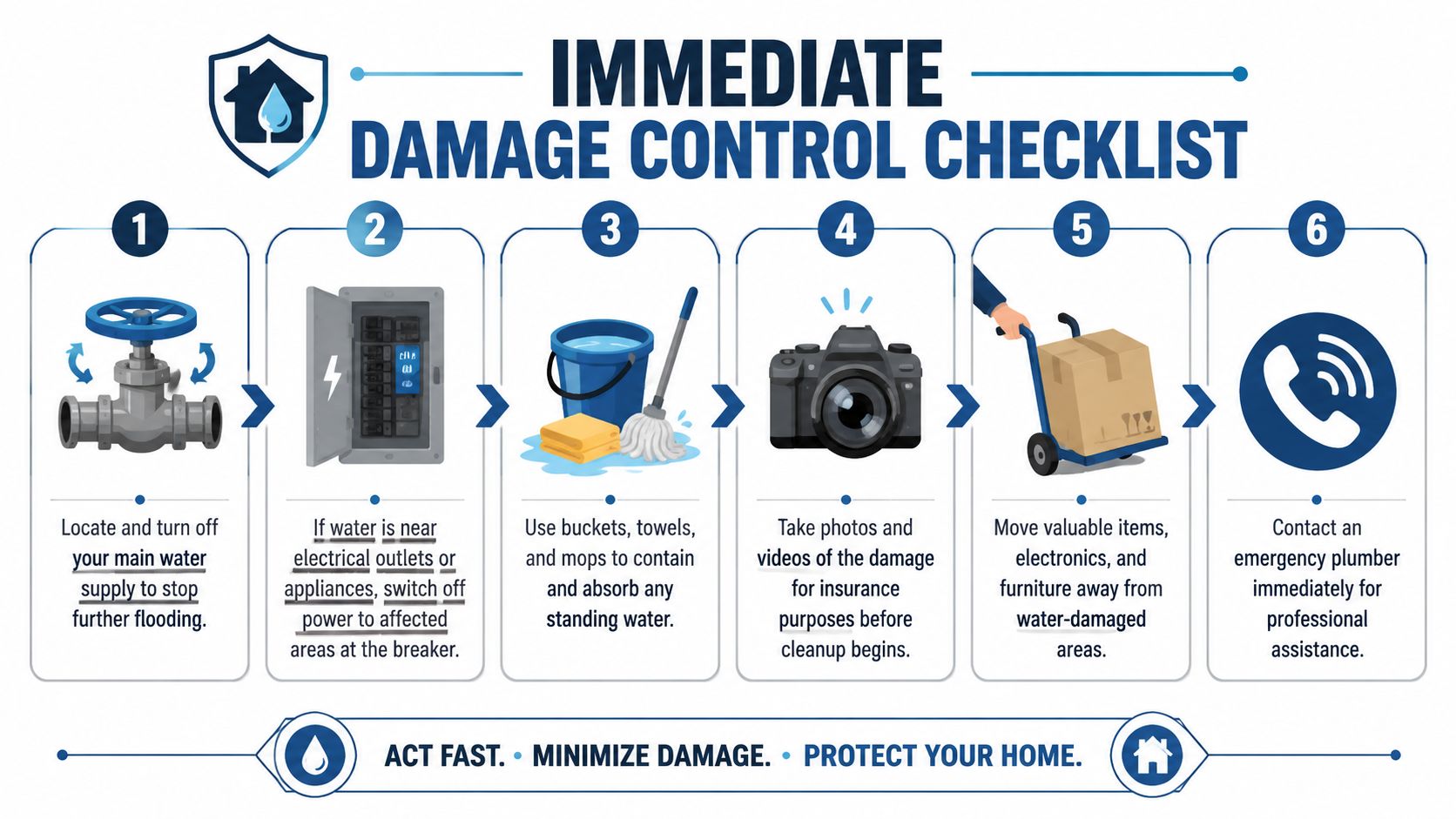
Do these actions in order
- Shut off the main water first. In many Southern California homes, the valve is near an exterior wall, in a garage, or at a ground-level street box. Turn it clockwise to full closure.
- Relieve pressure. Open faucets starting at the lowest point, then work upward. That helps drain remaining water from the lines.
- Control electrical risk. If water is near outlets, appliances, or cords, shut off power to the affected area at the breaker only if you can do it safely.
- Contain the spread. Use towels, buckets, and mops. A small containment step now can save flooring, baseboards, and cabinets.
- Move what can be moved. Get boxes, electronics, rugs, and wood furniture out of the wet area.
- Document before cleanup goes too far. Take clear photos and video for insurance.
For a leaking shutoff itself, this quick guide on a leaking shut off valve can help you identify what you're looking at before the plumber arrives.
Shut the water down before you start diagnosing. A homeowner who keeps searching for the exact source while water keeps running usually turns a repair call into a restoration job.
Here's the walkthrough if you need a visual while you work:
What matters while you wait
You are not trying to complete the repair. You are trying to stabilize the scene.
That means no cutting into walls unless there's a clear safety reason, no random wrenching on fittings you can't identify, and no turning systems back on “just to check.” Keep the area accessible. Keep pets and kids away. Keep one person free to answer calls and guide the technician in.
If you're dealing with the aftermath and want a practical overview of drying, documentation, and recovery priorities, this expert water damage restoration guide is worth reviewing after the leak is contained.
Avoiding Costly Mistakes in a Plumbing Crisis
The biggest bad decision I see from homeowners is the rush to a “quick fix” that buys ten minutes and creates a bigger repair later. In Los Angeles, the worst offender is the chemical drain cleaner sitting under the sink.
The fast fix that makes things worse
Store-bought chemical drain cleaners can accelerate failure rates by 200% to 300% in older cast iron pipes, and 35% to 40% of emergency calls in Southern California involve systems where previous chemical use has already compromised the pipes, according to this emergency plumbing warning on chemical cleaners.
That matters in LA because a lot of properties still have older piping materials. You pour in a harsh cleaner, it heats up, sits in the line, and attacks the pipe wall. Then the clog is still there, and now the plumber has to work on a more fragile system.
If the drain is backed up and you've already tried basic manual clearing, stop pouring chemicals into it. You're not helping the plumber. You're making the line more dangerous to handle.
Other mistakes that turn a repair into a bigger repair
Some errors don't look dramatic in the moment, but they cost real money:
- Trying to repair a gas issue yourself. If you suspect a gas-related problem, get out and route the call correctly. Don't tighten random fittings.
- Using the wrong tool on a shutoff or supply connection. Rounded valves and crushed compression nuts create extra work fast.
- Ignoring a hidden leak because the water “stopped.” It may have stopped showing, not stopped leaking.
- Waiting on recurring signs. Repeated moisture, warped flooring, or unexplained wet spots usually don't fix themselves. Timely response matters, and this overview on why timely leak repairs save money and protect your home is a good reminder.
I'm opinionated on this for a reason. Homeowners usually don't lose money because they lacked effort. They lose money because they used the wrong method in the first twenty minutes.
How to Evaluate and Choose an LA Emergency Plumber
In a plumbing emergency, you do not need a perfect research project. You need a fast screen that eliminates the obvious bad options. That means checking the basics, setting realistic expectations, and getting clear on price structure before the truck rolls.
What to ask before you approve the visit
Ask these questions in plain language:
| Question | Why it matters |
|---|---|
| Are you licensed and insured? | You want a contractor who can legally perform the work and carry proper coverage. |
| Do you handle emergency calls in my area right now? | A real local dispatcher should know if they can get someone to you without guessing. |
| What is your emergency visit fee? | Emergency jobs in LA often include a separate trip or dispatch charge. |
| What is your hourly rate after hours? | You need to know whether you're approving diagnostic-only work or active repair time as well. |
| Are you equipped for my issue? | Sewer backup, water heater failure, and leak detection don't always need the same tools. |
| How do you communicate before arrival? | You want updates, not silence. |
For owners of rentals and multi-unit properties, it also helps to have a process for vendor approval, access, and tenant coordination. If you manage properties outside LA too, this guide for Inland Empire property owners is useful for thinking through operational support and emergency vendor workflows.
Typical Los Angeles emergency plumbing costs
Emergency plumber pricing in Los Angeles is higher than standard service because it includes urgent dispatch and after-hours labor. Rates commonly run $100 to $500 per hour, which is 1.5 to 3 times higher than standard rates, and many jobs also include an emergency visit fee of $75 to $250, based on this Los Angeles plumber cost breakdown.
Here's the practical version:
| Service | Average Call-Out Fee | Average Hourly Rate (Emergency) |
|---|---|---|
| Typical Los Angeles emergency plumbing call | $75 to $250 | $100 to $500 |
Don't argue with the existence of emergency pricing. Judge whether the company is clear about it. I'd rather hear a direct price structure at the start than a vague promise that gets expensive after the technician is already in the driveway.
A good los angeles emergency plumber should sound organized on the phone. Clear questions. Clear arrival window. Clear explanation of what they can and can't quote before inspection.
Get Fast Reliable Help from EZ Plumbing
If the leak is active, the backup is rising, or the water heater just let go, make the call and get someone moving. Waiting for normal business hours is how small failures become flooring, drywall, cabinet, and tenant problems.
When you need a direct call
EZ Plumbing is a licensed, insured plumbing contractor serving Los Angeles since 1989. The company handles 24/7 emergency response and same-day scheduling for planned repairs across areas including Beverly Hills, Santa Monica, West Hollywood, Pasadena, Glendale, Burbank, and the San Fernando Valley. For homeowners, HOAs, property managers, and commercial properties, that means one team can respond to urgent leaks, sewer issues, water heater failures, drain problems, and gas-related plumbing work.
Call (818) 908-2710 if you need help now.
When you call, be ready to say three things clearly: what's happening, whether the water is off, and whether there's any electrical or gas concern. That shortens the back-and-forth and helps dispatch send the right technician with the right equipment.
Frequently Asked Questions About LA Plumbing Emergencies
What if the main shutoff valve won't move
Don't force it with all your body weight. Older valves can seize, and forcing them can snap the handle or create a second leak. If you can't close the main safely, shut off the nearest fixture-level valve if the problem is isolated, keep the area contained, and tell the dispatcher the main valve is stuck so the technician arrives prepared for that complication.
What counts as a real emergency and what can wait until morning
A real emergency threatens property, safety, or sanitation right now. Active leaks, sewer backups, overflowing fixtures that won't stop, failed water heaters releasing water, and suspected gas-related plumbing issues belong on an emergency call. A slow drain with no backup, a minor drip you can isolate, or a fixture issue that doesn't affect use may be able to wait for scheduled service.
In Los Angeles, top-rated emergency plumbers often aim for 60 to 120 minute response times, day or night, as noted in this LA emergency plumber response guide. If the problem is actively worsening, treat it like an emergency.
What are the first signs of a hidden slab leak
Watch for signs that don't match normal use. Unexplained high water bills, warm spots on flooring, damp areas with no clear spill, the sound of running water when fixtures are off, or recurring moisture near the same area can all point to a hidden leak under the slab. Don't guess and don't start breaking concrete based on suspicion alone. Hidden leaks need proper diagnosis.
If you need a calm, licensed team to handle a plumbing emergency in Los Angeles, contact EZ Plumbing. Tell dispatch what failed, whether you've shut off the water, and whether the issue may involve a private line or a utility problem. They'll help you route the call correctly and get the next step moving fast.