
Los Angeles plumbing code: A compliance guide for homeowners
Los Angeles operates under its own distinct plumbing code, layered on top of California state regulations, and many homeowners and property managers don’t realize this until they’re already in the middle of a renovation or repair project. Assuming that state standards alone are enough for compliance is one of the most common and costly mistakes we see in this city. The Los Angeles Plumbing Code carries local amendments that change real requirements for both residential and commercial properties. This guide walks you through exactly how the code is structured, how compliance works, and what you need to do to stay on the right side of the rules.
Table of Contents
- What is the Los Angeles plumbing code?
- How plumbing code compliance works in Los Angeles
- Jurisdiction and local amendments: Navigating LA’s patchwork
- Fixture counts, scope, and practical requirements
- Why code compliance is more than paperwork: Real-world lessons from Los Angeles
- Get expert help for LA plumbing code compliance
- Frequently asked questions
Key Takeaways
| Point | Details |
|---|---|
| Layered codes matter | Los Angeles plumbing code includes state regulations and city amendments that can impact compliance. |
| Permits are essential | You must secure proper permits and inspections through LADBS for any significant plumbing changes. |
| Jurisdiction impacts requirements | Neighborhood boundaries and local authorities influence which plumbing codes and amendments apply to your property. |
| Fixture counts vary | Minimum fixture requirements reference state tables but are altered by local code amendments. |
| Expert help saves money | Working with experienced plumbers and inspectors minimizes compliance risks and costly mistakes. |
What is the Los Angeles plumbing code?
The foundation of plumbing regulation in Los Angeles is not a single document. It’s a layered system that begins at the national level and narrows down to local rules that apply specifically to your property.
At the top of this structure sits the Uniform Plumbing Code (UPC), a national model code developed to provide consistent standards across the country. California adopts the UPC as its baseline and publishes its own version: the California Plumbing Code (CPC), which serves as Part 5 of Title 24 of the California Code of Regulations. The CPC is published by the International Association of Plumbing and Mechanical Officials (IAPMO) and governs all plumbing system design, installation, and inspection across the state.
But here’s where Los Angeles differs from the rest of California. The Los Angeles Plumbing Code is the LAPC, and it is the City of Los Angeles’s own adopted and amended version of the CPC. The LAPC sits in Article 4 of Chapter IX of the Los Angeles Municipal Code (LAMC). This means that when you do plumbing work in Los Angeles, the CPC is your baseline, but the LAPC’s local amendments override or supplement that baseline wherever they apply.
The practical difference matters more than most people expect. Local amendments can change minimum fixture requirements, alter pipe material specifications, or add inspection checkpoints that the state code doesn’t require. Understanding which layer governs your project is not optional. It’s essential.
Here is a quick summary of the code hierarchy that applies to Los Angeles properties:
| Code level | Document | Governing body |
|---|---|---|
| National | Uniform Plumbing Code (UPC) | IAPMO |
| State | California Plumbing Code (CPC) | California DSA/IAPMO |
| Local | Los Angeles Plumbing Code (LAPC) | City of Los Angeles |
For residential plumbing standards, the LAPC applies to everything from single-family homes to multi-unit apartment buildings. For commercial plumbing code details, the requirements often go further, with additional fixture minimums and inspection requirements tied to occupancy classifications.
How plumbing code compliance works in Los Angeles
Now that the code’s structure is clear, it’s vital to understand how compliance operates in practice for residential and commercial properties.
Compliance in Los Angeles is not passive. It requires active engagement with the permitting and inspection process, and that process runs through a specific agency. Permits and inspections for plumbing work within city limits are administered by the Los Angeles Department of Building and Safety (LADBS). If your property sits inside the City of Los Angeles, LADBS is the authority you work with for permits, plan checks, and final inspections.

Most significant plumbing work requires a permit before the job begins. This includes water heater replacement, repiping, sewer line repairs, new fixture installations, and any work that changes the existing plumbing layout. The permit process ensures that both the CPC and the LAPC’s local amendments are being applied to your project, and the final inspection confirms the work meets those standards.
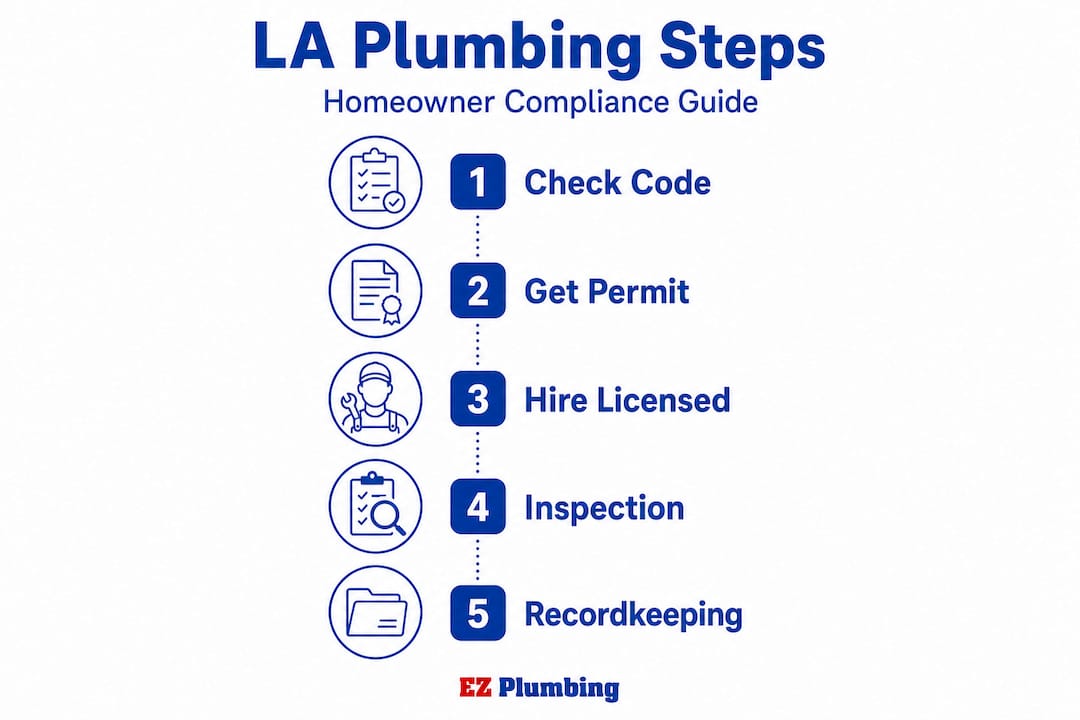
The steps typically involved in the compliance process are as follows:
- Determine the scope of your plumbing work and whether it falls under permit-required categories.
- Hire a licensed plumber (C-36 license in California) to assess and document the work.
- Submit a permit application through LADBS, including any required plans or specifications.
- Schedule a plan check for larger projects, or proceed directly to permit issuance for straightforward repairs.
- Complete the approved work following both CPC and LAPC requirements.
- Schedule the required inspections with LADBS before closing walls or covering any new plumbing.
- Receive final sign-off, which becomes part of your property’s official record.
Skipping any of these steps creates real problems down the road. Unpermitted plumbing work can halt a property sale, invalidate homeowner’s insurance claims, and expose you to fines and mandatory corrective work.
Pro Tip: Before starting any plumbing project, check the local AHJ requirements for your specific address. Even within Los Angeles, the exact permit thresholds and inspection requirements can vary based on the type of work and the property classification.
For a detailed walkthrough of the process, the step-by-step permit guide available on our site covers the most common scenarios homeowners and property managers face.
Jurisdiction and local amendments: Navigating LA’s patchwork
Understanding the importance of permits leads to another frequent area of confusion: jurisdiction and local amendments.
Los Angeles is not a uniform regulatory environment. The greater Los Angeles area contains dozens of incorporated cities, each operating as its own municipality with its own authority to adopt and amend the California Plumbing Code. Jurisdiction matters significantly in this region, because the City of Los Angeles, incorporated cities like Santa Monica, Burbank, Pasadena, and Long Beach, and LA County unincorporated areas can all have different local amendments and different authorities having jurisdiction (AHJs).
The AHJ is the official body, typically a city’s building and safety department, that is legally responsible for enforcing the applicable plumbing code in that area. The AHJ’s interpretation of the code governs what gets approved and what gets rejected during inspection.
Several practical realities follow from this patchwork structure:
- A water heater installation that meets City of Los Angeles requirements may not meet Burbank’s code without modification.
- Pasadena’s local amendments may require different venting specifications than those required in unincorporated LA County.
- A property that straddles a city boundary, or is located in an unincorporated area, may fall under county jurisdiction rather than any city’s code.
- Older properties in transitional neighborhoods may have legacy permits that reference outdated code versions, requiring careful review before any new work begins.
“Always confirm which AHJ governs your property before initiating any plumbing project. The name on your mailing address is not always the same as your legal jurisdiction for building code purposes.”
The role of licensed plumbers in jurisdiction compliance is particularly important here. An experienced local plumber knows the amendment history in different jurisdictions and can catch compliance issues before they become permit rejections or failed inspections.
Fixture counts, scope, and practical requirements
With jurisdiction clarified, it’s important to see how plumbing code requirements translate to practical steps for property managers and homeowners.
One of the most direct ways the code affects your property is through fixture count requirements. These requirements specify the minimum number of toilets, sinks, drinking fountains, and other fixtures that must be present based on the type of building and its occupancy. For commercial buildings and multi-unit residential properties, getting the fixture count wrong is a common and expensive oversight.
The fixture count requirements for specific occupancies reference CPC tables, with LAMC amendments applied on top. This means you cannot simply use a standard CPC table and assume it applies directly to your Los Angeles property without also checking whether the local code has modified the minimums for your occupancy type.
For reference, CPC Table 422.1 is the primary fixture count reference at the state level, but the LAPC amendments are what ultimately govern in the City of Los Angeles.
Key areas where homeowners and property managers frequently make mistakes include:
- Water heater replacements: Even a like-for-like replacement requires a permit and inspection in most cases. Installing a larger unit or changing fuel type triggers additional code requirements.
- Repiping projects: Full or partial repiping, especially when converting from galvanized steel to copper or PEX tubing, must meet both material standards and pressure testing requirements under the LAPC.
- Sewer line work: Any repair or replacement of a sewer lateral, the pipe running from your building to the city main, requires a permit, inspection, and in many cases a camera inspection before and after the work.
- Fixture relocations: Moving a toilet, sink, or bathtub, even a few feet, requires a permit because it changes the drain, waste, and vent system configuration.
- Fixture additions: Adding a bathroom or laundry room triggers a full permit review that checks fixture counts, water supply sizing, and drain capacity.
Pro Tip: When managing a commercial property, keep a dedicated compliance folder that includes all permits, inspection reports, and as-built plumbing diagrams. When a new tenant requests build-out changes, you’ll be able to show inspectors the existing approved configuration immediately, which speeds up the permit process significantly.
The common fixture pitfalls for Los Angeles homes are well-documented, and many of them trace directly back to work done without proper permits or without accounting for local amendments.
It’s also worth noting that the scope of work determines the permit threshold. Minor repairs, like replacing a faucet cartridge or clearing a clogged drain, generally don’t require permits. But as soon as work involves opening walls, adding or relocating pipes, or changing the water supply configuration, you’re almost certainly in permit territory. When in doubt, confirm with the local AHJ before starting.
Why code compliance is more than paperwork: Real-world lessons from Los Angeles
Here’s what you won’t find in most guides: the real lessons from years of LA plumbing compliance work. Most homeowners focus on the permit form itself and treat the process as a bureaucratic hurdle to clear. That perspective misses the point entirely and creates downstream problems that are far more expensive than the permit fee.
The biggest mistake we see is the assumption that the California Plumbing Code covers everything. It doesn’t, and in Los Angeles, the local amendments are not minor footnotes. They represent genuine differences in required materials, inspection points, and system configurations. A plumber who works across the state but doesn’t specialize in Los Angeles can produce perfectly compliant work under the CPC that still fails a City of Los Angeles inspection because of an LAPC amendment they weren’t tracking.
Code compliance also has direct consequences for insurance coverage. After a water damage event, insurance adjusters frequently check whether the failed component was installed with permits. Unpermitted work is one of the most common reasons insurers deny or reduce claims on residential and commercial properties. The cost of pulling a permit is always lower than the cost of an unpaid insurance claim.
There is a practical strategy that most guides overlook: building relationships with local inspectors and knowing your local AHJ’s enforcement priorities. Inspectors are not adversaries. They’re professionals doing a job defined by code. When you work with a licensed plumber who has an established relationship with local LADBS staff, inspections move faster, questions get answered more accurately, and problems get resolved before they become stop-work orders.
Long-term, the properties that maintain clean permit records are easier to renovate, easier to sell, and less likely to generate liability exposure. Practical code solutions start with documentation: keep every permit, every inspection card, and every as-built diagram in a permanent file tied to the property address.
The uncomfortable truth is that many Los Angeles properties carry unpermitted plumbing work done by prior owners. If you’ve purchased a property and aren’t certain about the permit history, a licensed plumber can perform a system assessment that flags potential compliance issues before they become your liability.
Get expert help for LA plumbing code compliance
If you want to avoid the mistakes outlined above and ensure your property meets every applicable requirement under the LAPC and CPC, working with a locally experienced, licensed plumber is the most reliable path forward.
EZ Plumbing holds a C-36 plumbing license (#583868) and specializes in code-compliant residential and commercial plumbing services throughout the greater Los Angeles area. Whether you need sewer line repair with proper permitting, professional drain cleaning that meets local standards, or leak detection services backed by camera inspection technology, we know how to navigate the city’s layered code requirements from start to finish. Our team coordinates with LADBS and other local AHJs regularly, so your project stays on track and fully documented.
Frequently asked questions
How can I find the official plumbing code for my Los Angeles property?
The official plumbing code for City of Los Angeles properties is the Los Angeles Plumbing Code, found in Article 4 of Chapter IX of the Los Angeles Municipal Code. You can access the full text through the LAMC or through services that compile municipal codes for easy reference.
Who enforces plumbing code compliance in Los Angeles?
Within city limits, permits and inspections are handled by the Los Angeles Department of Building and Safety (LADBS). LADBS reviews permit applications, performs plan checks on larger projects, and conducts the inspections required to close out permitted work.
Do neighboring cities follow the same plumbing code as Los Angeles?
No. Jurisdiction varies across the region, and cities like Santa Monica, Burbank, Pasadena, and Long Beach each maintain their own local amendments and AHJs. Always verify the exact code requirements with the governing authority for the city or county area where your property is located.
What triggers a need for a plumbing permit in Los Angeles?
Permit requirements depend on scope, but generally include fixture additions or relocations, water heater replacement, repiping, and sewer line work. Minor repairs like faucet replacement typically don’t require permits, but confirming with LADBS before starting any significant project is always the safest approach.