
Why Every Homeowner Should Hire a Licensed Contractor
Licensed contractors protect you by meeting the regulatory, insurance, and contractual safeguards that unlicensed workers typically cannot offer. Before you sign anything or hand over a deposit, take these three steps:
- Look up the contractor’s license number on your state licensing board’s website.
- Call the insurer listed on the certificate of insurance to confirm the policy is active.
- Require a written contract that includes scope, payment milestones, warranty terms, and lien releases.
The three strongest legal and financial protections a license delivers:
- Insurance coverage that shifts liability for property damage and worker injuries away from you.
- Complaint and arbitration access through state licensing boards, giving you a formal path to restitution.
- Bond and recovery fund eligibility that can compensate you if a contractor abandons the job or fails to pay subcontractors.
Pro Tip: Before you write a single check, run the contractor’s license number through your state board’s online lookup and call the insurer directly to confirm the certificate of insurance is current. That two-minute check has saved homeowners thousands of dollars.
Key Takeaways
Licensed contractors protect homeowners through insurance, bonding, code compliance, and formal complaint pathways that unlicensed operators cannot provide.
| Point | Details |
|---|---|
| Verify before you pay | Run the license number on your state board’s site and call the insurer to confirm the COI before signing. |
| Recovery funds exist | Massachusetts’s Guaranty Fund may compensate eligible homeowners up to $25,000 for unpaid judgments against registered contractors. |
| Bonds protect against abandonment | Surety bonds and payment bonds cover project abandonment and unpaid subcontractors who might otherwise lien your property. |
| Permits create a paper trail | A licensed contractor who pulls permits and passes inspections gives you documented proof of code compliance for insurance and resale. |
| Written contracts are non-negotiable | Require scope, milestones, payment schedule, warranty terms, and lien releases in writing before any deposit changes hands. |
Table of Contents
- What “licensed contractor” actually means in the U.S.
- Top reasons to hire a licensed contractor for your home project
- Practical risks of hiring unlicensed contractors
- Which insurance and bond documents to request before work begins
- How to verify a contractor’s license, insurance, and complaint history
- Questions to ask and the written-contract checklist you need before any deposit
- When a licensed contractor is legally required for your project
- How Ez-plumbing protects Los Angeles homeowners on every job
- A practical perspective on owner-builder trade-offs
- Authoritative resources to bookmark for your project
- Sources
What “licensed contractor” actually means in the U.S.
A contractor license is a state- or locally issued credential that ties a specific business principal to minimum competency and consumer-protection standards. It is not the same as registering an LLC or obtaining a general business license, which require no proof of trade knowledge, insurance, or bonding.
The most common license categories you will encounter as a homeowner:
- General contractor (GC): Oversees multi-trade projects, pulls master permits, and coordinates subcontractors.
- Plumbing (C-36 in California): Covers water supply, drain, waste, and vent systems, gas lines, and water heaters.
- Electrical: Covers panel upgrades, wiring, outlets, and service changes.
- HVAC: Covers heating, ventilation, air conditioning, and refrigerant handling.
- Specialty remodeler: Covers roofing, tile, concrete, or other trade-specific scopes depending on the state.
Licensing requirements vary by state, but most demand that the principal pass a written exam, carry general liability insurance, maintain a surety bond, and in some states complete continuing education to renew. The Minnesota Department of Labor and Industry confirms that a license often requires an exam, proof of insurance, and in some cases ongoing education, along with access to a Contractor Recovery Fund for consumers who suffer losses.
A contractor license is not a formality. It is the state’s mechanism for holding a tradesperson accountable to a published standard, and it gives you a legal avenue when something goes wrong.
Top reasons to hire a licensed contractor for your home project
Code compliance and required inspections
Licensed contractors know the building codes that apply to your jurisdiction and pull the permits that trigger mandatory inspections. Those inspections are not bureaucratic hurdles; they are independent checks that the work is structurally sound, electrically safe, and plumbing-tight. Work done without permits can trigger stop-work orders, require demolition and redo at your expense, and complicate a future home sale.
Shifted liability for worker injuries
If an unlicensed worker is injured on your property and carries no workers’ compensation insurance, your homeowner’s insurance policy may be the only coverage available, and some policies exclude that scenario entirely. A licensed contractor with active workers’ comp shifts that liability off your shoulders entirely. Consumer reporting from KSAT notes that workers’ compensation coverage is one of the clearest practical advantages of hiring a licensed pro.
Insurance protection for property damage
General liability coverage carried by a licensed contractor pays for accidental damage to your home during the job. Without it, you are filing a claim against your own homeowner’s policy, which can raise your premiums and may not cover contractor-caused damage at all.

Bonding and recovery fund access
Surety bonds protect you if a contractor walks off the job or fails to pay subcontractors, who can otherwise place a mechanic’s lien on your property. Beyond the bond, many states maintain contractor recovery funds. Massachusetts, for example, operates a Guaranty Fund through its Home Improvement Contractor program that may compensate eligible homeowners up to $25,000 for unpaid judgments against registered contractors.
Enforceable warranties and written-contract requirements
Most state licensing laws require licensed contractors to provide written contracts for jobs above a certain dollar threshold. Those contracts are legally enforceable, and warranty terms written into them give you recourse if work fails within the covered period. An unlicensed operator who disappears after a bad job leaves you with no formal complaint pathway.
Formal complaint and arbitration access
When a licensed contractor performs substandard work, you can file a complaint with the state licensing board, which can investigate, suspend, or revoke the license. Some states, including Massachusetts, operate arbitration programs specifically for registered contractor disputes. That accountability pathway simply does not exist with unlicensed operators.
Pro Tip: The California Contractors State License Board recommends getting at least three written bids and verifying the license number and complaint history for each bidder before making a decision. A bid that comes in dramatically lower than the others often signals missing insurance or unlicensed status.
Cost vs. value: what a higher bid often reflects
A licensed contractor’s bid typically includes permit fees, insurance premiums, bond costs, and the overhead of maintaining a compliant business. When you see a bid that is 30–40% below the others, you are often looking at a contractor who has stripped out those costs, not one who is more efficient. The short-term savings can become long-term liability.
Practical risks of hiring unlicensed contractors
Hiring an unlicensed contractor is not just a gamble on workmanship quality. The legal and financial consequences can be severe and immediate.
Homeowner liability for injuries. Without workers’ compensation, an injured worker can sue you directly. Depending on your state and policy language, your homeowner’s insurance may deny the claim.
Voided homeowner insurance. Some insurers will deny claims for damage caused during unpermitted or unlicensed work, on the grounds that the work itself was not code-compliant.
Fines and stop-work orders. Local building departments can issue stop-work orders and fines when unpermitted construction is discovered, sometimes during a routine inspection of a neighboring property.
No path to recovery. State contractor recovery funds and arbitration programs are available only when the contractor holds a valid license or registration. An unlicensed operator leaves you with civil court as your only option, which is slow and expensive.
Mechanic’s liens from unpaid subcontractors. An unlicensed GC who does not pay their subs can leave your property encumbered by liens you had no part in creating.
Hiring an unlicensed contractor to save money upfront is one of the most reliable ways to spend far more money later, often on repairs, legal fees, and code-compliance corrections.
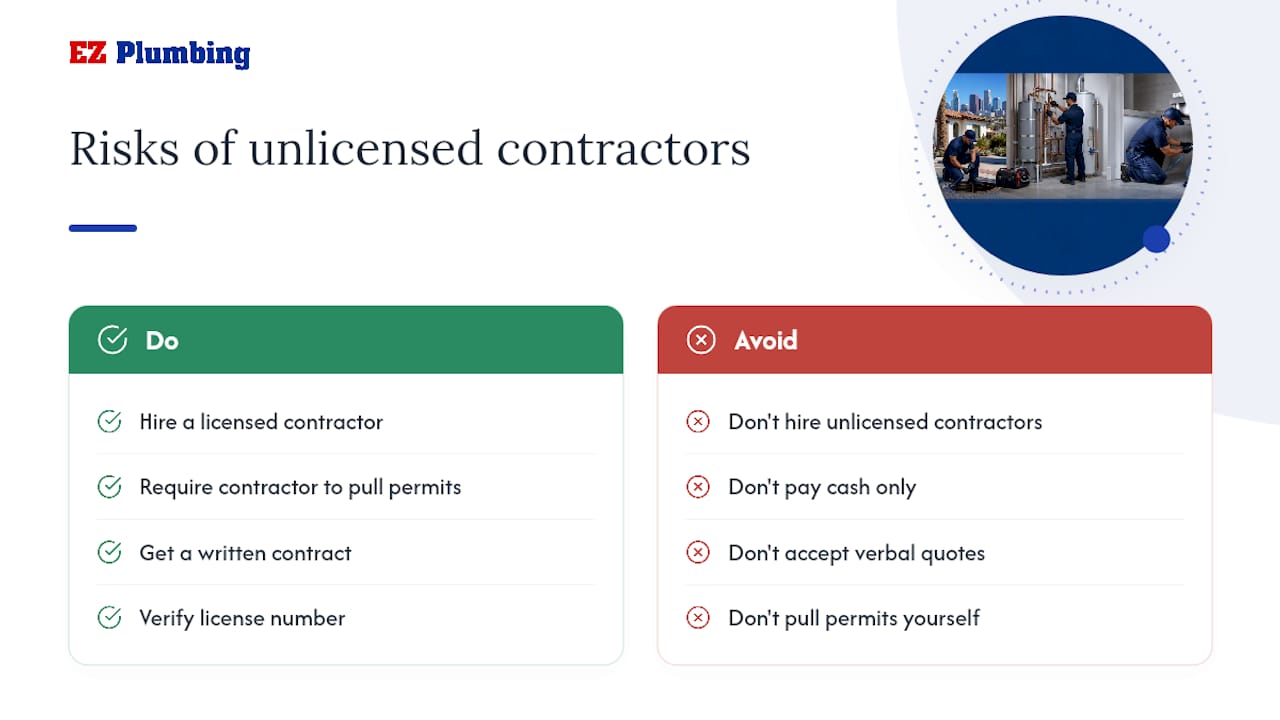
Pro Tip: Watch for these red flags: a contractor who asks you to pull the permit yourself, insists on cash-only payment, cannot provide a license number on request, or gives you a verbal quote with no written contract. Reputable licensed contractors include permitting in their workflow and treat it as a documented project milestone.
As Boston.com reports, homeowners who pull permits themselves assume full legal responsibility for code compliance, and doing so may waive access to state arbitration or guaranty fund protections.
Which insurance and bond documents to request before work begins
Confirming a contractor’s coverage takes about ten minutes and protects you from the most common financial traps. Request these documents before any work starts:
- License number (verify independently on the state board’s website).
- Certificate of Insurance (COI) showing active general liability coverage.
- COI showing workers’ compensation coverage with your project address listed.
- Bond number and surety company name so you can verify the bond is active.
- Permit copies once the contractor pulls them, before work begins.
| Policy Type | What It Covers | Homeowner Implication |
|---|---|---|
| General liability | Property damage and bodily injury caused by contractor operations | Pays for accidental damage to your home during the job |
| Workers’ compensation | Medical costs and lost wages for injured workers | Protects you from direct lawsuits by injured workers |
| Surety/performance bond | Contractor’s failure to complete the contracted scope | Provides a financial remedy if the contractor abandons the project |
| Payment bond | Unpaid subcontractors and suppliers | Prevents mechanic’s liens from being placed on your property |
Washington state’s L&I guidance confirms that registered contractors must maintain surety bonds and insurance, and notes that bond minimums were raised in July 2024, a sign that states are actively strengthening these consumer protections.
How to verify a COI: call the insurer’s main line (not a number the contractor gives you) and ask to confirm the policy number, coverage amounts, and expiration date. A forged or expired certificate is a common deception that a direct insurer call catches immediately. For a deeper look at how insurance works in plumbing projects specifically, Ez-plumbing’s guide on the role of insurance in plumbing walks through COI verification and workers’ comp in plain language.
Pro Tip: Ask the insurer or broker to email you a verification confirmation directly, not through the contractor. Keep that email in your project file alongside the license lookup screenshot.
How to verify a contractor’s license, insurance, and complaint history
Follow these steps before signing any contract or paying any deposit:
- Get the license number in writing. Ask the contractor for it upfront. California’s CSLB requires contractors to include their license number on all bids and contracts.
- Run the number through your state licensing board’s online lookup. Confirm the license is active, the name matches the company you are hiring, and the license type covers the work being done.
- Check the complaint and disciplinary record. Most state boards display formal complaints, citations, and license suspensions in the same lookup tool.
- Confirm insurance directly with the insurer. Call the insurer listed on the COI and verify policy number, coverage limits, and expiration date.
- Check permit history with your local building department. A contractor who has pulled permits in your jurisdiction before has a documented compliance track record you can review.
- Search the Better Business Bureau and local court records for unresolved complaints or judgments.
Key resources for each step:
- State contractor licensing board (e.g., California CSLB, Minnesota DLI, Washington L&I): license status, complaint history, disciplinary actions.
- Local building department: permit history, code compliance records.
- Department of Labor or Insurance portals: workers’ comp verification in many states.
- County planning and codes departments: some counties, such as Johnson County’s contractor management system, provide online contractor registration and permit verification tools.
- Better Business Bureau: consumer complaint history and ratings.
Ez-plumbing’s licensed plumbing contractor resource walks through the verification process with step-by-step guidance tailored to Los Angeles homeowners.
Pro Tip: Screenshot the license lookup result with the date visible, note the insurer’s confirmation number, and save the COI reference in a single project folder. If a dispute arises later, that documentation is your evidence.
Questions to ask and the written-contract checklist you need before any deposit
Interview questions to ask every contractor
- What is your license number, and which state board issued it?
- Can you provide a certificate of insurance for general liability and workers’ comp?
- Do you carry a surety bond, and what is the bond number?
- Who pulls the permits, and how do you handle inspections?
- What is your change-order policy, and will changes be documented in writing?
- What is the project schedule, and what are the key milestones?
- What warranty do you offer on labor and materials?
- How do you handle lien releases from subcontractors and suppliers?
What your written contract must include
- Detailed scope of work with specific materials, brands, and specifications.
- Project start date and completion milestones.
- Payment schedule tied to milestones, not to calendar dates.
- Warranty terms for both labor and materials, with duration and coverage clearly stated.
- Proof of insurance and bond attached or referenced by policy number.
- Lien release process: conditional releases at each payment, unconditional releases at final payment.
- Change-order procedure requiring written approval before any additional work begins.
- Dispute resolution clause specifying arbitration or mediation before litigation.
Payment red flags to watch for:
- A request for more than 10–15% of the total contract as an upfront deposit (some states cap this by law).
- Cash-only payment with no receipts.
- Refusal to provide a license number or COI before signing.
- No written contract offered at all.
Retain 10–15% of the final payment until you have received unconditional lien waivers from all subcontractors and suppliers and have confirmed the final inspection passed. That retained amount is your last point of leverage.
When a licensed contractor is legally required for your project
Most states require a licensed contractor for any work that “adds to or subtracts from real estate” above a certain dollar threshold, though that threshold varies widely. Specialized trades, including plumbing, electrical, HVAC, and structural work, typically require a licensed tradesperson regardless of project cost.
Common triggers that legally require a licensed contractor:
- Any plumbing work beyond simple fixture replacement (water heater installation, repiping, sewer line repair).
- Electrical panel upgrades, new circuits, or service changes.
- Structural modifications, including load-bearing wall removal.
- HVAC installation or refrigerant handling.
- Projects that require a building permit in your jurisdiction.
How to confirm the rules for your specific project:
- Visit your state contractor licensing board’s website and search for the license type required for your trade.
- Contact your local building department and ask whether your project requires a permit and a licensed contractor.
- Review your state’s homeowner exemption rules if you are considering acting as your own general contractor.
Licensing thresholds and permit triggers vary by city, county, and state. Always confirm the specific requirements with your local building department before hiring or pulling permits — what applies in one jurisdiction may not apply in the next.
The Minnesota DLI and Washington L&I both publish plain-language homeowner guides that explain when licensing is required and how to verify contractor credentials in those states. California homeowners can use the CSLB’s online tools to confirm license requirements by trade and project type.
How Ez-plumbing protects Los Angeles homeowners on every job
A water heater replacement or sewer line repair in Los Angeles illustrates exactly how licensed contractor protections work in practice. When Ez-plumbing takes on a job, the homeowner receives:
- License verification: C-36 License #583868, verifiable through the California Contractors State License Board.
- Certificate of Insurance: Active general liability and workers’ compensation coverage, confirmable by calling the insurer directly.
- Permit documentation: Ez-plumbing pulls the required permits and provides copies to the homeowner before work begins.
- Inspection sign-off: The job is not considered complete until the city inspector has signed off, giving the homeowner independent confirmation that the work meets Los Angeles municipal code.
- Lien releases: Conditional releases accompany each payment; unconditional releases are provided at project close.
Working with a licensed local plumber also reduces the risk of code violations specific to Los Angeles, where older clay sewer laterals, galvanized supply lines, and seismic strapping requirements add complexity that out-of-area or unlicensed contractors often miss.
When a licensed plumber pulls a permit and passes inspection in Los Angeles, the homeowner has a documented record that the work was done to code — a record that protects property value, supports insurance claims, and satisfies disclosure requirements at resale.
For homeowners considering a water heater replacement, Ez-plumbing’s water heater installation service covers the full permitted process, from permit application through final inspection, with all credentials provided upfront.
A practical perspective on owner-builder trade-offs
The owner-builder route, where a homeowner pulls their own permits and manages subcontractors directly, is legal in most states for your primary residence. For a straightforward cosmetic project with no structural, plumbing, or electrical scope, it can be a reasonable way to manage costs. The trade-offs become serious the moment the work touches anything that affects safety systems.
When you pull your own permit, you assume full legal responsibility for code compliance. If an inspection fails, you pay to correct the violations. You also lose access to state arbitration programs and recovery funds that are reserved for disputes with licensed contractors. As Boston.com notes, that shift in responsibility is not theoretical; it has real financial consequences when work fails.
If you do act as owner-builder, at minimum: verify every subcontractor’s license and insurance independently, keep copies of all permits and inspection records, and confirm your homeowner’s insurance policy covers owner-managed construction. For any work that touches plumbing, electrical, or structural systems, the liability exposure of the owner-builder path usually outweighs the cost savings. The risks LA homeowners face with DIY plumbing are a useful reference for understanding where unlicensed or self-managed work tends to go wrong.
For most homeowners, the recommendation is straightforward: hire a licensed contractor for any work that affects structure, plumbing, or safety systems. The verification steps in this guide take less than an hour and protect you from consequences that can take years to resolve.
Authoritative resources to bookmark for your project
Use these official sources to verify licensing, bonds, and consumer protections for your state and project:
- Mass: Registration lookup, arbitration program details, and Guaranty Fund eligibility for Massachusetts homeowners.
- Minnesota Department of Labor and Industry: Licensing requirements, contractor verification, and Contractor Recovery Fund information.
- California Contractors State License Board (CSLB): License status, complaint history, and consumer guidance for California projects.
- Washington State L&I: Contractor registration verification, bond requirements, and workers’ comp lookup tools.
- Johnson County Contractor Management System: Example of a county-level permit and contractor registration verification tool.
- Your local building department: The authoritative source for permit requirements, inspection scheduling, and local code rules specific to your city or county.
Bookmark your state licensing board and local building department pages at the start of every project. Screenshot your license lookup results with the date visible, note your insurer confirmation number, and keep all COI copies in a single project folder. That documentation protects you if a dispute arises and satisfies disclosure requirements if you sell the property.
This article is general information, not a substitute for advice from a qualified lawyer. Consult a qualified legal professional about your own circumstances before acting on anything here.
Sources
- Mass
- Tips for hiring a contractor | Minnesota Department of Labor and Industry
- How do I find the right licensed contractor? – CSLB
- F625-084-000 What You Should Know About Hiring a Contractor, Remodeler, or Handyman