
Why Upgrade Your Water Heater: 2026 LA Guide
Upgrading a water heater is defined as replacing an aging unit with a modern, energy-efficient system that delivers consistent hot water, lowers monthly utility costs, and protects your home from leaks and unexpected failures. For Los Angeles homeowners and property managers, the decision to upgrade carries extra weight in 2026. Heat pump water heaters and tankless models now qualify for federal tax credits under the Inflation Reduction Act, making the financial case stronger than it has ever been. Understanding why upgrade water heater decisions matter now, rather than waiting for a cold shower emergency, is the difference between a planned investment and a costly crisis.
Why upgrade your water heater before it fails
The most common reason to replace a water heater is age. Standard tank units typically last 8–12 years before performance declines and failure risk rises sharply. Modern heat pump water heaters, by contrast, last 10–15 years or more while maintaining better efficiency throughout their lifespan. That gap in longevity alone makes upgrading a sound financial decision for any unit approaching the decade mark.
Beyond age, specific warning signs tell you a replacement is overdue. Watch for these indicators:
- Rust-colored or discolored water coming from the hot tap, which signals internal corrosion or sediment buildup inside the tank. Rusty, discolored water left unaddressed risks tank failure and water damage to floors, walls, and cabinetry.
- Inconsistent hot water supply, where the shower runs cold mid-use or the tank takes unusually long to recover. This points to a failing heating element or excessive sediment insulating the burner.
- Visible leaks or pooling water around the base of the unit. A leaking tank cannot be repaired and requires immediate replacement.
- Multiple service calls within a single year, which signals systemic decline rather than isolated component failure.
The repair-versus-replace calculation is straightforward. Repair costs exceeding 50% of the price of a new unit favor replacement every time. Plumbers also use a simple formula: multiply the unit’s age in years by the cost of the repair. If that number exceeds $500, replacement is the wiser financial choice.
Pro Tip: Schedule a professional assessment when your water heater turns 10 years old, even if it appears to be working fine. Proactive replacement lets you plan the upgrade on your terms, choose the right technology, and capture available rebates rather than paying emergency service premiums.
How do modern water heaters reduce energy costs?
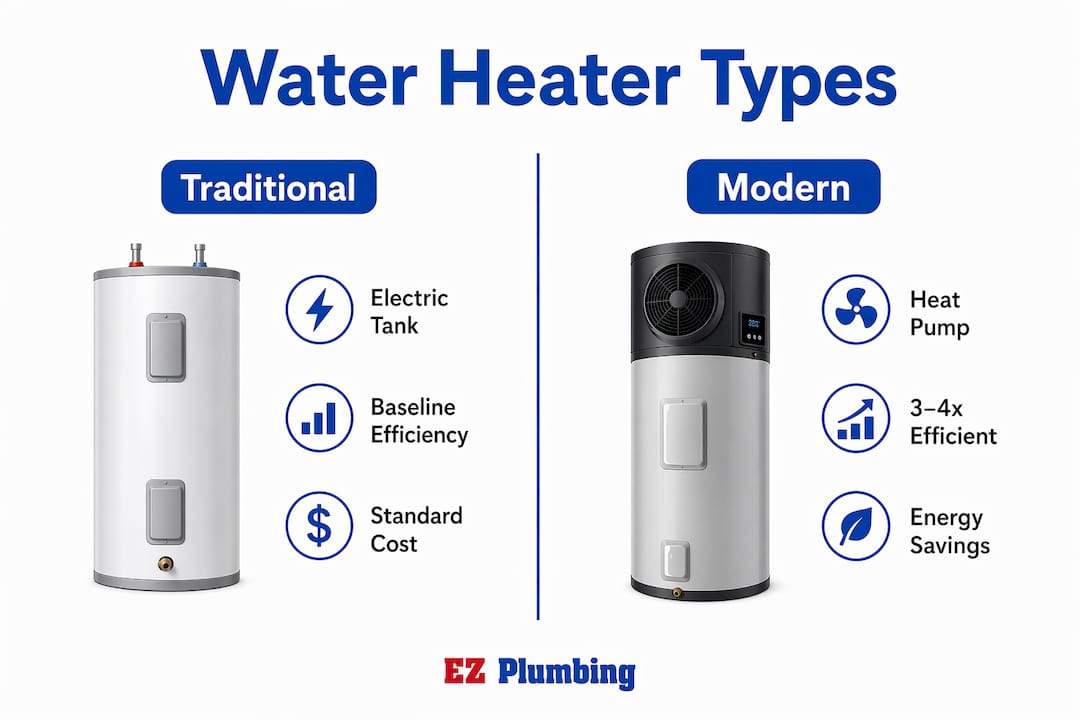
The core efficiency advantage of modern water heaters comes from how they generate heat. Traditional electric resistance tanks convert electricity directly into heat at roughly a 1:1 ratio. Heat pump water heaters work differently. They move existing heat from the surrounding air into the water, delivering 3–4 units of heat energy for every single unit of electricity consumed. That ratio translates directly into lower utility bills every month.
The savings are significant. Switching from a standard electric tank to a heat pump model saves $450–$600 annually, and federal tax credits under the Inflation Reduction Act provide up to $600 per year for qualifying heat pump water heaters. Many Southern California utility companies layer additional rebates on top of that. For many Los Angeles households, the net payback period falls under two years.
Tankless water heaters offer a different efficiency profile. They heat water on demand rather than maintaining a stored tank, eliminating standby heat loss entirely. For homes with lower daily hot water usage, tankless units can be 24–34% more energy-efficient than conventional storage tanks. ENERGY STAR-certified tankless models also qualify for federal tax credits up to $2,000, which substantially offsets the higher upfront cost.
Here is a direct comparison of the three main options:
| Feature | Traditional Tank | Heat Pump | Tankless |
|---|---|---|---|
| Energy efficiency | Baseline | 3–4x more efficient | 24–34% more efficient |
| Lifespan | 8–12 years | 10–15+ years | 15–20 years |
| Federal tax credit | None | Up to $600/year | Up to $2,000 |
| Hot water supply | Limited by tank size | Limited by tank size | Unlimited on demand |
| Upfront cost | Lowest | Moderate to high | Moderate to high |
Pro Tip: If your Los Angeles home runs on natural gas, a tankless gas unit often delivers the fastest payback. If you have an electric panel with capacity to spare, a heat pump water heater typically offers the greatest long-term savings.
What installation factors should you consider before upgrading?
Choosing the right technology is only half the decision. The physical requirements of your home determine which system installs cleanly and which requires costly infrastructure upgrades.
Tankless water heaters, particularly gas-fired models, have specific installation demands that catch many homeowners off guard. Key considerations include:
- Gas line sizing. Most existing gas lines are undersized for the high-BTU demand of a tankless unit. Upgrading the gas line and adding dedicated venting adds to the installation cost and requires a licensed plumber to handle safely.
- Venting configuration. Tankless units require direct-vent or power-vent systems. Older homes in neighborhoods like Van Nuys or Pasadena may need new vent runs, which affects both cost and installation time.
- Location and clearances. Heat pump water heaters need at least 700–1,000 cubic feet of surrounding air space to operate efficiently. A cramped utility closet will reduce performance. Garages and large laundry rooms are ideal locations in most LA homes.
- Electrical panel capacity. Heat pump models require a dedicated 240-volt circuit. If your panel is already near capacity, an electrical upgrade may be necessary before installation.
Maintenance requirements also differ by technology. Annual descaling of tankless units removes mineral buildup from the heat exchanger, which is especially important given LA’s moderately hard water. For traditional tank heaters, anode rod replacement every 3–5 years slows internal corrosion and extends the unit’s life. Skipping these steps can void manufacturer warranties and accelerate failure. Professional sizing by a licensed plumber, based on your household’s peak demand and fuel availability, is the most reliable way to avoid performance problems after installation. Proper sizing and fuel assessment from Energy.gov confirms that mismatched capacity is the leading cause of inconsistent hot water after an upgrade.
How does upgrading your water heater add long-term value?
The benefits of a water heater upgrade extend well beyond the monthly utility bill. Energy-efficient appliances are a recognized factor in home resale value, particularly in the Los Angeles market where buyers and property investors pay close attention to operating costs. A heat pump or tankless unit signals to buyers that the home has been maintained with long-term cost efficiency in mind.
The environmental impact is also measurable. In California’s energy landscape, where the grid is increasingly powered by renewable sources, a heat pump water heater amplifies those gains. Using less electricity to produce the same amount of hot water means a lower carbon footprint per household. Upgraded water heaters contribute directly to energy independence and reduced environmental impact, which aligns with California’s statewide decarbonization goals.
Smart home compatibility is another advantage that older tank units simply cannot offer. Many new water heater models from brands like Rheem and A.O. Smith include Wi-Fi-enabled controls that let you schedule heating cycles, monitor energy consumption, and receive alerts for unusual performance. Smart home integration in modern units helps optimize energy use and monitor performance remotely, adding convenience alongside the savings.
| Benefit | Impact |
|---|---|
| Home resale value | Energy-efficient systems attract buyers and support higher asking prices |
| Carbon footprint | Lower electricity draw reduces household emissions, especially on CA’s grid |
| Smart home integration | Remote monitoring and scheduling reduce energy waste |
| Protection from rate increases | Higher efficiency insulates you from the full impact of rising utility rates |
Key takeaways
Upgrading a water heater to a heat pump or tankless model is the most cost-effective way to cut utility bills, extend equipment lifespan, and protect your Los Angeles home from water damage.
| Point | Details |
|---|---|
| Age triggers replacement | Units at 10–12 years old should be assessed for replacement before failure occurs. |
| Heat pump efficiency | Heat pump models deliver 3–4x more heat per unit of electricity, saving $450–$600 annually. |
| Federal incentives available | The Inflation Reduction Act offers up to $2,000 in tax credits for qualifying upgrades. |
| Installation needs vary | Tankless units may require gas line upgrades; heat pump models need adequate air space. |
| Long-term value | Energy-efficient water heaters raise resale value and reduce your carbon footprint. |
What i’ve learned after years of LA water heater upgrades
Most homeowners wait too long. That is the single most consistent pattern we see at Ez-plumbing across jobs in Van Nuys, Pasadena, and throughout the San Fernando Valley. A unit starts showing minor signs, the homeowner patches it, and then six months later we get an emergency call on a Saturday morning with water spreading across a hardwood floor. The repair bill for the water heater is the smallest part of that invoice.
The honest truth about the upgrade decision is that the technology choice matters less than the timing. A properly sized heat pump water heater installed at year ten will outperform a tankless unit rushed in during an emergency at year fourteen, because the planned installation allows for proper gas line assessment, panel evaluation, and location selection. Rushed jobs cut corners.
I also want to address the upfront cost concern directly, because it stops a lot of people from acting. The federal tax credits under the Inflation Reduction Act are real and accessible. When you factor in $600 per year in credits for a heat pump unit, plus utility rebates from providers like Southern California Edison, the net cost of a quality upgrade is often comparable to what you would spend on two or three repair calls on an aging tank. The math favors replacement far sooner than most people realize.
The other thing worth saying plainly: not every home in LA is set up for every technology. A 1960s bungalow in Reseda with a small utility closet and an undersized gas line is not the right candidate for a high-BTU tankless unit without infrastructure work. That is not a reason to avoid upgrading. It is a reason to get a professional assessment first, so you choose the right system for your specific home rather than the one that looked good in an advertisement.
— EZ
Ready to upgrade? Ez-plumbing can help
Ez-plumbing serves homeowners and property managers across Los Angeles with licensed, code-compliant water heater installation and replacement services. Whether you are weighing a heat pump model against a tankless unit or simply need a professional assessment of your current system, our team handles the full process from sizing and permitting to final inspection.
Our technicians are familiar with the specific infrastructure challenges found in LA homes, from undersized gas lines in older neighborhoods to panel capacity issues in multi-unit properties. We also help you identify and apply for available utility rebates and federal tax credits to reduce your out-of-pocket cost. Review our water heater installation guide to understand what the upgrade process involves, or call Ez-plumbing directly to schedule a no-pressure consultation. We also offer tankless water heater options for homes where on-demand heating is the right fit.
FAQ
When is it time to replace a water heater?
Replace your water heater when it reaches 10–12 years of age, shows rust-colored water, leaks, or requires repairs costing more than 50% of a new unit’s price. Proactive replacement avoids emergency costs and water damage.
What are the main benefits of upgrading a water heater?
The primary benefits include lower energy bills, longer equipment lifespan, access to federal tax credits, and more reliable hot water supply. Heat pump models save $450–$600 annually compared to standard electric tanks.
How do tankless and heat pump water heaters compare?
Tankless units heat water on demand and suit homes with lower peak usage, while heat pump models use ambient air to generate heat at 3–4x the efficiency of electric resistance tanks. Your home’s fuel availability, space, and usage patterns determine the better fit. Review the tank vs. tankless comparison for a detailed breakdown.
Does upgrading a water heater increase home value?
Yes. Energy-efficient appliances are a recognized selling point in the Los Angeles market, and a newer, high-efficiency water heater signals lower operating costs to prospective buyers and property investors.
What maintenance does a new water heater require?
Tankless units need annual descaling to remove mineral deposits, while tank models require anode rod replacement every 3–5 years. Neglecting maintenance can void warranties and shorten the unit’s lifespan significantly.