
Water Line Leak: A Los Angeles Homeowner’s Guide
A water line leak usually doesn't announce itself with a burst pipe in plain sight. In Los Angeles, it more often shows up as a bill that suddenly makes no sense, a patch of yard that stays damp when everything else is dry, or tenant complaints that the water pressure has dropped all over the building. If you manage a duplex, HOA, retail property, or single-family home, that uncertainty is what makes the problem expensive. People start guessing. Groundskeepers blame plumbing. Plumbers blame irrigation. Someone starts digging before anyone proves where the leak is.
That's the wrong sequence.
The right approach is to slow the panic down and make a few clear decisions in order. First, confirm whether water is moving when it shouldn't be. Then separate a likely main line issue from fixture leaks, toilets, irrigation valves, or branch-line problems. After that, decide whether the situation calls for shutoff and emergency response, or for targeted non-invasive leak detection that avoids tearing up a driveway, courtyard, or cultivated frontage for no reason.
Table of Contents
- That Sinking Feeling Discovering a Potential Leak
- Understanding Your Main Water Line and Common Leak Causes
- Telltale Signs of a Hidden Water Line Leak
- Immediate Steps to Take for a Suspected Leak
- Professional Leak Detection and Repair Methods
- Navigating Water Line Repair Costs and Insurance
- Protect Your Property and Call the Right Pro
That Sinking Feeling Discovering a Potential Leak
It often starts with one detail that doesn't fit.
A homeowner notices the front walkway is dry, but the planting strip near the meter box stays soft. A small apartment owner gets calls from two units saying the showers have weak pressure at the same time. A property manager sees overnight water use on a statement when the building should've been quiet. None of those signs proves a main water line leak by itself, but together they create the same problem. Water is going somewhere, and nobody knows where.
That uncertainty is what rattles people. Underground leaks don't give you the courtesy of a visible drip. They hide below concrete, root zones, crawlspaces, parking lots, and slab edges. In Los Angeles, where access is often tight and exterior surfaces are expensive to restore, one bad guess can cost almost as much as the repair itself.
Hidden leaks get expensive in two ways. The water loss hurts you first, and the wrong diagnosis hurts you second.
The good news is that most leak situations can be narrowed down without drama. You don't need to start by trenching a yard or breaking hardscape. You need a decision path.
Start with the pattern of symptoms. Is pressure low at one sink, or across the property? Is the wet area near irrigation, or between the meter and the structure? Does the meter move when everything is off? Those answers matter more than hunches.
For worried owners and managers, the priority is simple. Confirm the leak, isolate the likely zone, and escalate only when the evidence says you should. That's how you protect landscaping, foundations, tenant relations, and the repair budget at the same time.
Understanding Your Main Water Line and Common Leak Causes
Your main water line is the pressurized pipe that brings water from the utility side to the property. Think of it as the trunk line. Every shower, sink, hose bib, toilet, and appliance depends on that one path delivering steady flow.
Because it stays under pressure and usually runs underground, it fails differently than interior plumbing. You won't always see the leak where the pipe is damaged. Water follows soil, footing lines, roots, paving joints, and low spots. That's why a leak near the street can show itself closer to the house, or why a break near a slab edge can look like an irrigation issue at first.
The four causes plumbers see most often
Industry guidance identifies corrosion, high water pressure, damaged joints, and shifting soil or ground movement as common drivers of plumbing leaks, and it also notes that keeping home water pressure under 60 psi helps reduce stress on the plumbing system, according to NuFlow Midwest's plumbing leak prevention guidance.
Here's what that means in plain terms:
- Corrosion: Older metallic pipe can thin over time. A line may hold for years, then start pinholing or splitting once one weak section gives way.
- High pressure: Excess pressure beats up joints, valves, connectors, and pipe walls. Even when the leak doesn't show up at the regulator, pressure stress is often part of the story.
- Damaged joints: The pipe itself may be intact while a coupling, transition fitting, or connection point is what fails.
- Ground movement: Soil doesn't stay perfectly still. Expansion, settling, and vibration put buried lines in tension, especially at turns and connections.
Why Los Angeles properties need a little extra caution
In this market, leak diagnosis gets complicated by the property layout. You may have long runs under driveways, detached garages, ADUs, hillside lots, decorative concrete, mature landscaping, or shared service zones in multi-unit buildings. That means access matters just as much as the pipe material.
A short service line with open soil is a different job than a buried line crossing hardscape and occupied tenant paths. The cause may be simple. The logistics often are not.
Field rule: Don't assume the wettest spot is the break location. Underground water rarely stays where it exits the pipe.
What doesn't usually work
Guessing from age alone doesn't work. Neither does replacing random valves because pressure seems low. A worn fixture cartridge can mimic part of the symptom pattern, and a bad irrigation valve can make an outdoor area look like a main line failure.
That's why every reliable diagnosis starts with system behavior, not with a shovel.
Telltale Signs of a Hidden Water Line Leak
A hidden water line leak leaves clues, but the clues have to be read in context. One symptom alone is weak evidence. Several symptoms that line up in the same direction are what matter.
What points toward the main line
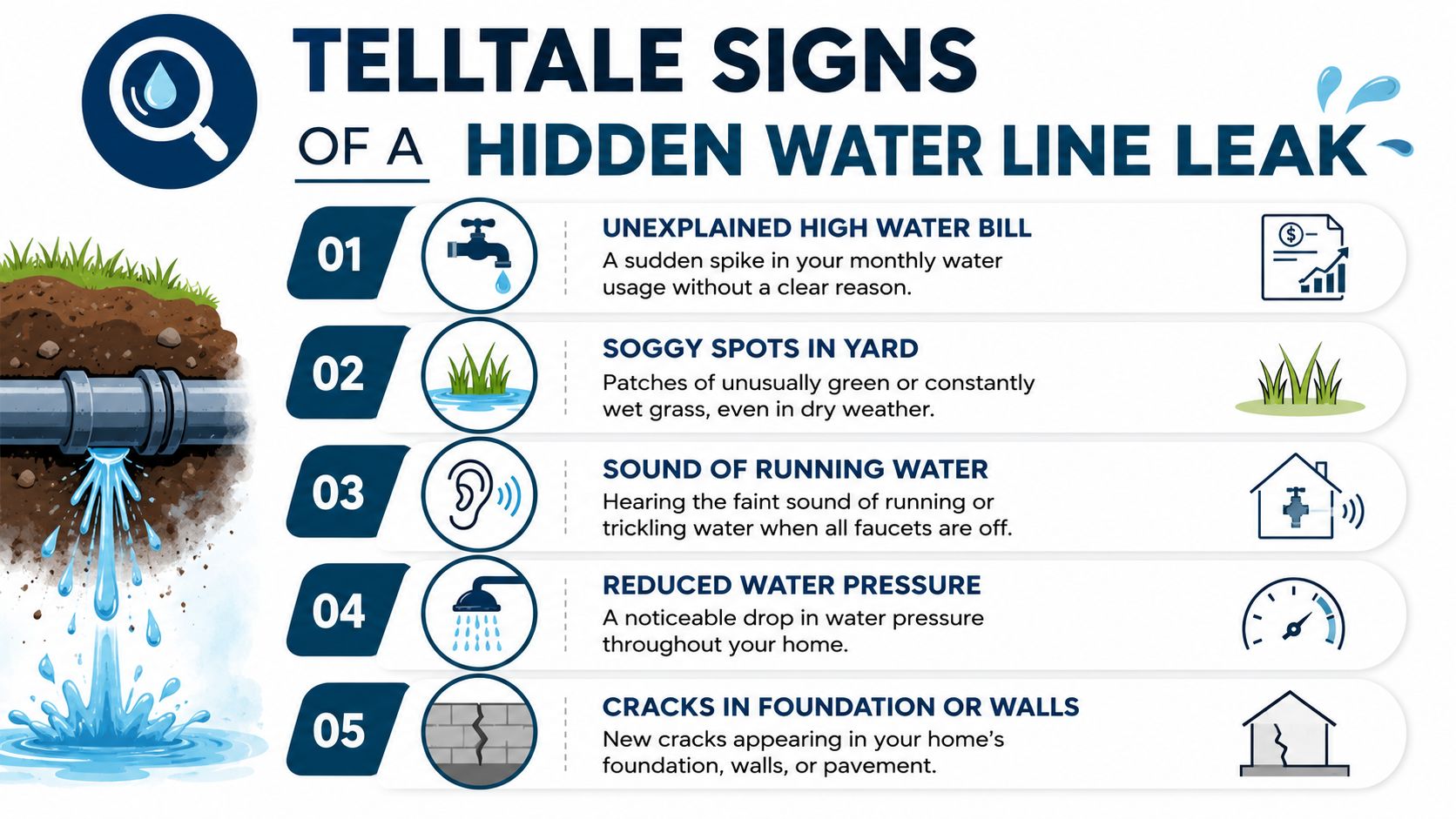
A noticeable drop in water pressure at multiple fixtures is one of the strongest clues. If the kitchen, hall bath, and shower all lose pressure around the same time, the problem is probably upstream of those individual fixtures. Utility guidance also supports the simple meter test. If the meter keeps moving after all water use inside the property is shut off, that points to a leak in the supply line, as explained by Home Water Works leak guidance.
That test matters because it separates a supply problem from normal usage.
Use this checklist:
- Pressure falls across the property: Not one faucet. Several.
- You hear water when everything is off: A faint hiss or flow sound can be a clue, especially at night when the site is quiet.
- Ground stays wet without irrigation running: This matters more if the damp area sits between the meter and the building.
- Water bills stop matching occupancy: If usage climbs while routines stay the same, investigate.
- Cracks or movement appear near hardscape or slab edges: Water below the surface can wash out support or shift soils.
If you need help confirming whether the meter is showing leakage, this walkthrough on how to read a water meter for leaks gives a practical starting point.
What often turns out to be something else
A lot of owners jump straight to “main line leak” when the actual cause is irrigation or a fixture that never fully closes.
Look at timing. If the wet area appears only after the sprinkler schedule runs, irrigation stays high on the list. If one toilet refills on its own, the meter can move even though no one is using water. If only one unit in a building has poor pressure, that usually points away from the main service line and toward a branch, valve, angle stop, aerator, or fixture issue.
When assessing outdoor areas, don't overlook irrigation overspray, stuck valves, or poor coverage patterns. A resource focused on exterior planting and irrigation like this guide to keeping your Prescott lawn green is useful because healthy turf and wet turf are not the same thing. Overwatering can imitate a leak, especially in planting strips and lawn margins.
If the evidence is mixed, don't dig yet. First prove whether the water loss is constant, scheduled, or fixture-related.
In multi-unit properties, the best clue is often whether the complaint is shared. Building-wide pressure loss suggests a supply-side issue. One stack, one wing, or one unit usually suggests something downstream.
Immediate Steps to Take for a Suspected Leak
Once you believe the leak is active, speed matters. Not frantic speed. Controlled speed.
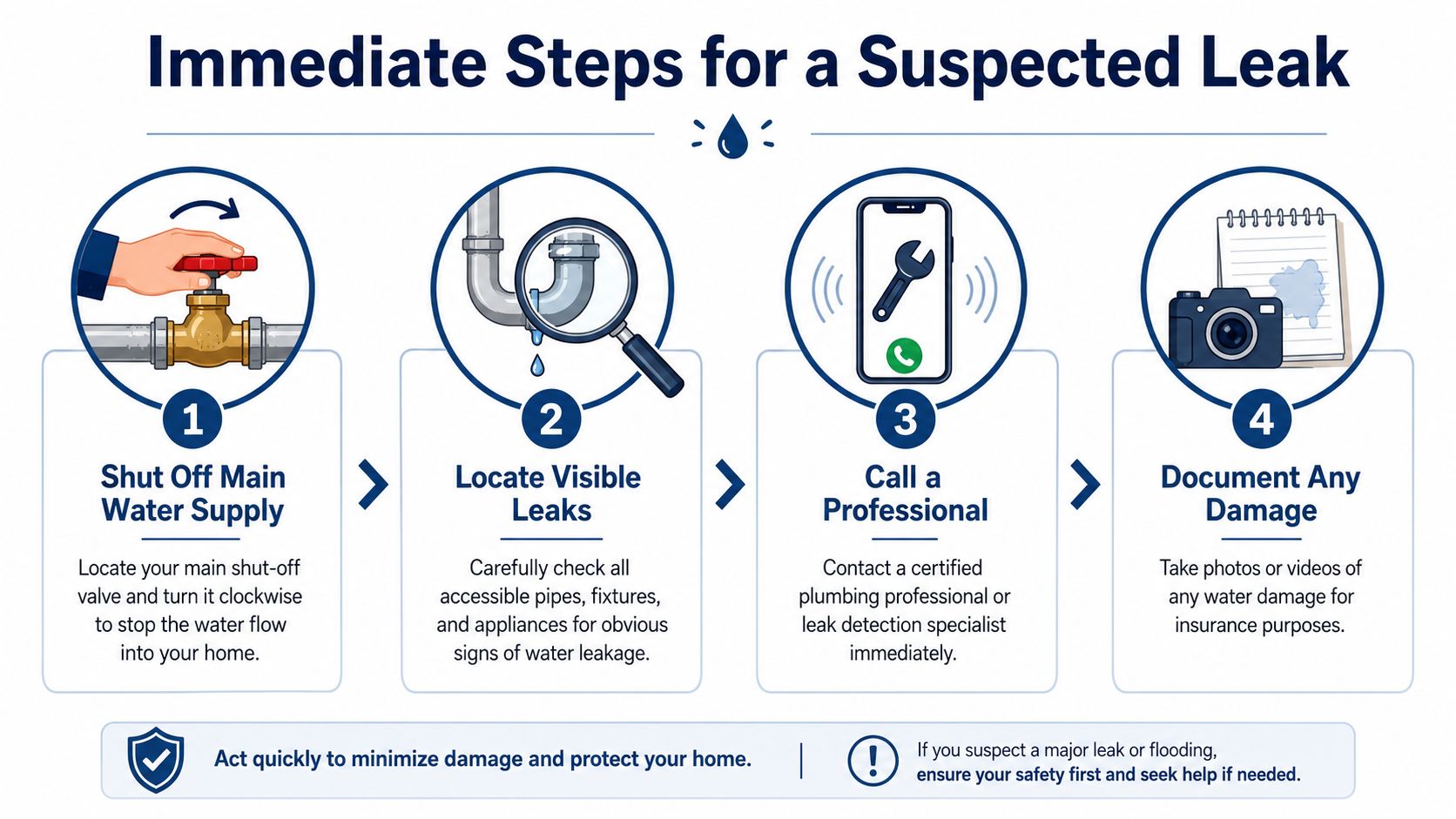
Start by getting the water off if the leak appears significant, if pressure has dropped sharply, or if water is surfacing near the structure, slab, retaining areas, or occupied walkways.
Shut the water off with purpose
- Find the main shutoff valve. On many properties it's either near the street in a utility box or where the service line enters the building.
- Turn the valve fully. A ball valve uses a lever. A gate valve uses a round handle. Don't force a stuck valve so hard that you create a second problem.
- Confirm the flow stops. Open a faucet and see whether pressure drops off and then stops.
- Check the meter if accessible. If it settles after shutoff, you've isolated the active flow.
If you're not sure where the shutoff is or what type of valve you're looking at, this guide on how to shut off the main water supply helps property owners and managers handle that step safely.
Protect the property while you wait
After shutoff, open faucets at high and low points in the building to relieve remaining pressure and drain down what's left in the line. That reduces continued seepage and makes some repairs easier once a plumber arrives.
A few priorities matter right away:
- Move valuables and electronics: Water travels farther than commonly realized.
- Keep people off softened soil: Saturated ground near a leak can shift underfoot.
- Document visible damage: Photos help with records, vendors, and insurance conversations.
- Tell tenants what's happening: A short, clear notice prevents panic and repeated maintenance calls.
This short video gives a practical visual on emergency response basics before the technician gets there:
Turn the water off first. Diagnosis comes second. Too many owners reverse that order and let the loss continue while they debate the cause.
If the suspected leak is near electrical equipment, don't step into standing water around energized areas. Call for help and keep the area clear.
Professional Leak Detection and Repair Methods
Once the immediate risk is under control, the next decision is whether the evidence is strong enough for direct repair or whether you need detection first. On Los Angeles properties with expensive hardscape, limited access, or multiple possible sources, detection usually saves money by preventing unnecessary excavation.
Why blind digging fails
Digging where the wet spot appears is often the rookie move. Underground leaks migrate. Water can travel along the pipe trench, rise at a crack in pavement, or show up at the low side of a slope while the actual break sits elsewhere.
That problem gets worse on properties with:
- Driveways and decorative concrete
- Mature trees and root zones
- Shared courtyards or HOA common areas
- Buried lines crossing parking or pedestrian paths
- Occupied units where access disruption matters
In those settings, a bad excavation plan creates restoration work, tenant disruption, and a second invoice.
How modern detection narrows the target
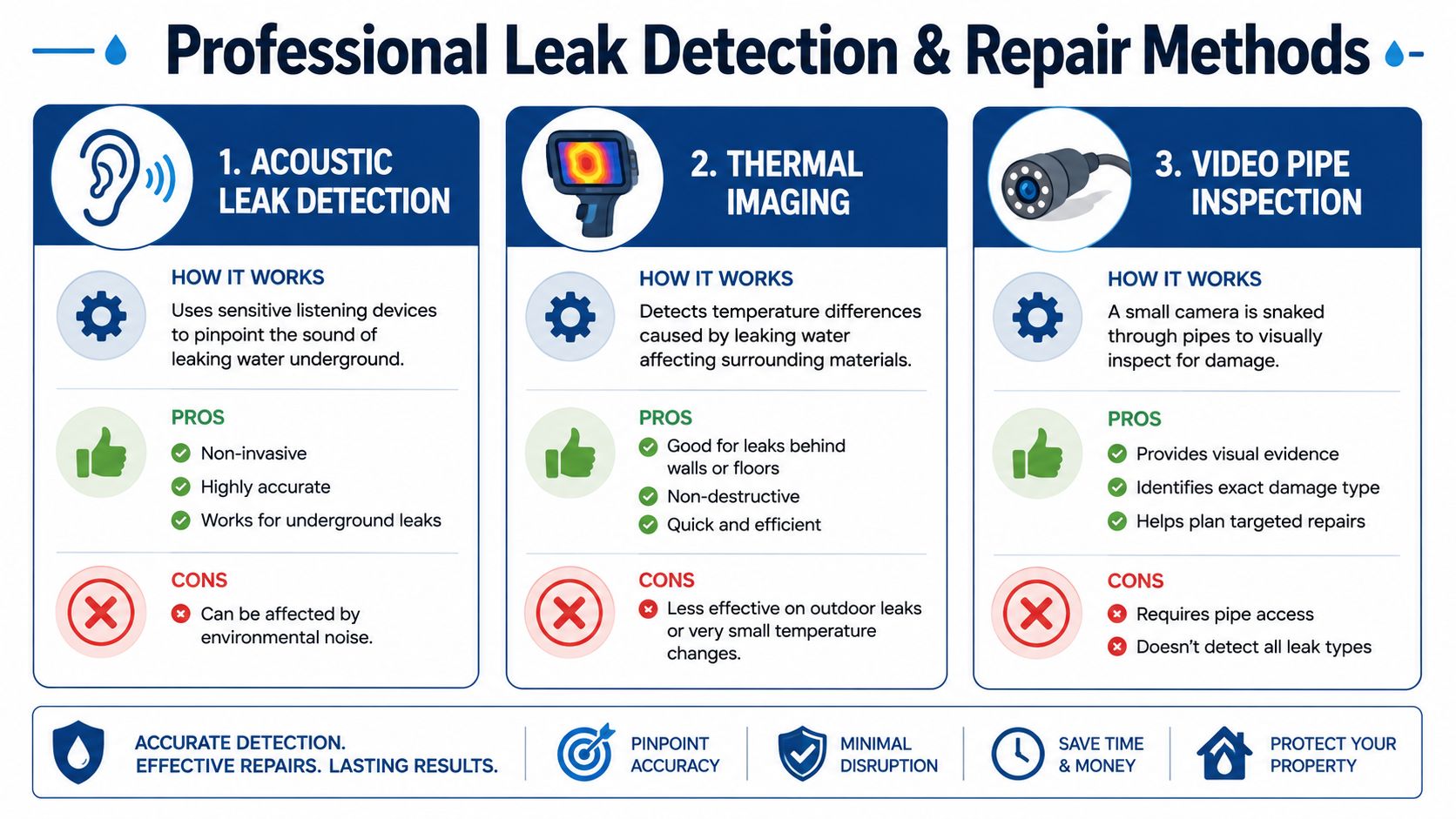
Current practice increasingly relies on noninvasive methods like acoustic listening and ground-penetrating radar to locate underground leaks with less destructive digging, according to Strong Built USA's leak detection overview.
Here's how the main options compare in the field:
| Method | How it helps | Best use | Limitation |
|---|---|---|---|
| Acoustic listening | Listens for the sound signature of pressurized water escaping pipe | Buried service lines and many outdoor leak paths | Background noise can interfere |
| Thermal imaging | Finds temperature differences caused by water affecting surrounding materials | Interior walls, floors, and some slab-related investigations | Less useful when the temperature contrast is weak |
| Ground-penetrating radar | Helps identify subsurface anomalies and utility paths | Complex sites where blind cutting would be risky | Interpretation depends on site conditions |
| Video inspection | Gives visual evidence inside accessible piping | Drain or pipe condition questions where camera access exists | It doesn't solve every pressurized supply leak problem |
For properties that need professional diagnosis, EZ Plumbing leak detection services are one example of a local option using targeted diagnostics instead of immediate destructive exploration.
Choosing the repair method
Once the leak is located, repair strategy depends on the pipe condition, access, and whether the failure looks isolated or systemic.
Spot repair works when the pipe is otherwise sound and the damaged area is limited and reachable. If one section failed because of a localized issue, opening only that section is often the cleanest answer.
Section replacement or full line replacement makes more sense when the pipe shows broader deterioration, repeated failure points, or weak transitions. Repairing one hole in a line that's failing in several areas often turns into a series of callbacks.
Trenchless methods can reduce surface disruption on some properties. They're especially worth discussing when the line passes under expensive hardscape, landscaping, or access routes that would be difficult to restore. They are not automatically the right answer for every site. Access points, pipe condition, and layout still decide that.
The right repair isn't the one with the smallest hole in the ground. It's the one that solves the actual failure pattern without setting up the next leak.
For HOAs and apartment owners, insist on a site plan before work begins. You want to know what gets shut down, which units are affected, where access is needed, and how the area will be protected during repair.
Navigating Water Line Repair Costs and Insurance
Most owners ask the money question immediately, and that's fair. A water line leak doesn't come with one standard price because the pipe isn't the whole job. Access, surface restoration, location, and diagnostic certainty often drive the final number as much as the actual repair work.
That's especially true in Los Angeles, where the same leak can be simple on one parcel and difficult on the next. A line in open soil is one kind of project. A line under decorative paving, a retaining edge, or a shared access path is another.
What changes the price
A repair estimate usually moves based on a handful of practical issues:
- Where the leak sits: Near the meter, under a slab edge, beneath concrete, or in a planted area all create different labor and restoration needs.
- How certain the location is: If the break is well defined, the repair can start tighter. If the source is still ambiguous, more diagnostic work may come first.
- How much site protection is needed: Occupied buildings, tenant pathways, and HOA common areas require more coordination.
- Whether the pipe has one bad point or a broader condition problem: One repair is not the same as replacing a line with repeated weak spots.
- Which restoration trades are involved: Concrete, grounds work, drywall, paint, and flooring are separate cost conversations.
For contractors and managers trying to compare bids, structured estimating matters. A tool like Exayard plumbing estimating software can be useful on the contractor side because line-item visibility often makes it easier to see where excavation, labor, material, and restoration costs are coming from.
Estimated Water Line Repair Costs in Los Angeles 2026
The table below is qualitative because reliable pricing changes by site conditions, access, and repair scope. Use it to frame conversations, not to treat one property like another.
| Repair Method | Typical Cost Range | Best For |
|---|---|---|
| Spot repair with limited excavation | Varies by access and restoration scope | One confirmed break in an otherwise sound line |
| Section replacement | Varies by pipe length, material, and access | A damaged run that extends beyond one isolated point |
| Full water line replacement | Varies widely by route, surface conditions, and building layout | Aging lines with repeated failures or widespread deterioration |
| Trenchless repair or replacement | Varies by equipment access and pipe conditions | Sites where minimizing surface disruption matters |
What insurance usually looks at
Insurance language is policy-specific, but the broad distinction owners run into is this. Carriers often separate the damage caused by water from the cost to repair the failed pipe itself. Sudden interior damage may be treated differently than long-term seepage, deferred maintenance, or gradual deterioration.
That's why documentation matters early. Save photos, service notes, tenant reports, and dates. If the leak affected flooring, drywall, cabinets, or personal property, record that separately from the plumbing repair itself.
One reason prompt action matters is simple waste control. The average U.S. household leak wastes more than 10,000 gallons per year, and fixing easily corrected leaks can save about 10% on water bills, according to South Chicago Heights leak facts. That doesn't tell you what your claim will cover, but it does show why delay costs real money even before damage spreads.
Call your carrier early, but don't assume the adjuster will diagnose the plumbing issue for you. The claim process goes smoother when the leak location, cause, and affected areas are already documented clearly.
Protect Your Property and Call the Right Pro
Once a leak is repaired, the goal is to avoid repeating the same cycle. That means focusing on the few habits that reduce risk instead of relying on luck.

Prevention that actually helps
Start with the basics that owners often skip:
- Know your shutoff location: In an active leak, finding the valve shouldn't be a scavenger hunt.
- Pay attention to pressure changes: Building-wide pressure loss is information, not an inconvenience.
- Watch wet areas that don't match irrigation schedules: Repeating damp spots deserve follow-up.
- Have pressure checked periodically: High pressure shortens the life of plumbing components.
- Keep records of past repairs: Repeat failures usually leave a pattern.
For single-family homes, that may be enough to catch trouble early. For managers, that's only the foundation.
What property managers and HOAs should do differently
Multi-unit and commercial properties need a more organized response because shared plumbing systems create shared consequences. Facility-oriented guidance notes that these sites often require broader diagnostics to identify problems in buried service lines or complex plumbing networks, making fast expert response important for minimizing disruption and operating loss, as discussed in facility leak location guidance from GPRS.
In practice, that means:
- Track complaints by location: One unit is different from one stack or the whole property.
- Document meter behavior during low-use periods: Overnight movement can be revealing.
- Coordinate with outdoor maintenance personnel before blaming plumbing: Irrigation and supply leaks get confused all the time.
- Set access rules before the emergency happens: Who can approve shutoff, entry, and repair after hours?
- Require non-invasive detection when the source isn't clear: Guessing is expensive in common areas.
For Los Angeles owners who need service support, EZ Plumbing is a licensed, insured contractor serving the area since 1989 with 24/7 emergency response for homes, HOAs, property managers, and commercial properties. The practical value there isn't marketing language. It's having a team that can diagnose, isolate, and repair with clear communication when tenants, boards, or building operations are involved.
The right pro should be able to answer simple but important questions without hedging. Is this likely main line, irrigation, or interior plumbing? What evidence supports that conclusion? Do we need detection before excavation? Which areas need shutoff, access, and restoration planning?
If those answers are vague, keep asking.
If you're dealing with a suspected water line leak in Los Angeles, EZ Plumbing can help you verify the source, shut the situation down safely, and move to targeted repair without unnecessary digging. Call (818) 908-2710 for emergency service or schedule online for a diagnostic visit.