
How to Detect Water Leaks Before They Cause Major Damage
You notice the water bill is higher than usual, but nothing looks obviously wrong. The sinks are dry, the ceiling isn't stained, and no faucet is dripping. In a Los Angeles home, that small change may be the first warning of a leak beneath a slab, behind a wall, or along a buried supply line.
Hidden leaks create a particular problem in multi-unit buildings and slab-foundation properties. Water can travel through concrete and framing before anyone sees a mark, while one failed line can disrupt several apartments, damage flooring, and create a dispute over responsibility. Learning how to detect water leaks early helps you separate a simple fixture problem from a concealed plumbing failure before the repair becomes a property emergency.
Table of Contents
- Why Early Water Leak Detection Matters
- Quick DIY Checks You Can Do in Under 30 Minutes
- Smart Leak Detectors and Consumer Tools Explained
- Professional Diagnostics for Hidden and Underground Leaks
- When to Call a Licensed Plumber in Los Angeles
- Building a Layered Leak Prevention Strategy
Why Early Water Leak Detection Matters
A homeowner may dismiss an unexplained bill increase as seasonal use, a visiting relative, or a billing adjustment. Months later, a warm patch appears on the floor, a baseboard begins to swell, or a downstairs neighbor reports a ceiling stain. By then, the visible symptom may be far from the actual break.
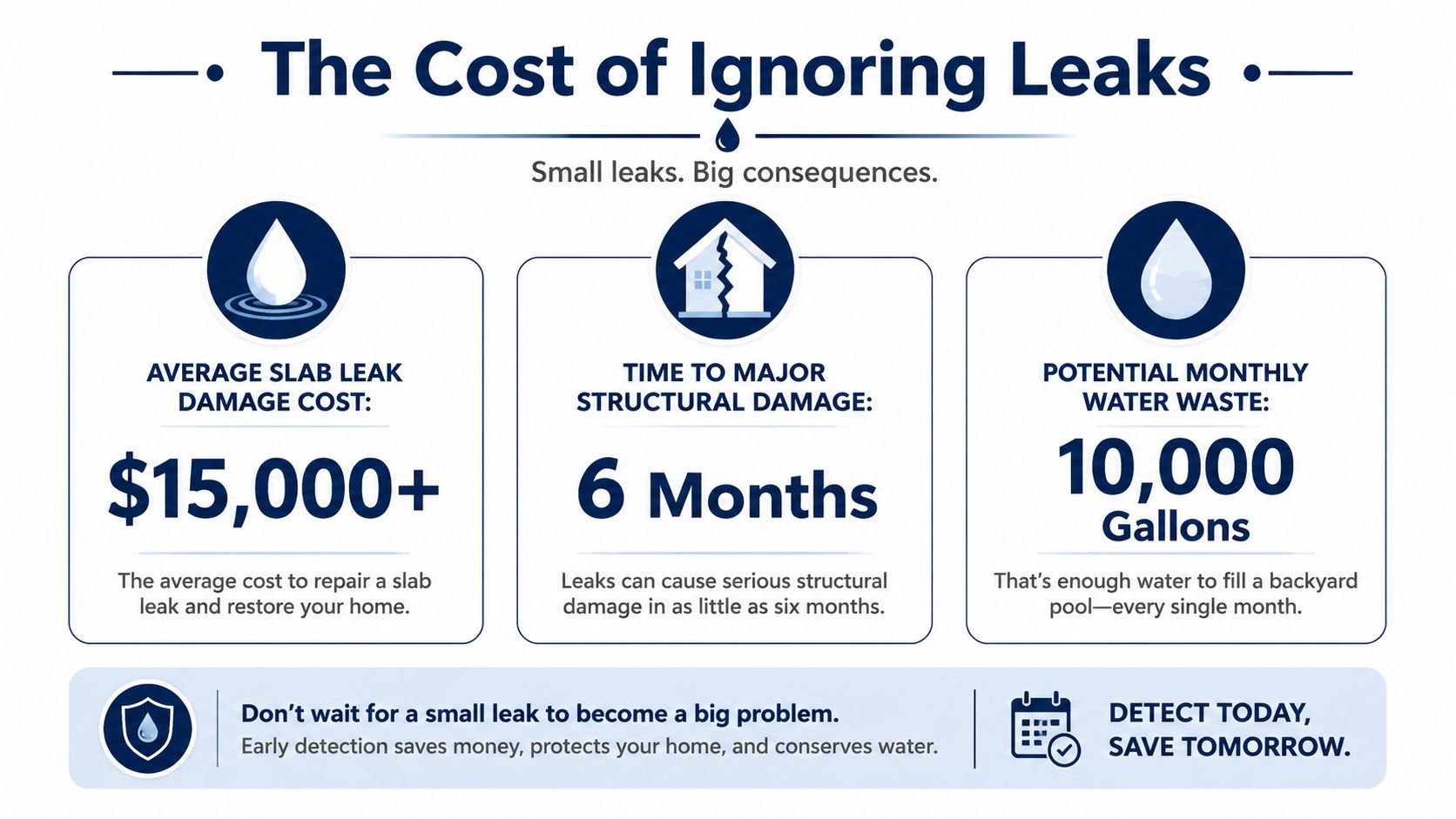
The U.S. Environmental Protection Agency's WaterSense guidance gives a useful baseline. An average household leak can waste more than 10,000 gallons of water per year, and 10% of homes have leaks wasting 90 gallons or more per day. The same EPA WaterSense leak guidance says a family of four using more than 12,000 gallons in winter each month likely has a serious leak problem.
Those figures aren't just about water conservation. A persistent leak can saturate subflooring, stain drywall, encourage mold, weaken finished flooring, and undermine confidence in a building's plumbing system. In a condominium or apartment property, the cost also includes tenant disruption, access coordination, temporary relocation, damaged personal property, and the possibility that water will move into a neighboring unit.
Why slab leaks are difficult
A slab leak doesn't always produce a puddle. Escaping water may follow reinforcing material, pipe channels, or small changes in the concrete before it reaches an exposed surface. You might hear water, notice a pressure change, or feel an unusually warm section of flooring before you see structural damage.
Los Angeles properties also vary widely in age, construction, and plumbing materials. A single-family house, a hillside duplex, and a large HOA building may need completely different diagnostic methods. The shortcut that works for a leaking toilet won't locate a pressurized line beneath concrete.
Field rule: Treat an unexplained water-use change as a plumbing clue, not an inconvenience to monitor indefinitely.
For broader preparation ideas, Seattle leak detection tips can add useful general guidance, but local conditions and building construction still determine which inspection method makes sense. Start with the meter and fixtures, then escalate when the evidence points below the visible plumbing.
Quick DIY Checks You Can Do in Under 30 Minutes
You don't need specialized equipment to identify many household leaks. A meter check, a toilet test, and a careful visual inspection can tell you whether water is moving when it shouldn't be. These checks won't locate every concealed leak, but they can prevent guesswork and give a plumber useful information.
Start with the water meter
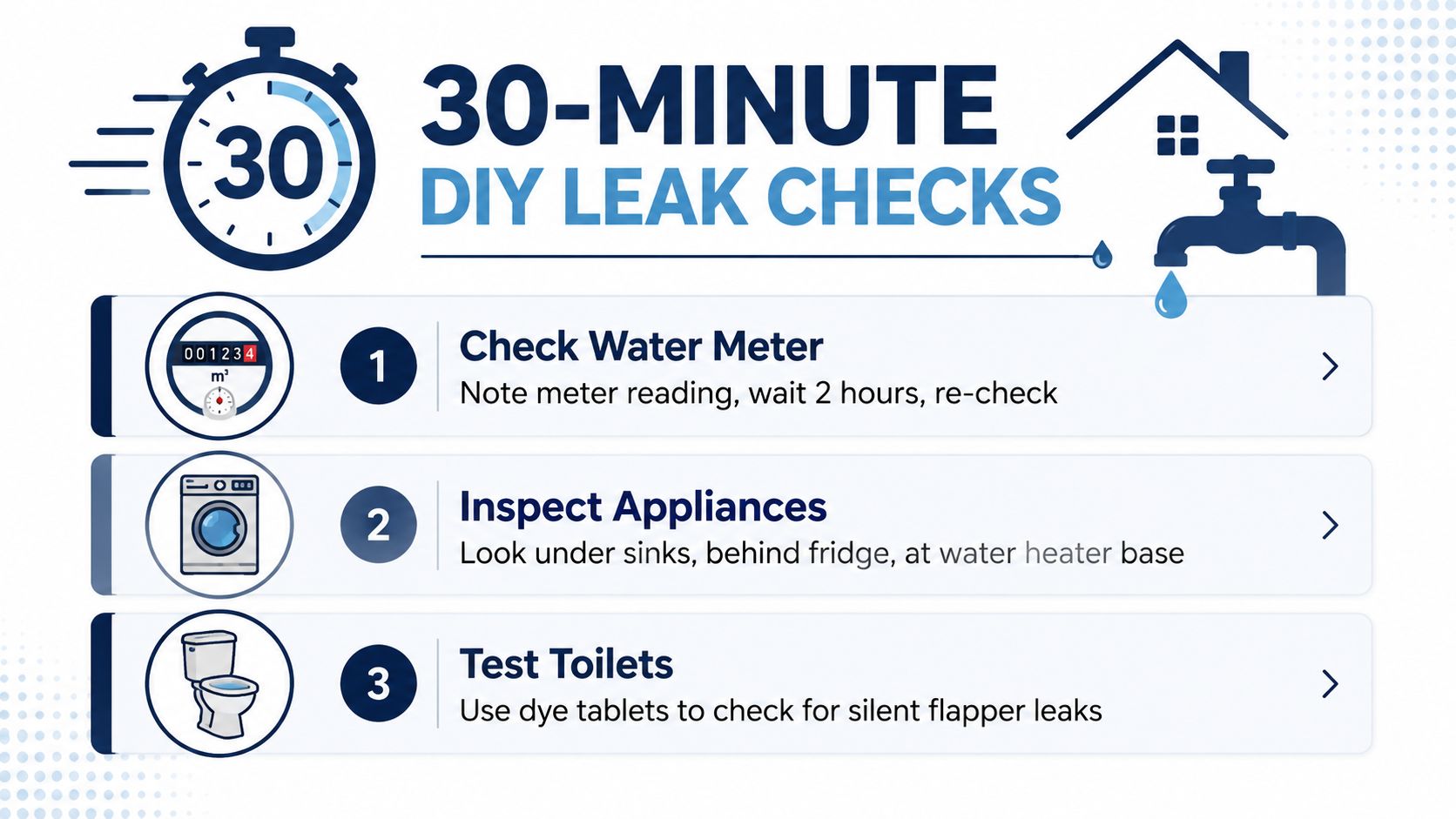
The EPA recommends checking the meter before and after a two-hour period with no water use. Turn off faucets, toilets, washing machines, dishwashers, irrigation, ice makers, and any other fixture or appliance that may draw water. Write down the reading, wait without using water, then compare it with the new reading. Movement indicates that water has passed through the meter.
For a more detailed walkthrough, use this guide on how to read a water meter for leaks. If the meter moves, repeat the test after closing the home's main valve, provided you know where it is and can operate it safely. Continued movement after the valve is closed points toward the service line or another section before the valve. No movement narrows the search to plumbing inside the home.
Test every toilet
Toilet leaks often hide inside the tank, where a worn flapper lets water pass into the bowl. Add food coloring to the tank without flushing. Wait at least 10 minutes, following the EPA's recommended method, and check whether colored water appears in the bowl. If it does, the toilet is leaking.
Don't use this test while someone else may flush the fixture, and remember to return the tank water to normal afterward. A toilet that fails the dye test may need a replacement flapper, fill valve adjustment, or a more complete repair.
Inspect common failure points
Use a flashlight and look beneath sink cabinets, around shutoff valves, behind the refrigerator, at washing machine connections, and around the base of the water heater. Feel for dampness with a dry paper towel, then check for swollen cabinet material, corrosion, mineral deposits, peeling paint, or a musty odor.
A visual inspection can reveal a loose supply connection or drain leak, but dry surfaces don't clear the building. Water behind a wall or below a slab may leave no accessible moisture at all.
Here's a short visual reference for the basic checks:
Smart Leak Detectors and Consumer Tools Explained
Smart detectors are useful, but they're often sold as if one device can monitor an entire property. In practice, a point sensor works best where water is likely to collect and where someone can respond quickly. Place one near a water heater, washing machine, dishwasher, or under-sink supply lines, rather than assuming it can identify a leak beneath a floor.
The consumer market commonly sits around $30 to $100, with many popular devices near $50, as described in this smart water leak detector buying guide. Some models add automatic shutoff, long-range connectivity, or multi-year battery life. Those features can be valuable in a vacant rental or a property manager's maintenance program, but only if the device has a reliable connection, a suitable installation point, and someone assigned to act on the alert.
| Tool Type | Cost Range | Best For | Key Limitation |
|---|---|---|---|
| Point moisture sensor | Around $30 to $100 | Drips beneath sinks, appliances, and water heaters | It may never contact water from a concealed or traveling leak |
| Whole-home monitor | Around $30 to $100 for many consumer products | Unusual usage patterns and centralized alerts | It may identify abnormal flow without exposing the exact source |
| Automatic shutoff system | Varies by product and installation | Limiting damage after a major flow event | A shutoff doesn't repair the failed pipe or always recognize slow losses |
| Moisture meter | Varies by product | Comparing damp and dry areas around walls or floors | Readings can be affected by building materials and surface conditions |
| Basic thermal camera | Varies by product | Screening temperature differences near suspected moisture | It can't confirm a leak without suitable temperature and subsurface conditions |
What sensors miss
A sensor under a kitchen sink can alert you to a burst connector there. It won't necessarily detect water escaping beneath a concrete slab, a buried irrigation line, or a slow leak that travels away from the sensor. Whole-home monitoring can flag unusual flow, but it may not distinguish a leak from normal filling, irrigation, or appliance use without careful configuration.
For a multi-unit building, point sensors are one layer, not the building's entire detection plan. Install them in known risk areas, document their locations, test their notifications, and pair them with meter reviews and professional diagnostics when water loss remains unexplained. The cheaper shortcut is buying sensors without planning who receives alerts and who has authority to shut water off.
Professional Diagnostics for Hidden and Underground Leaks
Professional leak detection starts with a question that consumer tools often can't answer: where is the loss occurring, and how confident can we be before opening concrete or walls? A technician may combine acoustic equipment, pressure testing, infrared thermography, and camera inspection rather than rely on one signal.
Acoustic detection listens for vibration and sound created by pressurized water escaping from a pipe. It can be effective under floors and around buried lines, but machinery, traffic, pumps, neighboring units, and building construction can create competing noise. A technician improves the result by isolating sections, comparing readings, and testing at more than one access point.
Infrared thermography looks for temperature patterns associated with moisture or escaping hot water. It isn't a magic underground camera. One study found IR thermography effective at 2% and 5% soil moisture content, but inconclusive at 10%, using a spectral range of 7.5 to 13.0 µm. The same study found ground-penetrating radar detected leaks with 66.67% success at 2% and 5% moisture, falling to 33.33% at 10% moisture. These results, reported in the study comparing infrared thermography and ground-penetrating radar, show why soil conditions matter.
Detection isn't the same as pinpointing
A thermal image can identify an anomaly without proving that the pipe has failed at that exact spot. In one comparison of IR and acoustic methods, IR-derived leak locations differed from acoustic findings by 1.01 meters to 2.30 meters across 25 leaks, making thermal imaging useful for field triage but not exact pinpointing. A careful proposal should explain whether the quoted service is intended to screen, isolate, or pinpoint the repair area.
Hybrid systems improve the picture by combining different physical signals. A 2024 study using thermal imaging and geophone data reported detection of underground leaks up to 750 millimeters depth with 95.20% accuracy, while its localization network reached 88.19% accuracy in 20-degree increments. Another vibroacoustic paper reported 88.02% accuracy for leaks shallower than 3.5 meters, decreasing to 82.76% for leaks between 3.5 and 15 meters. The research on hybrid and vibroacoustic leak localization illustrates the effect of depth and pipe topology.
What a proper inspection should include
Ask the technician to identify the suspected zone, explain the evidence, and distinguish confirmed findings from working hypotheses. Pressure testing can determine whether a supply line holds pressure, while a sewer camera can inspect a lateral for breaks, offsets, root intrusion, or collapse. Neither test should be presented as a universal answer.
For a practical explanation of the process, review this guide to detecting underground leaks. On a slab property, the best outcome isn't the most dramatic equipment demonstration. It's a defensible diagnosis that limits unnecessary demolition and gives the owner a clear repair path.
When to Call a Licensed Plumber in Los Angeles
DIY checks are appropriate for a suspected toilet, visible fitting, or accessible appliance connection. Stop troubleshooting and arrange professional help when the signs point to a pressurized, concealed, or shared plumbing line.
Call promptly if you hear water running while every fixture is off, find a warm patch on a slab floor, see recurring mildew in one location, or experience low pressure throughout the home. An unexplained bill increase also deserves attention when the meter test suggests flow but no fixture explains it. If water is actively spreading, shut off the nearest safe valve and protect electrical equipment before waiting for a diagnosis.
Los Angeles properties need context
A slab foundation changes the repair equation because the pipe may be below finished flooring and concrete. Older properties may also contain aging supply or drainage systems that require different testing methods than newer construction. Hillside grades, landscaping, and buried service lines add further complications, especially when a wet area outside doesn't line up with the pipe's actual route.
Multi-unit properties raise the stakes. A property manager may need to coordinate access, protect occupied units, notify an HOA, document the affected area, and determine whether the loss is on a private branch or a shared line. Delaying that coordination can allow one plumbing problem to affect multiple residents.
Questions to ask before work begins
A reputable plumber should explain the inspection scope before cutting, excavating, or recommending replacement. Ask:
- What evidence identifies the suspected area? You should understand whether the conclusion comes from meter movement, pressure loss, sound, temperature, moisture, or camera footage.
- What disruption is expected? The answer should address access, flooring, concrete, cabinets, walls, and restoration responsibilities.
- What happens if the first test is inconclusive? Hidden leaks often require a second diagnostic method rather than a guess.
- What repair options are available? A professional should separate urgent containment from longer-term replacement and explain the risks of each.
Choose a licensed and insured plumber familiar with your part of Los Angeles, whether you're in the San Fernando Valley, Santa Monica, Pasadena, Glendale, Beverly Hills, or another nearby community. Confirm who will communicate findings to owners, tenants, and building representatives before the work starts.
Building a Layered Leak Prevention Strategy
A resilient leak plan uses several modest protections instead of trusting one device. Start with point sensors at high-risk locations, add routine meter and fixture checks, and use professional diagnostics when the property's construction or plumbing history makes concealed leaks plausible.
For a single-family home, place sensors near the water heater, washing machine, dishwasher, and vulnerable sink cabinets. Check the meter periodically when the property is quiet, test toilets when usage changes without explanation, and inspect accessible connections during routine cleaning. An automatic shutoff can add another response layer. Review how these systems work in automatic shutoff valve guidance before choosing equipment.
Landlords and HOAs need a documented process. Keep a unit-by-unit sensor map, record shutoff locations, identify after-hours contacts, and note previous leak repairs. A property with recurring unexplained loss, slab construction, or aging plumbing should receive periodic professional review instead of waiting for a tenant complaint.
A practical maintenance calendar
- Monthly: Review unusual water use, check sensor batteries and notifications, and look beneath appliances and sinks.
- Seasonally: Repeat the meter test, perform toilet dye tests, and inspect outdoor hose bibs, irrigation connections, and exposed service areas.
- After a plumbing event: Photograph affected materials, record the time water was shut off, save invoices and diagnostic reports, and preserve damaged components when practical.
- On a recurring schedule: Have higher-risk properties evaluated by a qualified plumber when unexplained losses persist or previous repairs haven't resolved the problem.
Documenting the source, response, drying work, and repairs helps owners communicate with insurers and future buyers. If flooring has already been affected, a resource covering water damaged floor repair options can help you understand why the restoration method depends on the material and extent of saturation.
The right strategy balances cost and consequence. A low-cost sensor may protect a cabinet, while professional testing protects the slab, the building envelope, and the relationships among tenants and owners. For multi-unit properties, assign responsibility before an alert arrives. A warning no one acts on is only an electronic notification.
EZ Plumbing provides leak detection and slab leak repair support for Los Angeles homes, HOAs, property managers, and commercial properties, with emergency response and planned scheduling available. If you've found unexplained meter movement, hidden moisture, or signs of a concealed line failure, visit EZ Plumbing to request professional help and a clear next step.