
Water Coming from Under Toilet: Stop Leaks Fast in 2026
You walk into the bathroom, and there it is. A thin puddle around the toilet base, or maybe a damp ring that keeps coming back after you wipe it up. Most homeowners immediately assume the toilet itself is cracked or that they need a whole new fixture. Sometimes that's true. More often, the leak is smaller, more specific, and very fixable.
The key is not to rush into the wrong repair. Water coming from under toilet bowls can fool people. A drip from higher up can run down the porcelain and collect at the floor, making it look like the base is leaking when it isn't. On the other hand, a little water at the base can also mean the seal under the toilet has failed, and that's a repair you don't want to ignore.
A plumber's first move usually isn't grabbing a wrench. It's slowing down, controlling the area, and figuring out exactly when the water appears, where it starts, and whether the leak is on the supply side or the drain side. That triage saves time, prevents damage, and keeps you from replacing the wrong part.
Table of Contents
- What That Puddle Means for Your Home
- Immediate Safety Steps Before You Troubleshoot
- The Six Common Causes of a Toilet Leaking at the Base
- A Step-by-Step Guide to Diagnosing the Leak Source
- Repair Options DIY Fixes vs Professional Service
- Your 24/7 Emergency Plumber in Los Angeles
- Frequently Asked Questions About Toilet Base Leaks
What That Puddle Means for Your Home
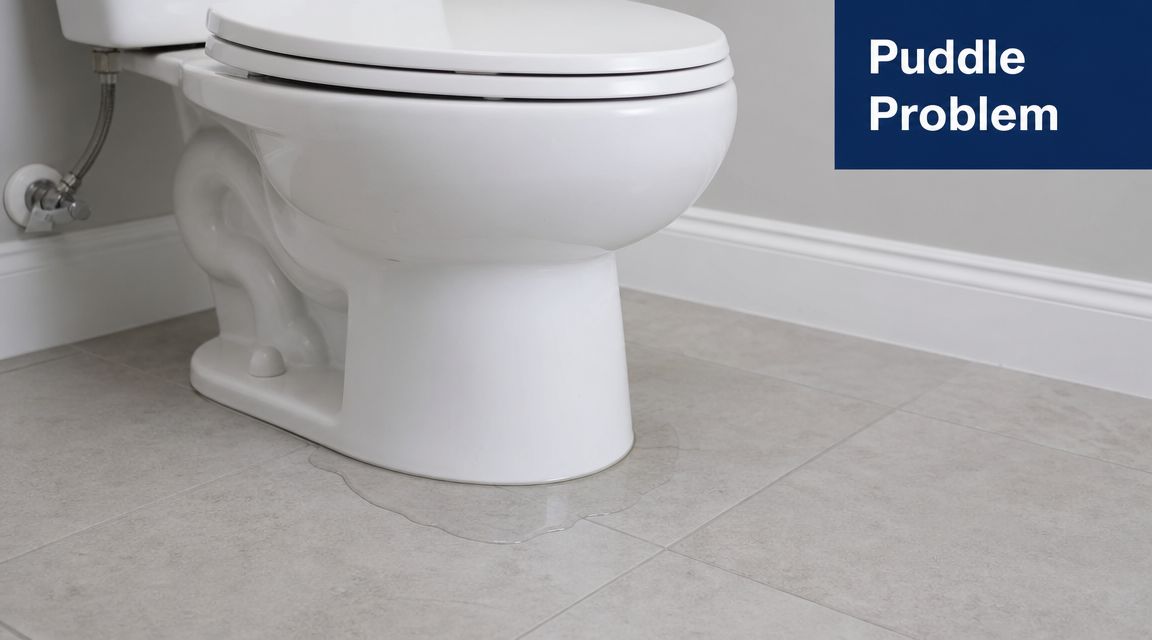
This leak is typically first noticed in a hurry. Socks get wet. The bath mat feels damp. Someone wipes up the floor, flushes later, and the water is back. That pattern matters because a toilet leak isn't just about the puddle you can see. It can soak grout lines, swell baseboards, stain the ceiling below, and soften the subfloor around the flange.
The water waste can be bigger than people expect. A U.S. municipal water guide says even a small leak can waste 30 gallons per day and a medium leak can waste 250 gallons per day, which works out to roughly 10,950 gallons per year at the small-leak rate and about 91,250 gallons per year at the medium-leak rate, according to Oldsmar's municipal water billing guide. That's before you even factor in flooring, drywall, and trim damage.
If the floor has already taken on water, the plumbing fix is only half the job. After the leak is stopped, many homeowners also need guidance on repairing water damaged floors so trapped moisture doesn't keep causing problems under finished flooring.
Practical rule: If water returns after cleanup, treat it as an active leak until proven otherwise.
There's also the mold side of this. Bathrooms dry slowly, especially around toilet bases where airflow is poor. If the leak has been going on for a while, it's smart to look into water and mold remediation support once the source is under control.
What usually calms people down is this: the puddle tells you something is wrong, but it doesn't tell you exactly what. Good diagnosis does. The right sequence is simple. Make the area safe, confirm whether the water appears only after flushing or all the time, then narrow the source before touching a tool.
Immediate Safety Steps Before You Troubleshoot
Before you inspect anything, stop the mess from getting worse. A slippery tile floor and an active leak are a bad combination.
Do these three things first:
Shut off the toilet's supply valve. It's usually the small angle stop on the wall or floor near the toilet. Turn it clockwise until it stops. This won't fix a failed wax ring, but it prevents refill water from adding to the problem while you inspect.
Wipe up all standing water. Use towels, paper towels, or a wet/dry vacuum. Dry the grout lines and the outer edge of the toilet base too. You need a dry starting point or you'll chase old water and misread the leak.
Tell everyone not to use that toilet. One extra flush can push more water under the base, into the floor, or into the ceiling below if the bathroom is upstairs.
If you can't get the toilet stop valve to close, or the valve itself drips when you touch it, you may need the home's main shutoff instead. If you're not sure where that is, this guide on the LA homes water shut-off location is useful before the problem turns into a larger cleanup.
Why these first steps matter
A lot of homeowners want to tighten bolts right away. That's understandable, but it's not the first move. Wet floors hide the leak path, and active use changes the symptoms while you're trying to observe them.
A dry floor gives you a clean test surface. A shut valve gives you control. Taking the toilet out of service prevents a small leak from becoming a flooring repair.
If you're guessing while the floor is still wet, you're not diagnosing. You're reacting.
Also pay attention to what the water looks and smells like. Fresh clear water from a supply connection is a different situation than wastewater escaping during a flush. You don't need to panic, but you do need to take that distinction seriously.
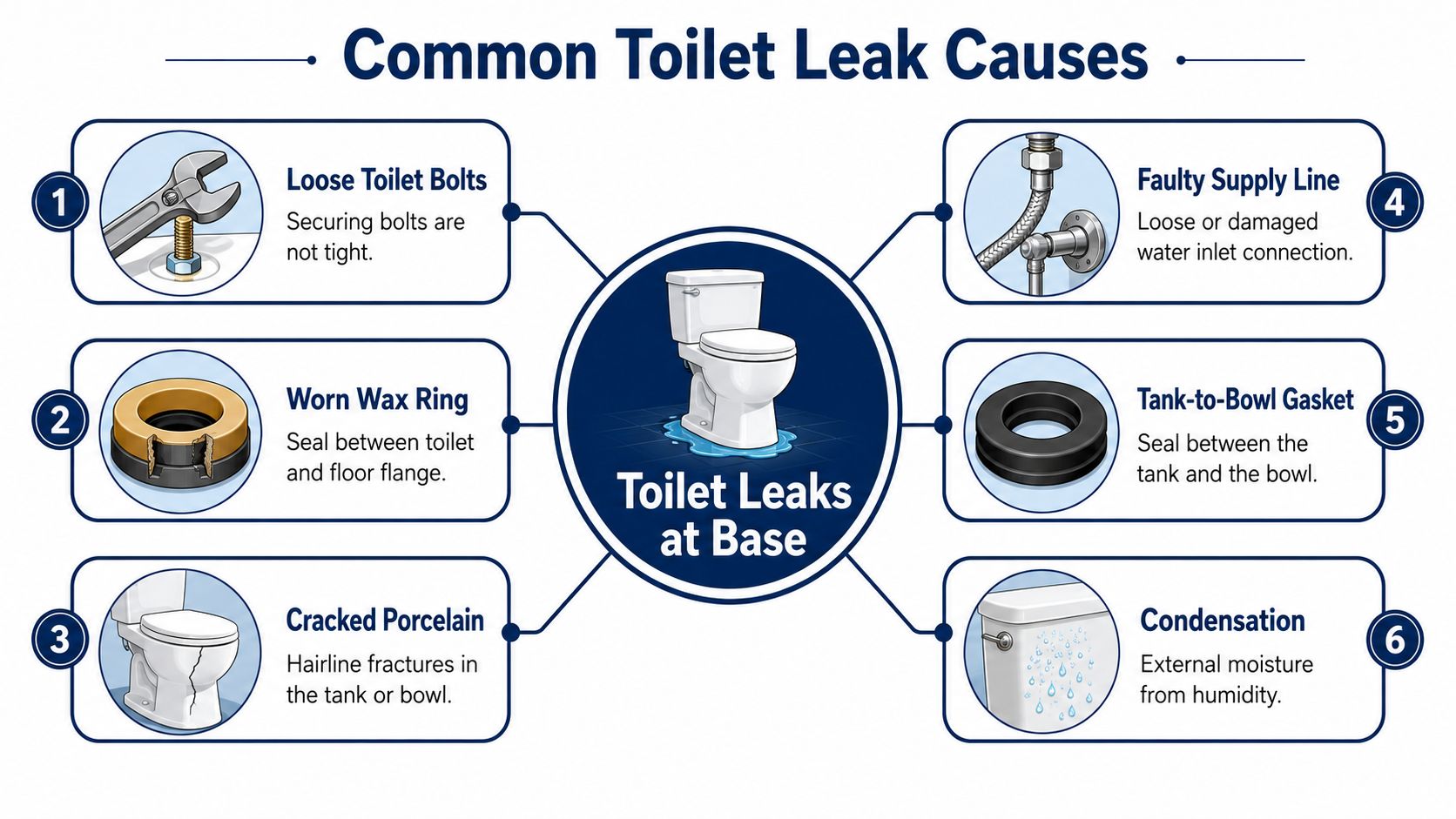
The Six Common Causes of a Toilet Leaking at the Base
When homeowners say they have water coming from under toilet fixtures, I mentally sort the possibilities into two buckets. First, true base leaks. Second, leaks from higher up that only appear to be base leaks because water runs down the bowl.
Start with the highest-probability causes
The two most common causes deserve your attention first.
1. Failed wax ring
The wax ring is the seal between the toilet outlet and the floor flange. It functions as a soft gasket that has one job: keep flush water and waste moving into the drain without escaping under the bowl. If that seal breaks, water can leak out during flushing and collect at the base.
2. Loose closet bolts
The bolts at the toilet base hold the bowl tight to the flange. If they loosen, the toilet can rock slightly. That movement compresses and disturbs the wax seal, which is why a loose toilet and a leaking seal often show up together.
A technical guide notes that over 90% of toilet base leaks start with the wax ring seal or loose closet bolts, according to Horow's toilet leak guide. That's why a plumber starts there before chasing rare causes.
The other four causes that can imitate a base leak
3. Tank-to-bowl gasket leak
On a two-piece toilet, the gasket between the tank and bowl can seep. Water then runs down the back or sides of the bowl and pools at the floor. From the front, it looks like a base leak.
4. Supply line or shutoff valve leak
The supply tube, coupling nut, or shutoff valve can drip slowly. This is common after slight movement, corrosion, or a worn washer. The water tracks along the porcelain or drips behind the bowl, then shows up at the base.
5. Cracked porcelain or internal body crack
A bowl or tank crack can leak in odd ways. Sometimes the water path is visible. Sometimes it isn't until the floor stays wet for no obvious reason. If bowl water drops while the toilet sits idle, that points away from a simple floor seal issue and toward a crack or another internal leak path.
6. Condensation
Cold tank water in a humid bathroom can create sweat on the porcelain. That moisture drips down and collects around the base. It isn't a plumbing connection failure, but it can look exactly like one if you only notice the puddle and not the damp tank.
A real diagnosis starts with timing. Water that shows up only after a flush means something different from water that appears while the toilet sits unused.
The practical takeaway is simple. Don't assume every puddle at the base means a wax ring. But also don't dismiss it as condensation without testing. The repair path changes completely depending on which of these six causes you're dealing with.
A Step-by-Step Guide to Diagnosing the Leak Source
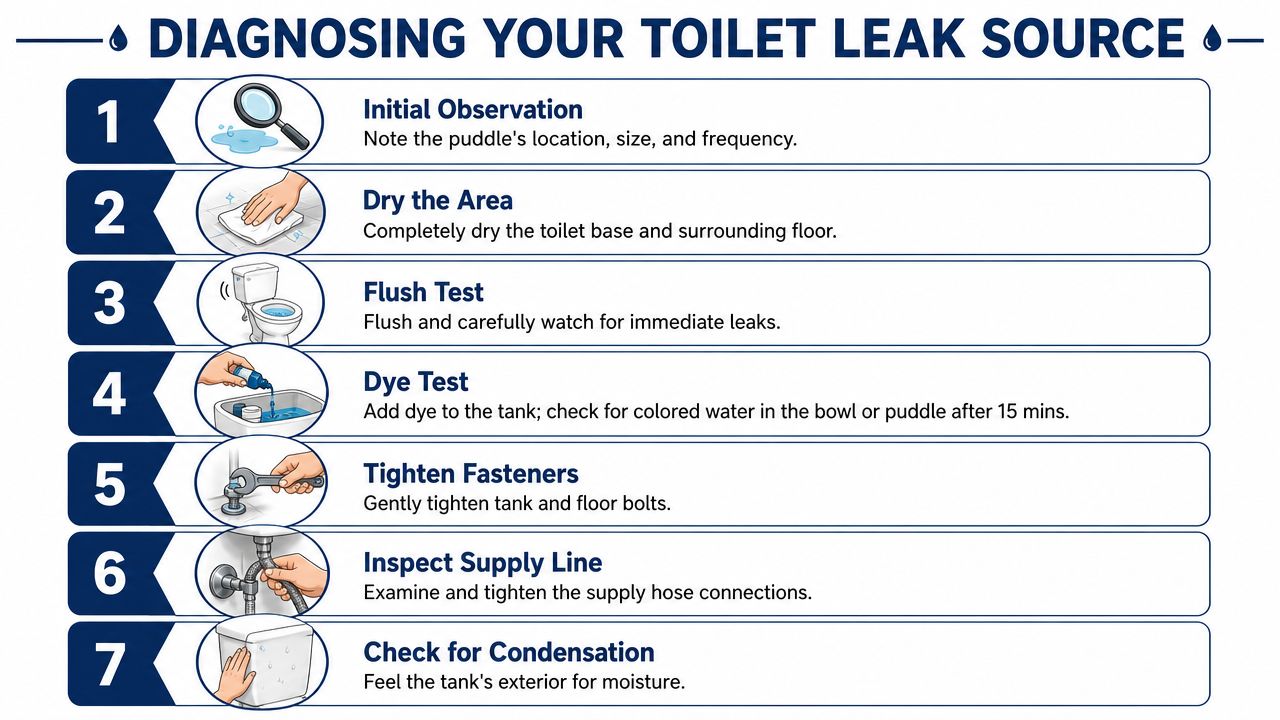
A careful diagnosis beats a fast guess every time. Before you buy a wax ring, before you remove a toilet, and before you tighten random bolts, use a sequence that rules out the easy imposters first.
First rule out false base leaks
Start with the toilet completely dry. Wipe the floor, the base edge, the supply line, the shutoff valve, the tank bolts, and the seam between tank and bowl. Then place dry tissue or paper towel at each suspect point.
Use this sequence:
- Check the supply connection: Feel around the coupling nut where the supply line meets the fill valve shank under the tank.
- Check the shutoff valve: Look for a bead of water around the valve body or packing area.
- Check tank hardware: Run a dry finger or tissue under the tank bolts and around the tank-to-bowl gasket.
- Check the tank exterior: If the tank feels cold and damp all over, you may be dealing with condensation rather than a plumbing joint leak.
A good visual walkthrough helps if you're more comfortable seeing the process before doing it yourself:
If you want to track whether the toilet is also wasting water internally while you're troubleshooting the floor leak, this guide on how to read a water meter for leaks can help you confirm whether water use continues when fixtures are off.
Then test the toilet under controlled conditions
Once you've ruled out obvious drips from above, move to the flush test.
A leak from under the toilet is most often a failed wax ring seal, which is the critical barrier between the toilet and the drain flange. Common diagnostic guidance is to dry the floor, avoid flushes, and watch whether moisture returns only after use. If water appears after flushing, the seal is the leading suspect, as explained in this toilet base leak guide.
Here's the process I recommend:
- Dry the area completely.
- Wait without flushing. If moisture appears anyway, think condensation or a supply-side drip.
- Flush once and watch closely. Look at the floor edge around the base, especially the sides and front.
- Check for rocking. Place a hand on the bowl rim and gently test for movement. Don't force it. Even slight rocking supports the case for a disturbed wax seal.
- Observe bowl water at rest. If the bowl level drops over time when the toilet isn't being used, that can point toward a crack or internal leak path rather than the floor seal.
Dry first, flush once, then observe. Multiple test flushes only spread water and muddy the evidence.
You can also use food coloring in the tank to help spot certain issues. If colored water shows up where it shouldn't, or the bowl behaves oddly while the toilet sits idle, that can help separate a tank issue from a true base-seal failure. The point isn't to prove one theory fast. It's to eliminate the wrong ones methodically.
Repair Options DIY Fixes vs Professional Service
After you identify the leak source, the repair path usually narrows fast. The key question is not just, "Can this be fixed?" It is, "Can I fix this without creating a bigger problem under the toilet or inside the floor?"
Water that shows up at the base can still start higher up on the fixture. A tank-to-bowl gasket leak, a supply line drip, or a shutoff valve seep can run down the porcelain and collect at the floor, which is why diagnosis comes before repair. ABC Home & Commercial's guide to toilet leaks at the base covers that point well.
Repairs that homeowners can often handle
DIY makes sense when the leaking part is exposed, the water can be shut off easily, and the repair can be tested without pulling the toilet.
| Problem | DIY Difficulty | Estimated DIY Cost | Estimated Pro Cost (2026) |
|---|---|---|---|
| Loose closet bolts | Easy | Qualitative only. Usually low for basic hardware or shims if needed. | Qualitative only. Usually lower than toilet removal jobs. |
| Supply line leak | Moderate | Qualitative only. Often limited to a replacement line and basic hand tools. | Qualitative only. Usually straightforward if no valve problems are found. |
| Tank-to-bowl gasket leak | Moderate | Qualitative only. Depends on correct gasket and bolt kit. | Qualitative only. More than a simple tightening visit, less than many drain-side repairs. |
| Condensation issue | Easy | Qualitative only. Usually minimal if ventilation or insulation changes solve it. | Qualitative only. Often not a plumbing rebuild unless another issue is present. |
Loose bolts are a good example. If the toilet is stable and the bolts only need a careful snugging, that is often manageable. The word careful matters. Overtightening can crack the base, and then a small leak turns into a full toilet replacement.
Repairs where professional service usually makes more sense
Some jobs look straightforward until the toilet is off the floor.
- Wax ring replacement: The toilet has to be shut down, drained, disconnected, lifted, reset evenly, and tested. If the bowl lands crooked or the seal smears, the leak often comes right back.
- Flange repair: Once the toilet is removed, you may find a broken flange, a flange set too low, rusted hardware, or damage in the subfloor around the mounting area.
- Cracked toilet body: Porcelain cracks are not a good trial-and-error repair.
- Persistent rocking: If the bowl still moves after simple bolt adjustment, the problem is often support, flange height, or floor condition under the toilet.
The hard part of a wax ring job is the reset. Getting the toilet back down squarely without disturbing the seal takes more control than many homeowners expect.
Comfort level also matters here.
I tell homeowners to use a simple rule. If the repair stays above the floor and you can see every connection you are touching, DIY is often reasonable. If the repair requires lifting the toilet, judging flange condition, or deciding whether the floor underneath is still sound, paying for professional service is usually cheaper than doing the job twice.
For a leak that appears to involve the seal, flange, hidden floor damage, or an urgent active leak, scheduling a Los Angeles emergency plumber for toilet leak repair is the safer call.
Your 24/7 Emergency Plumber in Los Angeles
Some toilet leaks can wait until morning. Some shouldn't.
Call a plumber right away if the leak is getting worse with every flush, the toilet is on an upper floor and water may be reaching the ceiling below, the bowl rocks noticeably, you smell sewer gas, or you see signs of backup instead of a simple clean-water drip. Those symptoms suggest more than a loose fitting.
For Los Angeles homeowners, tenants, landlords, HOAs, and property managers, Los Angeles emergency plumber service is available when shutting off the valve and drying the floor isn't enough. EZ Plumbing is licensed and insured, has served Los Angeles since 1989, and covers areas including Beverly Hills, Santa Monica, West Hollywood, Pasadena, Glendale, Burbank, and the San Fernando Valley.
This is also where comfort level matters. If you're uneasy about disconnecting a supply line, handling a toilet reset, or judging whether the water is coming from the flange versus the tank, stopping early is the right decision. A rushed wax-ring job can turn a manageable repair into damaged flooring and a second service call.
When you call for help, have three details ready: whether the leak appears only after flushing, whether the toilet rocks, and whether any water is showing up in the room below. That short report gives the plumber a strong head start.
Frequently Asked Questions About Toilet Base Leaks
Is the water clean or dirty
It depends on the source. Water from the supply line, shutoff valve, tank bolts, or condensation is generally clean-water leakage. Water escaping because the seal under the toilet failed during a flush is on the drain side. Treat that more cautiously, clean up promptly, and avoid using the toilet until it's repaired.
Can you keep using the toilet
You shouldn't. Even if the puddle seems small, every flush can add more water to the floor system if the seal has failed. If the leak is from above and only mimics a base leak, continued use still makes diagnosis harder and can spread moisture farther across the floor.
How long does a typical repair take
Simple work such as tightening exposed hardware or replacing an accessible supply line is usually much faster than removing and resetting a toilet. A wax ring repair takes longer because the toilet has to come off, the flange has to be checked, and the bowl has to be reset correctly. If the flange is cracked or the floor is damaged, the timeline extends from there.
Is a rocking toilet a big deal
Yes. Even slight movement matters. A toilet should sit solidly on the floor. Movement stresses the seal underneath and often explains why the leak appears only after someone sits down or after a flush.
What if the floor dries and stays dry until the next flush
That pattern strongly points toward a drain-side issue under the toilet rather than condensation. It's one of the clearest field clues that the seal below the bowl deserves attention.
If you've got water coming from under toilet fixtures in your home or rental property, EZ Plumbing can help you sort out whether it's a supply-side drip, a failed seal, or a larger flange or drainage problem. Call (818) 908-2710 for service in Los Angeles, or schedule online to get the leak diagnosed and repaired before it damages the floor underneath.