
Unclog a Toilet Pipe: Fast DIY Steps for Homeowners
Stop the overflow first: shut off the water supply valve behind the toilet, then try a flange plunger before anything else. If your toilet pipe is clogged, most blockages sit in the trap, the S-shaped channel inside the toilet base, and a proper plunger often clears them quickly. Do not flush a second time — that single mistake is the most common cause of an indoor overflow.
| Action | What to do | Expected result |
|---|---|---|
| Stop the water | Turn shutoff valve clockwise or lift the tank flapper | Prevents overflow immediately |
| One test flush only | Flush once (one diagnostic test only); do not repeat | Avoids flooding the bathroom |
| Flange plunger | Seal and pump firmly with multiple strokes | Clears most trap clogs effectively |
| Dish soap + hot water | Half cup soap, 1 gallon hot tap water, wait 10 minutes | Loosens soft organic clogs without tools |
If the bowl is already near the rim, wait 10–15 minutes for the water level to drop before you do anything else. Bail out a few cups if needed so plunging does not splash contaminated water across the floor.
Table of Contents
- How do you clear a clogged toilet pipe step by step?
- Chemical vs. enzymatic cleaners: what actually works in a toilet
- When should you stop DIYing and call a licensed plumber?
- What does a plumber actually do to fix a blocked toilet drain?
- Simple habits that prevent most toilet pipe clogs
- A licensed plumber’s perspective on why some clogs keep coming back
- How to disassemble and clean the toilet trap when manual methods fail
- What to do if you do not have a flange plunger
- The environmental cost of chemical drain cleaners
- Key Takeaways
- What recurring clogs tell you that a plunger never will
- Ez-plumbing handles what a plunger cannot
How do you clear a clogged toilet pipe step by step?
Start with preparation, then work through methods in order from least invasive to most. Skipping steps or jumping straight to chemicals wastes time and can cause damage.
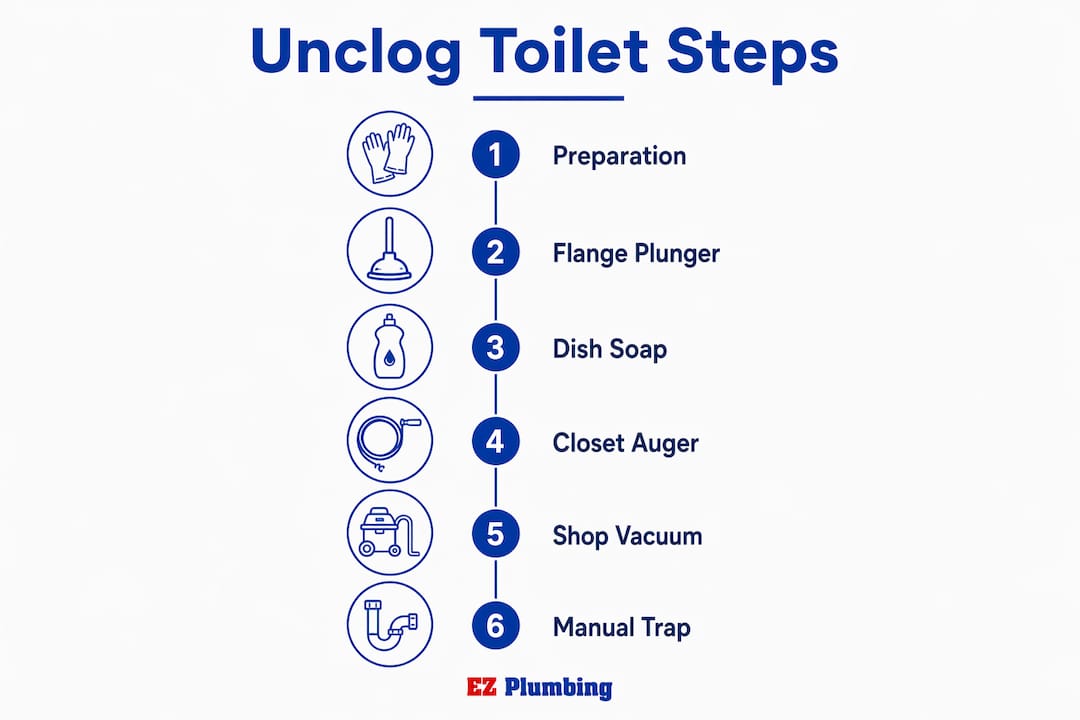
Preparation
Put on rubber gloves. Lay old towels around the base of the toilet. If the bowl is dangerously full, remove water with a small cup or old container until the level is a few inches below the rim.
Step 1: Flange plunger
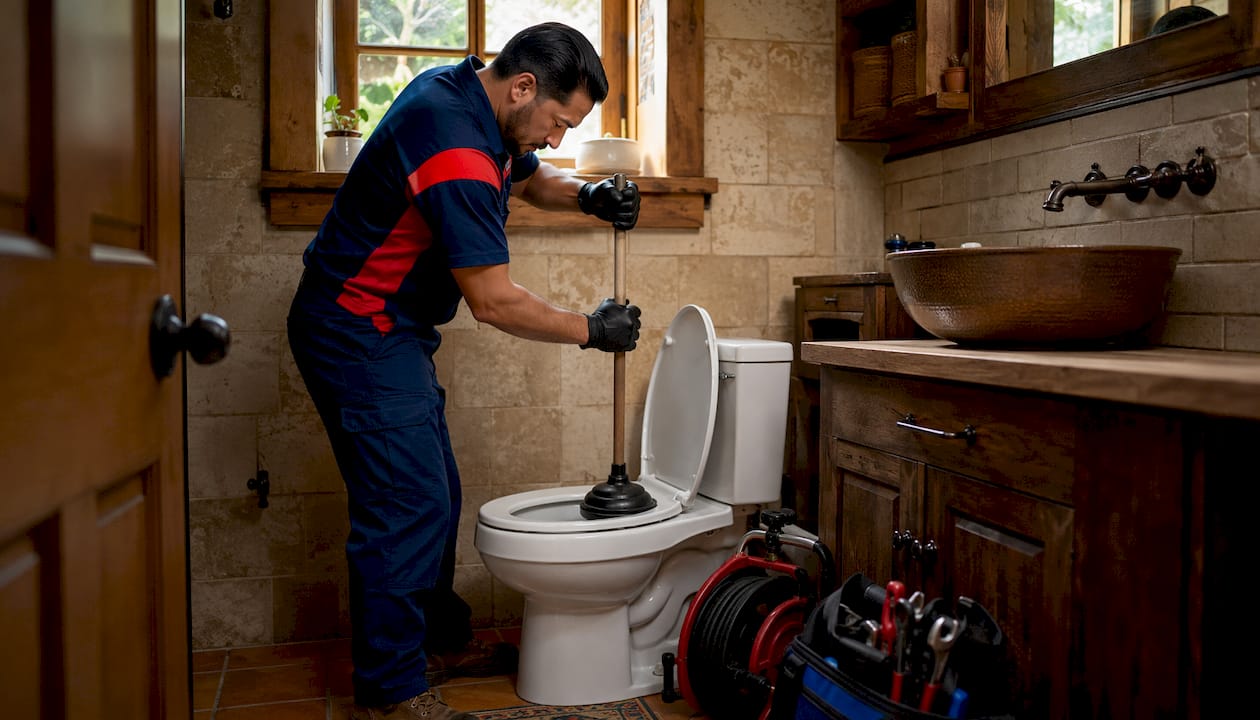
A flange plunger seals inside the toilet outlet; a flat cup plunger leaks air and wastes effort. Fold the rubber flange out, lower the plunger into the water at an angle so it fills with water rather than air, then seat it firmly over the drain opening. Push down gently on the first stroke to avoid splashback, then pump with firm, steady push-pull cycles. Multiple firm strokes usually handle most clogs.
Pro Tip: Stop plunging if you feel the toilet shifting or rocking. Repeated hard plunging can compress and damage the wax ring seal beneath the toilet, leading to a slow leak at the base that rots the subfloor.
Step 2: Dish soap and hot tap water
Squirt about half a cup of liquid dish soap into the bowl, wait five minutes, then pour roughly one gallon of hot tap water from waist height. Let it sit for ten minutes. The soap lubricates the passage, and the heat softens organic material. Never use boiling water — at 212°F, the thermal shock can crack vitreous china.
Step 3: Closet (toilet) auger
When plunging does not break the clog, a closet auger is the right next tool. A standard sink snake should never go into a toilet — its bare metal cable scratches and chips porcelain. A closet auger has a plastic sleeve and a curved, rubber-coated head that feeds safely through the trap. Insert the head into the drain opening, crank the handle clockwise until the cable meets resistance, then work it back and forth to break or retrieve the obstruction.
Step 4: Wet/dry shop vacuum
If a solid object (a toy, a thick wipe mass, a dropped item) is lodged in the trap, a wet/dry shop vacuum can pull it out. Vacuum the water from the bowl first, wrap a towel around the hose to create a seal at the drain opening, and use suction to draw the object out. Plug the vacuum into a GFCI outlet only. Never use a standard household vacuum near water — the shock risk is serious.
Step 5: Manual trap access (last resort)
If every method above fails, the toilet may need to come off the floor so the trap can be accessed from below. This is covered in detail later in this article.
Chemical vs. enzymatic cleaners: what actually works in a toilet
Caustic chemical drain openers — the kind marketed for sinks — are usually the wrong choice for a clogged toilet drain. They are formulated to dissolve hair and grease in sink traps, not the dense paper and solid-waste masses that block toilet traps. Worse, the caustic splash risk is real when you are working close to a full bowl, and repeated use can degrade wax rings and soften older porcelain surfaces over time.
Safety rule: Never mix chemical drain products. Combining bleach-based cleaners with ammonia or acid-based products produces toxic chloramine or chlorine gas. Keep children and pets out of the bathroom any time a chemical product is in use, and wear gloves and eye protection.
Enzyme-based cleaners work differently and more safely. They introduce bacteria that digest organic material — waste, paper, grease — over several hours. They will not clear a fully blocked toilet overnight, but they are genuinely useful for two specific situations: a partial, slow-draining clog where you have time to wait, and monthly preventive maintenance to keep buildup from accumulating in the first place.
Pro Tip: For septic system households, enzyme cleaners are the only drain-maintenance product worth using. Caustic chemicals kill the beneficial bacteria your septic tank depends on. Look for products labeled “septic-safe” and use them monthly as a maintenance dose, not as an emergency fix.
For a fully blocked toilet, the practical workflow is: plunger first, then dish soap and hot water, then a closet auger. Chemical products belong after those steps only if the clog is clearly organic and soft, and even then, enzyme-based products are safer for your pipes, your porcelain, and your septic system.
When should you stop DIYing and call a licensed plumber?
Limit your DIY attempts to roughly 15 minutes or two to three serious tries. Continuing to force a clog risks cracking the porcelain, displacing the wax ring, and causing hidden leaks that lead to subfloor rot — damage that costs far more than a service call.
Call a licensed plumber when you see any of these signs:
- Multiple fixtures backing up at the same time (slow tub drain, gurgling sink when you flush)
- Sewage appearing in the bathtub, shower, or floor drains
- Persistent gurgling from drains you are not using
- The clog returns within a day or two of clearing
- Foul sewer odor inside the home
- Soggy or soft ground near the sewer cleanout in the yard
- The toilet overflows repeatedly despite your best efforts
Multiple fixtures reacting when you flush is the clearest diagnostic signal that the blockage is not in the toilet trap at all. It is in a shared branch line or the main sewer line, and no plunger or auger you own will reach it.
For a standard drain service call in the Los Angeles area, expect a diagnostic visit plus mechanical clearing to run in the range of $150–$350 depending on access and severity. Camera inspection adds to that cost but provides documented proof of what is inside the line. Hydro-jetting, which clears scale and root intrusion with high-pressure water, typically runs higher. A full sewer line repair or relining is a larger project with costs that vary by pipe length and condition. When hiring, look for a licensed C-36 plumbing contractor, camera inspection availability, and a written diagnosis before any work begins.
What does a plumber actually do to fix a blocked toilet drain?
Professional diagnosis starts with history: how often does this happen, which fixtures are affected, how old is the home. From there, a licensed technician checks multiple fixtures to determine whether the blockage is local to the toilet or deeper in the system.
| Diagnostic or repair step | What it addresses |
|---|---|
| Multi-fixture check | Confirms whether the issue is trap-level or mainline |
| Sewer camera inspection | Locates exact blockage, identifies roots, scale, or pipe damage |
| Motorized auger | Breaks up compacted clogs beyond hand-tool reach |
| Hydro-jetting | Clears scale buildup, grease, and root intrusion with high-pressure water |
| Sewer line repair or relining | Addresses offset joints, cracks, or collapsed sections |
| Pulled toilet and trap inspection | Required when a solid object is lodged past the trap |
Camera inspection is the step that separates a guess from a diagnosis. A licensed technician feeds a waterproof camera through the line and records what is there — a soft paper mass, a wipe buildup, mineral scale narrowing the pipe, root intrusion through a cracked joint, or a partially collapsed section. That documentation matters because it tells you exactly what repair is needed and protects you from paying for work that does not address the real problem.
Hydro-jetting is the definitive fix for scale and root intrusion. A motorized auger breaks up clogs; hydro-jetting scours the pipe wall clean. For roots in a sewer line, root removal alone is a temporary fix — the crack that let roots in still needs to be addressed through relining or repair.
Simple habits that prevent most toilet pipe clogs
Prevention is straightforward, and most of it comes down to what you put in the toilet.
Never flush these items:
- “Flushable” wipes — they do not break down like toilet paper and form dense masses in traps and sewer lines
- Paper towels and tissues
- Cotton swabs and cotton balls
- Dental floss
- Feminine hygiene products
- Medications or small plastic packaging
Keep a small trash can next to the toilet. That single change eliminates the majority of non-paper clogs. For toilet paper, flush in smaller amounts rather than one large wad — especially with low-flow toilets, which use less water per flush and have less force to push heavy loads through the trap.
Pro Tip: Use an enzyme-based drain maintenance product once a month. Pour it in before bed and let it work overnight. This keeps organic buildup from accumulating in the trap and the first few feet of drain pipe, which is where most recurring clogs start. It is especially useful in homes with older cast-iron drain lines, where the rough interior surface catches material more easily.
For homes with older pipes or a history of recurring clogs, schedule a professional drain cleaning or camera inspection every one to two years. Understanding what causes drain blockage in your specific pipe material helps you target prevention where it matters most.
A licensed plumber’s perspective on why some clogs keep coming back
The most common misunderstanding homeowners have about a clogged toilet drain is that every clog is the same problem. It is not. A flange plunger fixes a trap clog. It cannot touch a mainline obstruction caused by root intrusion, mineral scale, or an offset pipe joint 20 feet down the line.
The critical distinction: If a plunger clears the toilet and the clog returns within 48 hours, the blockage was never fully removed — or the real restriction is deeper in the system. A plunger only moves material; it does not remove it. Recurring clogs almost always indicate a structural or accumulation issue that requires camera inspection to diagnose properly.
Forcing a blockage with repeated aggressive plunging is one of the more damaging things a homeowner can do. The wax ring compresses and shifts. Porcelain develops hairline cracks at the base. The flange connection loosens. None of these failures are visible until water starts appearing on the floor or the toilet begins to rock.
The 15-minute DIY rule exists for a reason: two or three serious attempts with the right tools is a fair test. If the clog does not respond, you are likely dealing with something a plunger was never designed to handle.
Pro Tip: Before calling a plumber, run a tap in the nearest sink and watch the toilet bowl. If the water level in the bowl rises or you hear gurgling, the blockage is in a shared branch line, not the toilet trap. That single test tells a licensed technician exactly where to start.
How to disassemble and clean the toilet trap when manual methods fail
When a plunger and closet auger have both failed and you cannot identify a retrievable object, pulling the toilet and cleaning the trap from below is the next step. This is a manageable homeowner repair if you are comfortable with basic plumbing work. For a full walkthrough of the process, the toilet repair walkthrough covers trap access and wax ring replacement in detail.
Here is the sequence:
- Shut off the water supply valve and flush to empty the tank and bowl as much as possible.
- Disconnect the supply line from the bottom of the tank.
- Remove the plastic caps at the base of the toilet and unscrew the floor bolts (closet bolts).
- Lift the toilet straight up and set it on its side on old cardboard or towels.
- With the toilet on its side, you can see directly into the trap from the bottom. Use gloved hands or a closet auger from this angle to remove the obstruction.
- Inspect the wax ring on the floor flange. If it is compressed, torn, or displaced, replace it before reinstalling the toilet — a damaged wax ring leaks every flush.
- Reinstall the toilet, press it firmly onto the new wax ring, reconnect the bolts and supply line, and restore water.
The most common mistake at this stage is reusing a damaged wax ring. A new wax ring costs a few dollars at any hardware store. Skipping the replacement to save time creates a slow leak that damages the subfloor over months before you notice it. For guidance on repairing pipe joints around the flange connection, that resource covers the specifics.
What to do if you do not have a flange plunger
No flange plunger on hand does not mean you are out of options. A standard cup plunger can be adapted, and there are non-tool methods that work on soft clogs.
Adapting a cup plunger: Fold a plastic bag around the cup to create a rough flange shape, or wrap the cup edge with a rubber band and a strip of cloth to improve the seal against the toilet outlet. The seal will not be as tight as a true flange plunger, but it can generate enough pressure to shift a soft clog.
Dish soap and hot water (no tools needed): This is the most practical no-tool method. Pour half a cup of dish soap into the bowl, wait five to ten minutes, then add one gallon of hot tap water from waist height. The soap acts as a lubricant, and the water weight adds pressure. Wait another ten minutes before testing with a partial flush.
Baking soda and vinegar: Pour one cup of baking soda into the bowl, follow with two cups of white vinegar, and let the fizzing reaction work for 30 minutes. This method works on light organic buildup but will not move a dense paper mass or a solid object.
If none of these approaches shift the clog, stop and get the right tool. A flange plunger costs under $15 at any hardware store and is worth keeping under every bathroom sink.
The environmental cost of chemical drain cleaners
Caustic drain chemicals — sodium hydroxide (lye) and sulfuric acid are the most common active ingredients — do not stay in your pipes. They pass through the drain system, through the wastewater treatment process, and in some concentrations, into waterways. Sodium hydroxide raises the pH of water, which is toxic to aquatic organisms at elevated levels. Sulfuric acid products carry similar risks.
For households on a septic system, the impact is more immediate. Caustic chemicals kill the anaerobic bacteria that break down waste in the septic tank. A single heavy dose can disrupt the bacterial balance enough to require a service call to restore function.
Enzyme-based cleaners are the practical alternative. They use naturally occurring bacteria and enzymes to digest organic material, produce no toxic byproducts, and are safe for septic systems. They are slower than caustic products, which is why they belong in a maintenance routine rather than an emergency fix. Used monthly, they reduce the organic accumulation that leads to partial clogs before those clogs become complete blockages.
For a fully blocked toilet, mechanical methods — plunger, closet auger, professional hydro-jetting — are both more effective and less environmentally damaging than pouring caustic chemicals into a stopped drain. Professional drain cleaning with hydro-jetting uses only high-pressure water, leaving no chemical residue in the line or the wastewater stream.
Key Takeaways
A toilet pipe clogged at the trap level clears with a flange plunger in most cases; recurring clogs or multi-fixture backups require professional camera inspection to diagnose the real cause.
| Point | Details |
|---|---|
| Stop overflow immediately | Shut the supply valve or lift the tank flapper before attempting any fix. |
| Use the right tools in order | Flange plunger first, then dish soap and hot water, then a closet auger — never a sink snake. |
| Know when to stop DIYing | Limit attempts to 15 minutes or two to three tries; forced plunging can damage the wax ring and porcelain. |
| Red flags require a pro | Multiple fixtures backing up, sewage in other drains, or recurring clogs signal a mainline issue beyond DIY reach. |
| Ez-plumbing for LA homeowners | Ez-plumbing (C-36 License #583868) provides camera inspection, hydro-jetting, and emergency drain service across greater Los Angeles. |
What recurring clogs tell you that a plunger never will
Most homeowners treat every toilet clog as a one-time event. The plunger works, the problem disappears, and the incident gets forgotten. That pattern is exactly how a slow-developing mainline problem goes undiagnosed for years.
The toilet trap is only the first few inches of a much longer system. Behind it runs a branch drain, a vent stack, and eventually the main sewer lateral connecting your home to the city line. In Los Angeles, many residential properties still have clay sewer laterals installed decades ago. Clay pipe joints crack, shift, and admit tree roots. Galvanized drain lines corrode from the inside out, narrowing the bore until even modest paper loads cause backups.
A plunger tells you the trap is clear. It tells you nothing about what is happening 10 or 20 feet downstream. Camera inspection is the only tool that answers that question with certainty — and it is the difference between fixing a symptom and fixing the actual problem. Homeowners who schedule a camera inspection after the second or third recurring clog almost always find something that explains the pattern: a root intrusion, a scale-narrowed section, or an offset joint that catches material on every flush.
The practical takeaway is this: one clog is a clog. Two clogs in the same toilet within a few months is a diagnostic signal worth taking seriously.
Ez-plumbing handles what a plunger cannot
When the clog will not clear or keeps coming back, Ez-plumbing is the licensed local option for Los Angeles homeowners who need a documented diagnosis and a permanent fix.
Ez-plumbing (C-36 License #583868) provides drain cleaning, sewer camera inspection, hydro-jetting, sewer line repair, and 24/7 emergency response across the greater Los Angeles area. Every service call starts with a camera inspection when the situation calls for it, so you get a documented picture of what is inside the line before any repair work begins. That means no guesswork, no unnecessary upsells, and no repeat visits for the same problem. For homeowners dealing with a stubborn or recurring toilet pipe blockage, the right next step is a professional drain cleaning appointment. Call Ez-plumbing to schedule same-day service or a diagnostic visit.
Trusted sources and further reading
- How to Unclog a Toilet: Plunger, Auger & What Not to Do — detailed technique guide covering flange plunger use, closet auger steps, and wet/dry vacuum safety
- When the Plunger Fails: Signs Your Toilet Clog Is Actually a Sewer Issue — diagnostic guide for identifying mainline vs. trap-level blockages
- Toilet Plumbing Problems, Repairs & Plumber Tips — overview of common toilet plumbing issues and when professional service is required
- Ez-plumbing sewer camera inspection — service details for camera-documented drain diagnosis in Los Angeles
- Ez-plumbing drain cleaning guide for LA homeowners — maintenance guidance and professional service options for Los Angeles properties
- Ez-plumbing: overflowing toilet emergency steps — step-by-step overflow response for homeowners