
The Role of Plumbers in Compliance: 2026 California Guide
Licensed plumbers are the primary compliance agents on every California plumbing project, responsible for ensuring that every pipe, fixture, and connection meets state and local code before a wall closes or a permit closes out. The role of plumbers in compliance covers far more than turning wrenches. It includes pulling permits, scheduling inspections, selecting certified fixtures, and maintaining documentation that protects you as a property owner. In Los Angeles, where the California Plumbing Code, CALGreen, and Title 24 all apply simultaneously, hiring a C-36 licensed contractor is not optional. It is the legal and practical foundation of any code-compliant project.
What is plumbing compliance and why is it critical in California?
Plumbing compliance is the practice of designing, installing, and documenting plumbing systems so they meet every applicable code, standard, and local ordinance at the time of installation. In California, that means satisfying the California Plumbing Code, the CALGreen Building Standards Code, and Title 24 energy and water efficiency requirements, all of which the California Building Standards Commission updates on a regular cycle.
The primary goals of plumbing compliance are public health and safety. Improperly vented drain lines create sewer gas hazards. Undersized water supply lines cause pressure failures. Non-compliant fixtures can introduce lead into drinking water. These are not theoretical risks. They are the exact scenarios that California’s regulatory framework is designed to prevent.
California’s compliance requirements include several specific mandates that go beyond basic code:
- Lead-free fixtures: All endpoint plumbing devices must meet NSF/ANSI/CAN 61 lead-free standards under the 2026 AB 100 law, which means plumbers bear liability for any non-compliant installation.
- Water efficiency limits: CALGreen sets maximum flow rates for showerheads at 1.8 gpm, toilets at 1.28 gpf, and kitchen faucets at 1.8 gpm, verified during inspections.
- Non-potable water rough-in: Buildings over 50,000 square feet must include rough-in piping for future non-potable water connections, documented on the Green Building Standards Checklist at permit submission.
- Product certification: Plumbing codes require certification to an accredited standard, and NSF certification is widely recognized by California authorities having jurisdiction (AHJs) as proof of compliance.
For homeowners and property managers in Los Angeles, understanding these requirements matters because you are the permit applicant of record on owner-builder projects, and any compliance failure becomes your financial and legal exposure. For business owners, a failed inspection can halt operations and trigger costly rework. The importance of plumbing regulations is not bureaucratic. It is financial protection.
How do licensed plumbers manage permits and inspections?
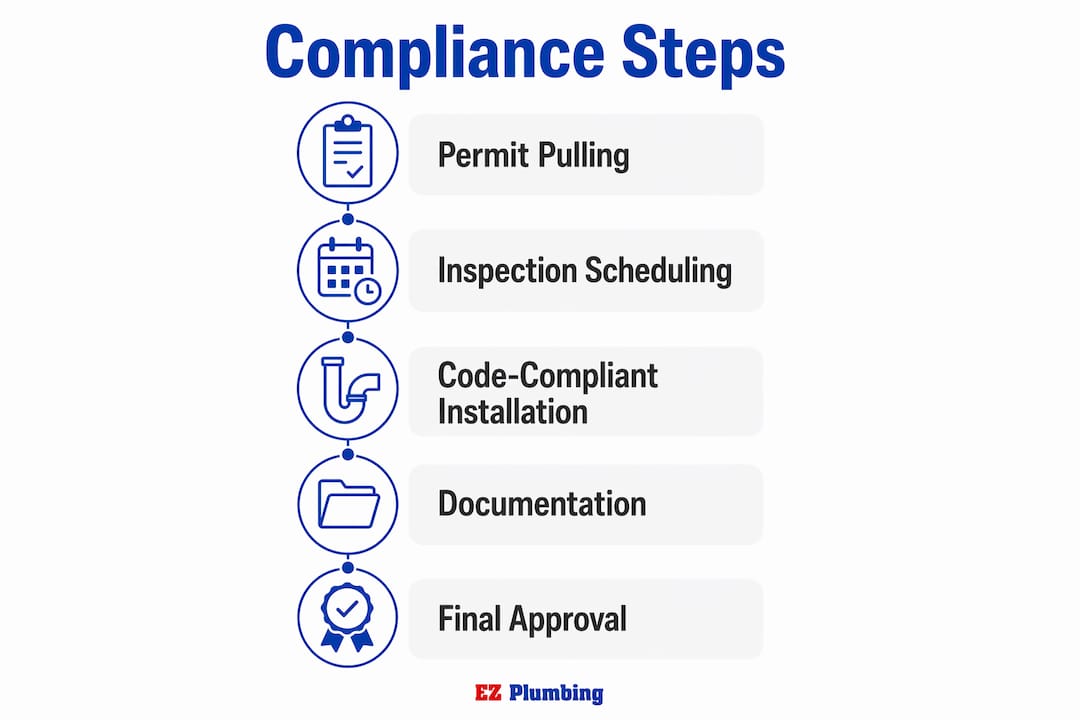
The permit-pull authority is the clearest expression of a plumber’s compliance responsibility. In California, only licensed C-36 contractors or property owners under owner-builder rules may pull plumbing permits. Unlicensed workers may assist under supervision, but the licensed contractor bears full compliance responsibility for every aspect of the installation.
Once a permit is issued, the plumber’s job is to coordinate inspections at each required stage without allowing work to be concealed before approval. The standard inspection sequence under Section P2503 of the IRC, which California adopts with amendments, follows three stages:
- Underground rough-in inspection: All below-slab drain, waste, and vent piping must be inspected and approved before the concrete pour. Inspectors check pipe material, slope, cleanout placement, and pressure test results.
- Above-ground rough-in inspection: All in-wall and in-ceiling piping is inspected before drywall or insulation is installed. This stage covers supply lines, vent stacks, and fixture rough-in locations.
- Final inspection: Fixtures are installed and functional. Inspectors verify flow rates, proper trap installation, water heater connections, and that all permit conditions are satisfied before issuing a certificate of occupancy or final sign-off.
Inspection approval at each stage is required before concealing work, and skipping a stage can trigger stop-work orders and require demolition to expose concealed piping. That is a direct cost to you as the property owner.
Pro Tip: Ask your plumber to provide you with the inspection card or digital inspection record after each stage is approved. This gives you a paper trail that protects you if the property is ever sold or if a dispute arises with the AHJ.

Plumbers who are familiar with local AHJ expectations in Los Angeles know that inspectors in different districts have specific preferences for documentation format, pressure test methods, and fixture placement. A plumber experienced with Los Angeles plumbing code requirements will schedule inspections proactively and prepare the site so the inspector can verify everything in a single visit, reducing re-inspection fees and project delays.
What documentation do plumbers maintain for compliance?
Documentation is where many plumbing projects fail, even when the physical installation is correct. Ongoing compliance tracking requires approximately 8 to 12 hours per month according to 2026 industry data, which reflects how much administrative work a code-compliant plumber actually carries. That time investment directly benefits you as the property owner.
The core compliance documents a licensed plumber maintains include:
- Permit numbers and permit cards: Proof that work was authorized before it began.
- Fixture certifications: Manufacturer documentation confirming that each installed fixture meets NSF/ANSI 14, NSF/ANSI/CAN 61, or other required standards.
- Inspection sign-offs: Written or digital approval from the AHJ at each inspection stage.
- CALGreen checklist: Required for new construction and major renovations, documenting water efficiency measures and submitted with the permit package.
- Pressure test records: Documentation that supply and drain lines were tested to the required pressure before concealment.
Pro Tip: Request a compliance package from your plumber at project completion. It should include the final permit sign-off, all fixture certifications, and any CALGreen checklist pages. Store this with your property records, because a future buyer’s inspector or a city audit can request it years later.
Good documentation also protects the plumber. If a fixture fails and a manufacturer claims improper installation, the plumber’s records establish exactly what was installed and when it was inspected. For business owners managing commercial properties, plumbing maintenance records are part of your operational risk management, not just a regulatory formality.
How do plumbers meet California’s 2026 CALGreen and lead-free standards?
The 2026 code cycle introduced two compliance areas that require specific plumber action before and during installation: CALGreen water efficiency verification and AB 100 lead-free fixture compliance. Plumbers incorporate both into their permit and inspection workflows rather than treating them as separate architectural responsibilities.
The table below compares the two requirements and what each demands from your plumber:
| Requirement | Regulatory source | Plumber’s specific responsibility |
|---|---|---|
| CALGreen flow-rate limits | CALGreen mandatory measures | Verify fixture specs before ordering; document flow rates on CALGreen checklist; confirm at rough-in and final inspection |
| AB 100 lead-free fixtures | 2026 California AB 100 law | Obtain NSF/ANSI/CAN 61 certification from distributor; audit inventory for pre-2026 stock; keep certification records for inspection |
| NSF/ANSI 14 pipe certification | California Plumbing Code | Verify pipe and fitting certifications match the application; retain documentation for permit file |
| Non-potable rough-in (50,000+ SF) | CALGreen mandatory measures | Install rough-in piping per plan; document on Green Building Standards Checklist at permit submission |
For CALGreen compliance, the plumber’s role begins at the fixture selection stage, not at installation. Ordering a showerhead that exceeds 1.8 gpm means the final inspection fails, and replacing a concealed shower valve after drywall is installed is an expensive correction. Experienced plumbers verify CALGreen fixture compliance before the order is placed, not after the inspector arrives.
For AB 100 lead-free compliance, the risk is in the supply chain. Some distributors still carry pre-2026 fixture inventory that does not meet the new standard. A licensed plumber verifies distributor documentation for every fixture before it goes on the truck, because a failed inspection due to a non-compliant faucet is the plumber’s liability, not the distributor’s. This is a detail that separates experienced, code-current contractors from those who are not tracking the 2026 changes.
The role of licensed plumbers in navigating these updates is not passive. It requires active code tracking, supplier communication, and documentation discipline that only a contractor invested in continuing education can deliver consistently.
Key takeaways
Licensed plumbers in California carry direct legal and practical responsibility for every compliance element of a plumbing project, from permit authority to fixture certification and final inspection sign-off.
| Point | Details |
|---|---|
| Permit authority is tied to licensing | Only C-36 licensed contractors or owner-builders may pull permits; the license holder owns all compliance responsibility. |
| Three inspection stages protect you | Underground, above-ground rough-in, and final inspections must each be approved before work is concealed to avoid costly demolition. |
| Documentation is a legal asset | Fixture certifications, permit sign-offs, and CALGreen checklists protect property owners in audits, sales, and disputes. |
| 2026 AB 100 changes fixture sourcing | Plumbers must verify NSF/ANSI/CAN 61 certification from distributors before installation, not after a failed inspection. |
| CALGreen compliance starts at ordering | Flow-rate limits for showerheads, toilets, and faucets must be confirmed before fixtures are ordered to avoid inspection failures. |
What working in Los Angeles compliance has taught us
The most common compliance failure we see in Los Angeles is not a bad installation. It is a good installation with missing paperwork. A plumber can install a perfectly functional system and still fail a final inspection because a fixture certification is not in the permit file, or because a CALGreen checklist was not submitted with the original permit application. The physical work and the administrative work have to move together.
We have also seen property owners get caught in a difficult position when they hire unlicensed contractors to save money on a renovation. The work looks fine until the property sells and the buyer’s inspector discovers unpermitted plumbing. At that point, the cost of retroactive permits, inspections, and potential demolition to expose concealed work far exceeds what a licensed contractor would have charged originally. The essential role of plumbers in renovations is not just technical. It is legal protection for your investment.
The 2026 code updates around AB 100 and CALGreen have also exposed a gap in the market. Many contractors are still sourcing fixtures from pre-2026 inventory without checking certification status. We audit our supplier documentation on every project now, because one non-compliant faucet can fail an entire final inspection. That kind of discipline requires ongoing code education, and it is something you should ask any contractor about before signing a contract.
— EZ
Work with Ez-plumbing for fully compliant plumbing in Los Angeles
Ez-plumbing holds C-36 License #583868 and serves the greater Los Angeles area with residential and commercial plumbing services built around California code compliance. Our licensed plumbers handle permit applications, coordinate all inspection stages, and maintain complete documentation packages for every project.
Whether you are replacing a water heater, repiping a commercial property, or managing a renovation that triggers CALGreen requirements, Ez-plumbing manages the compliance process from permit to final sign-off. Our team stays current on 2026 code changes, including AB 100 lead-free standards and CALGreen flow-rate mandates, so your project passes inspection the first time. For code-compliant water heater installation or any plumbing service in Los Angeles, contact Ez-plumbing today.
FAQ
What does a licensed plumber do for compliance?
A licensed C-36 plumber pulls permits, coordinates inspections at each required stage, selects code-compliant fixtures, and maintains documentation including fixture certifications and inspection sign-offs. The licensed contractor bears full legal responsibility for compliance on every project they manage.
What are the 2026 California plumbing code changes?
The 2026 code cycle introduced AB 100, which requires all endpoint plumbing fixtures to meet NSF/ANSI/CAN 61 lead-free standards, and updated CALGreen mandatory flow-rate limits including showerheads at 1.8 gpm and toilets at 1.28 gpf. Plumbers must verify distributor documentation for every fixture to confirm compliance before installation.
Can I do my own plumbing without a licensed contractor in California?
California allows property owners to pull permits under owner-builder rules for their primary residence, but the owner assumes full compliance responsibility for all work. Any plumbing that fails inspection or is later found non-compliant becomes the owner’s financial and legal liability.
What happens if plumbing work fails inspection in Los Angeles?
A failed inspection results in a stop-work order and requires the plumber to correct the deficiency before re-inspection. If work was concealed before approval, the AHJ can require demolition to expose the piping, which is one of the most expensive outcomes of skipping or failing an inspection stage.
Why does CALGreen compliance matter for my property?
CALGreen mandatory measures apply to new construction and significant renovations in California, requiring verified water efficiency measures and documented flow rates at inspection. Non-compliance can prevent a certificate of occupancy from being issued, blocking occupancy or sale of the property.