
Sewer Line Offset: Homeowners, Verify Camera Footage Before Digging
A sewer line offset is a misaligned joint where one pipe section sits higher, lower, or to one side of the next, creating an internal lip. Small offsets often just need monitoring and a camera re-check; larger or structural offsets need repair before they cause backups. If your inspection report flags one, ask for the footage timestamp and have a licensed plumber confirm the severity before agreeing to any repair plan.
TL;DR:
- Camera footage can exaggerate an offset, so request the raw footage, timestamp, and severity code, then get a clean second inspection before approving excavation.
- In older clay lines, offsets rarely exceed 1/4 inch unless a hub is broken; a displacement near an inch suggests structural movement.
- A sleeve repair without digging can correct confirmed offsets up to 1 inch, but cleanout access determines whether contractors can avoid excavation.
- Relining suits offsets spanning several joints or worn pipe, while excavation is reserved for collapse, severe displacement, standing water, or pipe too damaged to line.
- Act immediately if flow is fully blocked, soil enters the pipe, or a section has visibly shifted; otherwise, let verified footage guide repairs.
Table of Contents
- What Counts as a Sewer Line Offset
- How Inspectors Detect and Code Offsets on Camera
- Why Offsets Affect Flow and When They Signal Bigger Trouble
- What Usually Causes an Offset and How Big They Typically Get
- How Offset Repairs Work, From Cleaning to Excavation
- What to Do With an Inspection Report That Flags an Offset
- How We Read Offset Footage Before Recommending a Fix
- Don’t Let an Overstated Offset Push You Into an Unneeded Dig
- Get a Camera Re-Check Before You Commit to a Repair
- FAQ
- Sources
What Counts as a Sewer Line Offset
An offset joint happens when two pipe sections no longer line up evenly, leaving a ledge or small step on the inside wall of the pipe. That is different from two other terms inspectors use often, and mixing them up leads to confusion about urgency.
- An offset joint is vertical or lateral misalignment that creates an internal lip or shelf.
- A separated joint means the pipe sections have pulled apart, leaving a gap.
- An angular joint is an intentional bend built into the line, not a defect, though it can be mistaken for one on camera.
Pipe material matters here too. Older clay sewer laterals were often built from short sections with many joints, so they show offsets more often than modern solid-run PVC, which has far fewer seams to shift. Cast iron sits in between, prone to corrosion at joints that can eventually loosen alignment.
How Inspectors Detect and Code Offsets on Camera
Camera inspections remain the standard way to find and document offsets, but the footage has limits worth understanding before you react to a report. A camera lens close to the pipe wall can make a minor lip look larger than it is, and lighting angles inside a dark pipe distort depth perception.
Inspectors who follow NASSCO’s Pipeline Assessment and Certification Program use standardized joint defect codes to describe what they see:
- Offset (O): a step or lip at the joint where alignment has shifted.
- Separated (S): a visible gap where the joint has pulled apart.
- Angular (A): a built-in bend, not treated as a structural defect.
These codes feed into a grading system that ranks defects from minor to severe, and inspectors also use continuous defect flags to mark where a problem spans several feet of pipe rather than a single joint. That distinction changes how a repair gets prioritized, since a short isolated offset reads very differently from one that runs through a long section.
Why Offsets Affect Flow and When They Signal Bigger Trouble
The internal lip created by an offset catches grease, wipes, and solids that would otherwise flow through, and that buildup is what turns a minor misalignment into a recurring clog. Over time, the trapped debris narrows the usable channel of the pipe, and tree roots often find their way through the same gap that let the joint shift in the first place.
A 2015 field review found that camera-reported offsets are frequently overstated, with one re-inspected line showing a reported 1-inch offset that measured closer to 1/8 inch once checked again, according to Hydro Physics. That gap between what the camera suggests and what is actually there is exactly why a second look matters before anyone recommends excavation.
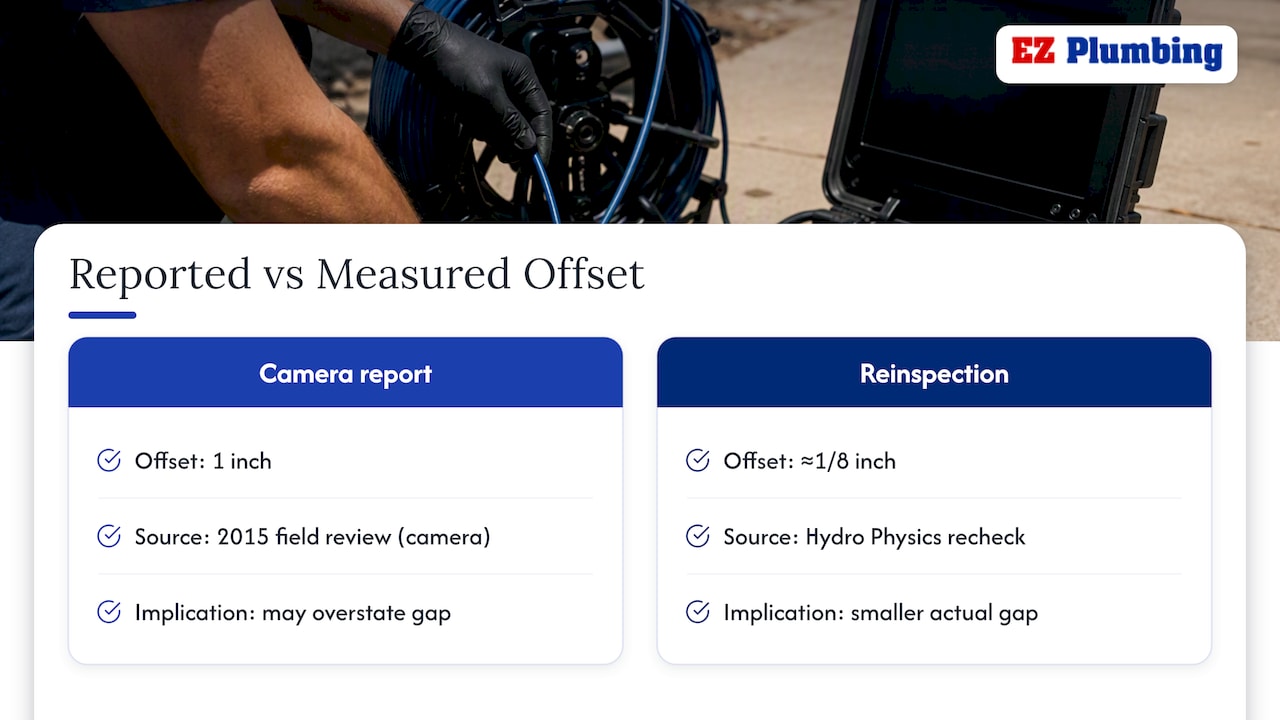
An offset becomes a bigger concern when it coincides with a belly in the line, visible soil intrusion, or signs that the pipe segment has physically moved rather than simply settled at the joint.
What Usually Causes an Offset and How Big They Typically Get
Most offsets trace back to ground movement rather than a manufacturing flaw; understanding the common causes of sewer backups can help homeowners take preventive steps. Soil settling beneath or around the pipe, voids left by erosion, and the natural give of bedding material all shift pipe sections over years of freeze, thaw, and compaction.
- Soil settling and voiding beneath the pipe are the most common drivers of joint movement.
- Short-section clay and some cast iron lines have more joints per foot, so they offset more often than long-run PVC.
- In clay pipe, offsets rarely exceed 1/4 inch unless the hub itself is broken, a size that cameras often cannot even pass cleanly.
- Larger displacements, especially anything approaching an inch or more, point toward active settling or a structural issue rather than normal joint wear.
A 1/4 inch offset in an older clay line is often just a sign of age. An offset near an inch, paired with a belly or flow restriction, is a different conversation entirely.
How Offset Repairs Work, From Cleaning to Excavation
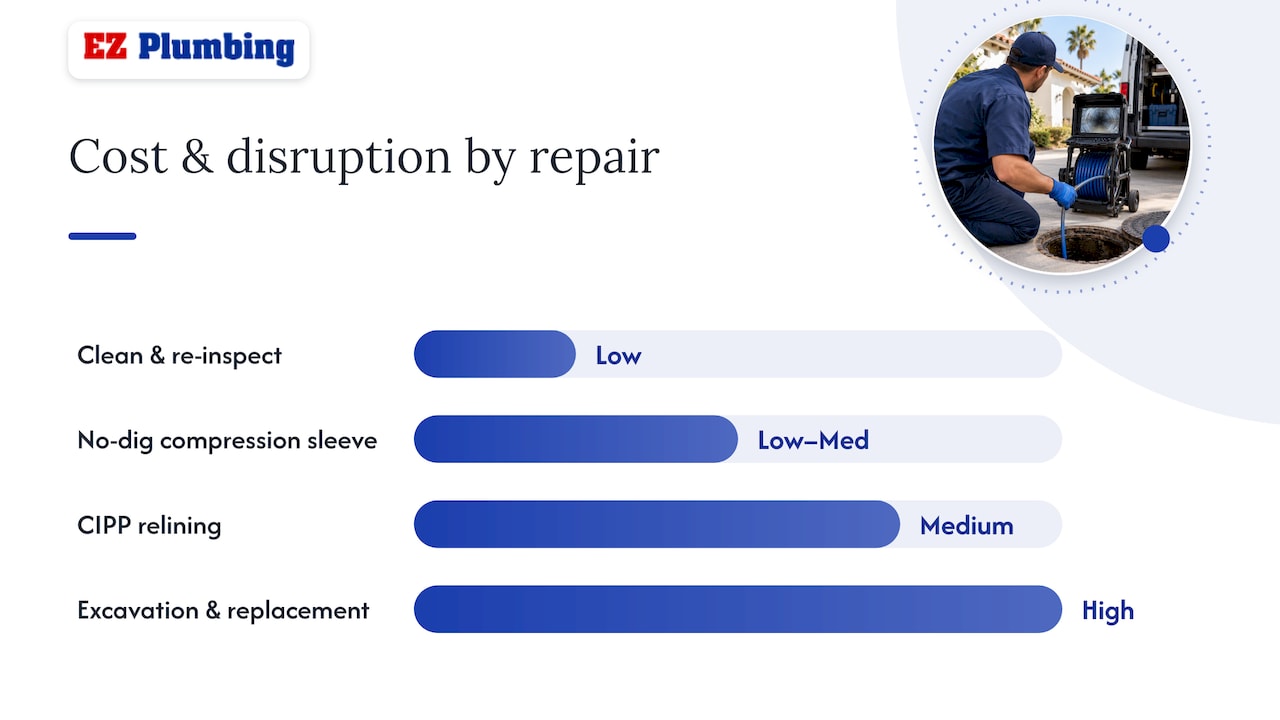
Repair almost always starts with the least invasive option and moves up only if the pipe’s condition demands it. The sequence below reflects how most licensed contractors approach a confirmed offset.
- Clean and re-inspect. Hydro-jetting clears roots and debris, then a fresh camera pass confirms the true size and shape of the offset without buildup distorting the image.
- No-dig point repair. A compression sleeve, such as the QuickLock Flex, uses a stainless-steel corrugated core with EPDM seals to correct offsets up to 1 inch without digging up the yard.
- Cured-in-place pipe (CIPP) relining. A resin liner restores a smooth, continuous interior along a longer stretch of pipe when the offset runs through several joints or the surrounding pipe shows wear.
- Excavation and replacement. Reserved for sections with a collapsed or severely displaced joint, a belly that traps standing water, or pipe material too deteriorated to line.
Pro Tip: Ask whether your contractor can reach the offset through an existing cleanout before approving any digging. Access point location often determines whether a no-dig repair is even on the table.
Cost and disruption scale with that sequence. A sleeve repair through a cleanout can often be done in a single visit, while excavation involves permitting, landscaping disruption, and a longer timeline.
What to Do With an Inspection Report That Flags an Offset
A report that lists an offset is a starting point, not a verdict. Before agreeing to any repair, a few questions separate a real problem from an overcautious estimate.
- Ask for the raw footage and the exact timestamp where the offset appears, not just a single still frame.
- Request the PACP or NASSCO code used, or at minimum a plain-language severity description and the footage range it covers.
- If the proposed fix involves excavation, get a second camera inspection before signing off, since footage can overstate offset size.
- In a home sale, a documented offset often becomes a repair credit negotiation point rather than a deal breaker, especially when the severity grade is low.
How We Read Offset Footage Before Recommending a Fix
We see camera footage misread more often than homeowners expect, usually because a wide-angle lens close to a joint exaggerates a lip that measures a fraction of an inch in reality. Our approach is to clean the line, run a second pass, and measure the offset directly against the footage before recommending anything beyond monitoring.
A camera makes the call easy to flag but hard to size accurately. Confirming the measurement in person, after a jetting pass, is needed to decide whether a sleeve or an excavation makes sense.
When excavation is the right call, Los Angeles permitting requirements apply, and we handle the documentation that keeps the repair compliant with municipal code.
Don’t Let an Overstated Offset Push You Into an Unneeded Dig
Documented footage should drive the decision, not the first number on a report. We lean toward evidence over assumption: a confirmed 1/4 inch offset in an old clay line rarely justifies the same response as a belly with standing water or a joint that has visibly separated.
Immediate action is warranted when flow is fully blocked, when soil is visibly entering the pipe, or when a section has clearly shifted rather than just settled. Short of that, a written proposal built on verified footage protects your budget and your negotiating position just as well.
— EZ
Get a Camera Re-Check Before You Commit to a Repair
If your inspection report flagged an offset, we start with a hydro-jet pass and a fresh camera look before recommending anything. That extra step has reversed plenty of repair estimates that looked far worse on the first pass than they turned out to be in person.

From there, we can walk you through a no-dig sleeve repair for a confirmed offset or scope a full sewer line repair if excavation is genuinely necessary, permits included. Request a written evaluation and footage review through our sewer camera inspection service, and we’ll give you a straight answer before any digging starts.
FAQ
What is an offset in a sewer line?
An offset is a joint where one pipe section has shifted out of alignment with the next, leaving an internal lip or step. It is different from a separated joint, where the pipe has pulled apart leaving a gap, and from an angular joint, which is a built-in bend rather than a defect.
Can you put a 45 degree angle in a sewer line?
Yes, an intentional bend is a standard feature used to change pipe direction and is coded as angular rather than defective during an inspection. It only raises concern if the pipe shows additional signs of misalignment, cracking, or debris buildup at that point.
What is the 135 rule in plumbing?
This generally refers to using multiple fittings to create a gentler curve rather than a single sharp turn, to keep solids moving and reduce clog risk at directional changes. Definitions and local code applications vary, so check with a licensed plumber or your municipal plumbing code for the specific rule as it applies to your line.
Can you use a 90-degree elbow in a sewer line?
A tight elbow is generally avoided on sewer lines because it slows flow and increases the chance of solids catching at the turn. Most codes and contractors favor multiple fittings that create a gentler curve for waste to pass through.
How much does sewer line offset repair cost in Los Angeles?
Cost depends on whether the fix is a no-dig sleeve, a reline, or full excavation, with hourly rates in the region running $150 to $280 for residential work. A written evaluation after a camera re-check is the only reliable way to get an accurate number for your specific line.
Sources
- Common problems in sewer lines — Pipe offset problems (Hydro Physics)
- QuickLock Flex for offset joints (Rausch USA)
- NASSCO PACP code summary (Metropolitan Water Reclamation District PDF)