
Sewer Cleanout Location: How to Find Yours at Home
Your sewer cleanout is a capped pipe, usually 3 to 4 inches wide, that sits on your main sewer line. On most single-family homes you will find it outside, within a few feet of the foundation, or inside a garage, basement or utility room near the floor, close to where the main line leaves the house. If you cannot see one, it may be buried under soil or concrete, or it may never have been installed.
Knowing where it is before a backup happens is the difference between a short, clean service call and a long, expensive one. This guide explains where to look, what you are looking at, what to do when you come up empty, and what is different for property owners in Los Angeles.
TL;DR
- Look first along the front of the house and the side where the main line exits, within a few feet of the foundation, then in the garage or utility areas.
- A cleanout is a capped 3 to 4 inch pipe, often a round or square cap with a threaded plug, flush with the ground or just above it.
- If you cannot find it, check the plot plan and permit records, then call a licensed plumber rather than probing or digging on your own.
- In Los Angeles, the owner is responsible for the whole sewer lateral, so an accessible cleanout protects your budget.
- Older LA homes often have no cleanout at all. A licensed plumber can add one.
Table of Contents
- What a sewer cleanout is and why it matters
- Where sewer cleanouts are usually located
- How to find your cleanout step by step
- Why you should not probe or dig for it yourself
- Sewer cleanouts in Los Angeles: what is different
- Do you need a sewer cleanout?
- Common cleanout problems
- Our perspective: what we see in the field
- When to call a plumber
- Need help finding or installing a cleanout?
- Frequently asked questions
- Sources
What a sewer cleanout is and why it matters
A sewer cleanout is a vertical access pipe with a cap. It gives a plumber direct entry to the main sewer line so a blockage can be cleared without digging up the yard or working through interior fixtures. The City of Los Angeles Sanitation FAQ describes the sewer lateral as the pipe that carries wastewater from a building on private property to the mainline sewer, and the cleanout is the access point on that pipe.
Think of it as the front door to your sewer line. When a main line clogs, every drain in the house can slow down or back up at once. The lowest fixtures, such as a shower or floor drain, are usually the first to show it. With a working cleanout, a plumber can open the cap, send in a cable or a hydro jetting hose, and run a camera to see what is happening in the pipe. Without one, the plumber may have to pull a toilet, work through a roof vent, or excavate.
That is why professional guidance stresses finding your cleanout before an emergency. If sewage is coming up in your home, you want to tell the plumber exactly where to go, and you may want to know where the cap is so you can keep the area clear.
Where sewer cleanouts are usually located
Cleanout positions vary with the age of the house, the layout of the lot and local code. Still, a few patterns hold on most properties.
Outside the house
The most common outdoor position is along the main sewer line between the house and the street, often within a few feet of the foundation. SERVPRO’s guide notes that outdoor cleanouts commonly sit close to exterior walls or hide beneath landscaping. In practice, check these spots:
- The front yard, in a line between the house and the street, especially near the side of the house where the plumbing is concentrated.
- Along the wall closest to the kitchen or bathrooms, where the main drain leaves the building.
- Near the water shutoff or hose bib. Plumbers often cluster utility penetrations in the same area of the foundation.
- At the side yard or the back of the lot if your sewer runs to an alley instead of the street.
The cap is typically round or square, often black, white or green plastic, or a brass or cast iron plug on older installations. It may sit flush with the ground inside a small box or just above it. The City of Minneapolis describes a typical cleanout as a 4-inch capped pipe with a steel or plastic cover. That matches what we see in the field.
Inside the house or garage
When the cleanout is indoors, it generally sits on the main sewer line just before the line meets the foundation or passes through the wall. Look in basements, utility rooms, crawl space entries and garages, low on the wall or in the floor. In Los Angeles, many homes have no basement, so the garage and the exterior wall at the front of the house are the most likely indoor and outdoor candidates.
As a rule of thumb, an indoor cleanout will look like a short capped pipe rising from the floor, or a plug set into a floor-level fitting. Do not confuse it with a floor drain, which usually has a metal grate rather than a threaded cap.
What the fitting looks like
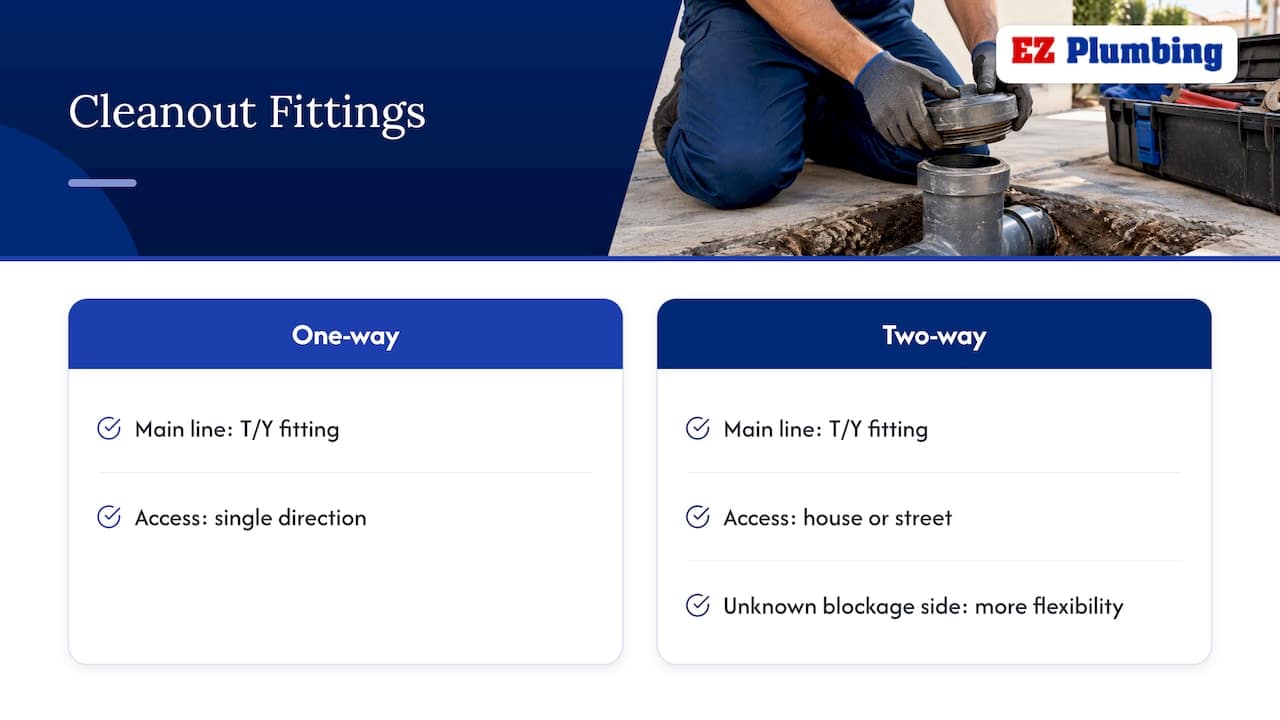
Behind the cap is usually a T or Y shaped fitting that connects to the main line. Some cleanouts are one-way, giving access in a single direction, and some are two-way, which lets a plumber work toward the house or toward the street. Two-way fittings give more flexibility when you do not know which side of the cleanout the blockage is on.
How to find your cleanout step by step
Work through these in order. Each takes only a few minutes, and most owners find theirs by step three.
- Locate where the main line exits. Walk around the house and find where the kitchen and bathroom plumbing is concentrated. Inside, note where the main drain would head toward the street. The cleanout is normally along that route.
- Walk the likely path outside. Check the front yard and the sides of the house, scanning for a cap, a small green or black lid in the ground, or a short pipe stub. Look under shrubs, ground cover and mulch. A cap hidden by landscaping is common.
- Check the garage and utility spaces. Look low on walls and in the floor for a capped pipe, especially near the exterior wall that faces the street.
- Read your plans. The engineered plot plan for the home often shows the cleanout location, as do plumbing permit drawings. In Los Angeles, the Department of Building and Safety keeps permit records, and it can help to review its general notes for single-family dwellings, which explain that plumbing work is inspected and approved before it is covered up.
- Ask neighbors with a similar house. Homes built by the same developer in the same era often share a layout. A neighbor’s cleanout can tell you where to look on your lot.
- Call a licensed plumber. If steps one through five fail, a plumber with a camera and a locator can trace the line and find the right spot.
If your sewer is in an alley, your cleanout is most likely at the back of the lot. If it is in the street, expect the front.
Why you should not probe or dig for it yourself
It is tempting to push a screwdriver or a rod into the soil along the likely route. The Spruce and other guides caution that this can be imprecise and potentially damaging. You can crack a clay or cast iron pipe, pierce a gas or irrigation line, or damage a buried cap, and you may still not find the cleanout. Gas and electric utilities also need to be marked before you dig. In California, that means a free call to 811 before any excavation.
A plumber has better options. A camera run through a toilet flange or roof vent, combined with a pipe locator, can trace the sewer line from the surface and find the pipe’s actual path. Once the pipe is found, a licensed plumber can raise the cleanout to grade so it is easy to reach next time.
Sewer cleanouts in Los Angeles: what is different
Los Angeles has a mix of housing eras, from 1920s bungalows in Highland Park and Echo Park to postwar tract homes in the Valley and newer infill in the Westside. That mix matters for cleanouts.
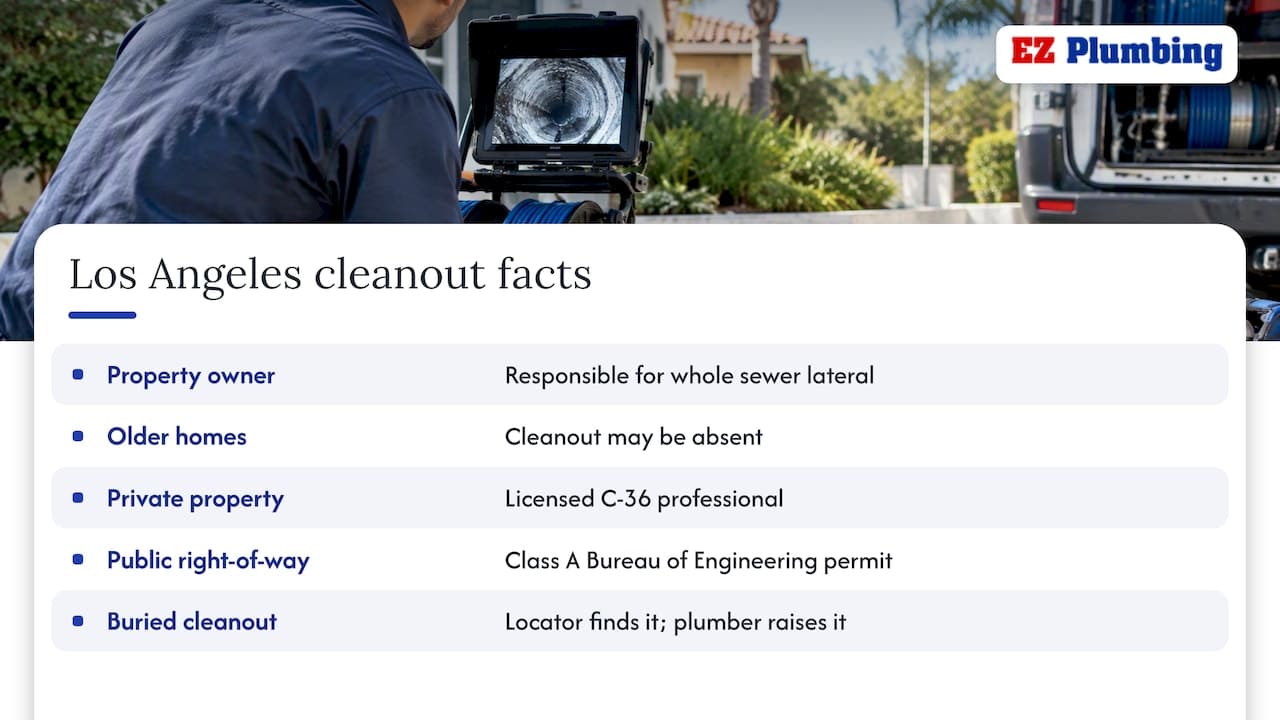
The owner owns the whole lateral. According to the City of Los Angeles Sanitation FAQ, property owners are responsible for the sewer lateral, including the lower portion that runs under the street or sidewalk. A blockage in that lower section can be technically under public property and still be the owner’s to fix. A reachable cleanout makes it far cheaper to find out where the problem lies. We cover the details in our guide on who is responsible for sewer line repair in Los Angeles.
Older homes may have none. In many Los Angeles properties, particularly older ones, a cleanout may be completely absent. If yours has none, a licensed plumber can install one so that future blockages do not require extensive digging. Adding one is generally far less costly than the repair it can prevent.
Licensing and permits. The City’s FAQ states that work on private property must be done by a licensed professional with a C-36 plumbing license, and that work in the public right-of-way needs a Class A permit from the Bureau of Engineering. If your cleanout work extends toward the street, you should know which permit applies. Our article on LADBS versus BOE permits for LA sewer repairs walks through the difference, and this guide to sewer lateral responsibility explains how to avoid permit delays.
Buried and paved over. In older neighborhoods such as Boyle Heights or Highland Park, a cleanout may exist but have been covered by a patio, a driveway or decades of landscaping. A locator can find it, and a plumber can raise it to grade without tearing out more than necessary.
Do you need a sewer cleanout?
In practical terms, yes. Any property with a sewer lateral benefits from at least one accessible cleanout, and many properties are better with two: one near the house and one near the property line. The benefits are concrete:
- Faster clearing. A plumber can reach the main line directly instead of working through a toilet or vent.
- Better diagnosis. A camera can enter at the cleanout and show roots, a belly, a cracked section or a collapsed pipe, which helps separate a simple clog from a failing lateral.
- Lower cost. Direct access shortens the job and reduces the chance of excavation.
- Less mess. A backup that can be cleared from the cleanout is less likely to flood the house.
As for the code, requirements for cleanouts depend on your jurisdiction and the code edition in force when your home was built or when the work is done. We do not want to quote a number that may not apply to your lot. The practical answer is that if you are replacing or repairing any part of the sewer line in Los Angeles, a licensed plumber will plan for code-compliant cleanout access as part of the job, and the City or County inspector will check it.
Common cleanout problems
Once you have found your cleanout, look it over. A few conditions deserve attention.
| Problem | What you see | What to do |
|---|---|---|
| Missing or cracked cap | Open pipe, gaps, sewer odor near the cap | Replace the cap promptly. A sealed cap keeps out sewer gas, pests and contaminants. |
| Buried cap | No visible opening, grass or soil over the spot | Have a plumber raise it to grade. |
| Stuck or seized plug | Cap will not turn, threads corroded | Do not force it. A plumber has the tools to free it without breaking the fitting. |
| Water or sewage at the cap | Wet ground or standing liquid near the cleanout | Treat as a possible blockage or break. Stop running water and call a plumber. |
| Roots in the line | Slow drains, recurring clogs, roots on a camera | Hydro jetting and a camera inspection can clear the line and show its condition. |
Keep the cap clear of dirt, mulch and debris, and replace it if it is cracked or missing. Industry guidance is clear that a properly sealed cap is what keeps sewer gas and odors out of your property.
A warning on opening the cap: if the line is backed up, the pipe may be full. Water and sewage can come out under pressure when the cap is loosened, so do not open it unless you know what to expect. If you suspect a main line stoppage, let a plumber open it.
Our perspective: what we see in the field
We have been a family-owned company serving Los Angeles since 1989, and a large share of our sewer calls start the same way. A homeowner has a backup, the plumber arrives, and nobody can find the cleanout. That adds time and cost before any work begins.
The lesson we pass on is simple. Find your cleanout when nothing is wrong. Mark it, photograph it, and make sure nothing sits on top of it. If you manage a building, put its location in your maintenance file. In older Los Angeles housing, with clay laterals, root intrusion and years of changes to the yard, the cleanout is often the first thing we have to find, and sometimes the first thing we have to build.
We also think owners should hear plainly that the lateral is theirs to maintain, all the way to the main. That is not a reason for alarm. It is a reason to keep the line accessible, inspect it on camera when buying or when drains slow, and use a licensed plumber who documents the work for code compliance. Our pricing is written up front, so you know what you are agreeing to before work starts.
— EZ
When to call a plumber
Call a licensed plumber if any of these apply:
- Several drains back up at once, or a toilet gurgles when a washer or shower drains.
- You have searched and cannot find a cleanout.
- The cap is stuck, cracked, buried or leaking.
- Raw sewage is in the yard or house. Stop using water and treat it as an emergency.
- You are buying an older home and want the sewer line scoped before closing.
For a stoppage that has already started, our guide on how to clear a main sewer line clog safely explains what a professional does and what you can safely do while you wait. If it is the middle of the night, emergency drain cleaning tips cover the steps before help arrives.
If the line turns out to be damaged, we also explain your options in our Los Angeles sewer pipe repair guide, including repair without digging, and what to expect in sewer lateral replacement costs.
Need help finding or installing a cleanout?
EZ Plumbing is a licensed plumbing company (C-36 License #583868) serving the greater Los Angeles area, with real local staff and 24/7 emergency dispatch. We can locate a buried cleanout, run a camera through the line, clear the blockage with hydro jetting, and install a new cleanout where none exists. See our drain cleaning service or our sewer line repair page, or use our rate calculator for a sense of cost. Our published residential plumber rate is $150-$280 per hour, and our commercial rate is $120-$240 per hour. For anything urgent, reach our emergency team.
Property managers, HOAs and restaurants can also ask about maintenance plans that include scheduled drain cleaning, a practical way to keep cleanouts accessible and lines flowing across several properties. See our commercial plumbing page.
Frequently asked questions
Where should a sewer cleanout be located?
It should sit on the main sewer line, in a place a plumber can reach without removing anything permanent. That usually means outdoors within a few feet of the foundation, or indoors near the floor where the line exits the house. Many properties benefit from a second cleanout near the property line.
What does an old sewer cleanout look like?
Older cleanouts are often a short capped pipe of cast iron, clay or galvanized material, with a brass or iron plug, and they may be rusted or partly buried. Some are only a small round cover in the ground. If you find a metal disc or a plug in the soil along the sewer route, treat it as a probable cleanout and have a plumber check it.
What if I cannot find my sewer cleanout?
Check your plot plan and permit drawings, then ask a licensed plumber to trace the line with a camera and locator. Avoid probing or digging blindly, which can damage the pipe or other utilities. If none exists, a plumber can install one.
Is the sewer cleanout my responsibility in Los Angeles?
Yes. Los Angeles property owners are responsible for their entire sewer lateral, including the lower portion under the street or sidewalk, per the City’s sanitation FAQ. The cleanout on your property is part of that system, so keeping it accessible is in your interest.
Can I open the cleanout cap myself?
If the line is flowing normally, you can usually check the cap and clear dirt away from it. If drains are backing up, the pipe may be full and the contents can rush out when the cap loosens. In that case, let a plumber open it.
Sources
- City of Los Angeles Sanitation: Sewer System FAQs
- SERVPRO: Sewer Cleanout, What it is and How to Find it
- The Spruce: What Is a Sewer Cleanout? How to Find Yours at Home
- City of Minneapolis: Sewer Cleanouts
- LADBS: General Notes for Single-Family Dwellings