
Reliable Plumber Near Me: A Los Angeles Homeowner’s Guide
It's late, water is showing up where it shouldn't, and your phone is already in your hand. You type reliable plumber near me, and the results all look the same. Everyone says they're fast. Everyone says they're licensed and insured. Everyone says they do emergency service.
That's where people get burned in Los Angeles.
A plumbing company can be close to your address and still be the wrong hire. A dispatcher can answer quickly and still send someone who gives a vague verbal price, pushes unnecessary work, or leaves you with a temporary patch instead of a real repair. If you own a home, manage units, or oversee an HOA, you need more than speed. You need a plumber who can prove reliability before work starts and back it up after the job is done.
Table of Contents
- Beyond the Search Bar Finding a Truly Reliable Plumber
- What to Look For Before You Even Click
- Your Vetting Checklist Key Questions for Any Plumber
- From Arrival to Completion What to Expect on Service Day
- Handling a Plumbing Emergency in Los Angeles
- Your Partner for Reliable Plumbing in Los Angeles
Beyond the Search Bar Finding a Truly Reliable Plumber
At 10 PM, you hear water tapping the inside of the sink cabinet. By midnight, the bottom shelf is warped, the shutoff valve is stuck, and the first company on Google is promising to be there in 20 minutes. That is when people get overcharged.
In Los Angeles, speed matters, but speed without process is expensive. I have seen plenty of service calls where the crew arrived fast and still wasted the customer's money. The truck did not have the right parts. The technician could not explain whether the issue was a drain stoppage, a failed angle stop, a wall leak, or a sewer backup. The estimate stayed verbal until the work was open. Then the price changed.
Reliable service starts earlier than the knock at the door. It starts with whether the company can explain how it handles your call, what it needs to know before dispatch, and what paperwork you will get before work begins.
Why fast is not enough
A quick answer on the phone does not tell you much. In this market, good companies ask a few pointed questions before they send anyone out. They want to know the fixture involved, whether water can be isolated, whether sewage is backing up, whether the building is a single-family home, condo, or multi-unit property, and whether access is limited. That is not stalling. That is dispatch discipline.
You also want proof the company is set up to work legally in California, not just a polished ad and a live phone line. If you want a clear breakdown of why licensing matters on residential work, read why hiring a licensed plumber for your home protects you.
A reliable plumber usually does four things before the wrench comes out:
- Classifies the problem correctly before arrival
- Explains whether diagnosis is separate from repair
- Gives written documentation, not just phone promises
- Shows a repeatable service process instead of improvising on site
Ask one direct question: "What will I receive in writing before you start?" If the answer gets vague, keep calling.
What reliability looks like in Los Angeles
Los Angeles adds a layer that generic hiring advice misses. Coverage matters. A company can list "LA" on its website and still dispatch poorly to the Valley, Northeast LA, the Westside, South Bay, or hillside properties with parking and access issues. Property managers know to test this early. Ask whether the company services your exact neighborhood every week, not just whether it "covers Los Angeles."
Then verify the contractor, not just the brand. In California, you can check the license through the Contractors State License Board and confirm that it is current and issued to the business you are hiring. For LA work, also pay attention to whether the company talks clearly about permits when the repair crosses into replacement, reroutes, gas work, or larger drain and sewer work. A reliable plumber will tell you when a job is service work and when it starts moving into permit territory.
A key signal is consistency. If the office cannot explain arrival windows, diagnosis charges, authorizations, or who is coming to your property, the job will probably stay disorganized after the truck pulls up.
Use the search results to build a short list. Use the phone call to screen out weak operators. Use the visit to confirm that the company works the same way it talked. That is how you avoid paying for panic in Los Angeles.
What to Look For Before You Even Click
Customers often skip the easiest screening step. They search, glance at the map pack, and start calling at random. A better move is to read the search result like a property manager would.
Before you click a website, look at what the listing already tells you. Strong plumbing companies usually leave a trail of operational signals in plain view.
Read the listing like a contractor
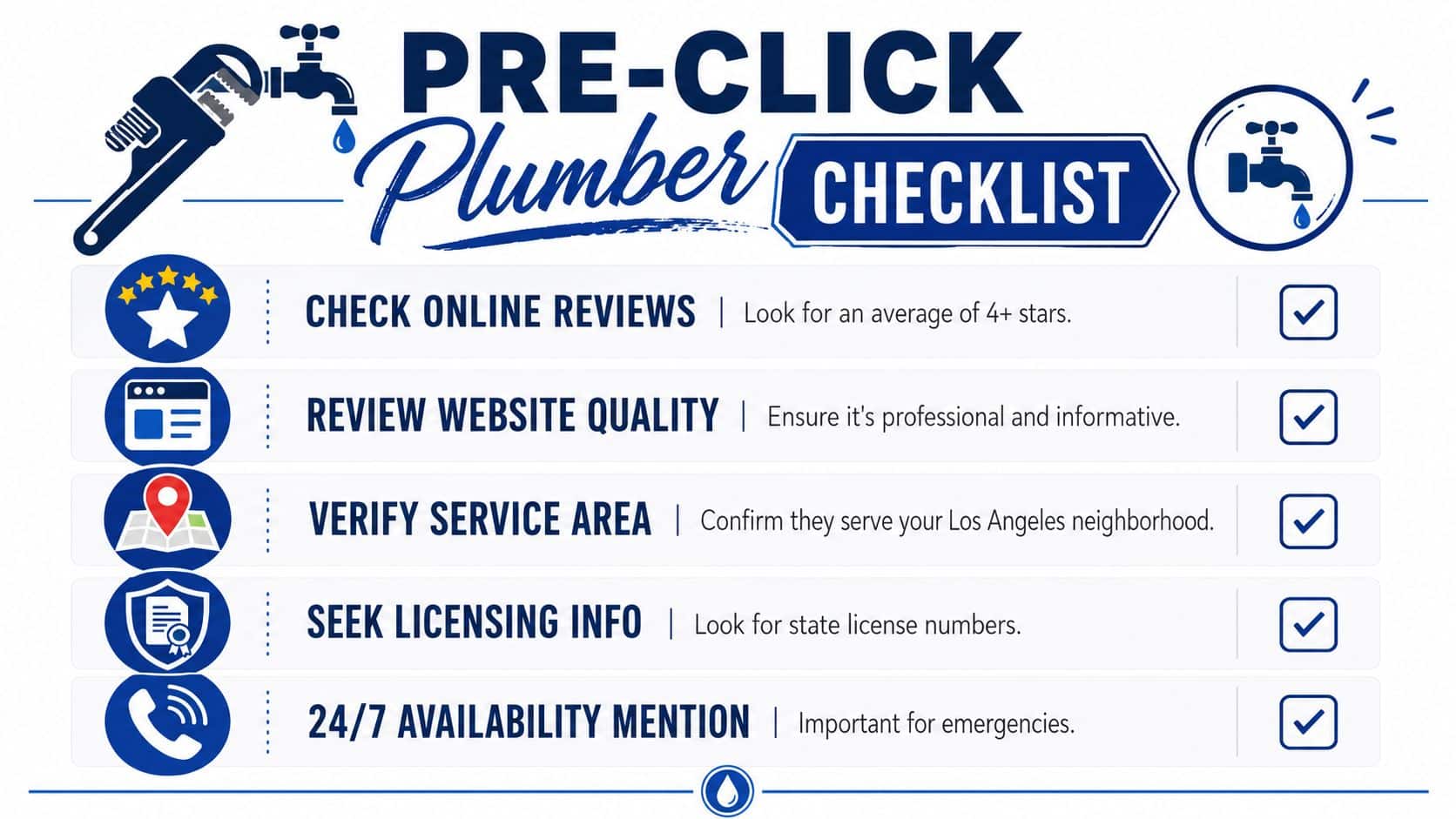
Start with the basics on the Google Business Profile or similar local listing.
- Review activity matters more than one perfect snapshot. Local SEO guidance for plumbers recommends about 2 to 4 new reviews per month for smaller firms and 8 to 12 monthly in more competitive markets, with a target average of 4.5+ stars, according to local SEO guidance for plumbers from Nova Advertising. That doesn't prove workmanship by itself, but it does suggest the company is active and still getting jobs.
- Service area should be visible. If the listing is vague about neighborhoods, verify they operate in your part of Los Angeles.
- Emergency language should be specific. “Available anytime” is weaker than a direct statement about 24/7 emergency service.
- Business scope should match your problem. A clogged branch line, gas issue, water heater problem, and sewer backup aren't the same call.
A stale listing is a warning sign. So is a profile with lots of generic praise but no indication of what kind of work the company performs.
What the website should show quickly
Once you click through, don't get distracted by slogans. Scan for operational proof.
Look for:
| Signal | Why it matters |
|---|---|
| License information | It shows the company understands compliance and accountability |
| Insurance mention | It tells you they're at least addressing risk upfront |
| Clear service pages | It suggests they regularly handle specific plumbing problems |
| Visible contact process | It shows whether dispatch is organized or improvised |
A professional site doesn't need to be fancy. It needs to answer practical questions fast. If you want a plain-language explanation of why that matters, this short page on why hiring a licensed plumber protects your home is worth reviewing.
A reliable local listing should make you feel informed before you call, not pressured to call just to get basic facts.
Green flags and fluff
Marketing fluff sounds like this: “best service,” “lowest rates,” “trusted by everyone,” “we do it all.”
Useful signals sound like this: clear neighborhoods served, identifiable services, review activity, and direct language about emergency availability.
If you're searching for a reliable plumber near me, your first job isn't to find the cheapest option. It's to eliminate the companies that hide important details until they're standing in your doorway.
Your Vetting Checklist Key Questions for Any Plumber
Once you've narrowed the list, the phone call matters more than the ad. During this call, you stop being a lead and start acting like the person approving work on a property.
A good plumbing office won't struggle with straightforward questions. If the answers come back vague, defensive, or rushed, that's useful information.
Start with credentials and documentation
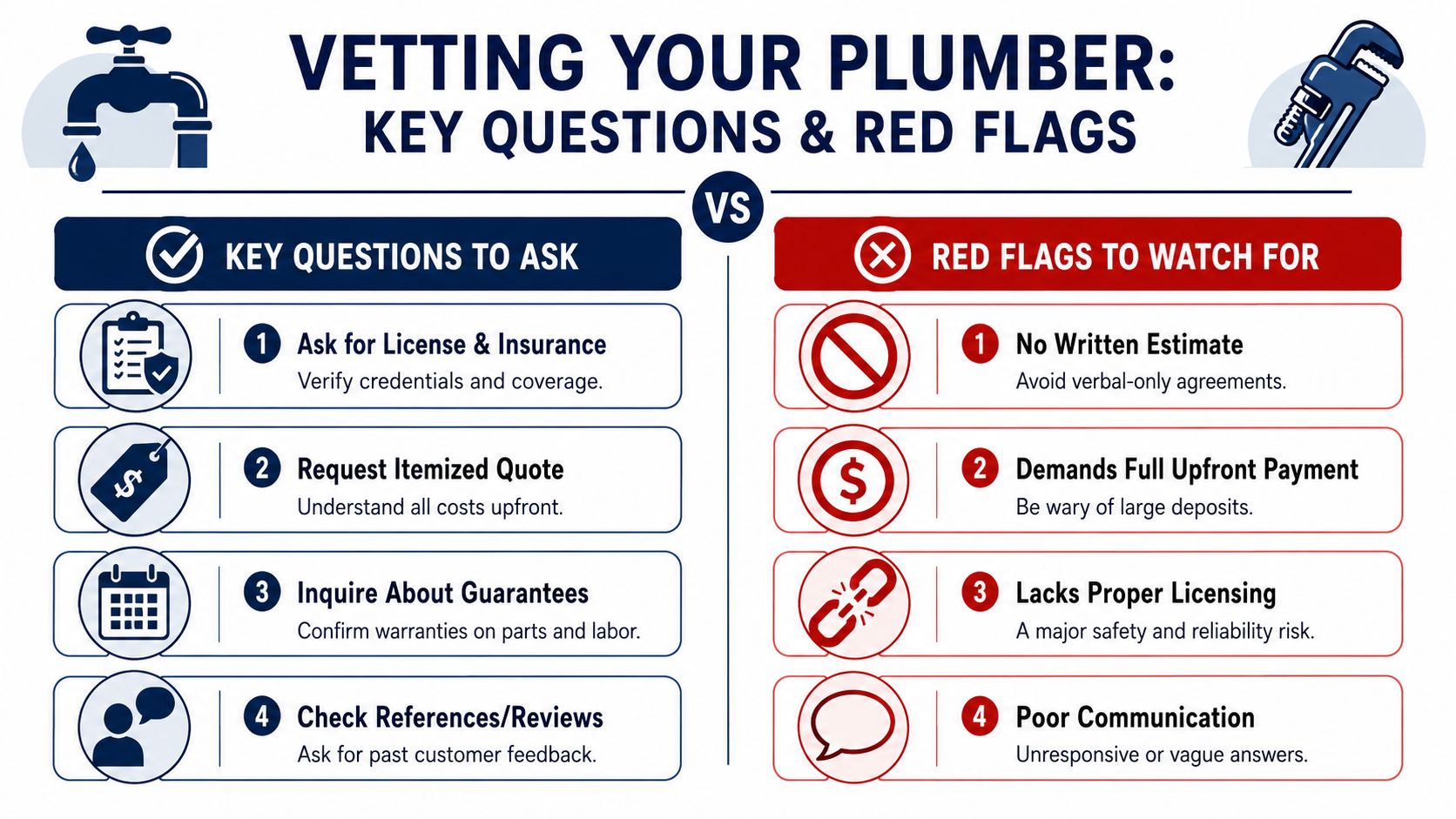
The first set of questions should be simple.
What is your license number?
In California, you should be able to verify a contractor's license status independently. If they hesitate, change the subject, or act annoyed, that's a bad sign.Do you carry current liability coverage and worker-related insurance?
The point isn't to sound formal. The point is to avoid being exposed if something goes wrong on your property.Will you provide a written estimate before work starts?
This is one of the main protections against scope creep and surprise charges. Plumbing-industry guidance says the vetting workflow should begin with licensing, insurance, reputation, and a written estimate before any work starts, as explained in this hiring-mistakes guide from Chesapeake Plumbing.
If they only want to “ballpark it over the phone” and won't commit to an on-site written estimate, stay cautious.
Ask how pricing actually works
A lot of disputes come from unclear billing, not from the repair itself.
Use direct questions such as:
- Is there a dispatch or diagnostic charge?
- Does that charge apply toward the repair?
- Do you bill flat-rate, hourly, or by task?
- If you open the wall or pull a toilet and find something else, how do you approve added work?
These questions don't make you difficult. They make you organized.
If you manage property, keep a standard worksheet. If you don't have one, a practical checklist library for service calls and approvals can help you structure what to ask before authorizing work.
Here's a useful comparison:
| Response from plumber | What it usually means |
|---|---|
| “We'll explain charges on site before starting.” | Reasonable, if they also confirm it will be written |
| “We can't know anything until we get there.” | Sometimes fair, but push for process details |
| “Don't worry about paperwork, we'll take care of you.” | Risky |
| “It should be cheap.” | Meaningless without scope |
Reputation isn't one website
This video gives a quick consumer-level view of screening contractors before hiring.
Don't rely on one review platform. Cross-check. Read how the company handles complaints, scheduling issues, or callbacks. Property managers usually care less about polished praise and more about whether the company communicates clearly when the job gets complicated.
You should also ask whether they can point to completed work, references, or warranty terms. Verbal confidence is cheap.
If a plumber can explain their process in plain English, that usually tells you more than a flashy ad ever will.
For larger repairs, it also helps to understand how to talk about pricing without weakening your own position. This guide to negotiating with contractors gives a practical framework for comparing proposals and keeping the conversation grounded in scope, not pressure.
Red flags that should end the call
Some signals aren't debatable.
- No license information
- No written estimate
- Pressure to approve immediately
- Large upfront payment demands before any real diagnostic work
- Vague answers about insurance
- Poor communication from dispatch
A reliable plumber near me search should end with a short list of companies that can verify who they are, how they bill, and what paperwork you'll receive. If they can't do that on the phone, don't expect better once the wrench comes out.
From Arrival to Completion What to Expect on Service Day
A professional service call has a rhythm to it. You shouldn't have to guess what happens next, and you shouldn't feel like the plan changes every ten minutes.
When the appointment is handled properly, you'll notice that the company respects your time before the technician even rings the bell.
The arrival should feel organized
You should get a call or text when the technician is on the way. The vehicle should be marked. The technician should look like they belong there and know which problem they were dispatched to inspect.
That matters more than people realize. A clean handoff from office to field usually means the company has systems, not chaos.
When they arrive, expect a brief walkthrough. Show the symptom, mention any past repairs, and point out access issues. In older Los Angeles homes, details like crawlspace access, shutoff location, and prior patchwork can change the diagnostic path.
Diagnosis comes before price
In major markets, hourly rates can range from $45 to $165 per hour, but reliability is better judged by a valid license, current liability insurance, and a written quote after the job is assessed, according to Thumbtack's Houston plumber guidance. That's the right way to think about service day in Los Angeles too. Price matters, but process matters first.
A solid technician will inspect before promising. They'll tell you what they know, what still needs to be confirmed, and whether the repair is straightforward or likely to expand.
A plumber who gives a confident final price before diagnosing the issue is often selling certainty they haven't earned.
What approval should look like
Before work begins, you should receive a written estimate or authorization that spells out the scope. It doesn't need to read like a legal brief, but it should be specific enough that both sides know what's included.
Good service-day communication usually includes:
- The identified problem in plain language
- The proposed repair
- Any access or demolition limits
- What changes require new approval
- Whether the fix is temporary or complete
If the technician starts reaching for tools before explaining the scope, stop the job and reset the conversation.
The closeout tells you a lot
The end of the call is where strong companies separate themselves from sloppy ones. After the repair, the technician should test the work, explain what was done, and show you the result whenever possible.
For example, after a stoppage, they should confirm drainage is restored. After a valve replacement, they should check for active leakage. After a water heater issue, they should explain what was adjusted or replaced and what you should monitor next.
The work area should also be left in serviceable condition. That doesn't mean every job is spotless. Plumbing can be messy. It does mean they don't leave you with unnecessary debris, standing water, or unanswered questions.
A reliable service visit feels documented, controlled, and respectful from dispatch through cleanup. If it feels improvised, that's the wrong company to call back next time.
Handling a Plumbing Emergency in Los Angeles
Not every urgent plumbing problem is a true emergency. A dripping faucet at night can usually wait. A burst supply line, sewer backup, overflowing toilet with no secondary bathroom, or gas-related concern usually can't.
That distinction matters because emergency plumbing should be reserved for problems that threaten property, habitability, or safety.
What a real emergency response includes
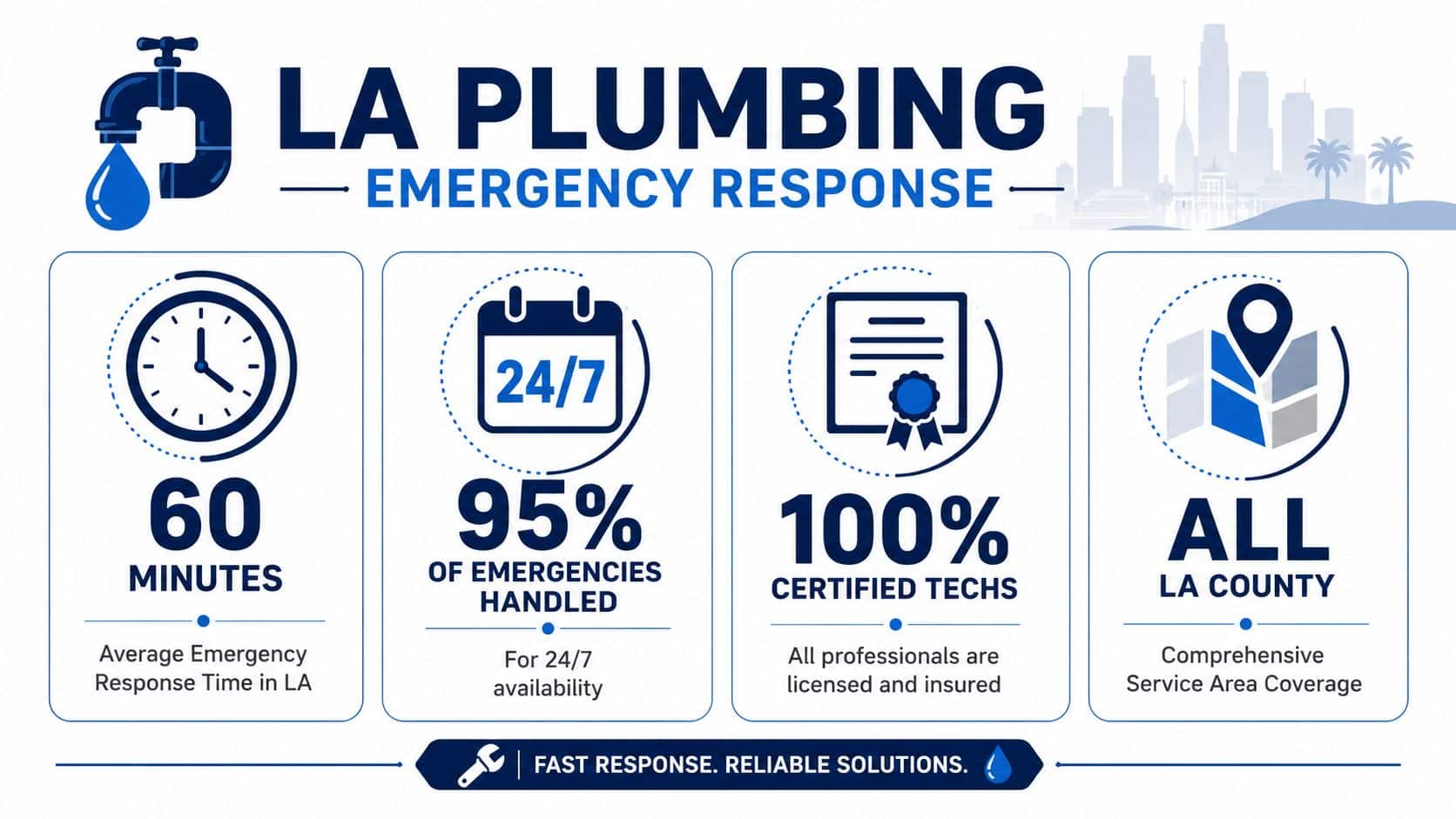
In major markets, established plumbing companies often signal reliability through 24/7 response, longevity markers such as being established in 2007, and service across multiple surrounding communities, according to Chron's coverage of Houston plumbers. In Los Angeles, the same principle applies. Emergency work takes dispatch capacity, geographic coverage, and technicians who can handle more than simple fixture swaps.
When you call for an emergency, be ready to tell dispatch:
- What is happening right now
- Whether water is active or contained
- Whether the main shutoff has been closed
- Whether sewage, gas, or water heater equipment is involved
- What type of property it is
That helps the dispatcher send the right technician and set realistic expectations.
Temporary stop versus proper repair
A lot of night calls begin with containment. That's normal. Shutting off water, isolating a fixture, capping a failed section, or making a space safe may be the first step.
But a reliable company should tell you whether that first action is only temporary. If a plumber treats every emergency like a quick patch and disappears, you're not getting emergency service. You're getting delay.
For owners and managers in Los Angeles, that distinction matters most in multifamily buildings. A one-unit leak can become a ceiling claim, a tenant issue, and a scheduling problem by morning.
In an emergency, the first question isn't “How cheap is it?” It's “Can this company stabilize the problem safely and document the next step?”
If you need a local example of how a company presents urgent service coverage, this Los Angeles emergency plumber page shows the kind of service framing you should expect to see: emergency-specific language, clear availability, and local relevance.
What to do before the plumber arrives
Keep this part simple:
- Shut off water if you can do it safely
- Keep people away from contaminated areas
- Move valuables and electronics out of the path
- Take photos for records if damage is visible
- Don't approve blind work without at least a documented scope once help arrives
Speed matters in Los Angeles emergencies. But calm, documented response protects the property better than panic ever will.
Your Partner for Reliable Plumbing in Los Angeles
At 6:30 a.m., a tenant texts photos of water under a kitchen sink, your maintenance person is off that day, and the first few search results all claim fast service. In Los Angeles, that is where owners get overcharged or stuck with a patch that fails again next week. A reliable plumber near me search only works if you treat it like vendor screening, not panic shopping.
Use the same standard property managers use. Verify what can be checked, ask how the company documents approvals, and pay attention to whether the office and field team sound coordinated. In LA, reliability shows up in process. It does not come from a slogan on a truck.
What long-term reliability looks like
For Los Angeles homeowners and property managers, reliable service usually comes down to a few repeatable standards:
| Standard | What you should expect |
|---|---|
| Clear communication | The person dispatching the job and the plumber arriving onsite are working from the same notes |
| Documented approvals | You receive a written estimate or scope before repair work starts |
| Appropriate capability | The company handles routine repairs, urgent calls, and follow-up work without changing vendors mid-job |
| Accountability | The business name, license, insurance, invoice, and service record all line up |
That last point matters more in Los Angeles than many owners expect. Plenty of companies market hard. Fewer make it easy to confirm who is licensed, who is insured, and who will still answer the phone if a repair needs follow-up.
A better test is simple. Ask where the company is licensed, whose name will be on the invoice, whether the technician is an employee or subcontractor, and how change-of-scope work gets approved. If the answers are vague, keep looking.
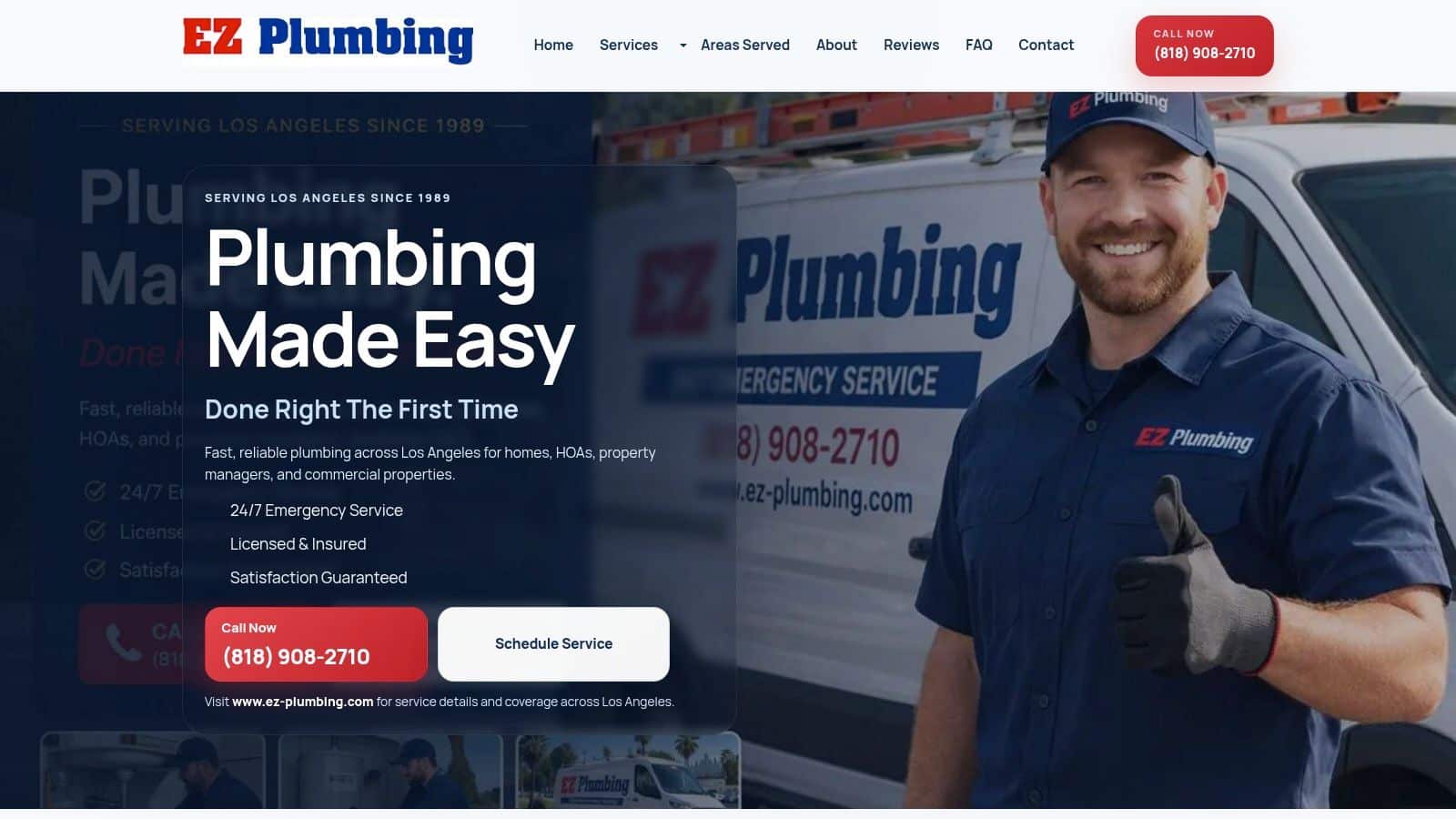
One local option that fits this framework is EZ Plumbing, a licensed and insured Los Angeles plumbing contractor serving the area since 1989. The company provides 24/7 emergency response, same-day scheduling for planned work, and services that include drain cleaning, hydro jetting, sewer diagnostics and repair, water heater service, and licensed gas leak detection and repair. For homeowners, HOAs, landlords, and commercial properties, those details show operating range and service structure, not just marketing copy.
Don't hire based on comfort alone
A polite phone call helps. A polished website helps. Neither protects your walls, flooring, or budget.
Hire the plumber who explains what happens first, what requires approval, and what changes if the repair opens up a larger problem inside the wall or under the slab. That is how experienced owners avoid surprise invoices and half-finished work.
If you remember one thing, remember this. A reliable plumber gives you enough information to verify the company before work begins.
If you want a plumbing company that matches the standards in this guide, EZ Plumbing is available for Los Angeles homeowners, property managers, HOAs, and commercial properties. You can call (818) 908-2710 or schedule service online for documented repairs, emergency response, and clean, professional plumbing work.