
Hydro Jetting vs Snaking: Which Method Unclogs Best
Sunday dinner is approaching in a Venice duplex, and the kitchen sink is already draining slowly again. It cleared after the last service call, worked normally for a week, and then started holding water whenever someone washed a pan. Across town, a Silver Lake restaurant hears its floor drain glug before the Friday rush, a familiar warning that the line is narrowing again.
Those are not usually signs of one stubborn object sitting in the pipe. They point to a recurring buildup pattern, often involving grease, soap residue, scale, sludge, or roots. A quick clearing can restore flow without removing the material attached to the pipe wall.
The practical question in hydro jetting vs snaking isn't which tool sounds more powerful. It's whether you need to reopen a path through an obstruction or clean the pipe itself, and whether the pipe can safely handle that cleaning method.
Table of Contents
- Why Your Drain Keeps Coming Back
- How Snaking and Hydro Jetting Actually Work
- Head-to-Head Comparison of the Two Methods
- Pipe Condition and the Safety Question
- Matching the Method to the Clog Scenario
- Cost Over Time for Homes and Properties
- How to Choose and When to Call EZ Plumbing
Why Your Drain Keeps Coming Back
A drain that backs up once may have a simple obstruction. A drain that slows, clears, and fails again is giving you different information. The blockage may be only the most concentrated point in a much longer layer of residue inside the line.
In the Venice duplex, the kitchen sink may flow after a cable reaches the obstruction. That doesn't mean the pipe is clean. If cooking grease has coated the interior, the cable can create enough room for water to pass while leaving the surrounding film in place. Food particles and more grease then catch on the roughened surface, and the same sink begins to slow again.
The Silver Lake floor drain follows the same pattern under heavier use. Restaurant lines receive repeated grease and debris loads, so a mechanical opening may solve the immediate backup without restoring the pipe's usable diameter. The next busy service exposes the remaining restriction.
Symptoms that point to buildup
Look for a pattern rather than one isolated event:
- Slow drainage: Water takes longer to leave even when the fixture hasn't fully stopped.
- Gurgling: Air and water are moving through a restricted line.
- Sewer flies: Persistent organic residue can create a favorable environment near a drain.
- Repeat backups: The same fixture or branch fails again after a temporary clearing.
- Multiple affected fixtures: Several drains acting up together can indicate a larger branch or sewer-line issue.
These signs don't identify the exact cause by themselves. A camera inspection can show whether the line contains grease, scale, roots, a displaced joint, or structural damage. The U.S. EPA's sewer-operations guidance describes high-velocity water cleaning as a way to work against pipe walls, remove debris and grease buildup, clear blockages, and cut roots in small-diameter pipes. EPA sewer-cleaning guidance provides the technical background for that distinction.
Practical rule: If the same line keeps failing, stop measuring success by how quickly water returns. Measure whether the material causing the restriction was removed.
That distinction frames every decision that follows. Snaking can be exactly right for a single hair clog or shallow obstruction. Hydro jetting can be the more complete answer for a grease-coated commercial line, but only when the pipe is structurally suitable.
How Snaking and Hydro Jetting Actually Work
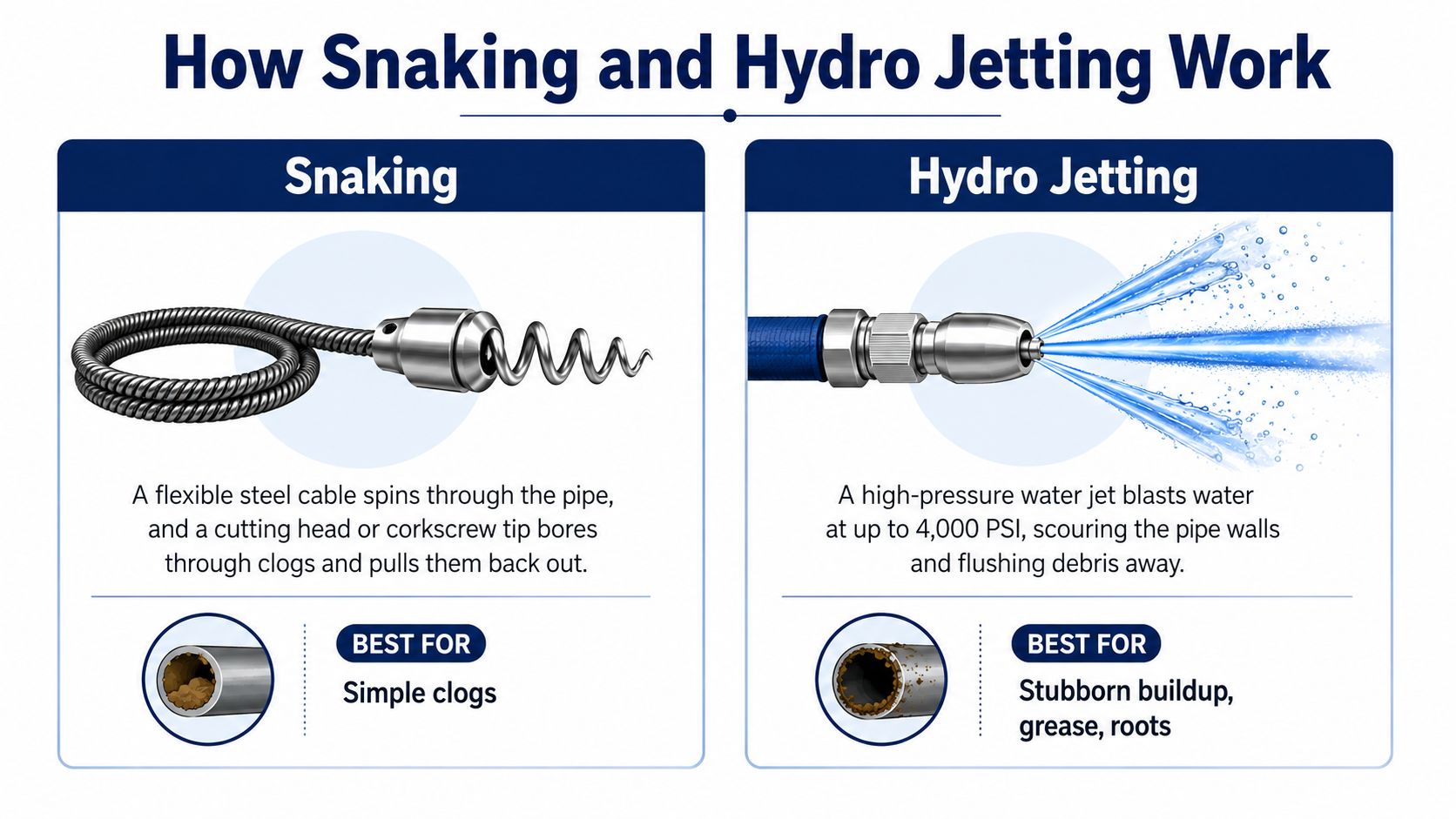
A plumbing snake is a flexible steel cable attached to a cutting head, corkscrew, or retrieval tip. The technician feeds the cable through an opening, rotates it as it reaches resistance, and uses the head to break through, catch, or pull back the obstruction.
The cable works at the point where its head makes contact. It may open a passage through hair, paper, food debris, or a compacted blockage, and the restored flow can be immediate. Its limitation is just as important: the cable usually doesn't scrub the entire circumference of the pipe wall, so grease, soap film, scale, and other residue can remain behind.
Hydro jetting uses a hose and a directional nozzle to send pressurized water through the line. The rear-facing jets help move the hose forward and scour the walls, while the forward spray helps open the route through the blockage. The EPA describes this high-velocity water approach as a method for removing debris and grease, clearing blockages, and cutting roots in smaller sewer pipes. This homeowner's hydro jetting guide explains the process in practical terms.
The pressure isn't one universal setting
Published maintenance guidance from the National Clay Pipe Institute lists allowable hydro-jet pressures that vary by pipe material, including 1,200 to 1,500 psi for some materials and up to 5,000 psi for vitrified clay pipe. NCPI maintenance guidance shows why a technician must match pressure and nozzle selection to the pipe, not turn equipment to its maximum.
Residential work generally uses equipment sized for smaller branch lines and sewer laterals. Commercial Los Angeles jobs may require larger tanks, pumps, hoses, and nozzles for longer or more heavily loaded lines. The central difference remains simple:
- Snaking punches through or retrieves a blockage.
- Hydro jetting scours and flushes material from the pipe walls.
That makes jetting a cleaning method, not merely a stronger version of a cable.
Head-to-Head Comparison of the Two Methods
In Los Angeles homes, the clog pattern and the pipe's condition determine the better tool. A snake often handles one localized obstruction efficiently. Jetting reaches farther and cleans more of the pipe interior, but it requires more setup, water handling, and confidence that the line can tolerate the work.
Hydro Jetting vs Snaking at a Glance
| Factor | Drain Snaking | Hydro Jetting |
|---|---|---|
| Best clog match | Hair, soap, paper, and one isolated obstruction | Grease, sludge, scale, recurring buildup, and small roots |
| Typical reach | About 50 to 100 feet, depending on equipment and access, as described in this industry comparison | About 300 to 500 or more feet with suitable equipment and access |
| Pipe-wall cleaning | Opens a path through the blockage and may retrieve material | Uses high-velocity water against the pipe walls to scour and flush buildup |
| Result pattern | Often shorter-lived when residue remains | Usually the longer-lasting option for buildup-driven clogs |
| Residential cost reference | Commonly $100 to $400 in broad industry pricing | Commonly $350 to $900 in broad industry pricing, as reported in this plumbing cost comparison |
| Typical service feel | Smaller setup and generally quicker for an accessible clog | Larger setup, more water handling, and more time on site |
| Pipe risk | Usually the gentler first option for questionable lines | Requires condition assessment because pressure can worsen existing damage |
| Primary objective | Restore flow quickly | Restore more of the pipe's internal capacity |
Reach depends on the equipment and the property. A cleanout's location, bends, pipe diameter, blockage severity, and machine selection can change the result. A long sewer lateral in an older bungalow does not present the same working conditions as a short, accessible branch line in a newer building.
Snaking is usually the practical first move for a single sink or tub obstruction. Jetting earns its cost when grease, scale, sludge, or repeated residue is restricting a larger section of pipe. It cleans the walls rather than creating only a narrow passage through the clog.
The honest comparison: Snaking is cheaper and targeted. Hydro jetting is more thorough and better suited to buildup. Neither method should be selected without identifying the clog and considering the pipe.
A plumber who recommends jetting for every slow bathroom sink is overselling the service. A plumber who keeps snaking a grease-heavy common line without discussing the remaining buildup is treating the symptom. In older Los Angeles housing, the method must fit both the material causing the blockage and the line carrying it.
Pipe Condition and the Safety Question
Hydro jetting should never be a blind test of whether an old pipe can survive pressure. In older Los Angeles housing, the pipe's material, age, and condition can matter more than the severity of the clog.
Original clay tile appears in older bungalow sewer systems, including pre-1960 construction. Mid-century properties may contain cast iron with internal corrosion, while some older hillside properties can have brittle Orangeburg. These materials don't all respond the same way to high-energy cleaning. PVC and ABS laterals in newer construction generally tolerate jetting well when their joints and surrounding sections are intact, but even modern plastic isn't a substitute for inspection when the line's history is unknown.
What the camera needs to reveal
A camera pass can identify conditions that change the recommendation:
- Offset joints: A section has shifted and may catch a cable or concentrate water force.
- Visible cracks: Pressurized water can worsen an existing opening.
- Severe wall thinning: A heavily deteriorated wall may not provide enough structural support.
- Root penetration: Roots at several points may indicate widespread joint or wall failure.
- Collapsed sections: Cleaning can't repair a section that has lost its shape.
These findings don't automatically mean jetting is impossible. They mean the technician needs to select pressure, nozzle, and method based on observed conditions. The National Clay Pipe Institute's maintenance information demonstrates that permissible jetting pressure varies by material, which is one reason a single maximum-pressure recommendation is unsafe.
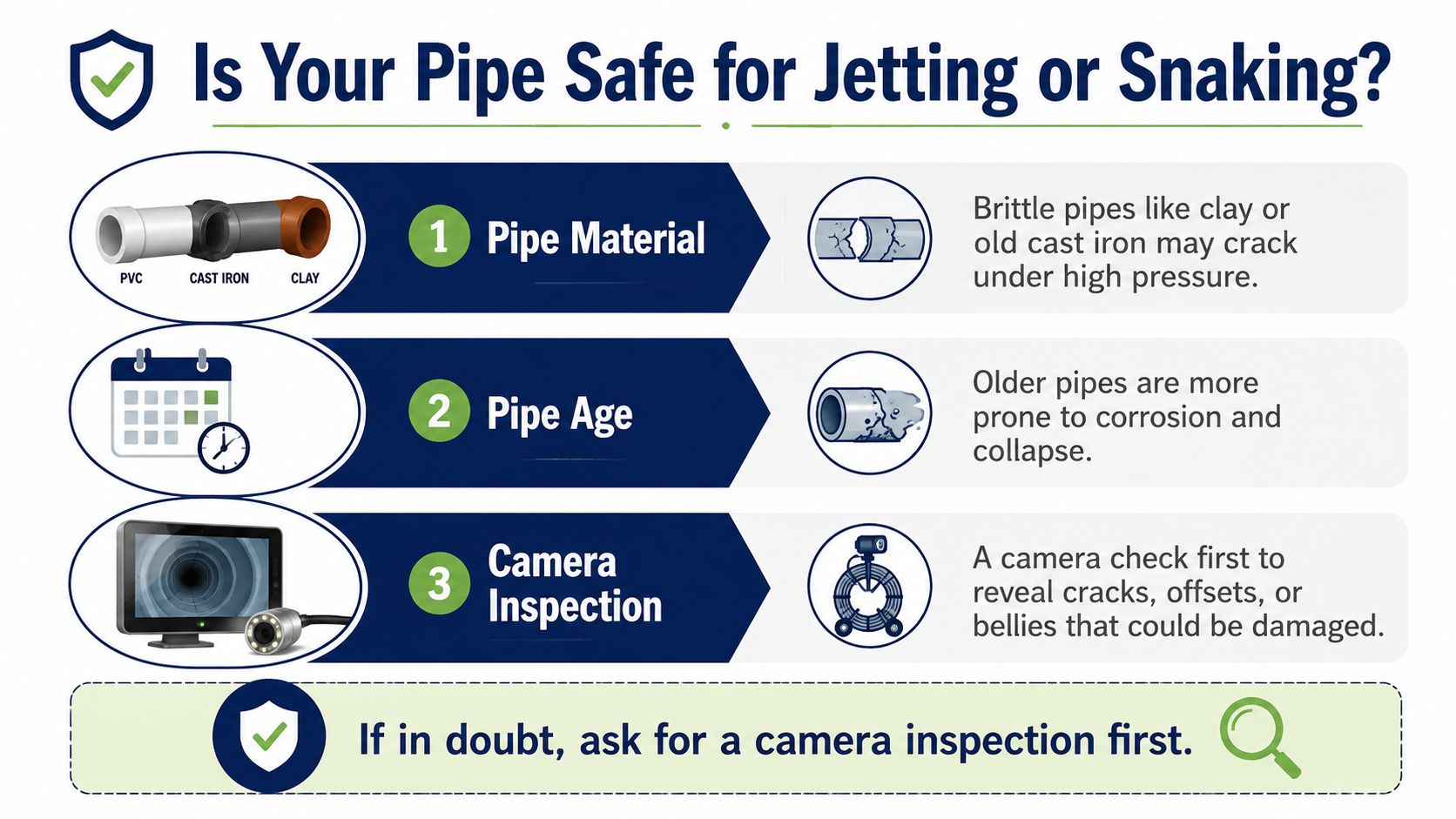
A reputable technician will often recommend a camera inspection before jetting when the property has old lines, repeated failures, unknown materials, or signs of a structural problem. Snaking is usually the safer default when pipe integrity is questionable because it provides mechanical clearing with less hydraulic force, and the cable can give the technician tactile feedback about resistance and fragility.
The camera also prevents the opposite mistake, refusing a useful cleaning solely because a building is old. Age raises the need for caution. It doesn't, by itself, determine the answer.
Matching the Method to the Clog Scenario
Most drain calls fit recognizable patterns. The useful question is not whether hydro jetting is stronger, but whether the blockage is local and simple or spread across the pipe interior.
Clog Scenario to Method Mapping
| Scenario | Recommended Method | Why |
|---|---|---|
| Single slow bathroom sink | Snaking | Hair and soap near one fixture usually call for a targeted mechanical clear |
| Recurring kitchen line with gurgling | Hydro jetting, after condition review | Grease film along the walls needs scouring, not merely a hole through the restriction |
| Restaurant grease trap and interior lines | Hydro jetting | High-use food-service lines need thorough removal of grease and debris |
| Root intrusion in a sewer lateral | Snake first, then controlled jetting when suitable | A root-cutting head can reopen flow, while water can flush loosened fragments if the pipe is sound |
| Slow branch serving multiple HOA units | Hydro jetting, after camera inspection | A longer branch may need internal cleaning across more than one fixture connection |
A bathroom sink that has slowed for the first time doesn't justify cleaning an entire sewer lateral. Remove the trap obstruction or use a small drum auger, then check whether the fixture drains normally. If the problem returns, investigate rather than escalating automatically.
Kitchen lines deserve a different response when the pattern includes recurring backups, gurgling, or greasy residue. In that setting, this guide to drain snaking helps distinguish a local mechanical clear from a line that needs deeper cleaning.
Commercial and multifamily decisions
Restaurant drains face repeated loading during service, so a cable may restore flow without removing the coating that causes the next restriction. Hydro jetting is generally the more appropriate cleaning approach for grease-heavy interior lines, provided the piping can safely receive it.
In an HOA or multifamily building, the affected fixture may not be the source. A slow branch or stack can create complaints in several units, and access may require coordination through a cleanout rather than a kitchen sink. A property manager should request the camera findings, the proposed access point, and a written explanation of whether the service is intended as emergency clearing or full line cleaning.
Root work often benefits from a sequence rather than a single tool. A spiral root saw can reopen the passage, but fragments may remain. If inspection confirms that the pipe is structurally suitable, controlled jetting can flush loosened material and clean the line.
Cost Over Time for Homes and Properties
The first invoice is only one part of the decision. A lower-cost snake can be the right response for a single, accessible blockage. It becomes a poor value when the same line needs repeated visits and continues to threaten kitchens, tenants, restaurant service, or finished interiors.
Residential snaking commonly costs $100 to $400, while hydro jetting commonly costs $350 to $900. These are comparison ranges, not Los Angeles quotes. Access, line size, emergency timing, inspection requirements, and pipe condition can change the estimate. In older Los Angeles housing, the material and age of the line deserve as much attention as the service price.
Count calls, not just the first visit
The longer-term pattern is usually clear:
- One isolated clog: A snake may be the lowest-cost complete response.
- Repeated calls on one line: Each temporary clearing adds labor, disruption, and another chance for a backup.
- Grease or scale visible on camera: Thorough cleaning may reduce repeat service by removing material around the blockage.
- Multifamily or commercial lines: Downtime and occupant complaints can cost more than the cleaning charge.
Hydro jetting may keep some lines clear for two to three years in suitable applications, while snaking may last only months if buildup remains. Neither interval is guaranteed. Drain use, grease disposal, roots, pipe slope, and structural defects can shorten the result. Jetting an older or damaged line to pursue a longer service interval can create a larger repair.
Property managers should include more than labor in the calculation. A backup can damage cabinets, flooring, walls, or stored property. Residents may lose access to kitchens or bathrooms, and a restaurant may interrupt service. Track the affected line, camera findings, method used, and how long the result lasted. That record shows whether the building needs routine cleaning, targeted clearing, or a pipe repair.
Professional sewer-line cleaning information can help property owners frame the decision around the line's condition and purpose rather than the cheapest initial intervention.
Review the plan after repeated failures. If one line has needed several snake services in a short period, ask whether grease, scale, roots, or a structural defect is turning each visit into a temporary purchase instead of addressing the cause. For sound piping, cleaning may improve the value of the work. For brittle, cracked, or badly misaligned piping, inspection findings should guide the next repair instead.
How to Choose and When to Call EZ Plumbing
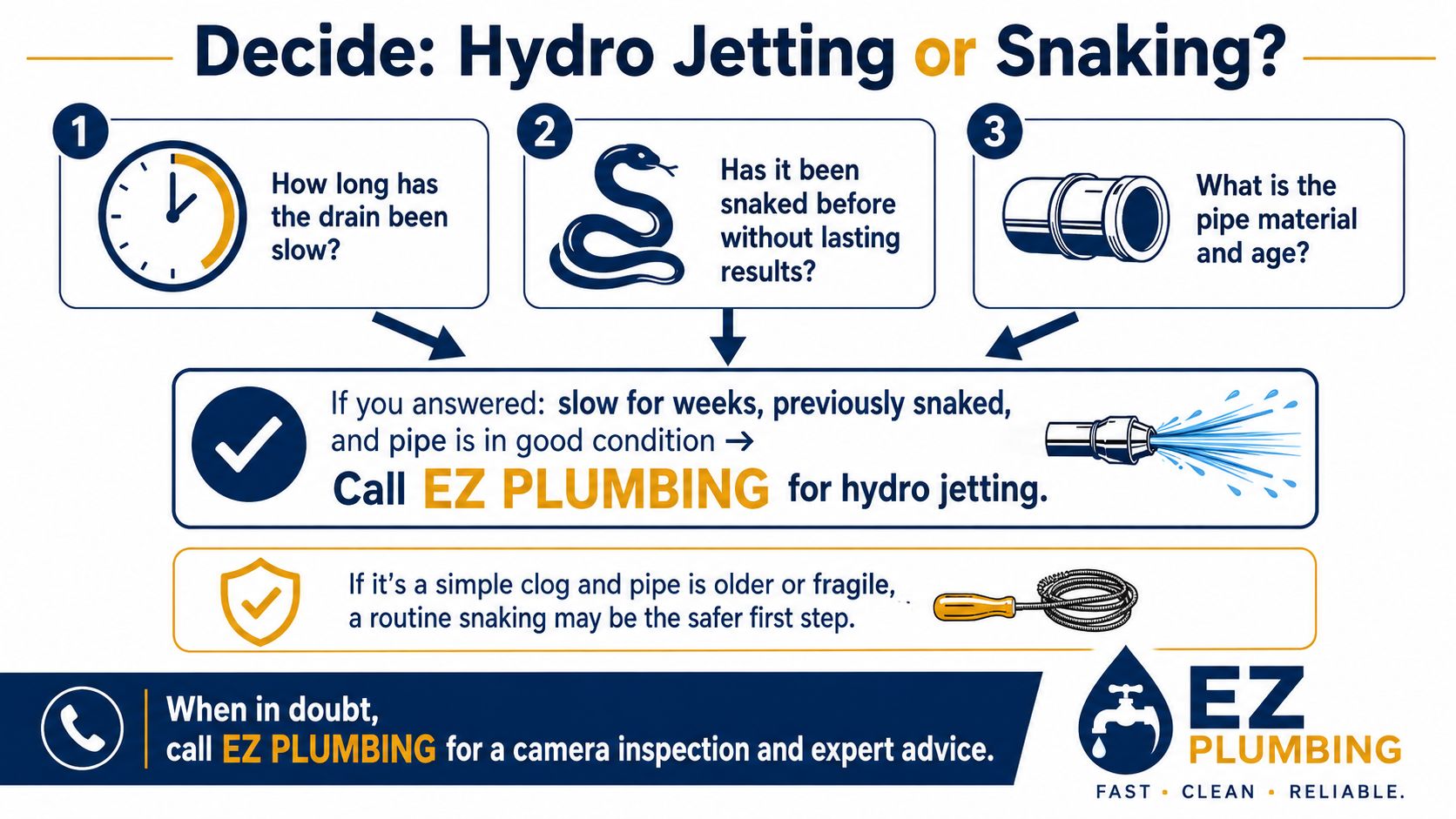
Start with three questions before approving any drain-cleaning method:
- How long has the drain been slow or backing up?
- Has someone snaked the same line before, and did the result last?
- What material and age are the pipes, and has anyone inspected them?
A new, isolated clog in an accessible trap usually points toward snaking. A line that has been slow for weeks, has failed after previous cable work, and shows grease, scale, or roots on camera is a stronger hydro jetting candidate. If the camera shows cracks, offsets, severe corrosion, or collapse, cleaning may not be the main repair.
Questions to ask before work begins
A qualified plumber should be able to answer these plainly:
- Inspection: Will you run a camera before jetting if the pipe condition is uncertain?
- Pressure: What pressure range and nozzle are appropriate for this material and line?
- Verification: Will you inspect the line after clearing or cleaning?
- Scope: Are you restoring flow only, or removing buildup from the pipe walls?
- Risk: What happens if the camera shows a compromised section?
- Quote: Can you provide the recommended method and price in writing before starting?
That conversation protects homeowners from unnecessary high-pressure work and protects property managers from paying for repeated temporary clears. It also creates a record for older buildings where future maintenance decisions depend on the same branch or lateral.
EZ Plumbing is one Los Angeles contractor that offers both drain snaking and hydro jetting, along with camera-based diagnosis. The useful part of that service model is the ability to match a targeted cable clear to a local obstruction or recommend higher-pressure cleaning when the line's condition and clog pattern support it.
For a fragile older line, the correct answer may be snaking now and repair planning later. For a sound pipe coated with recurring grease, jetting may address the problem more completely. The technician should be able to explain why the selected method fits the evidence.
If a Los Angeles drain keeps returning to the same failure, schedule a camera inspection and ask for a written recommendation on snaking versus hydro jetting before work begins. Contact EZ Plumbing for drain cleaning, sewer-line diagnosis, camera verification, and method-specific service for homes, HOAs, and commercial properties.