
Hot Water Heater Types: Find Your Home’s Best System
You usually don't start shopping for a water heater because it sounds fun. You start because the shower went cold, the garage floor is wet, a tenant called before sunrise, or the old unit is making popping noises that sound expensive. In Los Angeles, that decision gets more complicated than most online guides admit. A water heater that looks perfect on paper can turn into a bad fit once you factor in an older gas line, a tight garage, condo venting limits, or an electrical system that wasn't built for newer equipment.
That's why homeowners and property managers need more than a generic list of hot water heater types. You need to know what works effectively in LA housing stock, what creates expensive retrofit surprises, and what will still make sense years after installation. In many homes, the primary question isn't just tank versus tankless. It's whether the house can support the upgrade without added scope, and whether related work like an electrical panel upgrade may be part of the decision if you're moving toward a high-demand electric system.
Table of Contents
- Your Guide to Choosing a New Water Heater
- Understanding Water Heater Fundamentals
- Conventional Storage Tank Water Heaters
- On-Demand Tankless Water Heaters
- High-Efficiency Heat Pump Hybrid Heaters
- Choosing the Right Heater for Your Los Angeles Home
- Protecting Your Investment with Professional Service
Your Guide to Choosing a New Water Heater
Most replacements start the same way. The old unit gave plenty of warning, but nobody wanted to deal with it until there was no hot water left. Then the decision gets rushed, and rushed decisions usually favor whatever can be installed fastest, not what fits the property best.
That approach works sometimes. It also locks people into higher operating costs, poor hot water delivery, or upgrade work they didn't expect. In Los Angeles, I see this a lot in older single-family homes, small apartment buildings, and garages with just enough room for the old setup and not much else.
A good replacement decision starts with three practical questions:
- How does the household use hot water: One person with staggered use has different needs than a family running two showers and a dishwasher close together.
- What does the building support right now: Gas capacity, venting path, clearances, drainage, and electrical service matter as much as brand or brochure claims.
- What will cost less over time: Upfront price matters, but service access, maintenance, fuel type, and real-world performance matter too.
Practical rule: Buy for the property and the usage pattern, not for the sales pitch.
Some owners still need a straightforward replacement because the budget is tight or the unit has to go in today. Others should treat replacement as an upgrade opportunity. If your existing system struggles, takes too long to recover, or pushes utility costs higher than they should be, changing water heater type can solve more than one problem at once.
The right choice depends on the house, the occupants, and the installation conditions. That's where the major water heater types separate themselves.
Understanding Water Heater Fundamentals
A water heater can look fine on paper and still perform poorly in a Los Angeles home. I see that on replacement jobs all the time. The label says one thing, but the property has long pipe runs, multiple bathrooms, limited electrical capacity, or an old vent setup that changes what the unit can really deliver.
That is why the basic performance terms matter. They help you compare systems by hot water delivery, operating cost, and installation fit instead of by tank size alone.
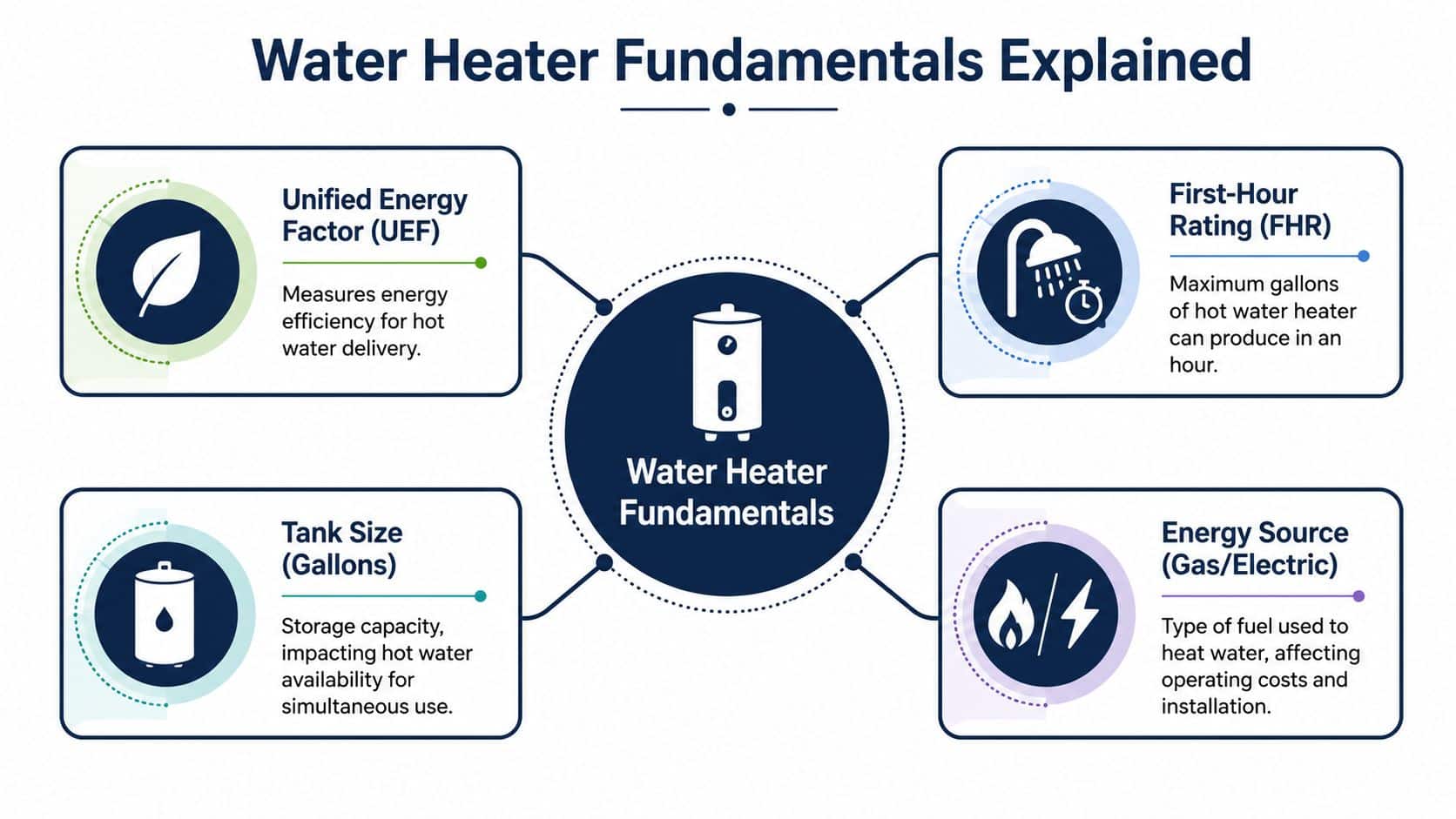
The numbers that matter
Unified Energy Factor, or UEF, is the efficiency rating homeowners should watch first. Higher UEF means more of the fuel or electricity goes into usable hot water instead of being lost during heating, storage, or cycling. That affects long-term utility cost, especially in properties with steady daily demand.
First-Hour Rating, or FHR, matters most for storage tanks and hybrid heat pump units. It measures how much hot water the heater can deliver during the busiest hour. In real terms, that is the number that tells you whether a household can handle back-to-back showers, laundry, and dishes without the second or third user getting lukewarm water.
Tank size only tells you how much water is stored. It does not tell you how fast the heater recovers after that stored hot water is used. A larger tank can help with short bursts of heavy demand, but recovery rate often decides whether the system keeps up.
Energy source shapes the whole project. Gas and electric heaters do not install the same way, and the differences matter in Los Angeles. Gas units raise questions about venting, combustion air, and gas line sizing. Electric models can trigger panel capacity issues, new circuit requirements, or a service upgrade. If you are comparing standard and gas water heater replacement options, those installation conditions can change the total price more than the heater itself.
Why sizing mistakes happen
A lot of owners replace by matching the old tank size and stop there. That works only if the occupancy, usage pattern, and building conditions are still the same. In Los Angeles, they often are not. A home that used to house one or two people may now have a larger family, an ADU, or tenants with heavier peak-time demand.
Standby loss is another part people overlook. Tank heaters keep reheating stored water as heat escapes through the tank and hot water piping. That is one reason two similar properties can have very different utility bills even if they use about the same amount of hot water.
Here is the short version:
| Term | What it tells you | Why it matters in real life |
|---|---|---|
| UEF | Overall efficiency | Affects monthly operating cost |
| FHR | Peak first-hour output | Affects shower and morning-use performance |
| Tank size | Stored hot water volume | Affects how long a heavy draw lasts |
| Energy source | Gas or electric | Affects retrofit scope, permitting, and service needs |
Size the heater for the current household and the property's limits, not just the label on the old unit.
Conventional Storage Tank Water Heaters
A lot of Los Angeles replacements start the same way. The old tank fails, water is on the floor, and the owner wants hot water back today without turning the job into a full remodel. In that situation, a conventional storage tank is often the fastest, least disruptive path.
That does not mean it is always the best long-term buy.
A storage water heater keeps a set volume of hot water ready in an insulated tank. That basic design is why these units remain common in older Los Angeles houses, small apartment buildings, and properties where the plumbing, venting, and service access were all built around a tank installation. Swap-in jobs are usually more predictable if the new unit matches the existing fuel type, venting method, and physical footprint.
For gas models, federal product criteria group storage units by tank volume, and the rules change at the 55-gallon mark. The same criteria also note that qualifying high-efficiency gas storage models can use condensing technology with very high efficiency ratings, including units at 0.97 UEF or higher in some categories, according to ENERGY STAR's residential water heater criteria. In practice, that threshold matters because a 50-gallon replacement and a larger high-output unit can lead to very different venting, condensate, and installation requirements.
That is the part many buyers miss. The cheaper tank on day one is not always the lower-cost decision over the life of the heater.
Where storage tanks still make sense
Standard tanks are often the right fit for Los Angeles properties that need a dependable replacement without opening up walls, resizing gas piping, or reworking the electrical system. They tend to fit best in situations like these:
- Straight replacement installations: Same location, same fuel, similar household demand.
- Budget-sensitive projects: Lower equipment cost can keep a rental turn or emergency replacement under control.
- Properties with predictable peak use: A correctly sized tank handles back-to-back showers and normal family demand well.
- Buildings with limited retrofit flexibility: Older homes and smaller multifamily properties often do better with equipment the existing layout can already support.
For owners comparing conventional gas models with upgraded options, it helps to look at how different gas water heater systems affect venting, recovery, maintenance, and operating cost before choosing on sticker price alone.
Real trade-offs Los Angeles owners should weigh
Storage tanks are simple, but they are not cheap to own if the fit is wrong.
First, they lose heat while sitting. That standby loss shows up month after month, especially in households with modest hot water use where the tank spends a lot of time reheating stored water instead of serving active demand.
Second, they take space. In Los Angeles, that matters more than national articles usually admit. A garage corner, exterior closet, or indoor utility space may already be tight because of laundry equipment, storage needs, or ADU work. A tank can limit layout options in a way a wall-mounted unit does not.
Third, failure is messier. When a tank leaks, it can damage drywall, flooring, and adjacent storage before anyone catches it. I see this most often in interior closet installations and older platforms where the drain setup was never ideal to begin with.
Installation realities that affect the true cost
On paper, a conventional tank looks simple. In the field, the job can still get expensive for reasons that have nothing to do with the tank itself.
Older Los Angeles homes often have tight access, outdated shutoff valves, marginal venting, or water pressure issues that should be corrected during replacement. Seismic strapping, drain pan configuration, expansion control, and code-compliant vent connections all need to be right. If they are not, the "basic" replacement stops being basic.
That is why storage tanks are best viewed as practical equipment, not default equipment. They work well when the property supports them, the tank is sized for actual use, and the owner understands the operating cost, space use, and leak risk that come with stored hot water.
On-Demand Tankless Water Heaters
A Los Angeles owner usually starts looking at tankless after a familiar problem. The household runs two showers, the dishwasher kicks on, and somebody ends up waiting for hot water. A tankless unit can solve the right problem, but it does not forgive a bad sizing decision or a rushed retrofit.
What tankless does well
A true tankless water heater has less than 2 gallons of storage capacity, and gas models typically operate with inputs between 50,000 and 200,000 BTU per hour, according to Energy Code Ace's residential water heating reference. In practical terms, these units heat water as it moves through the exchanger instead of keeping a full tank hot all day.
That setup offers three real advantages in Los Angeles homes and rental properties.
Space is the first one. A wall-mounted unit can free up floor area in a garage, side yard closet, or utility room where every inch matters.
The second is usage pattern. Tankless makes more sense in homes with irregular demand, guest occupancy, or long stretches with little hot water use.
The third is duration. If the unit is sized correctly, it can support long showers without the recovery limits that come with a storage tank.
For owners comparing real-world trade-offs, this review of tankless water heater pros and cons gives a useful side-by-side overview.
The sizing and retrofit issues owners miss
Tankless performance is measured in gallons per minute. That is the number that matters. A unit that looks adequate online can come up short fast if two bathrooms, a kitchen sink, and a laundry line are active at the same time.
Temperature rise matters too. The rated flow changes based on how much the unit has to heat the incoming water. That is why one property can do fine with a given model while another owner with the same model complains about weak hot water delivery during peak use.
In Los Angeles, the installation side is where budget surprises usually show up. Older homes in places like Highland Park, Mid-City, and parts of the Valley often need gas line upgrades, new vent routing, condensate handling for condensing models, electrical work for controls, or relocation to meet clearance requirements. In multifamily buildings, the path for venting can be the problem, not the heater itself.
I see another mistake all the time. Owners hear "endless hot water" and assume that means unlimited hot water at every fixture, all at once. Tankless does not work that way. It delivers continuous hot water within a fixed flow capacity, and that capacity has to match the property's peak demand.
A short walkthrough helps if you want to see the installed form factor and layout considerations:
Where tankless makes sense
Tankless is usually a strong fit when the owner wants to reclaim space, expects a long hold period, and is willing to pay more upfront to get the installation done correctly.
It is often a weaker fit in older properties with undersized gas piping, heavy simultaneous demand, or tight budgets that leave no room for venting and utility upgrades.
For Los Angeles homeowners and property managers, that is the key decision. Tankless can be an excellent long-term system, but only when the property conditions, fixture demand, and installation cost all line up.
High-Efficiency Heat Pump Hybrid Heaters
A lot of Los Angeles owners get interested in heat pump hybrids for one reason first. Electric bills. That makes sense, but the install location decides whether this type performs well or becomes an expensive disappointment.
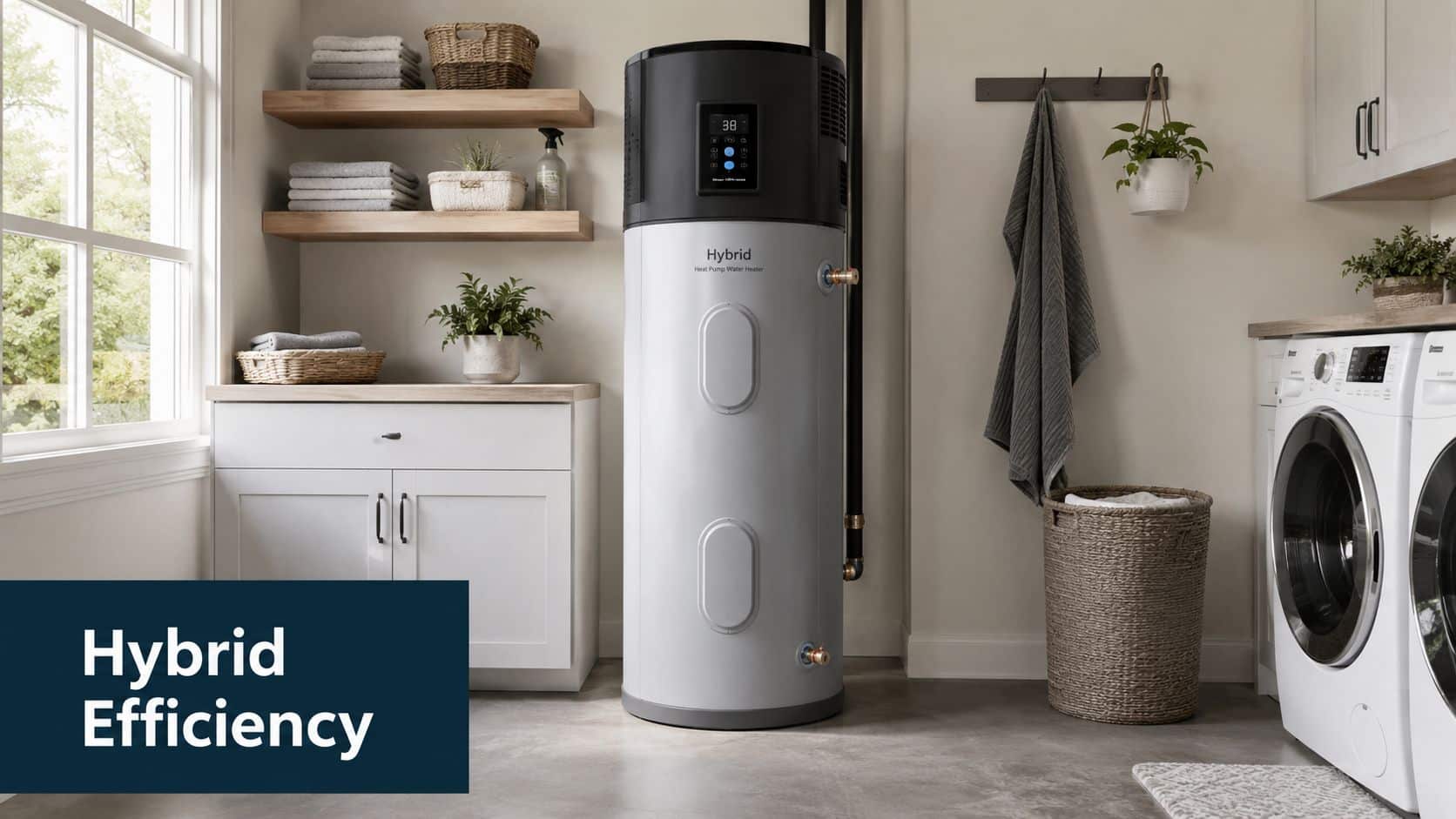
Heat pump water heaters move heat from the surrounding air into stored water instead of heating water with electric resistance alone. In plain terms, they use electricity more efficiently than a standard electric tank, which is why they are one of the strongest options for all-electric homes and owners planning to hold the property long enough to benefit from lower operating costs.
They are still tank water heaters, and that matters. You are buying stored capacity, recovery speed, and a mechanical system that depends on room conditions. That makes them a different decision from both a basic electric tank and a tankless unit.
Where they work well in Los Angeles
The best installations usually have enough air volume, enough physical clearance, and a location where the unit can pull heat without fighting the space around it. In Los Angeles, that often means a garage, a larger utility room, or another area that is not cramped, enclosed, or sensitive to sound.
Good candidates usually want one or more of these outcomes:
- Lower electric operating costs over time
- A tank-style supply instead of point-of-use flow limits
- An electrification-friendly replacement
- Better long-term economics than a standard electric resistance tank
For landlords and property managers, the appeal is straightforward. If the building is already electric or moving away from gas, a properly installed hybrid can lower ownership cost without changing the day-to-day user experience as much as a full system redesign.
The installation issues owners miss
Placement is the whole job with these units.
A heat pump hybrid cools and moves air while it runs. Put one in a small interior closet, a packed laundry alcove, or a location with poor airflow, and performance suffers. Put one near a bedroom wall or a quiet hallway, and noise complaints can become part of the ownership cost.
I also tell owners to pay attention to condensate drainage, service access, and the room's real operating conditions through the year. A garage in Los Angeles is often workable, but not every garage is a good mechanical space. Storage piled around the unit, tight clearances, or a location that traps cooler exhaust air can all reduce how well the heater recovers during heavier use.
Heat pump water heaters reward careful placement and expose lazy installation decisions fast.
That trade-off matters more in multifamily properties. The heater itself may pencil out, but the surrounding space may not. If the only available location is small, enclosed, or difficult to drain, the installation cost goes up and the efficiency advantage can narrow in real use.
The real ownership decision
Heat pump hybrids are usually a strong fit for Los Angeles owners who have the right location, expect to keep the property, and want to cut electric operating costs without giving up a storage tank format.
They are usually a weaker fit when the install space is tight, the property has heavy peak hot water demand, or the budget only covers the tank and not the surrounding electrical and mechanical work. In those cases, the cheaper bid can become the more expensive decision.
Choosing the Right Heater for Your Los Angeles Home
At 6 a.m., the wrong water heater choice shows up fast. A family in a Glendale bungalow gets through two showers and runs cold. A West Hollywood condo owner buys tankless for the space savings, then learns the electrical or gas upgrade blows up the budget. A fourplex owner in central Los Angeles replaces like-for-like to save money upfront, then keeps paying for the same recovery and operating cost problems for the next decade.
Los Angeles forces a more specific decision than most buying guides admit. Age of the building, panel capacity, gas line size, vent path, access, and how many people need hot water at the same time matter more here than generic national rankings.
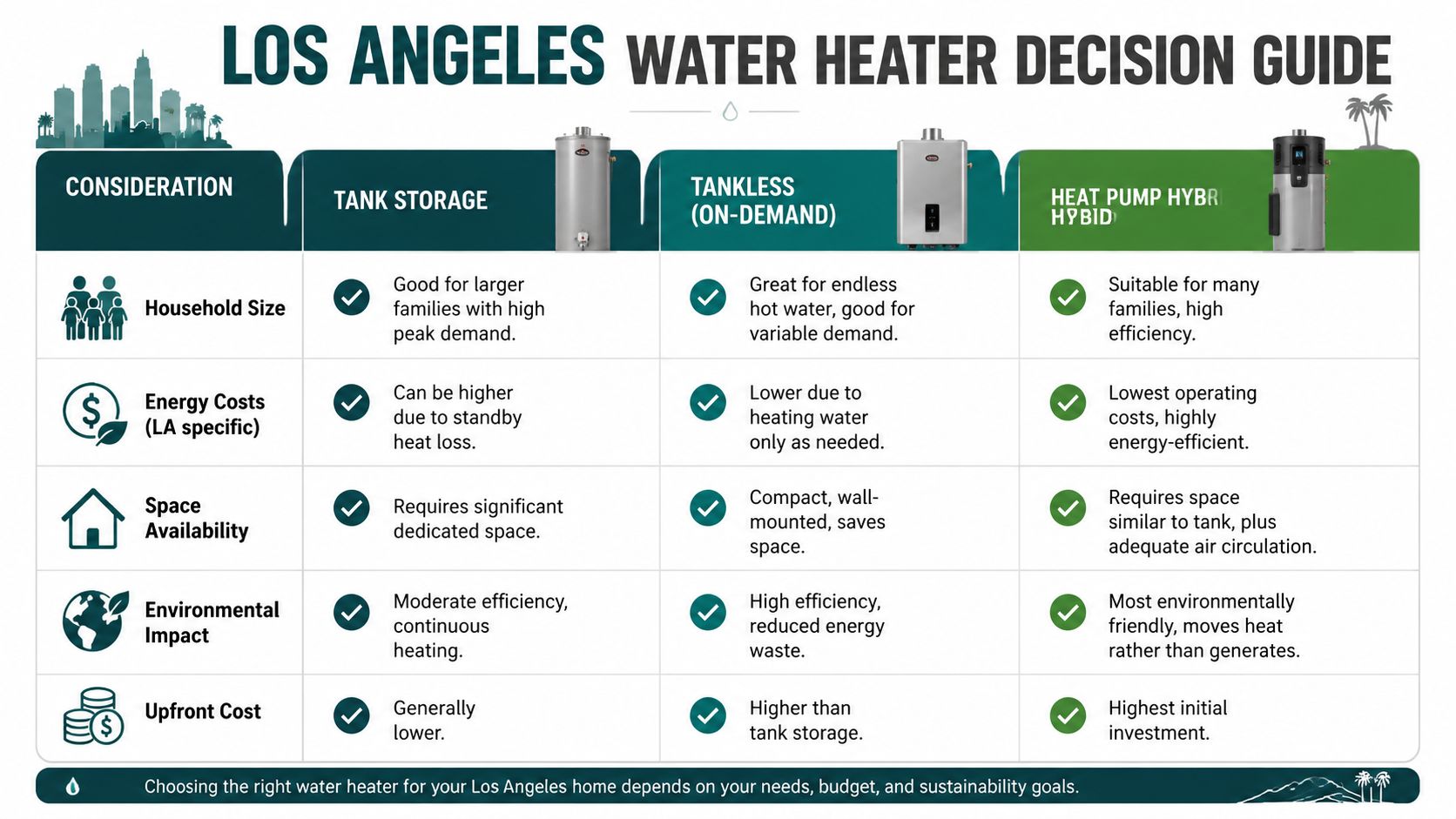
Best fit by property type
Here is the field version.
| Property situation | Usually the strongest fit | Main caution |
|---|---|---|
| Older home with simple existing setup | Storage tank | Cheapest install is not always cheapest to own |
| Home short on space | Tankless | Gas, venting, or electrical upgrades can change the whole job cost |
| Electrified home with good utility area | Heat pump hybrid | The room and drain setup have to support the unit |
| Multifamily retrofit | Depends on distribution layout | Centralized changes and tenant disruption can get expensive fast |
For a lot of single-family homes, the right choice starts with the underlying problem.
A standard tank usually makes the most sense when the priority is a fast replacement with fewer surprises behind the wall. In Los Angeles, that matters in older houses where the owner wants hot water restored quickly and does not want to open up venting, gas, or electrical work unless there is a clear payoff.
Tankless makes sense when space is tight or the household regularly pushes past the limits of a tank. The catch is retrofit cost. I see owners focus on the compact unit and miss the rest of the job. Gas line upsizing, category-specific venting, condensate handling on condensing models, and access for service are often what decide whether tankless is a smart investment or an expensive one.
Heat pump hybrids fit owners who plan to keep the property and want lower electric operating costs. In Los Angeles, they work best when the installation area already supports the unit without awkward carpentry, drainage improvisation, or clearance problems. If the space does not cooperate, the efficiency story gets weaker because the install cost rises before the heater even goes online.
Special cases worth considering
Solar water heating still comes up, especially with owners already investing in broader efficiency upgrades. It can lower utility costs, but it is rarely the simple answer people hope for. The upfront cost is high, the design has to suit the property, and a backup water-heating method is still part of the plan. For many Los Angeles properties, that makes solar a whole-house strategy decision, not just a water heater decision.
Condensing gas storage systems are another option that deserves more attention than it usually gets. They can be a good middle ground for gas households with heavier demand that want better efficiency without switching to tankless or going all-electric. They are more specialized than a basic tank, so parts availability, venting layout, and installer experience matter more.
Property managers should also look past equipment labels and think about service burden. A heater that saves money on paper can still be the wrong fit if it is hard to access, difficult to isolate in a tenant-occupied building, or likely to create longer downtime during repairs. That is part of total cost of ownership, same as fuel and power use.
A simple decision lens works well here:
- Choose tank if you want the lowest install complexity and a predictable replacement path.
- Choose tankless if space savings and long hot water draws matter enough to justify the retrofit work.
- Choose heat pump hybrid if the property supports the install and you plan to hold the building long enough to benefit from lower operating cost.
After installation, the long-term result usually comes down to upkeep. A basic water heater maintenance checklist for homeowners and property managers helps prevent the avoidable failures that make a good equipment choice look bad. And if the heater or piping sits in a garage or another exposed area, seasonal planning still matters in Southern California. This actionable guide for winter pipe protection is a useful reference for that.
Protecting Your Investment with Professional Service
A water heater doesn't fail only because it gets old. Many fail early because nobody maintained them, nobody checked warning signs, or the installation left little issues uncorrected. Sediment buildup, neglected valves, improper venting, bad expansion control, and ignored leaks all shorten service life.
That's why professional service matters after installation just as much as the initial equipment choice. A good installer doesn't just connect water and power. They verify the venting, combustion air, drainage, shutoffs, temperature settings, and service access so the next repair isn't a nightmare.
Maintenance that actually matters
Most owners don't need a complicated maintenance plan. They need a short list that gets done consistently.
- Flush sediment where applicable: Tank-style units collect mineral buildup over time. That affects performance and can create noise.
- Test the relief valve carefully: This is a safety component, not an afterthought.
- Inspect for corrosion or small leaks: Rust at fittings, moisture around the base, or staining on nearby materials should be checked early.
- Keep service space clear: Tankless and hybrid units especially need room for proper inspection and maintenance.
If your system sits in a garage or other exposed area, seasonal protection matters too. For broader cold-weather pipe planning, this actionable guide for winter pipe protection is worth reviewing, especially for vulnerable piping near exterior walls or drafty spaces.
Signs you should call before it fails
A few warning signs should never get ignored:
Rumbling, popping, inconsistent temperatures, rusty water, pilot issues, and minor seepage usually show up before total failure.
A licensed plumbing contractor can usually tell whether the fix is maintenance, component repair, or full replacement. For owners who want a straightforward checklist, this guide on how to maintain a water heater covers the basic service points that protect performance and help avoid preventable breakdowns.
For Los Angeles property managers and homeowners, one local option is EZ Plumbing, a licensed contractor that handles tank and tankless water heater service, repair, and installation. The important part is choosing a qualified plumber who understands local housing stock, code issues, and retrofit conditions well enough to spot problems before they turn into water damage or a bad investment.
If your current unit is leaking, undersized, inefficient, or at the end of its run, EZ Plumbing can inspect the setup, explain which water heater type fits the property, and handle the installation or repair with clear recommendations for Los Angeles homes, HOAs, and multifamily buildings.