
High Water Pressure in Your House: Signs, Causes and Fixes
Water pressure above 80 psi is too high for a home, and the usual fix is a pressure-reducing valve (PRV, also called a pressure regulator) set to roughly 50 to 60 psi. You can check your own pressure in about five minutes with a gauge on an outdoor hose bibb. If the number is high, or the regulator you already have has stopped doing its job, a licensed plumber can adjust or replace it, often in a single visit. Left alone, high pressure wears out faucets, toilet fill valves, supply lines and water heaters long before their time.
This guide explains what normal pressure looks like, how to recognize the warning signs, what causes the problem in Los Angeles homes, how long a regulator lasts, and when to call us.
TL;DR
- Normal household pressure is about 45 to 60 psi. Anything above 80 psi is too high and, under most plumbing codes, calls for a regulator.
- Banging pipes, whistling, leaking faucets, running toilets and a water heater relief valve that drips are the classic signs.
- Test with a pressure gauge on a hose bibb with every fixture and appliance off. Do not guess from how the shower feels.
- A PRV commonly lasts 10 to 15 years, though some fail much sooner. Older LA homes may not have one at all.
- Replacing or adjusting a PRV is a job for a licensed plumber, because the valve can change how your whole system handles thermal expansion.
Table of Contents
- What counts as high water pressure
- Signs of high water pressure in a house
- What damage high pressure does
- Why pressure runs high in Los Angeles homes
- How to test your water pressure
- What to do if pressure is too high
- How long does a PRV last
- Our perspective: why we test before we sell anything
- When to call a plumber
- Getting it fixed with EZ Plumbing
- Frequently asked questions
- Sources
What counts as high water pressure
The U.S. EPA’s WaterSense program says incoming residential service pressure should generally be 45 to 60 psi, and that most U.S. plumbing codes require a PRV when the supplied pressure exceeds 80 psi. Utilities describe the range in similar terms. The City of Green River, Wyoming, for example, says residential pressure typically runs 45 to 80 psi and that anything over 80 psi is too high.
That answers the question many homeowners type in: is 120 psi too high? Yes. So is 100 psi, and so is 140 psi. The EPA notes that pressure in supply mains can reach 100 psi or more, and the Department of Energy’s Pacific Northwest National Laboratory says some supply systems can exceed 200 psi. Without a working regulator, your pipes take whatever the street delivers.
| Pressure at the hose bibb | What it means |
|---|---|
| Below 40 psi | Low, and a different problem from the one in this guide |
| 45 to 60 psi | The range EPA WaterSense recommends |
| 60 to 80 psi | Acceptable under code, but harder on fixtures over time |
| Above 80 psi | Too high; a regulator is expected |
The 40 psi low threshold comes from the Green River guidance. The rest of the table follows the EPA and PNNL figures above.
Pressure and flow are not the same thing. Portland Water points out that clogged aerators or corroded pipes can reduce flow even when pressure is normal. If your problem is weak water rather than forceful water, our guide to fixing low water pressure in a house is the better place to start.
Signs of high water pressure in a house
High pressure rarely announces itself with a burst pipe on day one. It shows up as small, repeating annoyances, and each one is worth taking seriously. A city guideline from San Diego lists the symptoms of a damaged PRV that is letting pressure through: banging or high-pitched whistling when water is turned off, higher-than-expected flow at fixtures, and frequent toilet and faucet leaks. The utility in Cave Creek, Arizona, adds water discharging from the water heater relief valve and leakage from the PRV itself.
In practice, here is what we see in homes across Los Angeles:
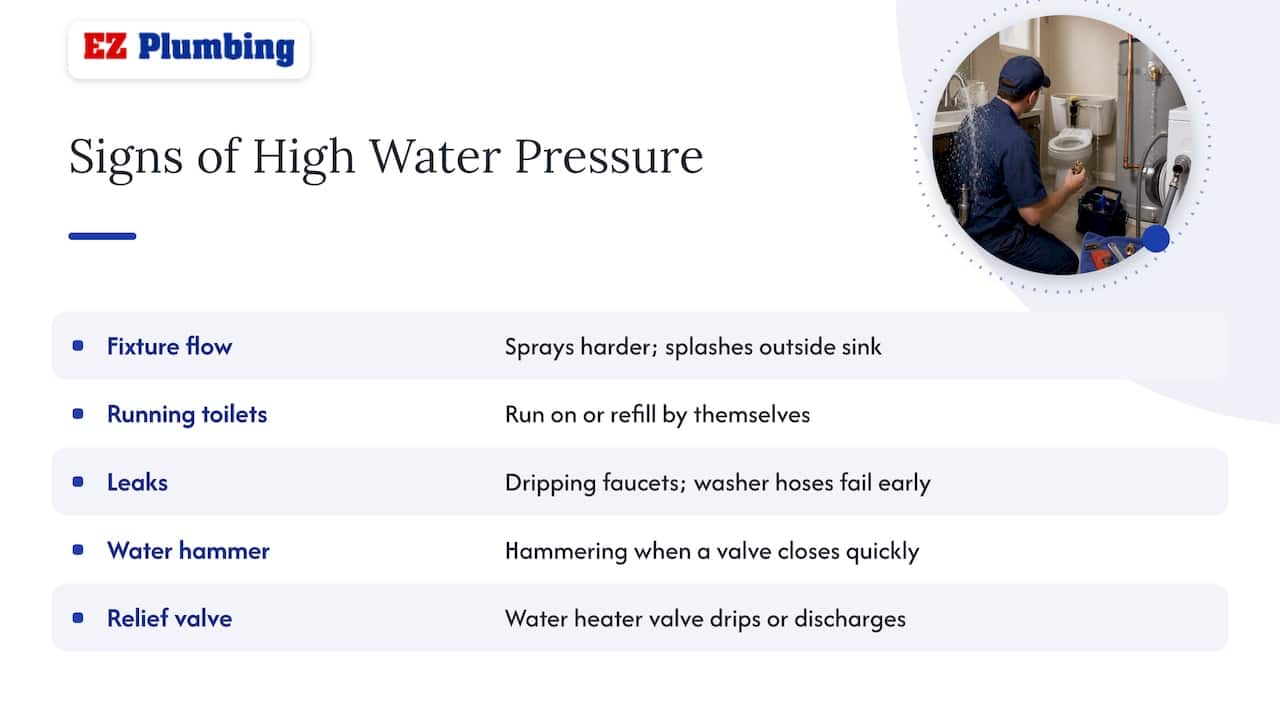
Faucets and showerheads that spray harder than they used to, or splash well outside the sink. A short burst of extra force when you first open a tap is a particularly common complaint.
Toilets that run on or refill by themselves. Fill valves have small seats that high pressure forces open or wears down.
Dripping faucets and washing machine hoses that fail early. Washer supply hoses are among the first parts to give up.
A hammering or thumping noise when a valve closes quickly. This is water hammer, and high pressure makes it worse. Our article on water hammer causes explains how to tell it apart from other pipe noise.
A water heater relief valve that drips or discharges. This can point to pressure creeping up in a closed system, and we cover it in our pressure relief valve guide.
None of these proves high pressure on its own. Together, or paired with a gauge reading over 80 psi, they make the case. For a broader checklist, see our warning signs of plumbing problems.
What damage high pressure does
The EPA says high pressure can damage piping, fixtures and appliances, increase water consumption, cause premature equipment failure and raise the risk of leaks, all stated in the WaterSense technical sheet. PNNL adds that holding service pressure at or below 60 psi reduces the likelihood of leaking faucets, ruptured pipes or hoses, and leaking water heaters.
The expensive failures tend to be hidden ones. A braided washer hose that bursts while you are at work, a supply line inside a wall, or a water heater that starts weeping at the tank seams can each put water into a house for hours. If the damage has already happened, an insurance claim may be in order, and a plumber’s written report on pressure and the failed part makes that conversation easier.
Older copper, galvanized and mixed-material systems are particularly vulnerable. Galvanized pipe that has corroded internally has thin spots, and constant high pressure finds them. That is one reason we often recommend a pressure check before anyone decides whether a home needs repiping.
Why pressure runs high in Los Angeles homes
The baseline cause is geography. Charlotte Water explains that household pressure is primarily set by the elevation of the storage tanks relative to your home. Portland’s utility says the same, and adds that water-main breaks and other distribution events can cause temporary pressure changes. Los Angeles is a city of hills and canyons, so a house at the bottom of a slope can sit far below the reservoir that feeds it and receive correspondingly high pressure.
LADWP says it can tell you the maximum and minimum pressure for any address it serves, because pressure is calculated from ground elevation at that location. The service is free and records of the quote are kept for the Department of Building and Safety. If you live in a low-lying part of a hillside neighborhood, that call is a useful first step.
The second cause is the equipment inside your property line. In Los Angeles, new residential plumbing requires a regulator wherever main pressure can exceed 80 psi, a requirement that comes from the Uniform Plumbing Code as adopted by LADBS. LADWP also notes that regulators are installed and maintained by the property owner, and that older homes may have none at all because they predate the current code. A lot of Los Angeles housing stock was built in exactly that window, so an unregulated 1940s or 1950s bungalow is a realistic scenario.
The third cause is a regulator that has worn out. Springs weaken, diaphragms harden and debris lodges in the seat, so the valve stops holding pressure back. Homeowners often notice it only when the shower suddenly feels different.
How to test your water pressure
You need a pressure gauge with a hose-thread fitting, which is inexpensive at any hardware store. The EPA’s guidance on testing is to attach the gauge to a hose bibb with all water-using fixtures turned off.
- Shut off every faucet, and make sure the dishwasher, washing machine and irrigation are not running. Ice makers count too.
- Screw the gauge onto the hose bibb closest to where the water line enters the house.
- Open the bibb fully and read the needle.
- Test again in the early morning and in the evening. Pressure can shift with daily and seasonal demand, which Portland’s utility notes in its troubleshooting guide.
Write down the readings. A number that stays near 55 psi is fine. A number that sits at 90 psi, or that swings from 60 to 100 psi through the day, tells a plumber exactly where to start. Elizabethton Utilities also recommends using this same gauge method to establish a baseline for an existing regulator.
What to do if pressure is too high
If you have no regulator, you need one installed. The EPA recommends placing it downstream of the water-source connection and setting it to limit pressure to 45 to 60 psi. LADWP says most regulators are adjustable and normally set between 50 and 70 psi.
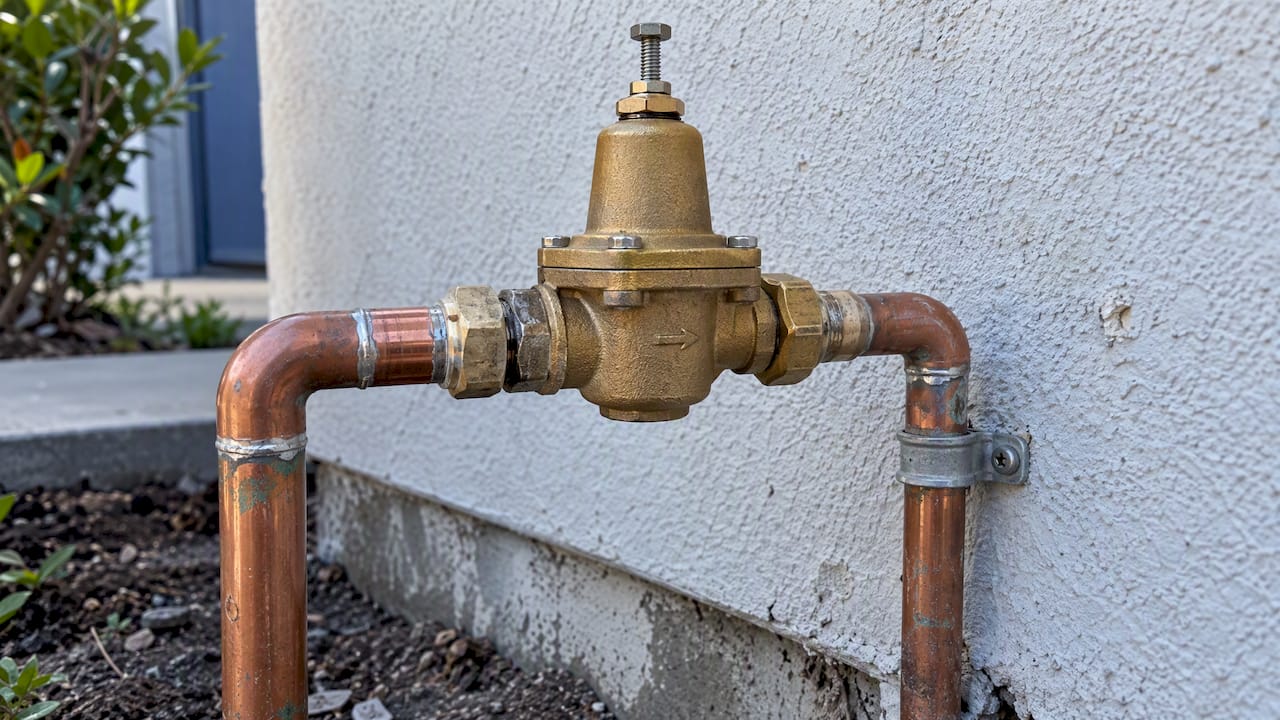
If you already have a regulator, check it first. It is typically a bell-shaped brass valve above ground near the point where the line enters the house. Cave Creek’s guidance says adjustment should follow the manufacturer’s instructions and describes the adjustment screw as generally raising pressure when turned clockwise and lowering it counterclockwise. If you turn it and the gauge does not move, or the pressure creeps back up, the valve is finished and should be replaced.
If pressure is high at the street and you are unsure about the cause, Portland’s utility advises reporting it to the water provider, which may test pressure at the meter. In Los Angeles, LADWP’s free pressure lookup does the equivalent job.
Thermal expansion after a PRV goes in
This is the detail many online guides skip. Installing a PRV can create a closed plumbing system, because water expanding as it heats in your tank has nowhere to go but into your pipes. The EPA cautions homeowners to consult local codes about addressing thermal expansion. In practice that usually means an expansion tank on the water heater. A plumber who skips it can leave you with a relief valve that drips every time the heater runs. If you see that, read our pressure relief valve guide or ask us to check the system.
How long does a PRV last
Sources differ a little, which is honest reflection of how much conditions matter. Elizabethton Utilities says a PRV most commonly lasts 10 to 15 years, though one may malfunction at three years or still work at 20 if maintained. Cave Creek says rebuilding or replacement commonly happens every 5 to 10 years, depending on environmental conditions, and that the manufacturer’s servicing instructions should govern.
Our practical reading: plan on a check every year and a replacement somewhere between year 10 and year 15, sooner if your water is hard or carries sediment. Elizabethton’s test is simple: restore the adjustment to its original setting, and if pressure does not return to its original reading, replace the valve.
Our perspective: why we test before we sell anything
We have been a family-owned Los Angeles plumbing company since 1989, and a surprising number of calls that begin as a leaking faucet, a noisy pipe or a dripping water heater turn out to be a pressure problem. Replacing the faucet fixes nothing if the next one will fail in two years for the same reason.
So our first step is a gauge reading, taken the way the EPA describes, with everything off. We write down the number, show it to you, and explain what it means for your particular house: its age, its pipe material, its location on the hill. Older Los Angeles homes with galvanized or mixed piping need a more careful hand than a 2010 build, and we know which eras tend to lack a regulator.
We also document the work for code compliance, including the expansion-tank question that follows a new PRV. You get the price in writing before we start, from real local staff, not a remote call center.
— EZ
When to call a plumber
Call a licensed plumber the same day if your gauge reads above 80 psi and you have visible leaks, if a relief valve is discharging, or if you hear sustained banging. Call within the week if you simply have a high reading and no symptoms. In both cases, shut off water at the main if anything is actively leaking.
Do not tighten the adjustment screw on an old regulator to chase a feeling. Pressure decisions affect your whole system, and a valve that has been over-adjusted for years often needs replacing anyway.
Getting it fixed with EZ Plumbing
We are a licensed plumbing company (C-36 License #583868), fully insured and familiar with Los Angeles code. We test pressure, adjust or replace regulators, check the water heater and expansion tank, and find the leaks and worn fixtures that high pressure has caused. Our residential plumbing team handles homes, and our commercial plumbing team works with property managers, HOAs and restaurants, where a pressure problem in one building can mean dozens of fixtures.
Our published hourly rates are $150 to $280 for residential work and $120 to $240 for commercial work, and our rate calculator shows how they apply. If water is already coming through a ceiling, call our 24/7 emergency plumbing line.
If the pressure problem has already damaged a pipe, our leak detection service finds hidden leaks without opening walls unnecessarily, and our water heater repair team checks tanks that have been stressed.
Frequently asked questions
What is normal house water pressure in psi?
About 45 to 60 psi is the range the EPA recommends for homes. Many utilities treat up to 80 psi as acceptable, and most plumbing codes require a regulator above that. In Los Angeles, regulators are normally set between 50 and 70 psi.
How long does a PRV last?
One utility puts the most common lifespan at 10 to 15 years, while another says rebuilds or replacement often come every 5 to 10 years. Water quality and conditions explain the gap. Check it annually with a gauge.
What are the symptoms of a bad pressure regulator?
The common ones are banging or whistling when water shuts off, unusually forceful flow, frequent toilet and faucet leaks, and a water heater relief valve that discharges. Leakage from the regulator body is another clear sign. A gauge reading above 80 psi confirms it.
Is 120 psi water pressure too high?
Yes. That is 40 psi above the 80 psi level where codes call for a regulator, and double the top of the EPA’s recommended range. At 120 psi, hoses, fill valves and water heater connections are at real risk, so have a plumber look at it soon.
Can I fix high water pressure myself?
You can test pressure with a gauge and, if you have a regulator, make a small adjustment following the manufacturer’s instructions. Installing or replacing a PRV is better left to a licensed plumber, since it affects thermal expansion and must meet local code.
Sources
- WaterSense Labeled Homes Technical Sheet: Service Water Pressure (EPA)
- Home Maintenance (EPA)
- Control High Water Pressure (City of Green River, WY)
- Service Water Pressure (Building America Solution Center, PNNL)
- Troubleshooting water pressure and flow (Portland Water Bureau)
- What Causes High Water Pressure and How Do I Fix It? (Charlotte Water)
- Residential PRV guidelines (City of San Diego)
- Pressure Reducing Valves Q&A (Cave Creek, AZ)
- Pressure Reducing Valve FAQ (Elizabethton Utilities)
- Water Pressure (LADWP)