
Examples of Plumbing Upgrades for Homes and Properties
When your plumbing is working against you, every month shows up on your water bill. Homeowners and property managers across Los Angeles face the same challenge: knowing which plumbing upgrades actually deliver results versus which ones just look good on paper. The right examples of plumbing upgrades give you a concrete starting point, something you can evaluate against your own property’s needs, your budget, and your long-term goals. This article breaks down the most practical upgrade options with enough detail to help you make a confident decision.
Table of Contents
- Key takeaways
- 1. How to evaluate plumbing upgrades before you spend a dollar
- 2. Water-efficient fixtures
- 3. Leak detection and flow monitoring systems
- 4. Tankless water heaters
- 5. Repiping with modern materials
- 6. Remodel-driven upgrades: curbless showers and freestanding tubs
- 7. Upgrade comparison: choosing the right fit for your property
- My take on prioritizing plumbing upgrades
- Let Ez-plumbing help you plan your next upgrade
- FAQ
Key takeaways
| Point | Details |
|---|---|
| Leak detection saves first | Fixing leaks before major upgrades protects your investment and reduces waste immediately. |
| Water-efficient fixtures pay back fast | WaterSense-certified toilets and faucets lower bills without sacrificing performance. |
| Tankless heaters cut energy costs | On-demand water heating eliminates standby energy loss common in tank-style heaters. |
| Remodel upgrades change function and form | Drain relocations and water line rerouting enable modern designs like curbless showers. |
| Phased upgrades fit any budget | Prioritizing by impact lets you spread costs without losing momentum on improvements. |
1. How to evaluate plumbing upgrades before you spend a dollar
Not every upgrade makes sense for every property. Before you commit to any plumbing renovation, you need a framework that filters your choices by what actually matters: water efficiency, energy savings, installation complexity, and return on investment.
Water and energy efficiency should be your first filter. Why upgrade your plumbing system? Because outdated fixtures and aging pipes waste thousands of gallons and inflate your utility bills every year. Low-flow fixtures certified by WaterSense reduce annual water use without sacrificing performance, connecting water savings to lower energy costs for water heating as well.
Installation complexity matters more than most homeowners expect. Some upgrades, like swapping out a faucet, take an hour. Others, like full repipes or drain relocations during a bathroom remodel, require permits, wall access, and licensed plumbing work. Knowing this upfront prevents budget surprises.
Long-term savings and property value should anchor your final decision. Cost-saving plumbing solutions often pay for themselves within two to four years, and they add measurable appeal to buyers and tenants who understand what efficient infrastructure means.
Pro Tip: Start with a plumbing audit before selecting any upgrade. A licensed plumber can identify hidden leaks, aging pipes, and underperforming fixtures in a single visit, giving you a prioritized list rather than a guessing game.
2. Water-efficient fixtures
Replacing outdated fixtures with WaterSense-certified models is one of the most accessible examples of plumbing upgrades available to any homeowner. The upfront cost is low, installation is straightforward, and the savings begin immediately.
WaterSense toilets use 1.28 gallons per flush, compared to older models at 1.6 gallons per flush or more. Across U.S. households, that difference saves over 260 billion gallons of water annually. For a single-family home in Los Angeles, this translates to a measurable reduction in monthly water costs.
Low-flow faucets and showerheads follow the same principle. WaterSense-labeled faucets use at least 20 percent less water than standard models while maintaining adequate pressure for everyday use. A family of four replacing bathroom faucets alone can save several thousand gallons per year.
Key considerations for water-efficient fixture upgrades:
- WaterSense certification confirms both efficiency and performance standards
- Aerators on existing faucets offer a low-cost interim option before full replacement
- Dual-flush toilets give users control over water use per flush
- Low-flow showerheads with pressure-compensating technology maintain a satisfying experience
- Fixture upgrades qualify for rebates through the Los Angeles Department of Water and Power
3. Leak detection and flow monitoring systems
Household leaks waste nearly 10,000 gallons of water per year on average. That water is gone before you even know it is leaving your pipes. Smart leak detection and flow monitoring devices address this problem at the source by alerting you to abnormal water use in real time.
Modern leak detection systems install at the main water line and track flow patterns continuously. When usage deviates from your baseline, such as a toilet running overnight or a slow drip behind a wall, the system sends an alert to your phone. Some models can automatically shut off the water supply to prevent damage.
For property managers, the financial case is even more striking. A 30-unit building reduced water costs from $56,000 to $16,000 annually after fixing leaking toilets, a savings of nearly $40,000 per year. Leaks accounted for 41 percent of total water consumption in that building.
Whole-home leak detection devices pair well with timely leak repairs to create a complete defense against water waste and property damage. For Los Angeles properties specifically, where water rates are among the highest in the country, this upgrade often delivers the fastest payback of any option on this list.
4. Tankless water heaters
Conventional water heaters maintain a tank of hot water around the clock, burning energy whether you need hot water or not. Tankless water heaters eliminate that standby energy loss by heating water on demand, only when you open a tap or run an appliance.
The efficiency advantage is genuine. Tankless units also eliminate the risk of tank failure flooding your utility closet, a real concern with older tank-style units that corrode from the inside out. Units are wall-mounted, freeing up floor space that traditional 50-gallon tanks require.
For homeowners, a gas-powered tankless unit provides continuous hot water supply regardless of simultaneous demand from showers, dishwashers, and washing machines. For property managers overseeing multi-unit buildings, individual tankless units per unit eliminate the shared hot water shortages that generate tenant complaints.
Tankless water heaters require professional installation to optimize energy efficiency and system longevity. Gas line sizing, venting configuration, and water pressure requirements all affect performance. Cutting corners on installation reduces both lifespan and efficiency gains.
5. Repiping with modern materials
If your home was built before 1980, there is a reasonable chance the supply lines are galvanized steel. Galvanized corrosion is a gradual process, but it produces rust-colored water, reduced pressure, and eventually pinhole leaks that cause serious damage before they become visible.
Modern pipe materials like PEX and copper solve these problems at the system level rather than the symptom level. PEX is flexible, freeze-resistant, and easier to route through existing wall cavities than rigid copper, which makes it well-suited for retrofit repiping in occupied homes. Copper remains the gold standard for long-term durability, with a lifespan that exceeds 50 years in most applications.
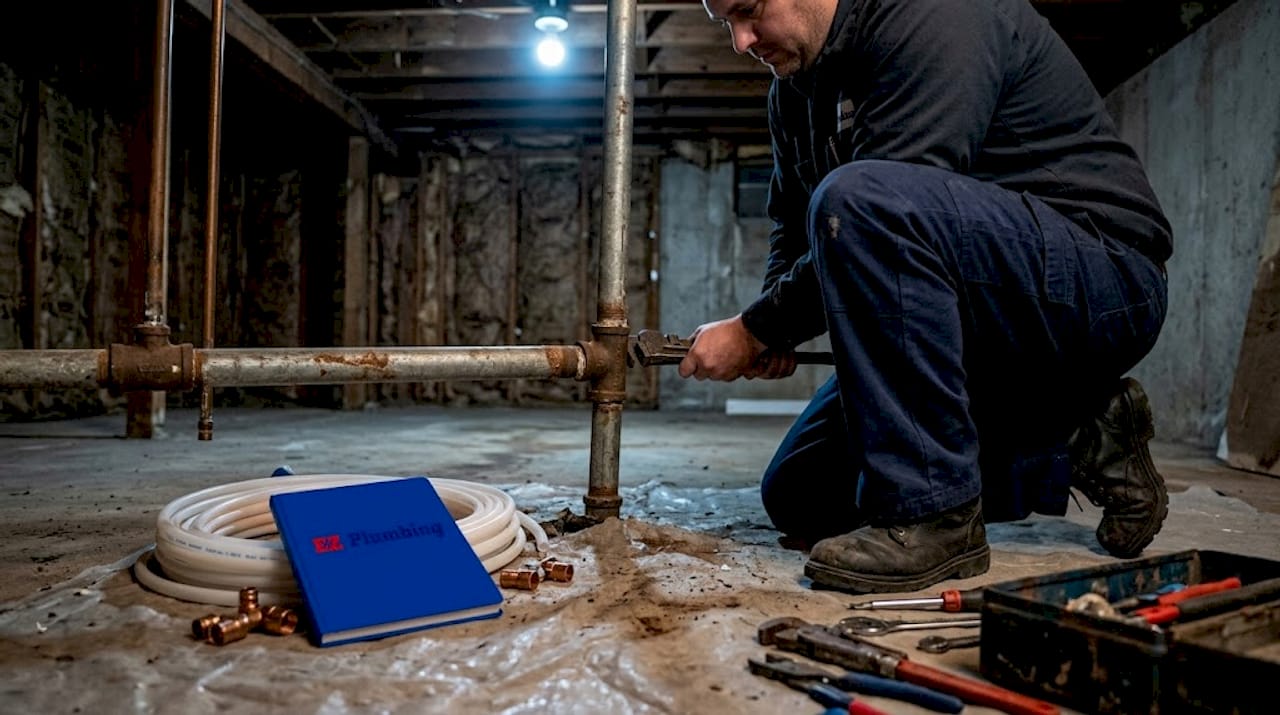
Repiping is a significant project, but it is one that pays off across every dimension: water quality improves, pressure stabilizes, and the risk of sudden leak damage drops substantially. Buyers and appraisers recognize repipe work as a meaningful property improvement, particularly in older Los Angeles neighborhoods where galvanized and polybutylene pipes are still common.
6. Remodel-driven upgrades: curbless showers and freestanding tubs
Bathroom renovations create the opportunity to rethink your plumbing layout entirely. Two of the most requested modern designs, curbless showers and freestanding tubs, require specific plumbing changes that go well beyond a fixture swap.
Curbless shower drains
A curbless shower eliminates the step-over threshold, making it both more accessible and more visually open. Achieving this design requires relocating the shower drain, often by 25 to 30 inches from its original position, and rerouting supply lines to accommodate the new layout. Drain relocations in bathroom remodels often move shower drains approximately 30 inches and tub drains approximately 32 inches to enable these modern barrier-free configurations.
The subfloor must also slope correctly toward the new drain location, typically one quarter inch per foot, to prevent standing water. Continuous waterproofing across the pan and up the walls is non-negotiable. These are technical requirements, not optional finishing touches, and they require a licensed plumber working alongside the tile contractor.
Freestanding tubs and wall-mounted fixtures
Freestanding tubs create a clean, sculptural look but require supply lines to rise directly from the floor rather than from the wall. This means floor-penetrating connections with proper waterproofing at each penetration point. Wall-mounted faucets and toilets present a different challenge: all connections are embedded in the wall, requiring precise valve placement before the drywall closes.
For homeowners planning a full bathroom renovation, working with both a designer and a licensed plumber from the beginning prevents costly rework. The role of plumbers in Los Angeles renovations includes roughing in supply and drain lines to exact design specifications before any tile or fixtures are installed.
7. Upgrade comparison: choosing the right fit for your property
The table below summarizes the most common plumbing upgrade ideas across four criteria to help you compare options side by side.
| Upgrade | Water savings | Upfront cost | Installation complexity | Best for |
|---|---|---|---|---|
| WaterSense fixtures | High | Low | Low | Homeowners, all properties |
| Leak detection systems | Very high | Medium | Low to medium | Property managers, older homes |
| Tankless water heater | Medium (energy) | Medium to high | High | Single-family homes, multi-unit |
| Repiping (PEX or copper) | Medium | High | High | Pre-1980 homes, galvanized pipes |
| Curbless shower remodel | Low (direct) | High | High | Renovation projects |
| Low-flow faucet aerators | Medium | Very low | Very low | Budget-conscious upgrades |
Property managers should weight leak detection and fixture upgrades heavily. These produce the most measurable ROI per dollar spent across multiple units, especially when paired with sub-metering to track usage per tenant. Single-family homeowners often find the most satisfaction in tankless water heaters and WaterSense fixtures because the daily experience improvement is immediate and tangible.
Pro Tip: Combining a tankless water heater installation with WaterSense fixture upgrades in the same project often qualifies for bundled rebates through local utility programs, reducing the net cost of both upgrades simultaneously.
My take on prioritizing plumbing upgrades
I have worked with homeowners who come in ready to spend $10,000 on a bathroom renovation without realizing they have a slow toilet leak costing them $40 a month. My honest advice: address leak detection first, every time. It costs less, pays back faster, and gives you accurate data on your actual water consumption before you make any larger decisions.
What I have also learned from years of working with property managers is that aesthetics and function are not competing priorities. They are sequenced ones. Get the infrastructure right first, then make it beautiful. A freestanding tub sitting above a poorly waterproofed drain connection is a liability, not a feature.
If you are managing a renovation budget that cannot cover everything at once, a phased approach works. Start with leak detection and fixture upgrades in year one, move to a tankless water heater in year two, and address a full repipe or remodel when your budget allows. Each phase builds on the last, and none of them becomes wasted work.
— EZ
Let Ez-plumbing help you plan your next upgrade
When you are ready to move from researching to doing, the quality of your installation matters as much as the quality of the product you choose. Ez-plumbing serves homeowners and property managers throughout greater Los Angeles with licensed, code-compliant plumbing work on every project we take on.
Our team handles tankless water heater installation and replacement with proper gas line sizing, venting, and pressure configuration to maximize efficiency from day one. We also provide professional leak detection services using acoustic and thermal technology to locate hidden leaks without unnecessary demolition. For full water heater replacements, our water heater installation services cover both tank and tankless systems across residential and commercial properties. Call Ez-plumbing to schedule a consultation and get a clear picture of what your property needs before you invest.
FAQ
What are the best plumbing upgrades for saving money?
Leak detection systems and WaterSense-certified fixtures consistently deliver the fastest financial return. Household leaks alone waste nearly 10,000 gallons of water per year, making early leak detection one of the highest-value upgrades available.
How much does a tankless water heater save?
Tankless water heaters eliminate standby energy loss by heating water only on demand, which reduces energy consumption compared to conventional tank heaters. Savings vary by household size and usage patterns, but most homeowners see meaningful reductions in their monthly energy bills.
What plumbing work is required for a curbless shower?
Curbless showers require drain relocation, correct subfloor slope toward the new drain position, and continuous waterproofing across the shower pan and walls. These are licensed plumbing tasks that must be completed before any tile installation begins.
Why should property managers prioritize plumbing upgrades?
Property managers fixing leaks in a 30-unit building reduced water costs by nearly $40,000 annually. Upgrades that reduce invisible water waste across multiple units produce compounding savings and reduce tenant complaints about water quality and availability.
When should I repipe instead of repair?
If your home has galvanized steel pipes showing rust-colored water, frequent pinhole leaks, or consistently low pressure, a full repipe is more cost-effective than repeated patch repairs. Modern PEX and copper materials extend system lifespan well beyond 50 years.