
Emergency Water Leak Repair: Los Angeles First Steps
It's 2 a.m., your feet hit a wet floor, and you hear water before you fully wake up. In Los Angeles, that can mean a burst braided supply line in a second-floor bath, a slab leak surfacing along a baseboard, or a riser issue in a fourplex that's already dripping into the unit below. The first few minutes decide whether this stays a plumbing repair or turns into flooring, drywall, cabinet, and insurance work.
Emergency water leak repair isn't one playbook for every house. An older bungalow in Echo Park, a slab-on-grade ranch in the Valley, and a hillside home in Mount Washington all force different choices. The key is knowing which shutoff to hit, what's safe to touch, and what temporary move can buy you time without making the damage worse.
Table of Contents
- What an LA Leak Emergency Looks Like in the First 60 Seconds
- Immediate Safety Steps Before You Touch a Valve
- Finding the Right Shutoff Valve for Your LA Home
- Temporary Fixes You Can Safely Try Right Now
- Documenting Damage for Insurance Before the Plumber Arrives
- Calling a 24/7 Plumber What to Expect
- Stopping the Next Emergency Before It Starts
What an LA Leak Emergency Looks Like in the First 60 Seconds
A real leak emergency usually announces itself fast. You hear a sharp hiss, not an occasional drip. You feel spray on your legs before you find the source. In a two-story house, the water may already be running through the subfloor and staining the ceiling below by the time you turn on the bathroom light.
In Los Angeles, one of the most common midnight calls starts with a failed braided supply line under a vanity or behind a toilet. In a 1920s house with old hardwood and patched plumbing, that pressurized line can throw water across the room, under the door, and toward an outlet in less time than it takes to find a towel.
What to notice before you do anything
The first minute is triage. Three questions matter:
- Where is it coming from. Under a sink, behind a toilet, from a wall, from the ceiling, or through flooring at a baseboard.
- Where is it going. Toward stairs, through a kitchen ceiling, under cabinets, into a neighbor's unit, or toward electrical.
- What is it touching. Outlets, appliances, pilot-lit equipment, finished wood, laminate edges, or drywall seams.
That sounds simple, but panic makes people skip the obvious. They grab a wrench before they know whether the leak is at the fixture stop, the house main, or the meter.
Practical rule: In the first 60 seconds, don't try to repair anything. Confirm the leak, locate the nearest shutoff, and move people out of the spray path.
LA housing stock changes how leaks show up. In slab homes in the Valley or parts of the South Bay, a pressure-side leak may not flood the room at all. You may see water curling out from under baseboard, feel a warm patch on tile, or hear water moving with every fixture off. In multi-unit buildings, what looks like “my ceiling is leaking” may be the upstairs unit's failed angle stop or supply line.
When this is already bigger than one fixture
If the leak is active and you can't tell whether it's confined to one fixture, assume it's bigger until proven otherwise. Multi-unit owners and tenants should think vertically. Water often travels farther than the failed part itself.
If you need a quick way to compare local emergency plumbing service providers, use that while someone else starts locating valves. And if you suspect hidden flow, it helps to know how to read a water meter for leaks before the situation settles into a slow, expensive mystery.
Immediate Safety Steps Before You Touch a Valve
People get hurt in water emergencies when they focus on plumbing first and hazards second. A supply line leak is usually clean water. That doesn't make the room safe.
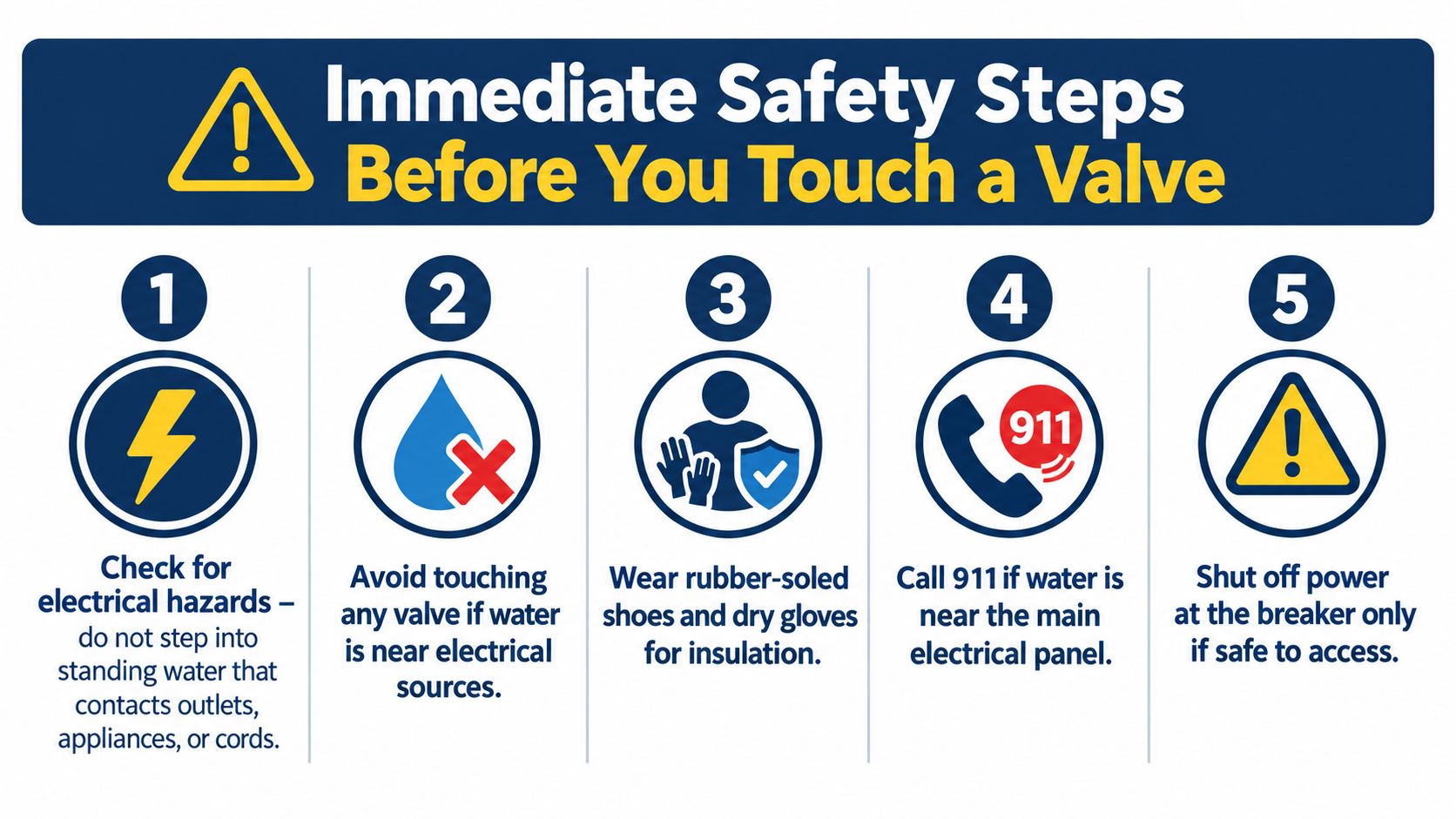
Start with electricity
If water is contacting an outlet, extension cord, appliance, or the base of the electrical panel, don't step into it. Don't reach through it to close an angle stop. Don't kneel in it to save a cabinet.
Use this order:
- Stop moving toward the source if water is near anything energized.
- Warn everyone nearby so nobody walks into the area barefoot.
- Shut power at the main only if the path is dry and safe to reach.
- Leave the structure and call 911 if water is rising near the panel or you smell burning.
Then check footing and overhead materials
A lot of indoor falls happen after the leak starts, not when it starts. Wet tile gets slick immediately. Swollen hardwood lifts at edges. On stair landings, a thin sheet of water is enough to put someone down hard.
Look up, too. Saturated drywall ceilings can sag and let go. If a bulge forms overhead, keep people out from under it.
Don't stand under a leaking ceiling and start poking holes unless you know the water is clear, the area is electrically safe, and the ceiling isn't carrying a fixture or fan box.
Gas and contamination change the response
Water around a gas water heater, floor furnace, or rangetop matters because spray can affect ignition and nearby controls. If the leak involves a drain backup or sewage line, that is not the same as a clean supply leak. Treat black or gray wastewater as contamination, not a simple wet-floor cleanup.
Use a plain rule of thumb:
- Clean supply leak. Usually a plumbing and drying problem.
- Drain or sewer backup. A contamination problem first, plumbing problem second.
- Electrical or gas hazard present. A life-safety problem first.
If water is still rising, electrical is threatened, or gas equipment is involved, get out and call emergency services before you call a plumber.
Finding the Right Shutoff Valve for Your LA Home
The fastest way to limit damage is hitting the smallest shutoff that stops the leak. In Los Angeles homes, that usually means working through a three-tier hierarchy instead of sprinting straight to the curb.
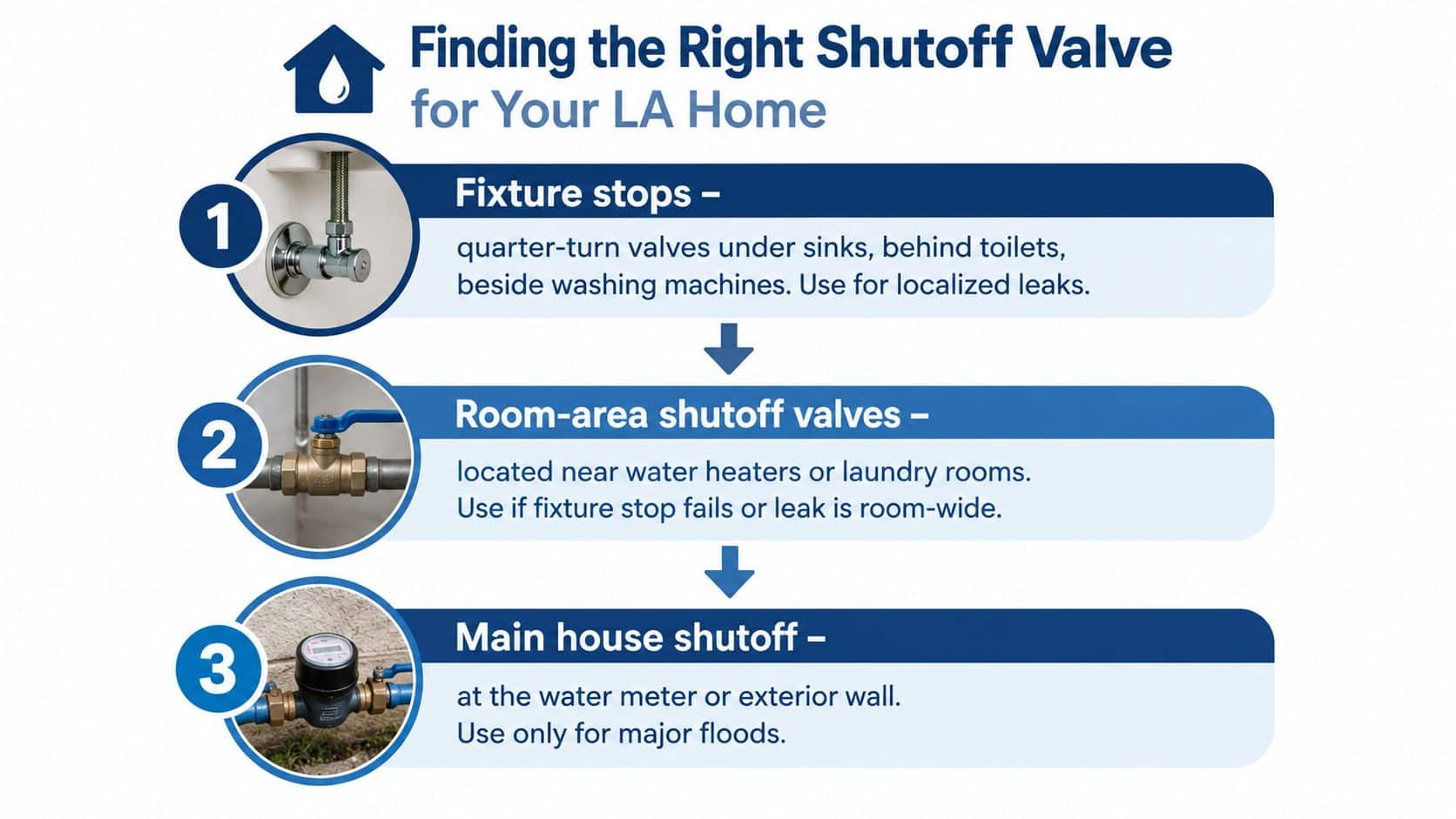
Tier one fixture stops
These are the valves under sinks, behind toilets, and at washing machine boxes. If a braided connector, faucet supply, toilet fill valve, or lavatory stop is the problem, this is your best-case scenario.
Turn a quarter-turn stop so the handle goes perpendicular to the pipe. If it's an older multi-turn angle stop, turn it clockwise gently. Don't force a seized valve hard enough to snap it. On older LA properties, especially where paint, corrosion, and years of mineral buildup are involved, that happens more than homeowners expect.
Keep an angle-stop tool or compact adjustable wrench where you can reach it in the dark.
Tier two house main
This shuts off water to the building without going to the street. In many LA homes it's on an exterior wall facing the street, in the garage, beside the water heater, or in a utility closet. In hillside homes, it may sit behind a painted metal panel or in a cramped side yard that nobody has opened in years.
Use the house main when:
- The fixture stop won't close
- The leak is inside a wall
- More than one fixture line is involved
- You can't safely identify a single source
Some slab-on-grade homes don't have a convenient interior main that homeowners can reach quickly. That's why people end up at the meter even for what started as an interior leak.
For a quick visual reference on common valve types, this water shut off valve guide helps homeowners identify what they're looking at before they start turning things.
Tier three meter shutoff
This is the curbside or property-line stop that kills water to the whole property. If the house main is inaccessible, frozen in place, missing, or not shutting the leak down, go to the meter.
In practice, a lot of Valley slab homes and some older rentals push you straight here. Use a meter key if you have one. If not, an adjustable wrench may work depending on the setup. Turn carefully. Don't reef on old hardware.
The right shutoff is the one that stops the leak with the least collateral disruption. If a sink stop works, use it. If the leak is hidden or pressurized and moving fast, skip straight to the house main or meter.
Household leaks in the United States waste nearly 1 trillion gallons of water each year, common household leaks can waste enough water to supply about 11 million homes, the average household leaks almost 10,000 gallons annually, and 10% of homes leak more than 90 gallons per day according to water damage statistics compiled by iPropertyManagement. When a line is actively spraying, delay adds up fast.
Temporary Fixes You Can Safely Try Right Now
Once the water is off and the line is depressurized, a temporary fix can buy you a few hours or overnight stability. It can't replace proper repair, but it can stop a bad night from getting worse.
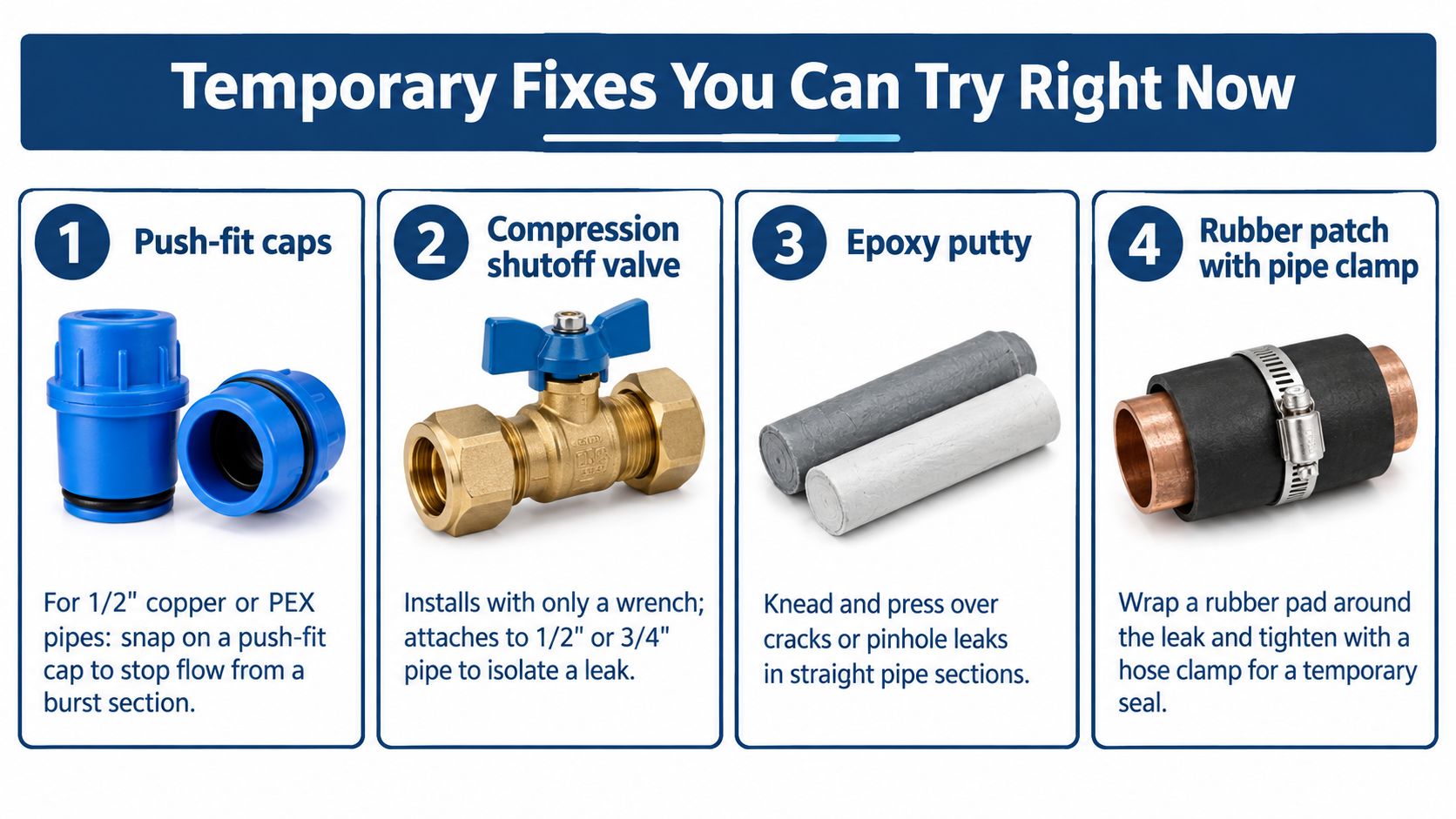
Temporary fixes that are realistic for homeowners
Push-fit cap on a cut, dead line. If a failed fixture branch is 1/2-inch copper or PEX and you can isolate it, cut back to sound pipe and push on a cap. This can hold well if the pipe is round, clean, and fully inserted.
Compression shutoff valve. If the old stop failed or won't close, a compression valve installed on a prepared copper stub can isolate that fixture without soldering.
Epoxy putty on a pinhole or split in a straight section. This only makes sense on a dryable surface with pressure removed. It's a time-buying patch, not a repair strategy.
Towel-and-bucket ceiling triage. For a drip through drywall, catch water, move contents, and relieve pooling only when the area is safe and you're confident electrical isn't involved.
Here's a basic visual walkthrough before trying any stopgap:
What not to try at 2 a.m.
People turn a service call into a restoration job.
- Don't solder. Open flame, wet framing, poor visibility, and panic are a bad mix.
- Don't clamp heavily corroded galvanized. The pipe wall may be too weak to hold the clamp load.
- Don't cap a live line unless you've confirmed isolation and relieved pressure.
- Don't assume a patch on a hot pressurized line will hold just because it slowed the leak for a minute.
A useful field rule is simple. If the temporary fix depends on force against rotten metal, it probably won't last. If it depends on clean pipe, proper insertion, and no active pressure during installation, it has a fighting chance.
When to stop and wait for the plumber
Temporary repairs work best on short, accessible branch lines. They work poorly on hidden slab leaks, split valves in walls, cracked cast fittings, and anything with uncertain pressure behind it.
Utility repair practice gets this part right. First isolate, then restore temporarily if needed, then perform the permanent repair. In one operational benchmark, 31% of 13,038 main-leak cases took more than six hours to isolate the mains, while the same report targeted temporary emergency supply restoration within three hours after isolation for 90% of cases and reported 98% of small-size burst repairs finished within 1.5 hours in that context, according to the Hong Kong Water Supplies Department audit report. Different system, same lesson. If isolation is shaky, every repair attempt is shaky too.
If you need a local option after isolation, EZ Plumbing offers 24/7 emergency response for active leaks, leak detection, and repair work in Los Angeles.
Documenting Damage for Insurance Before the Plumber Arrives
If the leak is under control, start building the record while conditions are unchanged. Adjusters and restoration teams want to see what happened before cleanup hides the path of water.
Water damage and freezing claims are among the most common homeowners insurance claims. Roughly one in 60 homeowners files that kind of claim each year, and the average cost per claim is almost $11,000, according to GEICO's overview of homeowners insurance and plumbing damage. Sudden and accidental damage is generally treated differently from long-term neglect, so your documentation needs to show the event clearly.
What to capture before anything gets moved
Take a slow photo sweep first. Start wide, then move tighter.
| Evidence Type | What to Capture | Why Adjusters Want It |
|---|---|---|
| Room overview | Wide photos of every affected wall, floor, and ceiling | Shows spread pattern and relation to the source |
| Leak source | The failed line, valve, fitting, fixture, or stain origin | Helps establish cause |
| Material damage | Close-ups of baseboards, flooring edges, cabinet toe-kicks, drywall seams | Documents what was physically affected |
| Appliance evidence | Model and serial labels on impacted water heaters, washers, dishwashers, or refrigerators | Ties damage to specific property |
| Water-loss support | Meter reading photo if relevant, plus visible pooling or saturation | Supports the timeline and severity |
| Repair records | Invoices, dispatch notes, drying receipts, plumber scope notes | Creates chain of custody for the claim |
The details that make claims cleaner
Use both video and still photos. Put a coin or ruler next to stains or lifted flooring for scale. If a contractor or mitigation company takes moisture readings later, photograph those readings in place rather than as random numbers on a screen.
Don't throw out the failed part if it came off cleanly and safely. Bag it, label where it came from, and keep it until the claim settles or your plumber says it's no longer needed.
Save the boring paperwork. The invoice, the dispatch text, the emergency receipt, and the written scope often matter as much as the damage photos.
For homeowners who want a broader cleanup checklist after the leak is stabilized, these step-by-step restoration tips for 2026 are useful as a general process reference, especially for separating immediate mitigation from later finish repairs.
Calling a 24/7 Plumber What to Expect
A good emergency call goes faster when the caller sounds like they already know the situation. Dispatch doesn't need a dramatic story. They need a clear source, a clear hazard picture, and a clear access plan.
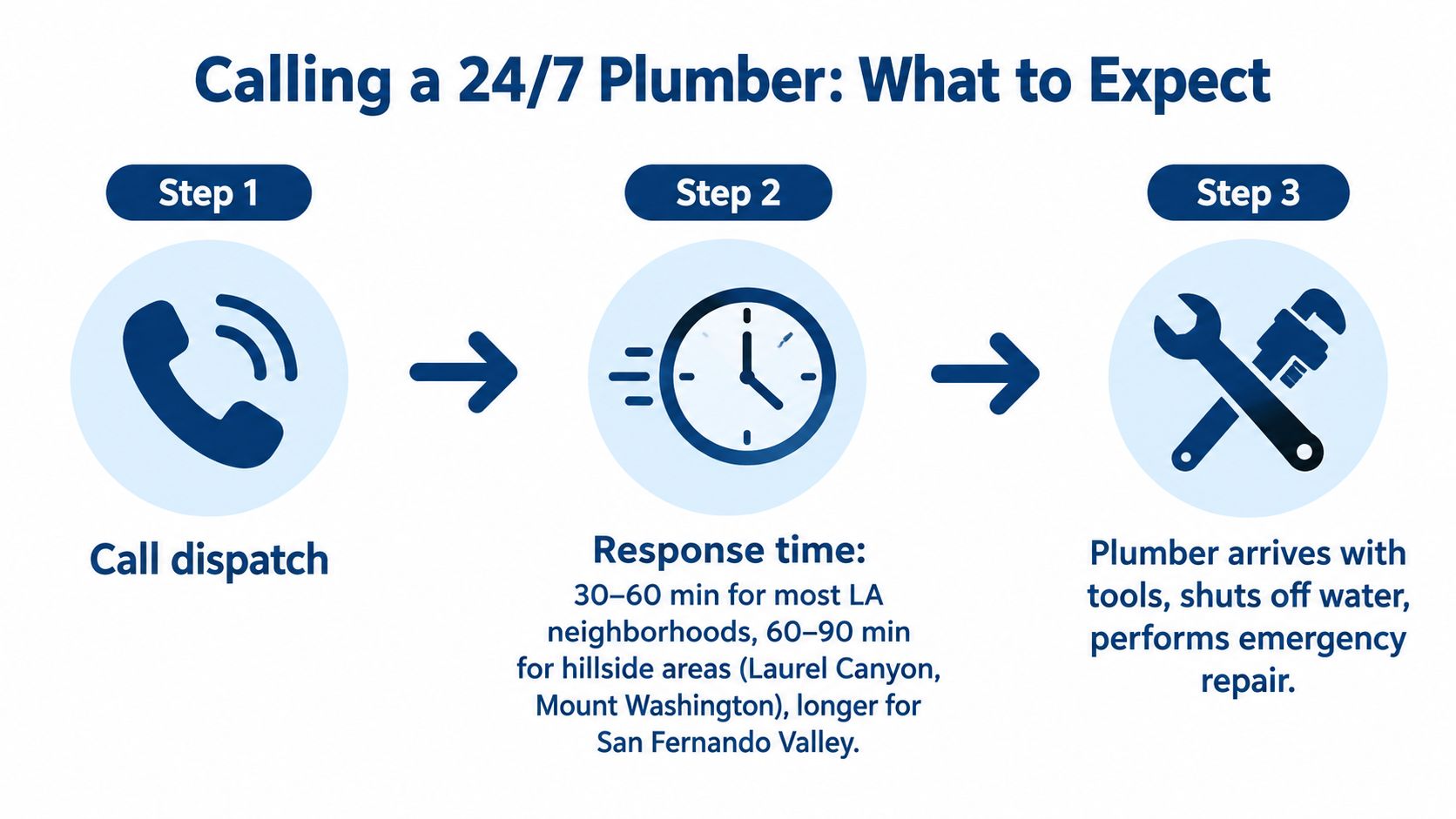
What dispatch should ask you
Have these answers ready:
- Exact address and cross street
- Building type, such as single-family, duplex, condo, or apartment
- Leak source if known, such as toilet supply, ceiling leak, water heater line, slab leak signs
- Whether the water is off
- Whether electrical or gas hazards are involved
- Whether the leak affects another unit or common area
In LA, access details matter more than people think. A gate code, rear alley approach, detached garage, or hillside stair access can change arrival and tool planning.
If you need an example of what a dedicated local emergency response page should cover, this 24-hour plumbing service in Los Angeles page lays out the kind of after-hours scope homeowners should expect.
What counts as real emergency scope
A real emergency plumber does more than throw a towel under the leak. The job usually includes diagnosis, confirmation of isolation, exposure of the failed area if accessible, and either a permanent repair or a stable temporary repair that safely holds until return work.
That may mean replacing a burst angle stop, cutting out a failed copper section, capping a branch, replacing a supply connector, or isolating a leaking water heater. In multi-unit buildings, it can also mean tracing which riser or unit feed serves the leak before shutting down more of the building than necessary.
Why response discipline matters
The utility world treats repair speed as a measured performance issue, not an improvised one. One EU leakage-management benchmark aimed to repair leaks within 12 hours for large mains above 300 mm, within 3 days for all diameters, and keep average time from location to shutoff or repair at around 2 days, as outlined in the EU leakage management case study document. Residential calls move faster than utility repairs, but the same discipline applies. Slow localization and the wrong temporary fix are what drag a straightforward leak into a larger outage.
A solid emergency call ends with the leak stopped, the failed section identified, and the property owner knowing what can be used safely before morning.
Stopping the Next Emergency Before It Starts
Most midnight leaks leave clues first. Homeowners miss them because they don't look dramatic until the day they are.
Watch the failure patterns your property type tends to have
Slab-on-grade homes in the Valley and South Bay often show warning signs in odd ways. You may hear running water with all fixtures off. You may notice unexplained meter movement. You may see flooring warm in one strip and normal everywhere else. That's different from a visible under-sink failure, and the response should be different too.
Hillside homes have their own issue set. Large elevation changes and pressure swings can be hard on old stops, flex lines, and aging copper. Older houses in Silver Lake, Mount Washington, and Beachwood Canyon benefit from pressure checks and valve labeling because the wrong shutoff search in the dark costs time.
Property managers need a different checklist
A single-family owner can usually focus on one kitchen, one bath, one laundry box. HOAs and landlords don't have that luxury. The higher-risk walk-through points are usually risers, fire-sprinkler manifold areas, laundry rooms, water heater platforms, and tenant angle stops that haven't been touched in years.
Commercial and multi-unit operators also face a bigger loss picture. One market report says water damage incidents in those environments average over $89,000 per claim, and commercial water monitoring is projected to grow at a 13.2% CAGR from 2025 to 2034, according to DataIntelo's smart water leak detection market report. That's why hidden-leak triage matters so much in buildings with stacked units, equipment rooms, and common walls.
Small habits that prevent ugly nights
- Label every shutoff. Under-sink stops, toilet stops, laundry valves, house main, and meter location.
- Exercise valves carefully. A valve that hasn't moved in years shouldn't wait until an emergency to prove it's frozen.
- Check exposed exterior plumbing before colder winter nights. Even in LA, localized cold snaps catch people off guard.
- Inspect water heater areas. Look for corrosion at nipples, supply lines, pans, and shutoff valves.
- Walk irrigation and side-yard plumbing after service interruptions. Repressurization often exposes weak points.
If you're helping an older homeowner who may not move fast in an emergency, this home-safety guide for aging parents is worth reviewing alongside valve labeling and access planning.
The best move is simple. Save a real 24/7 plumber in your phone now, tag every valve tonight, and don't wait for active flooding to learn where your meter shutoff lives.
EZ Plumbing handles emergency water leak repair across Los Angeles, including active interior leaks, hidden leak detection, shutoff diagnosis, and after-hours plumbing response for homes, multi-unit properties, and commercial buildings. If you want help before the next midnight spray turns into major damage, visit EZ Plumbing and get your shutoffs, pressure issues, and leak risks addressed now.