
Burst Pipe Repair Cost in Los Angeles: An EZ Guide (2026)
Most Los Angeles homeowners should plan for a burst pipe repair cost of about $500 to $2,500, but that number can swing fast when the pipe is buried behind a wall, under a slab, or the leak has already soaked drywall, flooring, or cabinets. In the broader market, burst pipe repairs typically run $400 to $2,000, with simple accessible leaks as low as $150 to $500 and harder access repairs climbing past $2,000 to $4,500.
If you're reading this with water on the floor, a stained ceiling, or that sickening sound of running water where there shouldn't be any, the goal isn't to become a plumbing expert in five minutes. The goal is to stop the damage, protect the property, and avoid getting blindsided by the bill. Los Angeles homeowners face a different reality than generic national guides suggest. Access is harder. Emergency response matters more. Labor drives the invoice.
A burst pipe isn't just a pipe problem. It's a labor problem, an access problem, and sometimes a water-damage problem. That's why two homes can both have "a burst pipe" and end up with very different final costs.
Table of Contents
- That Unmistakable Sound Your First Steps When a Pipe Bursts
- The Real Cost of Burst Pipe Repair in Los Angeles for 2026
- What Drives Your Final Repair Bill Up or Down
- Emergency vs Scheduled Repairs and The Price Difference
- Navigating Insurance Claims and HOA Responsibilities
- Prevention Is Cheaper Than Repair How to Protect Your Property
That Unmistakable Sound Your First Steps When a Pipe Bursts
It usually starts the same way. You wake up, the house is quiet, and then you hear water moving inside a wall or dripping where no faucet is on. Maybe it's under the kitchen sink. Maybe it's a wet ceiling below an upstairs bathroom. Maybe it's water creeping across hardwood floors.
Your first job is simple. Stop the water. Don't start by searching repair prices or arguing with insurance. Find the main shut-off valve and close it. If you don't know where it is, this walkthrough on how to shut off your main water supply is worth bookmarking before you need it.
What to do in the first few minutes
Handle it in this order:
- Shut off the main water supply. If the leak is isolated and you know the fixture valve works, you can shut off that branch. If you're not sure, shut off the whole house.
- Cut power to affected areas if water is near outlets, lights, or appliances. Water and electricity don't negotiate.
- Open nearby faucets. That relieves pressure in the lines.
- Move rugs, boxes, electronics, and furniture. Save what you can quickly.
- Take photos and short video clips. You'll want that record later.
- Call a plumber before the damage spreads further.
Practical rule: If water is actively flowing, every minute you wait gives the repair bill more ways to grow.
Keep your head clear
People panic and focus on the visible mess. Often, the trouble is hidden. Water gets into drywall, subfloor, insulation, cabinets, and framing long before the room looks catastrophic.
The number you're worried about is real, but the immediate priority is controlling scope. A small leak caught fast can stay a plumbing repair. A delayed response can turn into demolition, drying, mold work, and reconstruction. That difference is where homeowners get burned.
The Real Cost of Burst Pipe Repair in Los Angeles for 2026
At 2 a.m., with water spreading across the floor, homeowners in Los Angeles are not asking for a national average. They need to know whether this is a few-hundred-dollar repair or the start of a five-figure mess once access, drying, and patching get added.
Los Angeles pricing runs higher for one simple reason. The pipe repair is only part of the bill. Older housing stock, plaster walls, slab foundations, tight crawlspaces, tile, stucco, and condo access rules all push labor up fast. Generic cost roundups miss that. If you want a useful budget, build around the ugly version of the job, not the easy one.
Typical burst pipe repair ranges in Los Angeles
National guides still help as a starting point. Angi reports that burst pipe repairs commonly fall between $150 and $5,000, depending on location, pipe material, and how much pipe needs replacement, in its burst pipe repair cost guide. That wide range is exactly why Los Angeles homeowners should stop fixating on averages.
In practice, a straightforward repair in an open, accessible spot can stay in the low hundreds. Once the failed line is hidden behind finished walls, above a ceiling, under a slab, or tied into restoration work, the invoice climbs fast. In Los Angeles, that jump happens all the time.
Homewyse also shows how access and local labor rates change the math. Its burst pipe repair cost estimator prices a basic repair job by project conditions and ZIP code, which is a much better way to budget in LA than using one flat national number.
Estimated Burst Pipe Repair Costs in Los Angeles 2026
| Repair Scenario | Typical Cost Range |
|---|---|
| Minor accessible leak under a sink or in an open area | $150 to $500 |
| Average burst pipe repair | $400 to $2,000 |
| Pipe behind a wall or under concrete foundation | $2,000 to $4,500 |
| Underground sewer line or main pipe replacement | $1,300 to $5,000 |
| Extra fee for weekend, holiday, or late-night emergency work | $100 to $300 or more |
What the invoice usually includes
Homeowners usually focus on the broken section of pipe. That is rarely the expensive part.
A burst pipe invoice often includes:
- Diagnosis and leak location
- Minimum service call or dispatch fee
- Labor to expose the pipe
- The actual pipe and fitting repair
- Time to pressure test and confirm the leak is solved
- Basic cleanup
- Emergency after-hours charges
- Patch or restoration work, if your plumber handles it in-house
The material cost for a short repair is often modest. The expensive part is getting to the pipe without turning a bad day into a bigger rebuild. That is especially true in Los Angeles homes with tile bathrooms, lath and plaster walls, slab leaks, finished garages, or pipes buried in ceilings between units.
Budget for the worst case, not the pleasant surprise
A smart LA budget has three tiers:
- Best case: exposed pipe, fast repair, little or no finish damage
- Middle case: wall or ceiling opening, extra labor, basic patching
- Worst case: slab, underground line, hard-to-trace leak, drying, mold prevention, and restoration
Use that framework before you approve work. If your plumber says the leak is probably behind tile, inside a ceiling cavity, or under concrete, do not budget around the lowest number in the table. Budget around the middle or upper end.
That approach is less comforting, but it is how homeowners avoid getting blindsided.
What Drives Your Final Repair Bill Up or Down
In Los Angeles, the final bill usually jumps for one reason. Access.
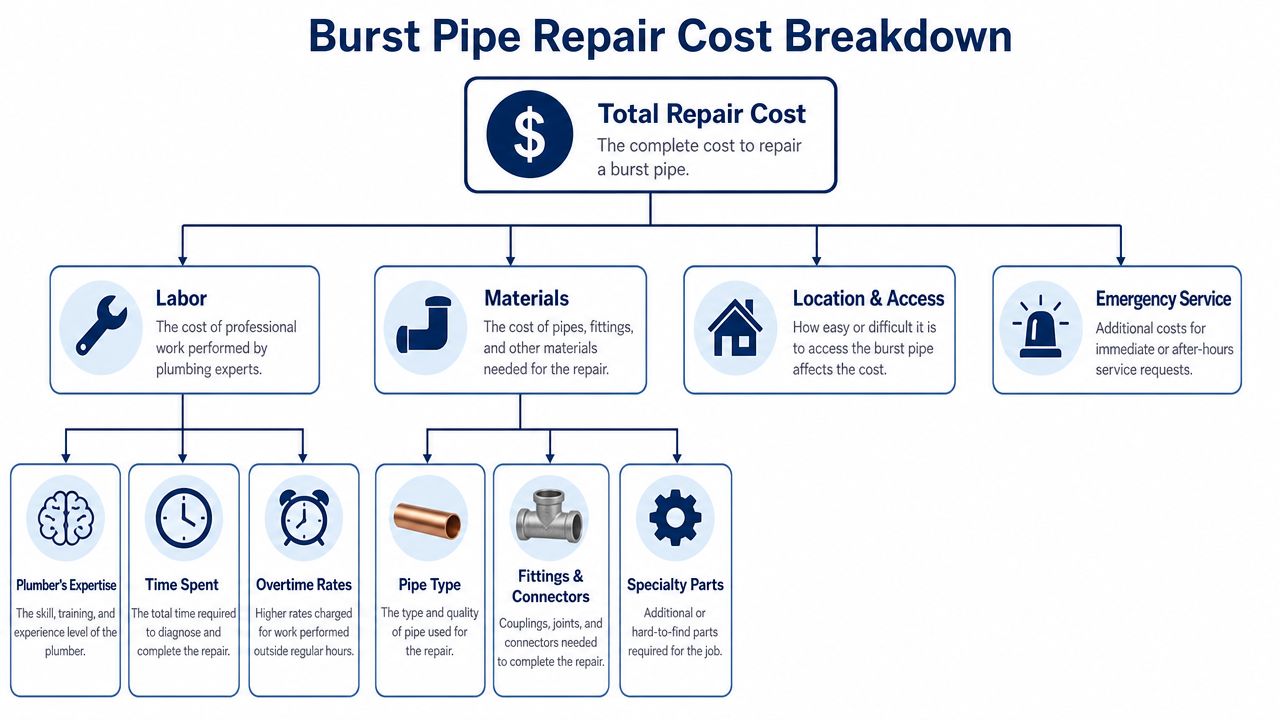
A short section of copper or PEX is rarely what hurts your budget. The expensive part is opening finished surfaces, protecting the home, tracing the exact failure point, and putting the area back into usable condition. In older LA properties with plaster walls, tight crawlspaces, slab foundations, stacked condo units, or tile-over-mortar bathrooms, labor climbs fast because the repair is tied to the building, not just the pipe.
Access is the cost driver homeowners underestimate
National pricing data from HomeAdvisor's burst pipe repair cost guide shows the repair range swings widely based on where the pipe sits and how hard it is to reach. That lines up with what occurs in Los Angeles. A visible laundry line is one job. A failed line inside a ceiling cavity below an upstairs bath is a different job entirely, even if the damaged pipe section is the same length.
Use this filter before you approve work:
- Low-cost access: exposed pipe in a garage, basement, utility room, or exterior wall
- Mid-cost access: drywall or ceiling cut, insulation removal, leak tracing, and basic patch prep
- High-cost access: tile, cabinetry, plaster, concrete, roofs, raised foundations, or pipes running between units
That is the budgeting framework that matters in LA. Generic guides often focus on the repair itself. The actual spread comes from how many trades and labor hours the property layout forces into the job.
If water is still running or spreading, call a Los Angeles emergency plumber for burst pipe response before the access problem turns into a drying and reconstruction problem.
Water damage often costs more than the plumbing repair
Homeowners get blindsided here.
The plumbing fix stops the leak. It does not dry wall cavities, save swollen cabinets, replace flooring, or prevent microbial growth. The Insurance Information Institute's water damage and freezing overview notes that water damage and freezing claims are among the most common homeowners insurance losses. That matches the pattern plumbers see every week. The pipe repair is often the first invoice, not the biggest one.
The cleanup side of the job usually grows based on what got wet and how long it stayed wet:
- Drywall and insulation often need removal and drying, not just a paint touch-up
- Wood and laminate flooring can cup, lift, or trap moisture underneath
- Cabinets and vanities made from MDF or particleboard can fail after one saturation event
- Shared walls and ceilings in condos and duplexes can spread costs into adjacent spaces
For drying and restoration, analysts at Homewyse's water damage remediation cost guide show costs are driven by affected square footage, debris removal, material replacement, and local labor rates. In Los Angeles, those labor rates are the part homeowners should respect. Add parking limits, older construction, permit questions, and access restrictions in multifamily buildings, and the total climbs quickly.
My advice is simple. Do not budget only for the plumber's repair ticket. Budget in layers:
- Repair the pipe
- Open and restore access
- Dry affected materials
- Replace what water ruined
- Leave room for the surprise item, usually hidden moisture, finish matching, or work in a neighboring unit
That is how you avoid the worst mistake. Approving a repair based on the cheapest possible scenario in a house that clearly has worst-case access conditions.
Emergency vs Scheduled Repairs and The Price Difference
A burst pipe at noon on a Tuesday and a burst pipe at 1 a.m. on a holiday are not the same job. The repair might be similar. The response logistics aren't.
What you're paying for in an emergency call
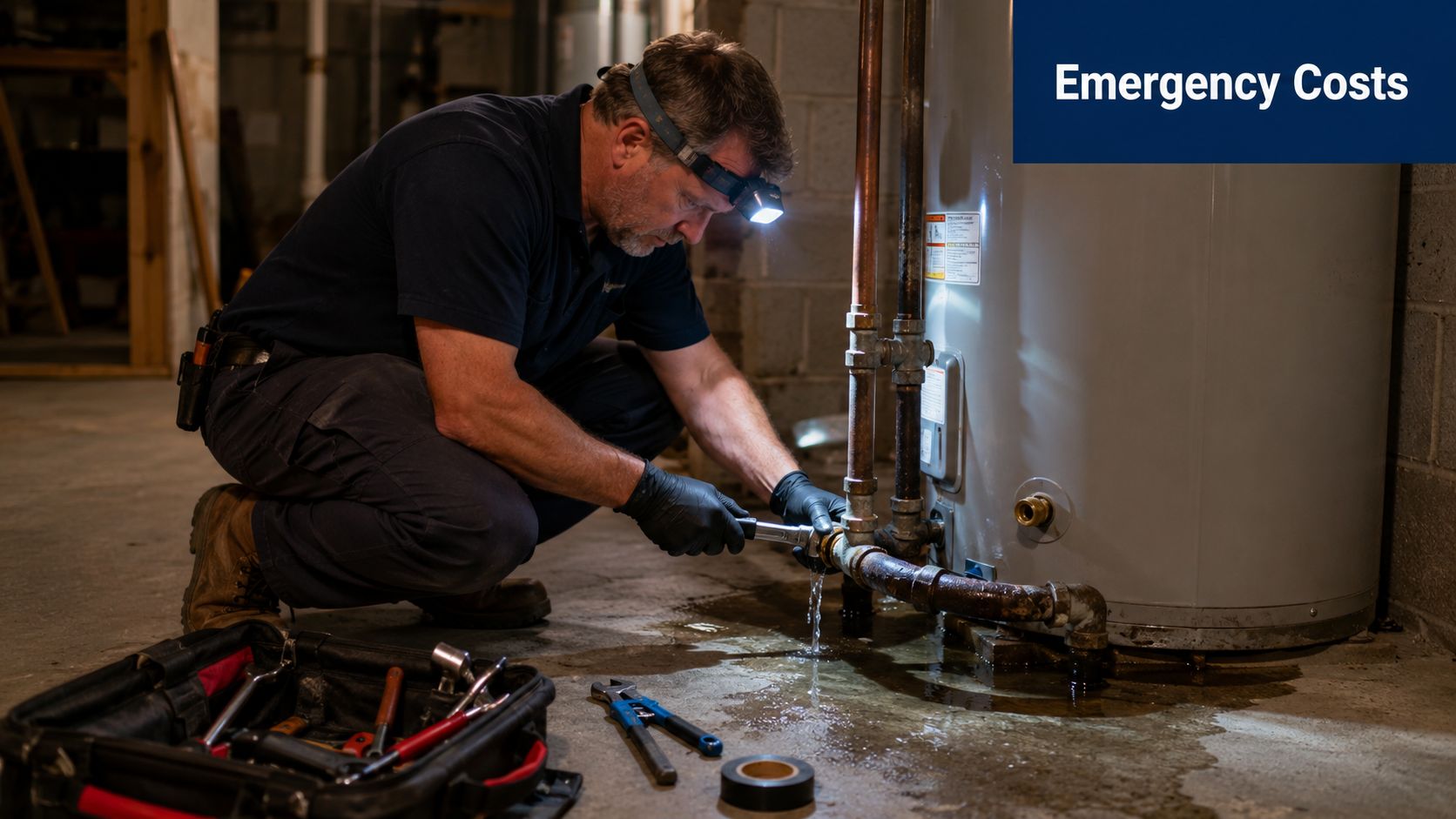
Emergency or after-hours burst pipe service adds $100 to $300 or more on top of normal costs, and a pipe behind a wall or under a slab can cost $1,200 to $2,000 or more because of demolition and access based on this analysis of burst pipe pricing and emergency premiums. The same source notes that in 2025 to 2026, emergency plumbing rates in major markets have risen 15% to 20% due to labor shortages.
That premium isn't random. Someone has to answer the phone, dispatch a qualified technician, stock the truck, drive across Los Angeles traffic patterns, diagnose the failure, and stop active property damage without the luxury of a normal workday schedule.
If the leak is active, the premium is usually the cheaper choice. Waiting until morning to save an emergency fee can cost far more if water keeps entering walls, saturating flooring, or dripping into units below. For true emergencies, a dedicated Los Angeles emergency plumber isn't a luxury service. It's damage control.
When it's safe to schedule instead of calling now
Not every burst pipe situation requires an immediate nighttime repair. Sometimes the right move is a temporary shutoff and a scheduled visit.
A scheduled repair often makes sense when:
- The water is fully isolated: The main or branch shutoff stopped the leak completely.
- No active damage is spreading: No pooling, ceiling bulge, or seepage is getting worse.
- The line serves a noncritical fixture: You can safely leave it offline.
- Access work is likely: A daytime visit may allow better coordination for opening walls or arranging follow-up trades.
Emergency service is about speed. Scheduled service is about planning. If you can safely stop the leak, a scheduled appointment can make the process calmer and more controlled. If you can't, pay the premium and protect the property.
Navigating Insurance Claims and HOA Responsibilities
Once the leak is stopped, most homeowners make the same mistake. They start cleaning before documenting. That's backwards.
What to do after the water is stopped
Build a record before anything gets tossed, cut out, or moved more than necessary. If you end up filing a claim, details matter.
Use this checklist:
- Photograph the source area. Get wide shots and close-ups.
- Photograph all affected finishes. Drywall, flooring, baseboards, cabinets, ceilings, insulation, contents.
- Record video of active dripping or pooling if it's still visible.
- Save damaged parts if practical. Don't throw away the failed section immediately.
- Write down timing. When you noticed it, when you shut off the water, who you called.
- Ask for itemized invoices and written findings from the plumber.
- Notify your insurer promptly if damage extends beyond the pipe itself.
For many homeowners, the right sequence is plumber first, insurer second. If water is active, stopping the loss comes before claim paperwork. Once the situation is stabilized, review guidance like this homeowner's guide to the role of insurance in plumbing so you know what documentation to gather and how to describe the event clearly.
Take photos before cleanup starts. Once wet drywall is removed and fans are running, you've lost part of your evidence.
What insurance covers depends on your policy language. Sudden accidental water damage is often treated differently from long-term neglect, deferred maintenance, or repeated leakage. Read your declarations and exclusions, not just the marketing summary.
How to sort out HOA responsibility without wasting time
Condos and townhomes get messy fast because multiple parties may share responsibility. Don't assume. Check the governing documents.
Start with these questions:
- Where is the failed pipe located? Inside your unit, in a common wall, above another unit, or in a shared line?
- Who owns the pipe under the CC&Rs? Unit owner responsibility and HOA responsibility often split at specific boundaries.
- Who is responsible for finishes? The HOA may handle common piping while the unit owner handles interior drywall, flooring, or cabinets.
- Did water spread into another unit or common area? If yes, notify management immediately.
Call the HOA or property manager early, but don't let that delay emergency mitigation. Water won't wait for committee approval. Stop the leak, document everything, then sort out reimbursement and scope.
Prevention Is Cheaper Than Repair How to Protect Your Property
The cheapest burst pipe repair cost is the one you never have to pay. That's not a slogan. It's basic math. Once water escapes the pipe, every surrounding material becomes part of the bill.
For Los Angeles homes, prevention isn't just about freezing weather. It's also about aging supply lines, neglected shutoff valves, slab leak risk, pressure issues, and hidden wear in older houses, duplexes, condos, and small apartment properties.
A practical prevention checklist for Los Angeles properties
Use a real checklist, not vague good intentions:
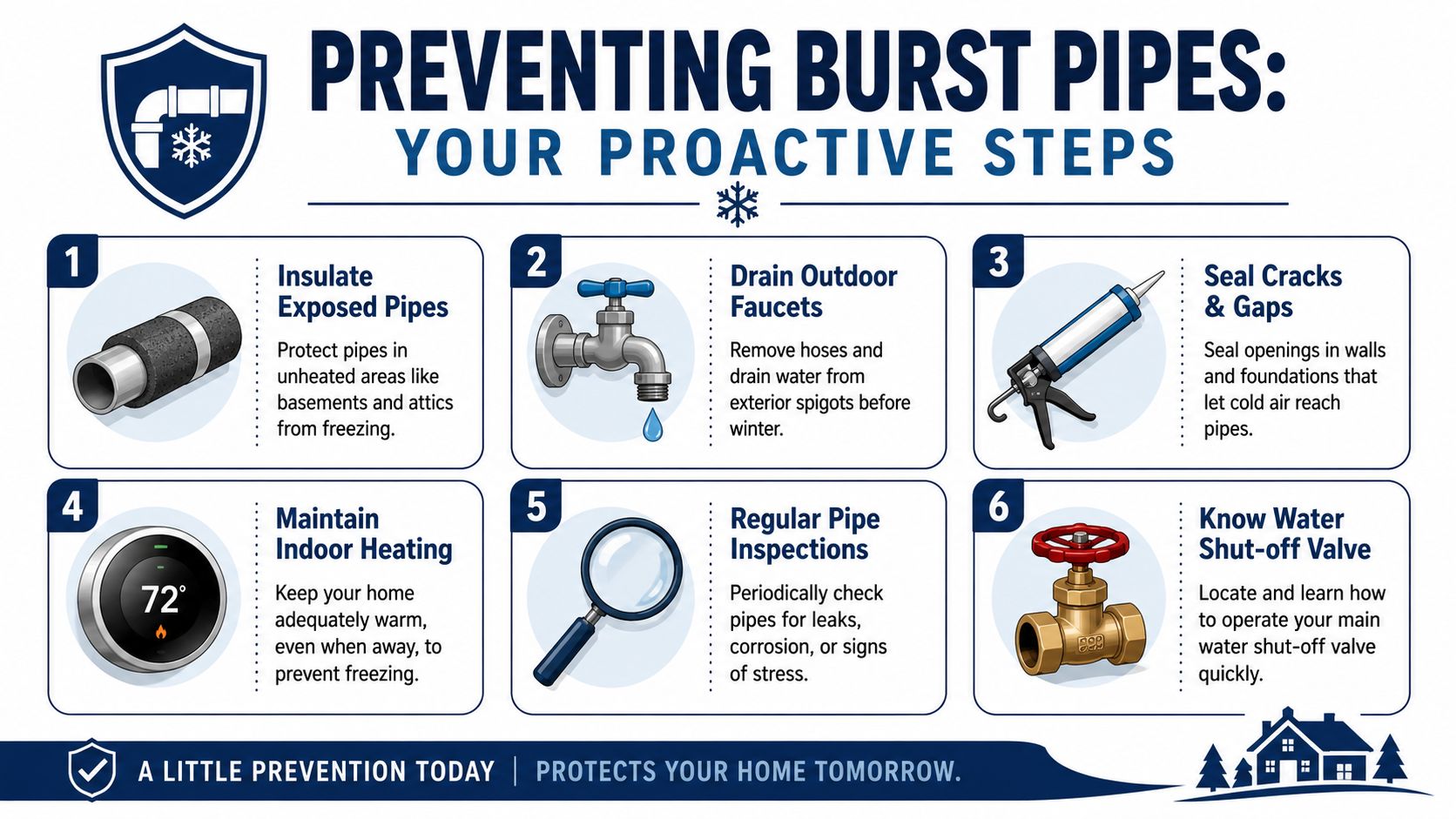
- Know your shutoff valve location: Everyone in the home should know how to use it.
- Inspect visible pipes: Look under sinks, around water heaters, in garages, laundry areas, and crawl-access points for corrosion, staining, mineral buildup, or slow drips.
- Test old fixture shutoff valves: A valve that won't close is useless in an emergency.
- Watch ceilings and baseboards: Small stains often show up before a larger failure.
- Pay attention to pressure changes: Sudden drops or hammering noises deserve investigation.
- Address minor leaks early: A pinhole leak doesn't stay small forever.
A broader home-safety approach helps too. This guide on keeping your home dry and safe offers practical ways to reduce water damage risk around the property, especially if you've already had one leak and don't want a repeat.
What to schedule before the next leak starts
Video can help if you want a quick visual refresher on prevention basics and what warning signs to watch for:
What should you schedule?
- A plumbing inspection if the home is older: Especially if you don't know the age or material of your supply lines.
- A water heater and supply connection check: Flexible connectors, valves, and nearby piping fail more often than people think.
- A pressure evaluation: High pressure can punish fittings and aging lines.
- A property-wide review for HOAs and landlords: Shared walls and stacked plumbing create bigger exposure when one leak spreads across units.
Small plumbing warnings are cheap to investigate. They're expensive to ignore.
If you've already had one burst pipe, stop thinking in terms of isolated bad luck. Treat it as a signal to inspect the rest of the system.
If you need fast help now or want to get ahead of the next leak, contact EZ Plumbing. They've served Los Angeles since 1989 and handle 24/7 emergency response, same-day repairs, inspections, and plumbing work for homeowners, HOAs, property managers, and commercial properties. Call (818) 908-2710 or schedule online for clean, professional service that protects your property instead of adding to the chaos.