
1–4 Days Plumbing, 1–3 Weeks Total: Repipe Timeline for Homeowners
Plumbing-only work on a whole-house repipe typically runs 1 to 4 working days, depending on home size and pipe material. Once you add permit inspections, drywall patching, texture matching, and paint, most homeowners are looking at a total elapsed timeline of about 1 to 3 weeks. Water stays on overnight in nearly every case since crews shut it off only during active work hours, roughly 8 to 10 hours per day.
TL;DR:
- Pipe material significantly affects overall timeline, with PEX reducing plumbing work by up to half compared to copper, especially in homes with attic or crawlspace access.
- The total project duration ranges from 3 days for small homes to 4 weeks for large, multi-story houses, when including inspections and restoration.
- Water is typically shut off only during active plumbing phases, for 8 to 10 hours per day, with most projects involving multiple short outages rather than one extended period.
- Restoration work, such as drywall patching and painting, can add one week or more to the total timeline, especially if separate subcontractors handle finishing work.
- Expect a written schedule covering daily water shutoff windows, permit arrangements, and scope details before starting, with delays possible from municipal inspections and permit processing.
Table of Contents
- Repipe Timeline by Home Size: What to Expect
- What Happens Each Day of a Repipe Project?
- What Makes a Repipe Faster or Slower?
- How Restoration Affects Your Total Project Time
- How Do Daily Water Shutoffs Actually Work?
- What Should a Licensed Repipe Contractor Provide?
- Why “1-Day Repipe” Marketing Rarely Tells the Whole Story
- Get a Written Repipe Timeline Before Work Starts
- Sources
- FAQ
Repipe Timeline by Home Size: What to Expect
The single biggest variable in any repipe timeline is square footage and bathroom count, followed closely by pipe material. Here’s how the ranges typically break down for single-family homes:
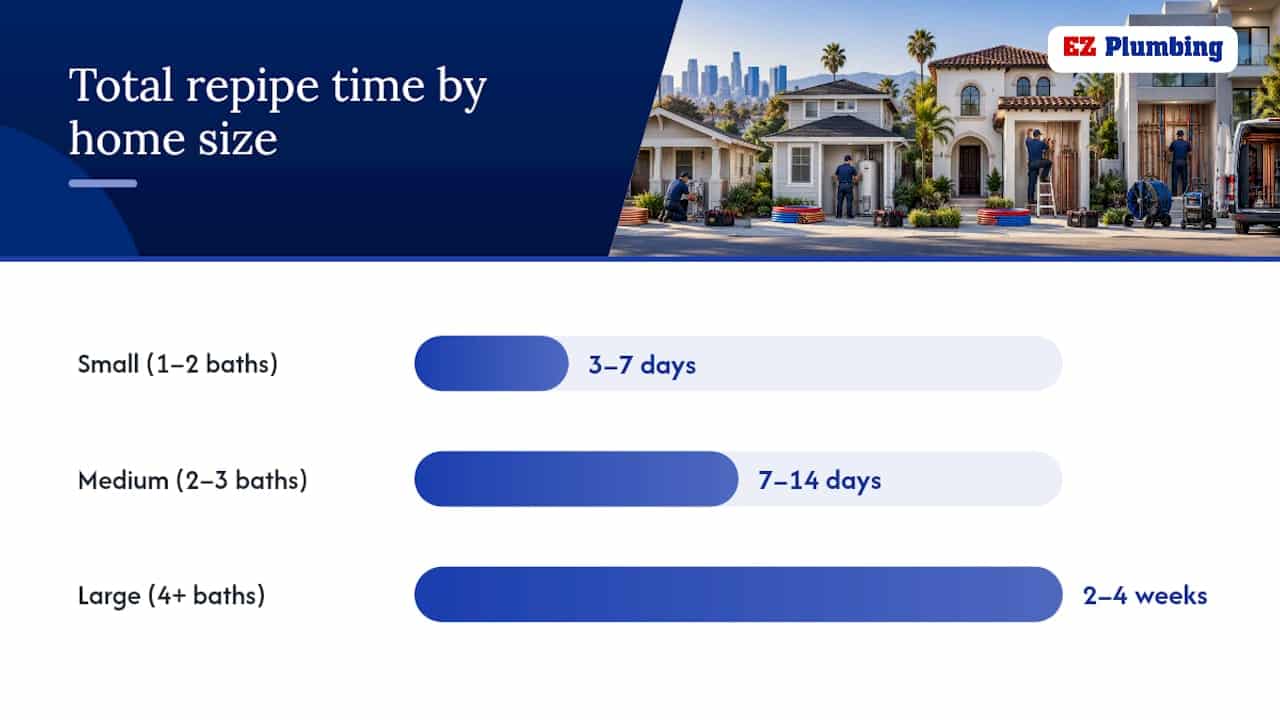
- Small homes (1 to 2 bathrooms): Plumbing-only work usually takes 1 to 2 days. With drywall patching and paint included, total project time runs about 3 to 7 days.
- Medium homes (2 to 3 bathrooms): Expect 2 to 3 days of active plumbing work. Total calendar time, including restoration, typically lands between 7 and 14 days.
- Large homes (4 or more bathrooms, multi-story): Plumbing crews often need 3 to 5 days on-site. Once inspections and full restoration are factored in, the total project frequently stretches to 2 to 4 weeks.
These ranges match what several repipe timing guides report across small, medium, and large properties, with roughly one additional day (or more) tacked on for drywall and final inspection depending on who handles the finish work.
Pipe material moves these numbers more than almost anything else. PEX tubing runs in continuous flexible lines with far fewer joints than rigid copper, which means less time cutting, soldering, and fitting connections at every turn. A material comparison guide breaks down why that flexibility translates into fewer wall openings and lower labor hours per fixture. For a medium-sized home, that difference can mean the gap between a two-day plumbing phase and a four-day one. If your home has an accessible attic or crawlspace, PEX’s speed advantage becomes even more pronounced because crews can snake lines through open framing instead of fighting tight wall cavities.
What Happens Each Day of a Repipe Project?
A repipe isn’t one continuous blur of work. It moves through distinct phases, each with its own water-off implications and crew activity. Understanding the sequence helps you plan around it instead of getting surprised by it.
- Prework and scheduling (1 to 4 weeks before work starts). A licensed plumber inspects the property, confirms scope, and handles permit paperwork. Non-emergency repipes commonly need 2 to 4 weeks of lead time just to get an estimate scheduled and permits filed.
- Day 1: Access and prep. Crews protect flooring and furniture, cut access points where walls or ceilings block a direct route, and confirm the daily water-shutoff window with you. This is also when they identify whether one bathroom can stay isolated and functional during the work.
- Days 2 through 4: Rough-in. New supply lines get routed to every fixture, branch connections and fixture shutoffs go in, and old pipe gets capped or removed. This is the bulk of the physical labor and where home size and material really show their impact on speed.
- Pressure test and inspection. Once lines are connected, the crew pressurizes the system and checks for leaks before closing anything up. Most jurisdictions require a city inspector to sign off before walls close, and that inspection may happen the same day or get scheduled for the next available slot, depending on municipal availability.
- Restoration visits. Drywall patching starts with cutting and mudding, then requires drying time before sanding and texture matching. Paint comes last, after texture has fully cured.
Water is typically shut off only during steps 2 through 4, not during prework or restoration. Most repipe projects run 2 to 5 days of active plumbing work, with each day carrying its own dedicated shutoff window rather than one continuous outage across the whole project.
What Makes a Repipe Faster or Slower?
Several project-specific details push a repipe toward the fast end of the range or drag it toward the slow one. Knowing which factors apply to your home lets you set realistic expectations before a crew ever shows up.
- Pipe material. PEX installations often move noticeably faster than copper because of fewer joints and simpler routing, an advantage that compounds in homes with multiple bathrooms.
- Access type. Attic and crawlspace access usually beats slab routing for speed, since crews can run new lines through open space instead of cutting concrete. Rerouting through the attic can shave several days off a slab home’s timeline when the layout allows it, though slab homes do avoid floor demolition entirely.
- Fixture count and layout. Every additional sink, tub, or appliance connection adds joints and routing time. A home with fixtures scattered across an irregular floor plan takes longer than one with bathrooms stacked directly above each other.
- Permit and inspection timing. Local building departments vary widely in how fast they schedule inspections. A contractor who pulls and tracks permits directly usually keeps this phase tighter than one who leaves it to the homeowner.
- Restoration scope in the contract. Some repipe quotes include drywall, texture, and paint. Others hand that off to a separate subcontractor, which adds scheduling handoffs and often stretches total calendar time.
How Restoration Affects Your Total Project Time
Plumbing work is usually the fast part. Restoration is where most repipe timelines actually stretch out, and it’s the phase homeowners underestimate most often.
Drywall patching isn’t a one-visit job. Crews cut openings, apply mud, let it dry, sand it smooth, and then match texture, a cycle that commonly spans multiple visits with drying time built in between each step. Rushing this sequence shows up later as visible seams or texture mismatches, so a contractor working correctly won’t compress it just to hit an earlier finish date.
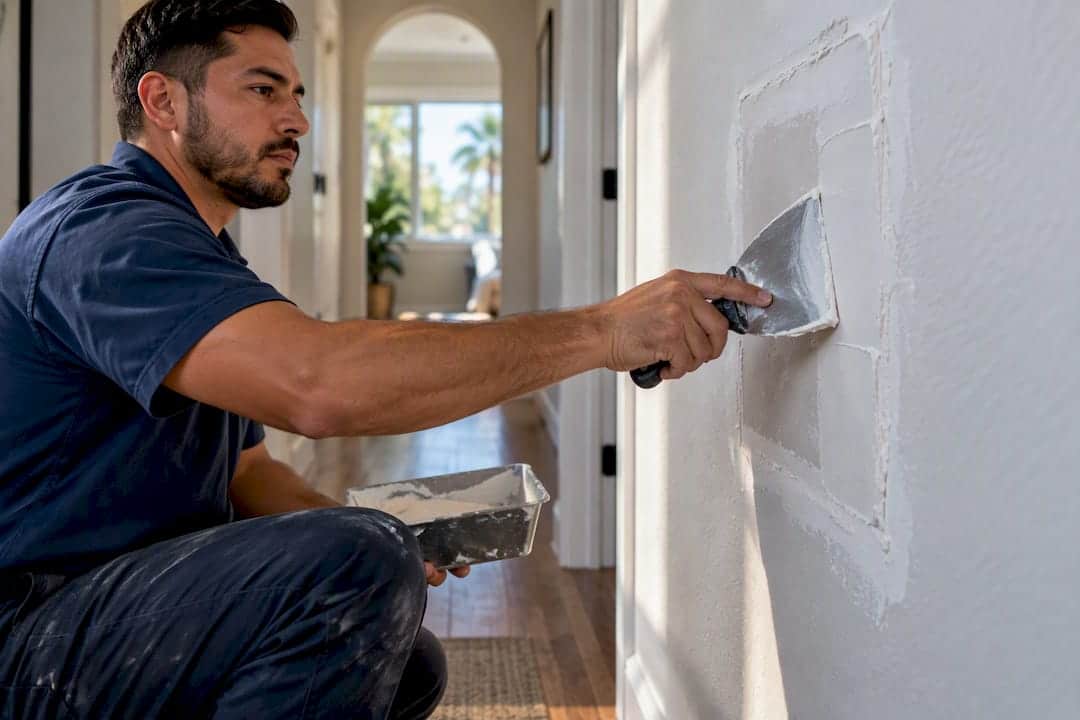
Paint adds another layer. Texture has to cure fully before paint goes on, and if multiple rooms need patching, painters typically work room by room rather than all at once, especially when color matching is involved. A single-bathroom patch might add two or three days to your total timeline. A whole-house repipe touching six or seven rooms can add a week or more of restoration alone, even after the plumbing itself wrapped up days earlier.
A few things worth confirming before signing anything:
- Ask whether the same crew handles drywall and paint or whether it’s subcontracted, since handoffs between separate teams tend to add days.
- Get the drying and texture-matching timeline in writing, not just a verbal estimate.
- Clarify who performs the final walkthrough and sign-off, and what happens if texture doesn’t match on the first attempt.
How Do Daily Water Shutoffs Actually Work?
You won’t be without running water for the entire repipe. Crews shut it off only while actively working on the lines, then restore it before leaving for the day in most cases.
- Expect roughly 8 to 10 hours of shutoff per active work day. Water typically comes back on each evening, though cumulative outage across a multi-day project can add up to 24 to 30 hours total by the time the job wraps.
- Fill containers the night before. A filled bathtub, a few large buckets, and bottled drinking water cover most household needs during a dry stretch.
- Ask about an isolated fixture. Some crews can bypass one bathroom or the kitchen sink so you retain limited access while the rest of the system is down.
- Plan meals and laundry around the schedule. Skip the dishwasher and washing machine on shutoff days, and shift showers to early morning before work starts if possible.
- Get the daily plan in writing. A written schedule showing exact shutoff windows for each day protects you if the project runs long.
Pro Tip: If anyone in your household relies on dialysis equipment, has mobility limitations, or needs consistent water access for medical reasons, tell your contractor before scheduling begins. A licensed crew can often rearrange the day’s sequence to restore water to a critical fixture earlier than the standard shutoff window allows.
What Should a Licensed Repipe Contractor Provide?
A repipe involves cutting into walls, working with pressurized water lines, and coordinating with municipal inspectors. That combination is exactly why licensing and documentation matter more here than in a simple faucet repair.
A written proposal worth signing states the daily water-off windows, names who closes up wall openings once plumbing passes inspection, and spells out whether the contractor handles permit scheduling from start to finish or leaves that step to the homeowner.
Before work begins, a licensed plumber should hand you a written scope of work, a day-by-day water-off schedule, documented pressure test results once lines are checked, and clear language on who pulls and tracks permits. Warranty terms on both parts and labor should be spelled out, not implied. A licensed plumbing company operating under appropriate California licensing has experience coordinating permit filing and inspection as part of the job process. Contractors who handle permits directly tend to avoid the scheduling gaps that come from homeowners chasing down municipal appointments themselves, and that reliability shows up directly in how predictable your total timeline ends up being.
Why “1-Day Repipe” Marketing Rarely Tells the Whole Story
A “1-day repipe” claim usually describes only the plumbing installation in a small home with easy attic access and PEX lines. It almost never includes the pressure test, city inspection, or any drywall and paint work that follows. Ask any contractor for the total elapsed timeline in writing, covering plumbing and restoration together, and build in a buffer for municipal inspection delays before you commit to a move-out date or a guest arrival.
— EZ
Get a Written Repipe Timeline Before Work Starts
Whole-house repiping projects are ideally managed as a single licensed project rather than a patchwork of separate contractors, allowing permits, pressure testing, city inspections, and restoration to be coordinated efficiently by one crew.

That matters most in the phase homeowners underestimate: restoration. A crew that patches its own drywall and matches its own texture skips the scheduling gap that comes from waiting on a separate subcontractor to fit your job into their week. If you want a real number instead of a marketing range, use the pricing calculator to get a project estimate, or visit the repipe services page to see what’s included in scope. Before your start date, clear a 3-foot work zone around every fixture the crew needs to access. Request your estimate, confirm the written schedule, and lock in a start date that gives you a realistic window for both plumbing and finish work.
Sources
- Repiping Timeline: How Long Will You Be Without Water? | Repipe Solutions Inc.
- Whole-home repipe guide | Alert Plumber
- How long does a repipe take? | Beaver Brothers Plumbing
FAQ
What Is the 135 Rule in Plumbing?
The “1-3-5” rule refers to typical plumbing-only day counts by home size: about 1 day for small homes, 3 days for medium homes, and 5 days for larger or more complex properties. It doesn’t include permit inspections or restoration, which is why real project timelines often run longer than the rule suggests.
How Much Does It Cost to Repipe a 2,000 Square Foot House?
Cost depends on pipe material, access, and fixture count, so it’s best evaluated per project rather than by square footage alone. Ez-plumbing’s residential plumbing rate runs $150 to $280 per hour, and you can request a full project quote through the online calculator.
How Often Do Homes Need to Be Repiped?
There’s no fixed schedule since it depends on pipe material and water quality, but homes with galvanized steel or aging copper often need repiping once corrosion, leaks, or reduced water pressure become frequent. Watching for common warning signs of plumbing problems helps you catch the need before a pipe fails outright.
How Difficult Is It to Repipe a House?
A whole-house repipe is a significant project involving wall access, pressurized line testing, and permit inspections, but it’s manageable with a licensed crew handling the sequence. Most single-family homes complete the plumbing-only phase in 1 to 4 days, with total elapsed time reaching 1 to 3 weeks once restoration is included.