
Fix Low Water Pressure Under 45 PSI in Los Angeles
Start by testing your outdoor hose bib with a pressure gauge. A reading below 40 to 45 PSI means you have genuinely low pressure, while anything over 80 PSI means your pressure reducing valve needs attention under California code. In Los Angeles, the most common culprits include a failing PRV, elevation differences, aging galvanized pipes, or issues with the municipal supply. A licensed plumbing company handles on-site diagnosis when the problem points past your fixtures.
TL;DR:
- A pressure gauge reading below 40 PSI at your hose bib indicates genuine low water pressure, often caused by an aging PRV, elevation, or leaks.
- Testing pressure before and after the PRV can help identify if the valve is the source of the problem, especially if there’s a significant pressure drop across it.
- A sudden pressure drop nationwide or on your property might signal a main line break, leak, or malfunction, requiring immediate professional diagnosis.
- Hard water buildup and aging galvanized pipes can cause long-term pressure decline, making repiping or water treatment necessary over years.
- Bypassing filters and softeners temporarily can verify if they contribute to pressure issues, with proper maintenance and sizing critical for ongoing performance.
Table of Contents
- How Do You Diagnose Low Water Pressure in Los Angeles?
- What Causes Low Water Pressure in LA Homes?
- What Can You Fix Yourself Before Calling a Plumber?
- When Should You Call a Licensed Plumber or LADWP?
- How Do You Prevent Low Pressure Long Term?
- Does a Water Filter or Softener Lower Your Water Pressure?
- What We See on LA Service Calls
- Get a Licensed Diagnosis From EZ Plumbing
- Sources
- FAQ
How Do You Diagnose Low Water Pressure in Los Angeles?
Before you call anyone, spend fifteen minutes with a $10 gauge. It will tell you whether the problem lives upstream in the LADWP main, at your PRV, or inside your own fixtures, and that distinction changes everything about what happens next.
- Test the outdoor hose bib. Attach a pressure gauge to the bib closest to your water meter, run no other water in the house, and read the static pressure. A normal residential range runs 40 to 80 PSI, with 45 to 60 PSI considered comfortable.
- Check pressure before and after the PRV, if you can access it. A big gap between the two readings usually means the valve itself is the problem, not the street supply.
- Isolate the complaint. Is it one faucet, one bathroom, or the entire house? Whole-house drops point to the meter, PRV, or main line. A single fixture points to a clogged aerator or a bad supply valve.
- Test at different times of day. Pressure that sags every morning between 7 and 9 AM often signals municipal demand rather than a problem in your own plumbing.
- Run a meter check for hidden leaks. Shut off every fixture and appliance, then watch the meter’s leak indicator (usually a small triangle or dial) for movement over 15 to 20 minutes. Any movement with everything off points to a leak somewhere in the line, a sign worth pairing with a look at your last two water bills.
Pro Tip: Ask a neighbor on the same block to check their pressure too. If their bib reads normal and yours doesn’t, the issue is almost certainly inside your property line, not the LADWP main.
What Causes Low Water Pressure in LA Homes?
Los Angeles has a specific set of pressure problems that show up more here than in flatter, newer cities, and most trace back to one of six sources.
- A failing pressure reducing valve. PRVs can stick closed, starving the whole house, or stick open, letting dangerously high main pressure through. This is one of the most common whole-house complaints plumbers see, especially in homes where the valve has never been swapped out. The California Plumbing Code requires a PRV installation when supply pressure exceeds typical upper thresholds around 80 PSI, which can occur in higher-pressure areas in LA.
- Elevation. Every 2.31 vertical feet of elevation costs roughly 1 PSI of pressure, which is why homes in Silver Lake, Mount Washington, and other hillside neighborhoods routinely run lower than flatland properties served by the same main.
- Municipal supply and demand. LADWP’s distribution network varies by zone and time of day, and the utility will provide location-specific pressure data if you ask.
- Scaling and corrosion. Homes built before the 1960s often still run galvanized steel pipe, and mineral buildup narrows the interior diameter over years, producing a slow, chronic pressure decline rather than a sudden one.
- Fixture-level clogs. A crusted aerator or showerhead is the cheapest possible explanation, and hot-only low pressure almost always points to the water heater’s shutoff valves or internal sediment rather than the supply line.
- Hidden leaks. A meter that keeps spinning with everything off, an unexplained jump in your water bill, or a damp patch on a wall or ceiling are the classic signs.
What Can You Fix Yourself Before Calling a Plumber?
A surprising share of low-pressure calls get resolved without a truck ever showing up, and checking your own PRV and main shutoff first resolves more cases than repiping or pumps ever will.
- Confirm the main shutoff and curb stop are fully open. A valve that’s only partly turned is an easy, invisible cause of chronic low flow.
- Run the outdoor bib gauge test described above; a basic gauge costs under $15 at any hardware store and takes less than five minutes to use.
- Unscrew and inspect aerators and showerheads. Soak them in vinegar overnight to dissolve mineral buildup, or replace them outright for a couple of dollars each if they’re heavily scaled.
- Check hot water connections at the heater. If cold water pressure is fine but hot water is weak everywhere in the house, look at the shutoff valve on top of the water heater and confirm it’s fully open.
- Leave PRV adjustment to a professional. Some valves have an adjustment screw, and turning it without a gauge and proper calibration can send pressure spiking well past safe limits or drop it further.
Pro Tip: Replace aerators every one to two years in LA even if they look fine. Local water hardness builds scale inside the threads faster than most homeowners expect.
When Should You Call a Licensed Plumber or LADWP?
Some symptoms are DIY territory. Others are not, and treating them like a weekend project usually costs more in the long run.
- Bib pressure under 40 PSI after confirming your neighbors read normal, which points to something specific to your property.
- Pressure over 80 to 100 PSI, which risks damaging appliances and water heaters and likely means a PRV has failed open.
- A sudden, whole-house drop with no obvious cause, which can indicate a main line break or a collapsed section of old pipe.
- Visible leaks, damp drywall, or a meter that won’t stop spinning with every fixture closed.
- A neighborhood-wide drop, which is worth a call to LADWP directly for location-specific pressure records before you spend money on your own plumbing.
A licensed plumber’s first visit typically includes a gauge test at multiple points, a PRV inspection, and leak detection equipment if a hidden leak is suspected. If the fix involves a booster pump or major repiping, expect a permit requirement through the Los Angeles Department of Building and Safety, which is one more reason to use a licensed, code-compliant contractor rather than an unlicensed handyman.
How Do You Prevent Low Pressure Long Term?
Quick fixes buy time. A few structural decisions buy years.
- Repiping makes sense once galvanized pipe is 40 to 60 years old or scaling has become chronic rather than occasional; expect a scoped, room-by-room project rather than a single afternoon job.
- PRV replacement on a set schedule, roughly every 10 to 15 years, prevents the slow failures that homeowners often mistake for a utility problem.
- Water softening or descaling matters more in LA than most homeowners assume. Local hard water can reach up to 16.3 grains per gallon, which accelerates scale buildup that narrows pipe diameter and chips away at pressure over time.
- Booster pumps for hillside homes are a real solution, but only after you’ve confirmed the source pressure is genuinely low. Installing a booster without that diagnosis just adds a permit requirement and a new point of failure, like cavitation or a failed tank bladder, on top of a problem it may not actually solve.
Does a Water Filter or Softener Lower Your Water Pressure?
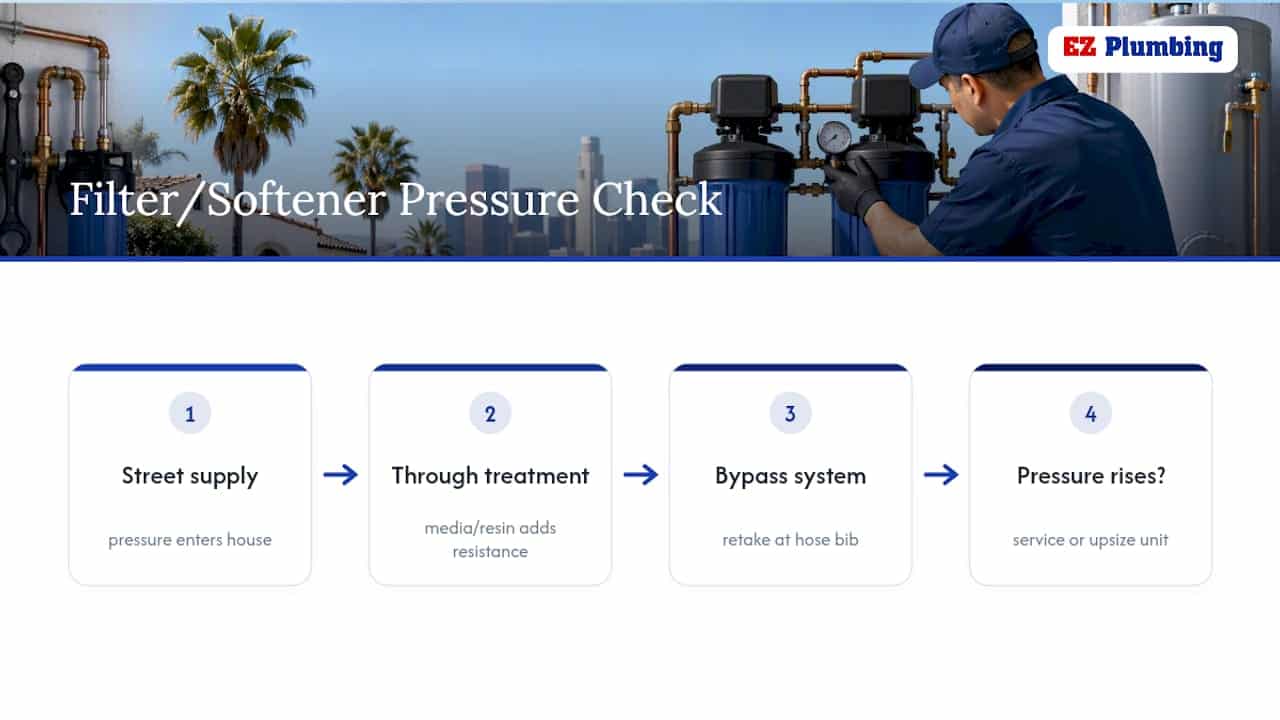
Yes, but usually only a little, and usually only when the system is undersized or overdue for maintenance. Whole-house filters and softeners work by forcing water through a media bed or resin tank, and that extra resistance naturally trims a few PSI off whatever pressure arrives from the street.
The bigger risk isn’t the equipment itself, it’s neglect. A sediment filter that hasn’t been changed in eight months, or a softener resin bed clogged with iron and scale, can act like a partially closed valve and cause a pressure drop that looks exactly like a PRV or main-line problem. If you added a filter or softener around the same time your pressure dropped, that’s your first suspect, not your meter or your PRV.
Sizing matters just as much as maintenance. A softener rated for a two-bathroom home will bottleneck flow in a four-bathroom house even when it’s brand new and perfectly clean. If you’re troubleshooting low pressure and you have a water treatment system installed, bypass it temporarily (most have a bypass valve built in) and retest at the hose bib. If pressure jumps back to normal with the system bypassed, the fix is servicing or upsizing that unit, not chasing a PRV or calling LADWP about the main.
What We See on LA Service Calls
Most of our low-pressure calls fall into three buckets: a PRV nobody’s touched in twenty years, a hillside property that finally needs a booster, or a repipe on a house built before 1960. Every job gets pulled to code, permitted where required, and quoted in writing before we start. Run the checklist above first, and if your numbers hit the red flags, call a licensed plumber.
— EZ
Get a Licensed Diagnosis From EZ Plumbing
If your gauge test came back low, or you’re staring at a PRV you don’t want to touch yourself, EZ Plumbing gives Los Angeles homeowners a faster path than guessing your way through hardware store fixes. We show up with the gauges, leak detection gear, and camera equipment to find the real cause the first visit, not the third one.
Our technicians handle PRV replacement, leak detection, water heater diagnostics for hot-only pressure problems, and full repiping for homes still running on old galvanized lines. Every job is quoted in writing before work starts, and every technician carries the licensing and code knowledge that permitted work in LA requires. If your pressure problem has crossed from annoying to urgent, whether that’s a sudden drop, a spike past 80 PSI, or a leak you can hear in the walls, our emergency plumbing team is available around the clock. Not sure what a fix will run? Use our pricing calculator to get a realistic range before you book, then schedule a diagnostic visit and get a straight answer instead of another guess.
Sources
- Water Pressure | Los Angeles Department of Water and Power
- Water Pressure Problems in Los Angeles
- 6 common plumbing problems and how to fix them — Today’s Homeowner
FAQ
What PSI Counts as Low Water Pressure in Los Angeles?
Anything below 40 to 45 PSI at your outdoor hose bib counts as low for residential use, with readings under 30 PSI considered very low. The comfortable range most LA homes aim for is 45 to 60 PSI.
Why Is My Water Pressure Low Only on the Second Floor?
Elevation is the usual answer. Every 2.31 feet of height above the meter costs about 1 PSI, so a two-story home or a hillside lot can lose several PSI before the water even reaches your upstairs bathroom.
Can I Adjust My Own PRV to Fix Low Pressure?
You can, but it’s risky without a gauge and calibration experience, since a small turn on the adjustment screw can send pressure spiking well past safe limits. It is recommended to leave PRV adjustment and replacement to a licensed plumber.
How Do I Know if LADWP or My Own Plumbing Is the Problem?
Test your outdoor hose bib and compare notes with a neighbor on the same block. If their pressure is normal and yours isn’t, the problem is inside your property; if pressure is low across the block, contact LADWP directly for location-specific pressure records.
Does EZ Plumbing Offer Pricing for Diagnostic Visits?
Current rates for residential service run $150 to $280 per hour, and the exact cost for your situation depends on the diagnosis. You can check current pricing and get an estimate through the EZ Plumbing pricing calculator before booking.
Recommended
- Low Water Pressure in Your LA Apartment: What to Do Now
- Causes of Low Hot Water Pressure and How to Fix Them
- How to Fix Low Water Pressure in House
- Sudden Drop in Water Pressure? a 2026 Diagnostic Guide
Recent EZ Plumbing Jobs in Los Angeles
Real, recent work from our crews — updated automatically as jobs complete.