
Pass LA Water Heater Inspections in 3 Days: Pro Code Checklist
Yes, the City of Los Angeles requires a plumbing permit for water heater installation or replacement, including same-for-same swaps. Before an inspector signs off, your installation needs two seismic straps, a properly piped temperature and pressure relief valve, a drain pan where required, and an expansion tank if your home has a closed system. Complete applications typically clear in a few business days, and at least one inspection is required before the job is considered legally finished.
TL;DR:
- A permit is required for all water heater installations in Los Angeles, including similar replacements, with approval typically taking around three business days.
- Permits cover plumbing, gas, and electrical work for tankless, relocated, or heat pump units, reflecting the project’s complexity and infrastructure modifications.
- Inspection checklists include seismic straps, T&P discharge lines, drain pans, expansion tanks, clearances, and proper enclosures, which need documentation beforehand.
- Common reasons for inspection failure are missing or incorrect seismic straps, capped discharge lines, improperly installed drain pans, and unapproved work covered before inspection.
- Using a licensed contractor who manages permit submission, inspections, and documentation reduces delays, legal risks, and liability caused by unpermitted work.
Table of Contents
- What Los Angeles Codes and Agencies Govern Water Heater Installations
- Do You Need a Permit to Install a Water Heater in Los Angeles?
- What Hardware Does an LA Inspector Check on Installation Day?
- Special Cases: Tankless Conversions, Heat Pump Units, and Relocations
- Inspection Sequence and the Mistakes That Trigger Rework
- How Much Does a Code-Compliant Water Heater Installation Cost?
- What to Require From Your Contractor Before Work Begins
- EZ Plumbing’s Approach to Code Compliant Water Heater Work in Los Angeles
- Why Licensed, Code-Aware Contractors Matter More Than the Permit Fee Suggests
- Get a Code-Compliant Water Heater Installation Handled Start to Finish
- Where to Find the Official Codes and Permit Forms
- Sources
- FAQ
What Los Angeles Codes and Agencies Govern Water Heater Installations
Three layers of authority shape water heater code in Los Angeles, and knowing which one to check saves you from calling the wrong office. The base framework is the California Plumbing Code (CPC), the statewide standard every jurisdiction builds on. Los Angeles adopts and amends that standard through its own municipal ordinance, generally referred to as the Los Angeles Plumbing Code, which defines scope, inspection triggers, and local technical add-ons. If your property sits in unincorporated LA County rather than the city proper, a separate but closely related county plumbing code ordinance applies instead, with its own amendments on details like drain pan sizing.
Three agencies handle enforcement and guidance, each with a distinct role:
- LADBS (Los Angeles Department of Building and Safety) issues permits, reviews plans, and performs the inspections that determine whether your installation passes.
- LADWP (Los Angeles Department of Water and Power) plays more of an advisory role on green building and water heating efficiency, and it publishes guidance on how city and state code interact.
- Local licensed contractors who regularly file LADBS permit packages tend to anticipate the plan-review questions specific to older LA housing stock, from knob-and-tube wiring near new HPWH circuits to undersized gas lines feeding a tankless retrofit.
When city, county, and state rules overlap, LADWP’s own guidance states that the most stringent requirement prevails. In practice, that means a local amendment written for LA’s seismic risk or older housing stock will usually override a more general state minimum. If you’re ever unsure which rule applies to your address, read the code text for background, but call LADBS permit staff before you buy equipment or schedule installation. They will tell you definitively which version of the code governs your parcel.
Do You Need a Permit to Install a Water Heater in Los Angeles?
Almost always, yes. A straightforward tank replacement, swapping a 40-gallon gas unit for the same type in the same closet, still requires a plumbing permit under the City of Los Angeles’s water heater rules. There is no informal exemption for “like-for-like” work, even though many homeowners assume otherwise because the job looks identical to what was there before.
The permit stack gets more complicated once the project moves beyond a straight swap:
- Same-for-same tank replacement needs a plumbing permit only.
- Tank-to-tankless conversion needs a plumbing permit plus a gas permit, and often an electrical permit if the new unit requires power for ignition or venting controls.
- Relocating the unit to a new spot in the house needs the full stack: plumbing, gas, and typically electrical.
- Heat pump water heater installs need plumbing and electrical permits at minimum, since these units run on a dedicated 240V circuit.
Your LADBS application needs specifics, not vague descriptions. Have your contractor ready with the equipment make and model, fuel type, venting configuration, a site plan showing the unit’s location, and their license number for the record. LADBS uses this information during plan review to confirm the equipment meets current listing and efficiency standards, including the federal appliance rules under Title 20 and Title 24 energy standards.
Turnaround for a complete, straightforward application through LADBS’s Express Permit process runs about three business days. That timeline assumes your paperwork is clean on the first pass. Missing details, an unlisted appliance model, or an incomplete site plan will bounce the application back for correction, which is where most delays actually happen. Contractors who file LADBS permits regularly tend to get faster first-pass approvals simply because they know what plan reviewers flag most often.
If you want to understand the difference between city and county jurisdiction before you file, this breakdown of Los Angeles plumbing code requirements walks through which rules apply to which addresses.
What Hardware Does an LA Inspector Check on Installation Day?
Inspectors are not guessing when they walk into your utility closet or attic. They are working from a specific checklist, and every item on it has a code section behind it. Here is what gets scrutinized, in the order most inspectors work through it.
- Seismic strapping. California’s earthquake risk means every water heater needs two straps, one in the upper third of the tank and one in the lower third, secured to wall studs or an approved bracket system rather than drywall alone. Inspectors reject straps that sit too close together or that anchor into material that can’t hold the tank’s weight during shaking. If you want the exact placement and mounting hardware that passes inspection the first time, see this guide to water heater seismic straps.
- Temperature and pressure relief valve and discharge line. The T&P valve itself must be a listed device rated for the tank, installed in the correct orientation. The discharge pipe has to run to an approved termination point, typically within 6 inches of the floor or to an outdoor location where scalding water won’t hit anyone. A threaded cap on the discharge end is an automatic fail; the line has to stay open so it can actually vent pressure in an emergency.
- Drain pans. Any water heater installed in an attic, above living space, or in a location where a leak could damage the structure below needs a corrosion-resistant drain pan. Local amendments specify a minimum pan depth of 1.5 inches and a drain diameter of at least 3/4 inch, piped to a visible, approved discharge point rather than left to dead-end inside a wall cavity.
- Expansion tanks. If your home has a pressure-reducing valve (PRV) creating a closed plumbing system, code requires an expansion tank to absorb the pressure spike that happens when water heats and expands with nowhere to go. It installs on the cold-water inlet line, sized to the tank’s capacity. Skip this on a home with a PRV and you’re not just risking a failed inspection, you’re risking a burst fitting down the road. This walkthrough of expansion tank requirements covers sizing and placement in more detail.
- Clearances and enclosures. Garage installations need the ignition source elevated 18 inches above the floor for gas units unless the model is specifically listed as flammable-vapor-resistant. Outdoor enclosures need weatherproofing and combustion air access. Attic installs need a solid, code-compliant platform and a clear access path for future service.
Pro Tip: Take photos of the strapping, T&P discharge routing, and drain pan connection before you close up any wall or ceiling access. If an inspector has questions later, or if you ever sell the property, that documentation saves you from reopening finished work.
Special Cases: Tankless Conversions, Heat Pump Units, and Relocations
Not every water heater project is a simple swap, and the special cases are exactly where homeowners get blindsided by scope and cost they didn’t budget for.
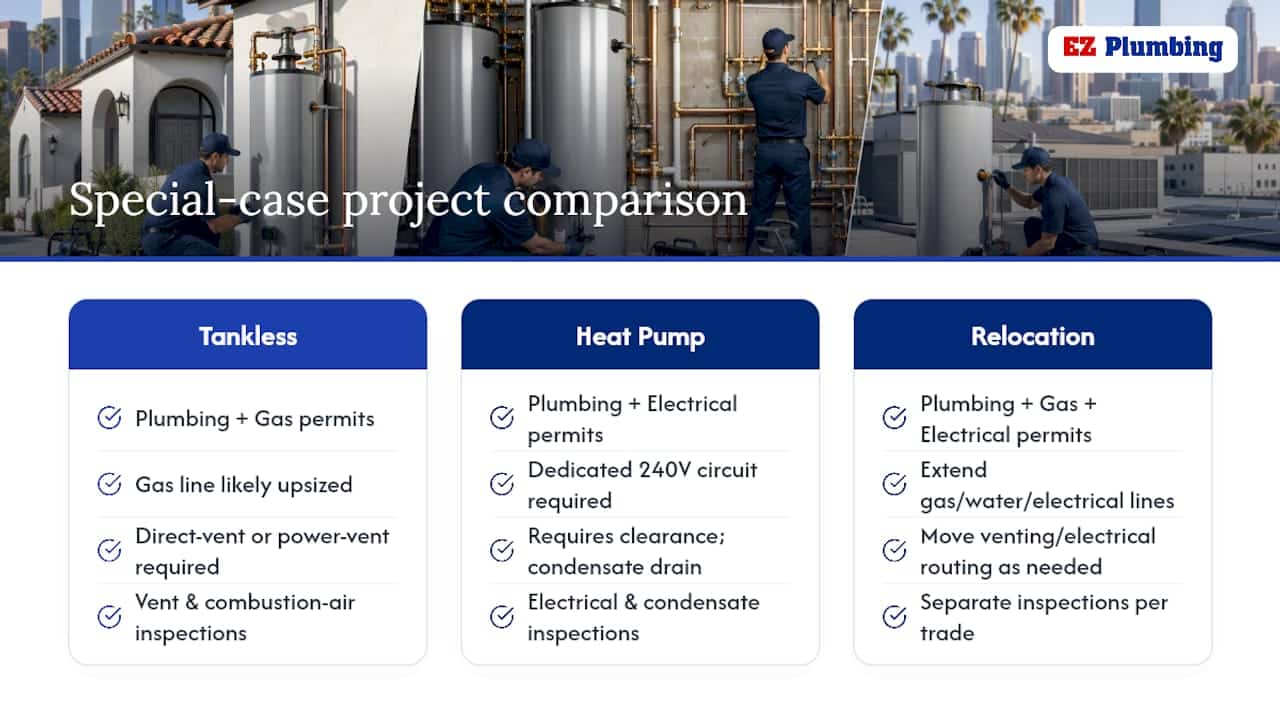
Tankless gas conversions almost always involve more than just permit paperwork. Older LA homes were frequently plumbed with gas lines sized for a single 40,000 BTU tank heater. Tankless units draw significantly more gas on demand, often north of 150,000 BTU, and running the numbers on your existing line size early avoids a mid-project surprise. Expect to pull a plumbing permit and a gas permit, and expect a venting change: tankless units typically require dedicated direct-vent or power-vent systems that a standard atmospheric flue can’t support. Combustion air supply has to meet code as well, particularly in tightly sealed, remodeled homes where makeup air is limited.
Heat pump water heaters (HPWH) bring an electrical dimension into a job that used to be purely plumbing. These units need a dedicated 240V circuit, which means an electrical permit alongside your plumbing permit. They also need adequate air volume around the unit to pull heat from the surrounding space efficiently, so a cramped closet installation that worked fine for a gas tank may not meet the manufacturer’s clearance spec for a heat pump model. Condensate drainage is another item inspectors check, since HPWH units produce water as a byproduct of the heat exchange process, and that water needs a proper drain path rather than a bucket someone forgot to empty.
Relocating a unit entirely, moving it from a garage to a new interior closet, for instance, is the most permit-intensive scenario of the three. You’re typically looking at plumbing, gas, and electrical permits together, plus separate inspections for each trade. Extending gas lines, water lines, and electrical circuits to a new location adds labor hours that a same-spot replacement never touches, which is usually the biggest line item in why relocation costs more than people expect going in.
Inspection Sequence and the Mistakes That Trigger Rework
LADBS inspections for water heater work generally follow a sequence, and skipping a step or covering work before it’s checked is the single most common way a project gets delayed.
For most installations, the sequence runs: rough-in inspection where applicable (mainly relevant on relocations or new gas/water line runs), a gas and venting check, an electrical inspection if a heat pump unit or new circuit is involved, and a final inspection that confirms the complete, operating system meets code.
The failures inspectors cite most often are avoidable with basic attention to detail:
- T&P discharge piping that’s missing entirely, capped, or routed to a spot that doesn’t meet the approved termination requirement.
- Seismic strapping that’s undersized, incorrectly spaced, or anchored into material that won’t hold under load.
- Hidden work that got covered by drywall or insulation before the inspector saw it, forcing a costly reopening.
- Undersized gas lines or venting on tankless conversions where the original infrastructure wasn’t upgraded to match the new unit’s demand.
Pro Tip: Ask your contractor for a written pre-inspection checklist before the inspector arrives. Walking through strapping, T&P discharge, drain pan connection, and gas line sizing yourself, or having your contractor confirm each item out loud, catches the small stuff that causes a failed inspection and a second visit.
How Much Does a Code-Compliant Water Heater Installation Cost?
Permit fees and installation costs both vary by project type and complexity, and the biggest cost driver isn’t the equipment, it’s how much of the existing infrastructure has to change to support it.
Installed cost climbs with complexity. A straightforward tank swap tends to run lower than a tankless conversion, which in turn usually costs less than a full relocation once you factor in extending gas, water, and electrical utilities to a new spot. Structural work, like reinforcing an attic platform or adding new venting through a roof, adds to the total as well. For a project-specific estimate, EZ Plumbing’s cost calculator breaks down labor rates by job type so you can budget before committing to a contractor.
What to Require From Your Contractor Before Work Begins
The fastest way to avoid a failed inspection or an unpermitted installation sitting on your property is to vet your contractor before they touch a single pipe.
- Ask for their license number and verify it. A licensed plumbing contractor in California carries a C-36 license, and you can confirm it’s active through the Contractors State License Board before signing anything.
- Confirm they’re pulling the permit, not you. A contractor who suggests skipping the permit or doing the work “off the books” is putting your property at legal and safety risk, full stop.
- Get the permit number and posted copy on site. LADBS requires the permit to be visible at the job location during work and inspection.
- Request a written scope listing every code item. Strapping, T&P valve and discharge, drain pan, and expansion tank should all be named explicitly, not assumed.
- Ask for the inspection schedule up front. A contractor who regularly files LADBS permits should know roughly when each inspection will happen and coordinate around it.
- Require final compliance documentation. Once the last inspection passes, you should receive a signed statement confirming the job is complete and permit closed, not just a verbal “we’re done.”
EZ Plumbing’s Approach to Code Compliant Water Heater Work in Los Angeles
Water heater installation and repair sit at the center of licensed plumbing work serving residential and commercial properties in the greater Los Angeles area. That means every job, from a straightforward tank swap in Highland Park to a heat pump conversion in Pasadena, goes through the same permit submission and inspection coordination process LADBS expects.
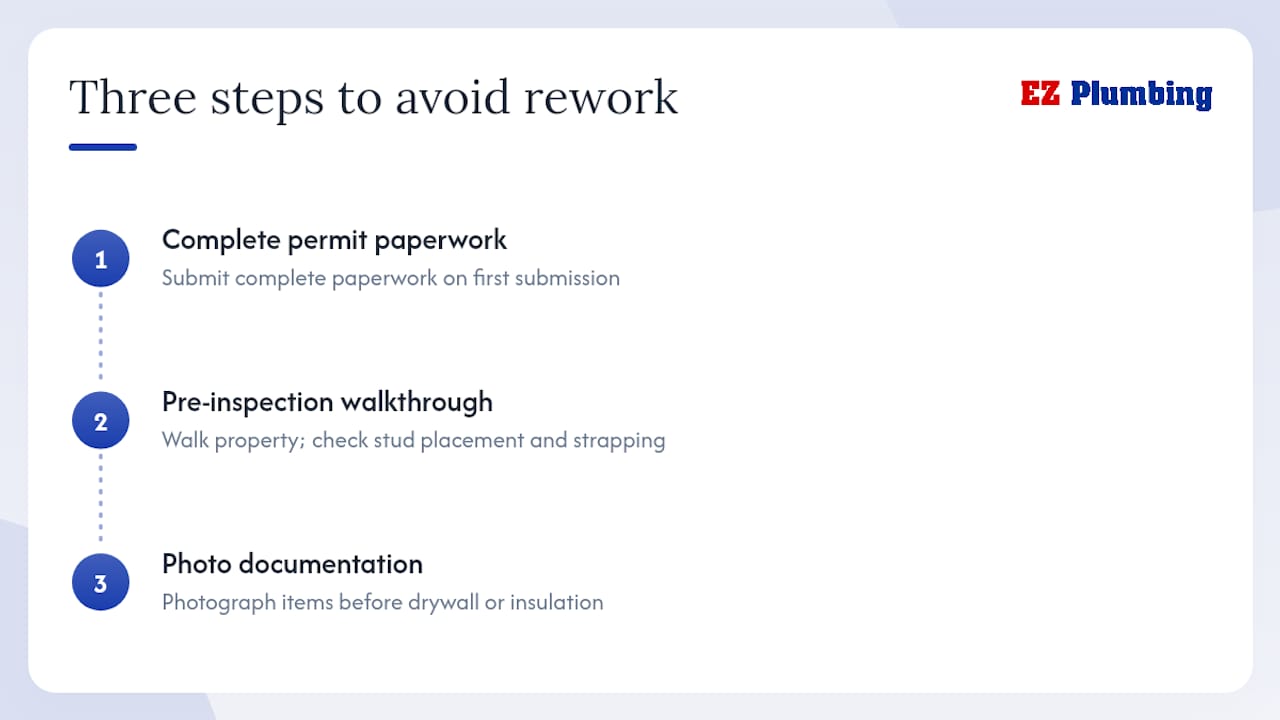
The rework EZ Plumbing sees most often on other contractors’ jobs traces back to a handful of repeat causes: incomplete permit documentation that stalls plan review, seismic strapping installed without checking stud placement first, and drain pans piped to nowhere useful. The fix isn’t complicated. Complete paperwork on the first submission, a pre-inspection walkthrough before the LADBS inspector shows up, and photo documentation of every item that gets covered by drywall or insulation later. That combination is what keeps a project moving through permit, install, and final sign-off without a callback.
Why Licensed, Code-Aware Contractors Matter More Than the Permit Fee Suggests
Skipping a permit to save a few hundred dollars is one of the more expensive shortcuts a Los Angeles homeowner can take. Unpermitted water heater work shows up on title reports and home inspections, and it becomes the buyer’s leverage point in every resale negotiation from here forward. Insurance companies have also been known to deny water damage claims tied to unpermitted plumbing work, which turns a code shortcut into a liability problem years after the installation.
For property managers and HOAs, the documentation trail matters even more. A permitted, inspected installation is a paper record that protects the association or management company if a tenant or resident is ever injured by a leak, a scald, or a gas issue. Following LA’s water heater code isn’t paperwork for its own sake. It’s the difference between a property that holds its value and one carrying a hidden liability nobody notices until it’s expensive.
— EZ
Get a Code-Compliant Water Heater Installation Handled Start to Finish
Licensed plumbing contractors can pull the permit, schedule the inspections, and handle the installation, so you’re not the one chasing LADBS paperwork between appointments while trying to run a household or a property portfolio.

Some local, experienced plumbing contractors have spent decades navigating the specific code quirks of Los Angeles housing stock, from older homes with undersized gas lines to newer builds with PRVs that require expansion tanks. Book a site visit and the team handles the permit submission, confirms every mandatory item (straps, T&P discharge, drain pan, expansion tank) before the inspector ever shows up, and hands you final compliance documentation once the job closes out. For same-for-same replacements, water heater installation covers the full process from quote to final sign-off. If you’re weighing a tank versus tankless versus heat pump decision, check current pricing before you commit to equipment, and if you just need help figuring out whether your project needs a permit at all, EZ Plumbing’s water heater permit guidance walks through it in plain language. Call to schedule a site visit and get the permit process started this week.
Where to Find the Official Codes and Permit Forms
For the exact code language rather than a summary, LADBS’s plumbing permits page has current application forms and Express Permit information. The full text of the Los Angeles Plumbing Code is available through the municipal code library, and a more readable chapter view covering water heaters specifically is available through UpCodes’ LA plumbing code viewer. If your property falls under county jurisdiction rather than city, the LA County plumbing code ordinance has the applicable amendments. For equipment efficiency questions tied to Title 20 and Title 24 standards, the DOE’s appliance standards database and Energy Saver’s guide to selecting a water heater cover the federal side of the requirement.
Sources
FAQ
Do I Need a Permit to Install a New Water Heater in Los Angeles?
Yes. LADBS requires a plumbing permit for any water heater installation or replacement in the city, including same-for-same swaps, and typical approval takes about three business days for a complete application.
What Is the California Code for Water Heaters?
The California Plumbing Code sets the statewide baseline for water heater installation, and Los Angeles adopts and amends it through its own municipal plumbing code, with LADBS enforcing the local version.
What Are the New Rules for Water Heaters in California?
Current requirements center on seismic strapping, proper T&P valve discharge, drain pans in vulnerable locations, and expansion tanks on closed systems. Local Los Angeles amendments add specifics like a 1.5 inch pan depth and 3/4 inch minimum drain diameter.
What Code Applies Specifically in Los Angeles, California?
Properties within city limits follow the Los Angeles Plumbing Code, while unincorporated LA County properties follow a separate county ordinance; when the two overlap with state code, the most stringent rule prevails.
Does EZ Plumbing Handle the Permit Process for Me?
Yes, EZ Plumbing submits the LADBS permit application, schedules required inspections, and provides final compliance documentation as part of its water heater installation service.
Recommended
- Los Angeles Homeowners: Express Water Heater Permit in 1–3 Days
- Natural Gas Water Heater Installation: A Los Angeles Guide
- Water Heater Maintenance Checklist: 2026 Guide
- Los Angeles plumbing code: A compliance guide for homeowners
Recent EZ Plumbing Jobs in Los Angeles
Real, recent work from our crews — updated automatically as jobs complete.