
Gas Water Heater Not Heating Water: A Practical Guide
You step into the shower before work and the water turns cold before you can rinse the shampoo out. In the utility area, the gas water heater's burner window is dark, and the tank feels like it isn't recovering. For a Los Angeles homeowner, “gas water heater not heating water” can mean a simple pilot outage, a burner problem, a control failure, or a safety condition that shouldn't be handled with a screwdriver.
Stay calm and observe first. The difference between no hot water, lukewarm water, and a short burst of hot water is one of the most useful clues you can give a plumber. A gas water heater is often the home's only hot-water source. The U.S. Energy Information Administration's residential energy data records 59.33 million U.S. homes using natural gas for their main water heater, while 117.78 million homes had no secondary water heater, so a single failed unit can affect every shower, sink, and appliance that uses hot water.
Table of Contents
- What to Do When Your Gas Water Heater Stops Heating
- Common Reasons a Gas Water Heater Stops Heating
- Safety First Before You Touch Anything
- Step-by-Step Diagnostic Checks You Can Do at Home
- DIY Fixes Versus When to Call a Licensed Plumber
- Preventative Maintenance for Los Angeles Homes
What to Do When Your Gas Water Heater Stops Heating
Start with the symptom, not the tools. If the shower is cold, run the hot tap at a nearby sink for a minute. If the sink also stays cold, the heater is the likely source. If only one fixture is affected, a failed cartridge, mixing valve, or local plumbing restriction may be responsible instead.
Use the first ten minutes carefully
- Check the thermostat dial. Look for a setting that has been turned down accidentally. Don't remove the gas control assembly or force a stiff knob.
- Look through the burner window. Depending on the model, you may see a standing pilot flame or an electronic status light. A dark window means the heater may not be receiving a call for heat.
- Listen near the tank. A click followed by burner ignition suggests the control is attempting to operate. Silence after the thermostat calls for heat points toward ignition, gas supply, or control trouble.
- Run a second hot tap. This distinguishes a whole-house heating problem from a single-fixture problem.
- Record what happens. Write down whether the water is cold immediately, lukewarm, briefly hot, or accompanied by popping, dripping, unusual odors, or rusty color.
Practical rule: Observe the heater before resetting or relighting anything. A symptom that disappears can make the eventual diagnosis harder.
If you smell rotten eggs or hear gas escaping, stop. Don't relight the pilot, operate electrical switches, or search for the source. Leave the property and contact the gas utility from a safe location.
Common Reasons a Gas Water Heater Stops Heating
A gas water heater can fail completely, or it can keep working so poorly that a normal demand feels like a breakdown. Water-heating equipment is a major, persistent household energy use. In Canada, residential water-heating energy use rose from 230.8 PJ in 1990 to 291.5 PJ in 2017, while natural-gas water-heating energy use rose from 129.0 PJ to 200.9 PJ over the same period, according to Natural Resources Canada's residential energy trends. That helps explain why ignition, burner, gas-supply, and temperature-control faults deserve a careful diagnosis.
Match the symptom to the likely cause
- No pilot flame: An extinguished pilot prevents the main burner from operating. If the pilot lights but won't stay lit, a weak thermocouple, blocked pilot assembly, or failing control may be involved.
- No response from the burner: A closed supply valve, utility interruption, or tripped gas control can leave the tank cold even when the thermostat is turned up.
- Small, yellow, or uneven flame: A dirty or corroded burner orifice can restrict gas flow. Soot, lazy flames, or repeated ignition attempts require professional attention because combustion quality matters.
- Popping or rumbling from the tank: Sediment at the bottom can insulate the burner from the water and create localized boiling. The heater may still produce hot water, but recovery becomes slow.
- Only lukewarm water: Don't assume the gas supply has failed. Sediment, a thermostat that stops calling for heat, a usage spike, or a tank that's recovering slowly can all produce partial heating. The Spruce's gas water-heater troubleshooting guide also identifies sediment as a cause of reduced heating performance, not only total shutdown.
- Hot water runs out unusually fast: A deteriorated dip tube may send incoming cold water toward the outlet instead of keeping it at the bottom of the tank.
- Rusty water or moisture around the tank: A leaking drain valve, pressure-relief valve, or corroded tank can reduce performance and signal a larger repair.
- Repeated shutdowns: A malfunctioning gas control valve, failing flame-sensing component, restricted combustion air path, or venting fault can stop the heater for safety reasons.
For broader heating-system terminology, a heating repair resource from Comfort Experts can help homeowners understand how ignition, airflow, and safety controls affect gas appliances, though a water-heater diagnosis still needs to match the specific appliance.
Safety First Before You Touch Anything
Gas troubleshooting starts with the air around the appliance. Natural gas is odorized with mercaptan, which commonly creates a rotten-egg smell. If you notice that odor, especially alongside a pilot outage or hissing sound, don't continue checking the burner window. Leave immediately, avoid flames and switches, and call the gas utility from outside or from another safe location. Guidance on the correct response is available in what to do if you smell gas.
Identify the shutoffs
Before inspecting a heater, locate these controls without turning anything unnecessarily:
- Gas shutoff valve: Found on the supply line near the tank. Know which position closes gas, but don't manipulate it repeatedly if you suspect a leak.
- Cold-water shutoff: Located on the pipe entering the top of the tank. Closing it can limit water flow if a leak develops.
- Electrical disconnect: Some gas models use electronic ignition, powered controls, or a nearby outlet. If the unit has electrical components, know how to disconnect power without reaching into the burner area.
Use a flashlight, not a match, lighter, or improvised flame. Keep combustible materials away from the heater, and don't place your face near the burner opening. If a removable outer door is designed to stay in place during operation, follow the manufacturer's instructions rather than leaving the combustion chamber exposed to drafts.
Never treat a gas smell as a pilot-light problem. Treat it as a gas emergency.
A homeowner can observe a pilot, thermostat setting, status light, and visible leak from a safe position. Replacing a thermocouple, opening a gas control valve, changing a gas connector, or disconnecting a gas union belongs with a licensed plumber and, where utility equipment is involved, the gas company. California gas work isn't a good place to test a repair theory.
Step-by-Step Diagnostic Checks You Can Do at Home
Follow the sequence from the control to the tap. Stop at the first unsafe sign rather than continuing to the next step.
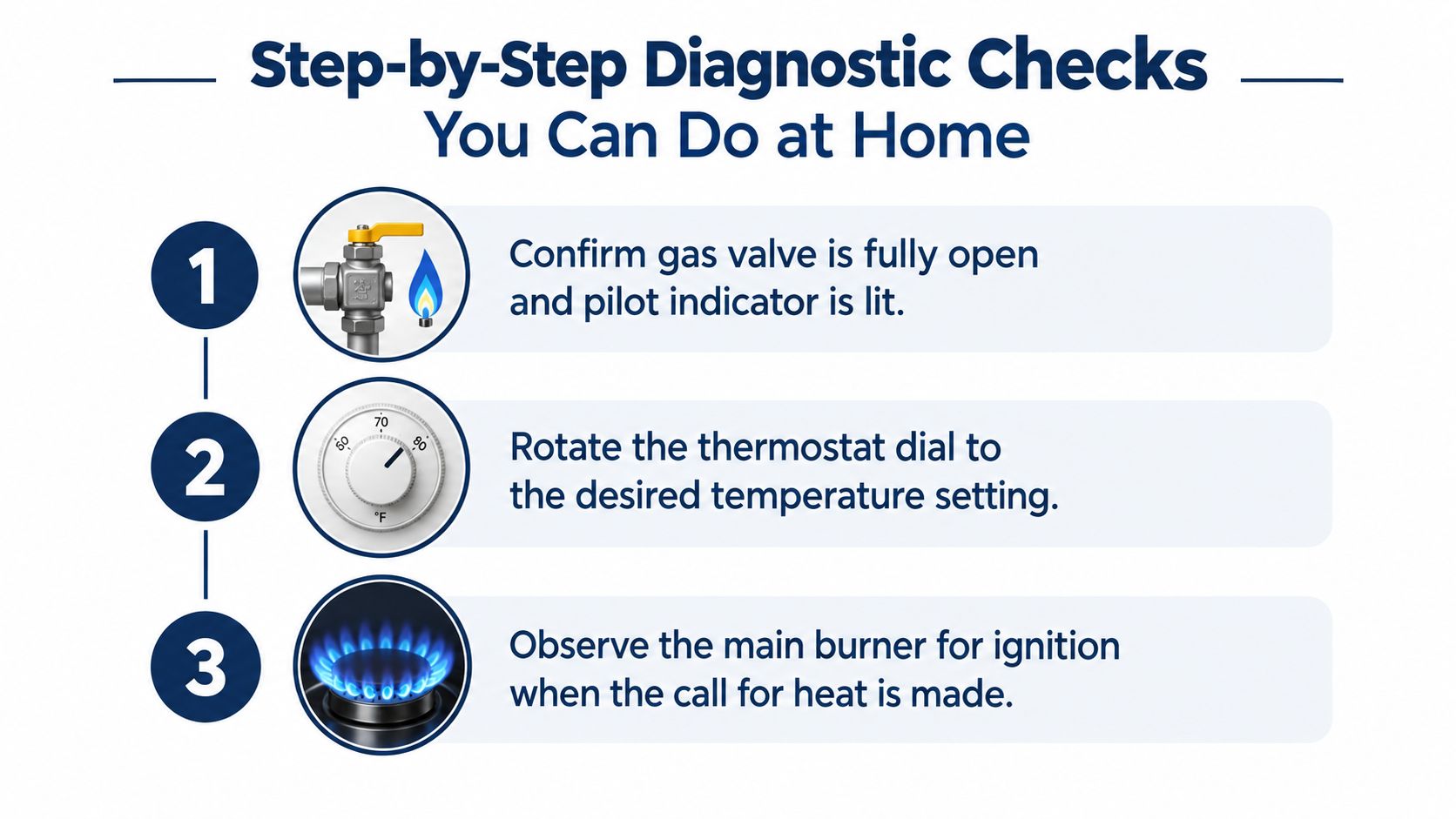
Confirm the gas valve and pilot status. Look at the manual gas valve on the supply pipe. A handle aligned with the pipe usually indicates an open position, but use the appliance label and valve markings as the authority. Check the pilot indicator or sight glass. If you smell mercaptan, stop and leave instead of relighting.
Raise the thermostat slightly. Turn the temperature dial upward only enough to create a call for heat. Listen for a click from the control and then for burner ignition. No click can point toward the thermostat or control circuit. A click without ignition suggests a gas-flow, pilot, igniter, or control problem.
Observe the burner briefly. With the correct outer cover removed only as directed by the manufacturer, look for a prompt, steady blue flame. Yellow, wavering, smoky, or delayed ignition isn't a cleaning invitation. It can indicate blocked combustion air, a dirty burner, or venting trouble. A.O. Smith's troubleshooting guidance highlights blocked air screens or filters as a gas-model concern because restricted combustion air can affect burner performance and safety shutdowns.
Check whether heat reaches the outlet. Once the burner operates, carefully touch the outgoing hot-water pipe without contacting the burner compartment. A pipe that warms indicates heat is moving out of the tank. If the burner runs but the outlet remains cool, the tank may need recovery time, or an internal component such as the dip tube may be affecting delivery.
Inspect the relief discharge area. Look for steady dripping from the temperature-and-pressure relief discharge pipe. A persistent drip can indicate a relief-valve issue, excessive pressure, or a temperature problem. Don't cap the pipe or remove the valve.
For control-valve symptoms, review this gas water heater control valve repair guide before deciding whether the next step is a service call.
A short demonstration can help you recognize the control and burner sequence, but video guidance doesn't replace an on-site safety diagnosis.
DIY Fixes Versus When to Call a Licensed Plumber
The safe boundary is simple. Homeowners can observe controls and perform limited, manufacturer-approved adjustments. They shouldn't open gas fittings, bypass safety devices, or replace components that control combustion.
Tasks that may be reasonable for a homeowner
- Relighting a pilot: Only follow the exact instructions printed on the heater. Never relight if there's a gas odor, and stop if the flame won't remain lit.
- Adjusting the thermostat: A setting around 120°F is commonly used for household water heating, but confirm the appliance instructions and household needs before changing it.
- Removing visible dust from accessible surfaces: A stiff brush or vacuum can help with loose exterior dust, but don't push tools into the burner orifice, pilot assembly, vent, or combustion chamber.
- Checking for visible leaks: Look, but don't tighten gas fittings or cap a relief discharge pipe.
Work that belongs with a licensed plumber
Thermocouple replacement, gas-control-valve replacement, dip-tube extraction, burner disassembly, gas-union disconnection, and venting corrections require trained judgment. A California C-36 licensed contractor should handle gas-line modifications, and required permits apply to gas-line work. If the pilot repeatedly goes out, the burner flame is abnormal, or the control valve appears faulty, schedule service rather than repeating the ignition cycle.
The costs below are planning ranges supplied in the brief, not a promise or diagnosis. Actual pricing depends on access, model, parts, code corrections, and whether emergency service is needed.
| Repair Task | Who Does It | Estimated Cost | Typical Time |
|---|---|---|---|
| Pilot relight or thermostat adjustment | Homeowner, if safe and manufacturer-approved | No part cost | A few minutes |
| Accessible exterior dust cleaning | Homeowner | No part cost | A short maintenance task |
| Thermocouple service | Licensed plumber | $120 to $180 | Often a same-visit repair |
| Gas control valve replacement | Licensed plumber | $400 to $700 | Usually a scheduled service visit |
| Dip-tube extraction or replacement | Licensed plumber | Varies by diagnosis and model | Schedule after inspection |
| Gas-union or gas-line work | Licensed plumber and applicable utility or permitting process | Varies by scope | Planned service |
If the heater is in a tight closet, serves multiple units, or supplies a commercial property, a professional can also distinguish delayed recovery from a component failure before parts are ordered.
Preventative Maintenance for Los Angeles Homes
Los Angeles heaters face two recurring pressures: mineral accumulation in the tank and airborne debris around combustion openings. A maintenance plan should address both. If a heater produces less hot water, makes popping sounds, or shows sediment at the drain, a water-heater maintenance checklist gives you a useful starting point for documenting service.
Prioritize the tank and water path
Sediment flushing is the central task for a storage tank. The brief identifies hard-water areas across the San Fernando Valley and South Bay at 8 to 12 grains per gallon, so calcium scale can collect at the tank bottom and slow heat transfer. A full drain-and-flush every six months can remove loose buildup, but don't force a seized drain valve or begin if the discharge can't be routed safely.
Inspect the anode rod regularly. The brief notes that aggressive local water can exhaust a standard magnesium rod in as little as four years, and an aluminum-zinc replacement may be appropriate after a plumber evaluates the tank and water conditions. The rod protects the steel tank by corroding before the tank does, so waiting for rusty water means the inspection may already be overdue.
Protect combustion performance
Dust from Santa Ana winds, wildfire smoke, and nearby construction can collect around the burner chamber, intake screen, and vent path. Vacuum accessible dust without disturbing burner components, and have a plumber inspect restricted screens, soot, flame quality, and venting. A blue flame that becomes lazy or yellow deserves service, not repeated brushing.
Also check that earthquake straps remain snug, test the temperature-and-pressure relief valve only according to the manufacturer's procedure, and inspect the gas flex connector for corrosion. Keep records of flushing, anode inspection, leak checks, and burner cleaning. Those notes help a plumber separate a gradual recovery problem from a sudden ignition failure.
EZ Plumbing provides gas water-heater repair, maintenance, installation, and replacement for residential and commercial systems in Los Angeles. If your tank is cold, leaking, repeatedly shutting down, or producing only lukewarm water, visit EZ Plumbing to request service and describe the symptoms you recorded. A licensed technician can assess the gas supply, ignition, burner, controls, leaks, and recovery performance without asking you to take unsafe shortcuts.