
How to Snake a Main Drain the Right Way
The washing machine is draining, the shower starts filling, and the toilet gives a hollow gurgle from down the hall. You shut off the washer, check the sink, and realize this isn't one dirty trap under one fixture. The blockage is probably farther downstream, where several drains share the main line.
That's the point where a main-drain snake can restore flow, but only if you use the right access point, the right machine, and enough restraint to recognize when the pipe itself is the problem. A cable can open a passage through roots, grease, paper, or a soft blockage. It can't repair a collapsed, bellied, badly offset, or severely deteriorated sewer line.
Table of Contents
- When You Actually Need to Snake a Main Drain
- Tools, Materials, and Safety Gear to Gather First
- Snaking Through a Cleanout Step by Step
- Access Scenarios That Change the Approach
- Common Problems, Mistakes, and When to Stop
- Los Angeles Specifics Every Homeowner Should Know
- Prevention, Follow Up, and Quick Answers
When You Actually Need to Snake a Main Drain
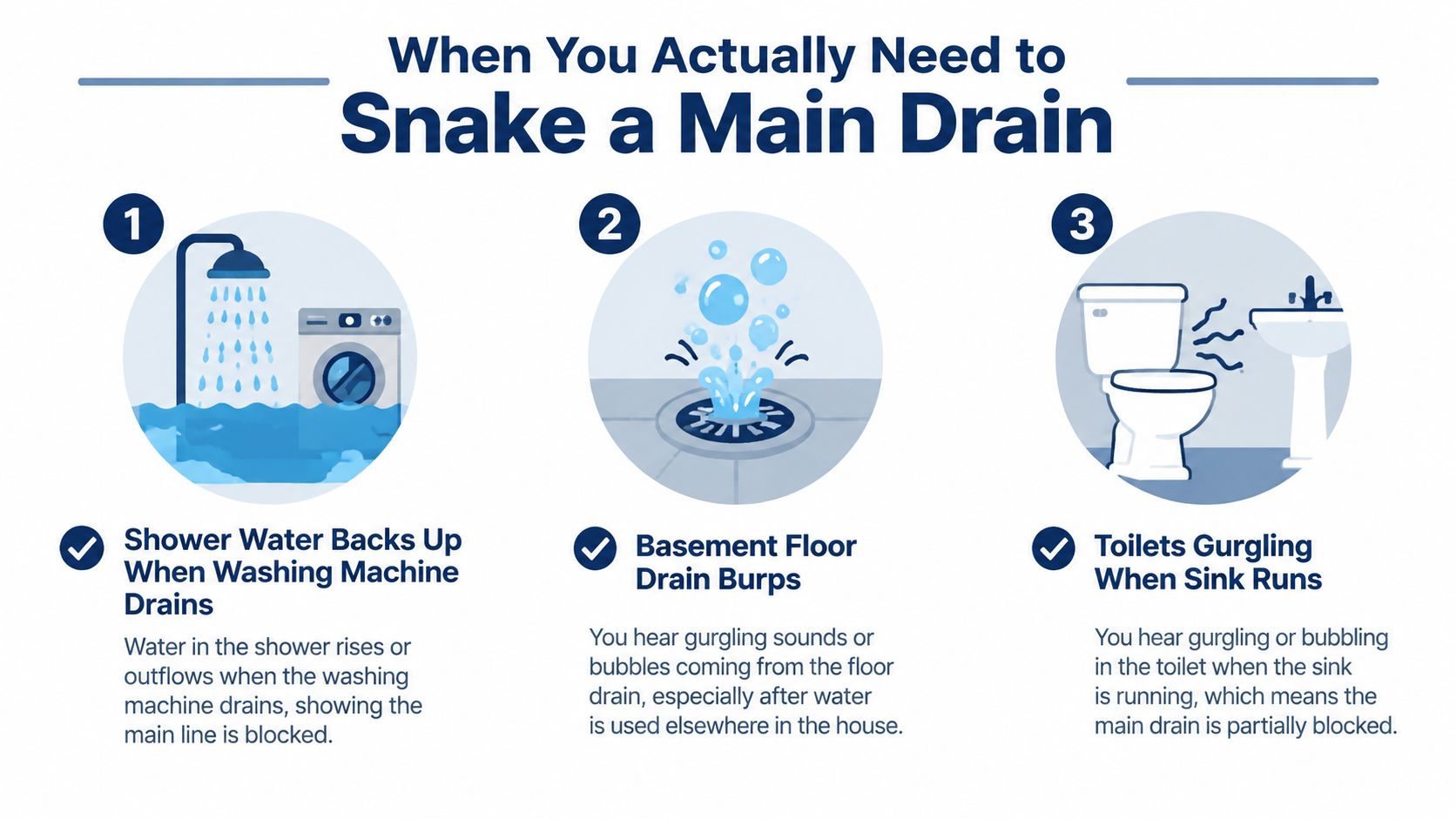
A main-line clog usually announces itself through more than one fixture. The shower may back up when the washing machine pumps out, the basement floor drain may burp or bubble, or the toilet may gurgle when you run a nearby sink. Those symptoms tell you that wastewater is meeting resistance after the fixtures join the larger drain, not just inside one sink or tub branch.
Try a simple observation test before opening anything. Flush a toilet while running a nearby sink, then watch and listen to the lowest drain in the house. If the toilet bubbles, the sink drains slowly, or water rises in a shower or floor drain, treat the pattern as a possible main-line restriction.
Partial and complete blockages
A partial blockage still allows some flow. You might get through a shower if nobody runs the laundry, but the system backs up whenever several fixtures discharge together. That's often a workable cleanout-and-snake situation, although delaying can turn a nuisance into an indoor sewage backup.
A complete blockage leaves nowhere for wastewater to go. Multiple fixtures may stop draining, and the lowest opening can overflow first. If sewage is already surfacing inside the house, stop treating this as a casual Saturday repair. Keep people and pets away from the contaminated area, avoid running water, and call a licensed Los Angeles contractor for emergency help.
Practical rule: The more fixtures involved, and the lower the backup appears, the farther downstream you should assume the obstruction is.
Snaking makes sense when the obstruction is reachable and the pipe is structurally sound enough to accept a rotating cable. It won't solve a broken lateral, a persistent root entry, a sag that holds standing water, or a blockage that keeps returning because the pipe wall is heavily coated. For broader context on professional line clearing, see sewer line cleaning in Los Angeles.
Tools, Materials, and Safety Gear to Gather First
Treat main-drain work like loading a service truck. The machine matters, but the setup around it keeps sewage, cable recoil, and contaminated water from turning a manageable clog into a dangerous cleanup.
Start with a heavy-duty drum machine and a main-line cable, not a small sink auger. A practical rental target is at least 100 feet of 5/8-inch cable, as described in the main sewer line auger guidance from Networx. A hand-crank tool may work on a short branch drain, but it's a poor match for a long, larger lateral. It can run out of reach, lack the torque to cut roots, or leave you forcing the cable because the tool isn't suited to the line.
Wear leather work gloves designed for drain cable, eye protection, long sleeves, and shoes you can clean or discard. Main-line openings can release dirty water under pressure, and the rotating cable can grab loose clothing or an unprotected hand.
Main drain snaking tool kit
| Item | Buy / Rent / Skip | Why It Matters |
|---|---|---|
| Heavy-duty drum machine | Rent for occasional work | Provides the torque and reach a main line requires without making a homeowner buy commercial equipment. |
| Main-line cable, at least 100 feet of 5/8-inch cable | Rent or buy for repeated maintenance | Reaches deeper blockages and handles larger lines better than a light hand auger. |
| Leather drain gloves | Buy | Protects your hands from sewage, sharp cable edges, and contaminated debris. |
| Safety glasses | Buy | Shields your eyes from splash and fragments. |
| Drop cloth, bucket, and old towels | Buy or use household supplies | Contains seepage around the cleanout and keeps the work zone controlled. |
| Adjustable wrench | Buy | Removes a cleanout plug when the fitting turns normally. |
| Garden hose | Use what you have | Supplies sustained flow for the post-clear test. |
| Flashlight or headlamp | Buy if needed | Lets you inspect the opening and cable path without holding a light in one hand. |
| Wet/dry vacuum | Optional rental or buy | Helps remove standing water around a basement floor drain. |
| Chemical drain cleaner | Skip | It can remain in the line, splash during cable work, damage aging pipe, and create a chemical hazard for the operator. |
Set the machine close enough that the cable doesn't lie across a walking path. Keep the drum stable, identify the power source before water is present, and have a second pair of gloves ready for cleanup. Don't put your hands near a rotating cable, and never operate the machine while wearing loose jewelry, dangling clothing, or anything that can catch.
Snaking Through a Cleanout Step by Step
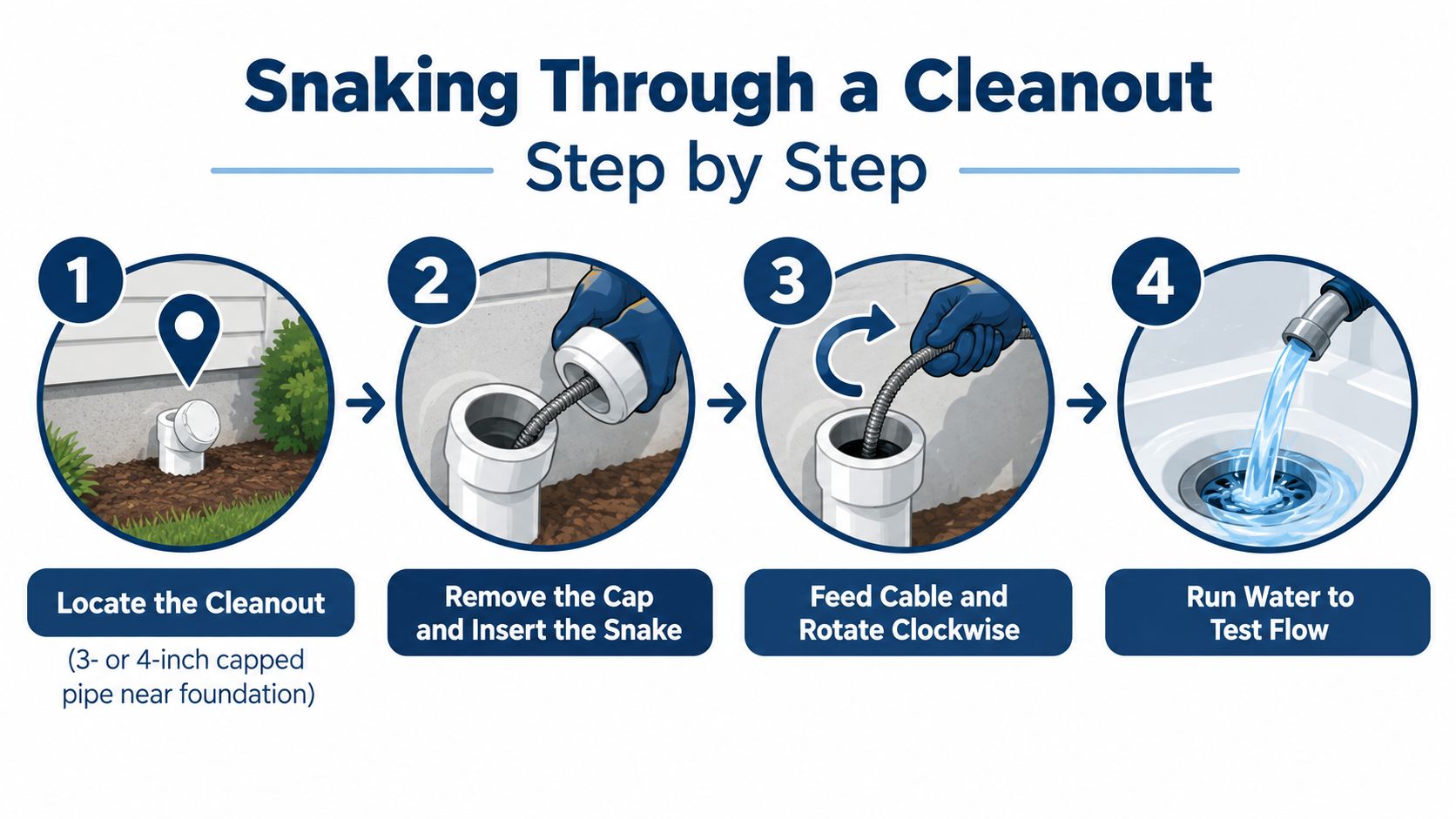
An exterior cleanout is usually the most controlled access point because it avoids removing a fixture and gives the cable a relatively direct route into the lateral. On many homes, you'll find a capped 3- or 4-inch pipe near the foundation, sidewalk, or side yard. The exact layout varies, so don't assume the closest cap points toward the street.
Set up before opening the line
Clear several feet around the cleanout. Lay down a drop cloth, place a bucket beside the cap, and position the drum machine within about 10 feet of the opening so the cable enters without a sharp side bend. Put on gloves and eye protection before touching the plug.
Turn the cleanout cap slowly with an adjustable wrench. A pressurized line can release water as soon as the threads loosen. If the plug won't turn with reasonable pressure, stop. Forcing an old fitting can break the cleanout, strip the plug, or expose you to a sudden discharge.
Once the cap is off, feed the cable by hand until you feel resistance. Keep the machine off during this initial feed. You're learning where the first bend or obstruction sits, and you don't want the rotating head to whip inside an unknown opening.
Feed with controlled rotation
Engage the drum only after the cable is properly supported and your gloved hand is controlling its movement. Rotate clockwise and advance in short 12 to 18 inch bursts, keeping steady forward pressure rather than jamming the cable into the line.
When the head meets resistance, back off slightly. Let the cutter or retrieving head work while you maintain rotation, then re-feed in small increments. This approach follows the standard cleanout workflow described in Networx's instructions for augering a home sewer line, and it reduces the chance of forcing the head into a bend.
When the obstruction gives way, don't immediately pull the cable out. Advance another 10 to 15 feet to move beyond the first opening and work on material farther down the line. Then retract slowly while continuing rotation, allowing the head to bring debris back instead of dragging it loose and leaving it in the pipe.
Stop signal: If the cable retorts back toward you without breaking through, shut off the machine. That usually means the head is binding, the cable is meeting an unexpected bend, or the obstruction isn't responding safely to force.
Test the result instead of guessing
Run a garden hose through the cleanout for two minutes as a breakthrough retest, while someone watches the lowest fixture inside. The line should accept sustained flow without rising, burping, or sending water back into a floor drain. Then flush fixtures upstairs one at a time and observe the drains.
Replace the cap only after the area is stable and the threads are clean. If it's a threaded fitting, PTFE tape can help the seal, but don't use tape to compensate for damaged threads or a cracked cleanout. For more detail about access locations and ownership questions, review sewer cleanouts in Los Angeles homes.
A visual demonstration can help you understand the cable rhythm and machine positioning:
Access Scenarios That Change the Approach
The cleanout isn't always the easiest or safest opening. The lowest drain in the house should guide your decision because gravity carries backed-up water toward that point. Before starting, ask one question: Where is the lowest drain in this house?
| Access Point | Best Tool | Typical Cable Length | Main Risk | When to Choose |
|---|---|---|---|---|
| Exterior yard cleanout | Powered drum machine or sectional machine | Main-line reach, often long enough to work toward the street | Roots, standing sewage, and a head catching at a joint | First choice when the cap is accessible and sound |
| Basement floor drain | Powered drum machine, with wet/dry vacuum ready | Enough to reach the main junction and downstream line | Sewage splash, trap resistance, and contaminated standing water | Useful when the basement drain is the lowest practical opening |
| Slab cleanout or floor-level access | Powered drum or sectional machine selected for the line | Depends on the distance to the main and street connection | Tight bends, fragile fittings, and limited cleanup space | Choose when the cleanout is known and exterior access is unavailable |
| Roof vent stack | Usually professional sectional equipment | Long reach through the stack and connected drain | Ladder falls, roof damage, poor visibility, and difficult retrieval | Last resort when no lower access point is usable |
Yard and slab access
An exterior yard cleanout gives the operator a direct path, but tree roots can hang the cutting head near joints and pull debris back into the line. A successful pass should restore flow at the lowest fixture, clear indoor gurgling, and survive a sustained hose test. If the cable repeatedly stops at the same distance, a camera inspection is more useful than adding cable.
A slab cleanout can be practical, but access is less forgiving. Protect flooring, control the opening carefully, and expect bends near the building drain. A handheld drum machine is appropriate only when the line and distance are within the machine's capacity. A powered sectional setup may be better for a longer or more resistant run, but it demands more operator control and cleanup planning.
Basement and roof access
A basement floor drain may already contain standing sewage. Use a wet/dry vacuum for surrounding water, ventilate the area, and keep electrical equipment positioned away from wet surfaces. The trap or first bend can catch the head, so feed gradually and don't mistake a bend for a blockage.
A roof vent is a last resort. Ladder stability, roof slope, fragile shingles, and the distance to the main make it a poor first choice for a homeowner. A cable can also damage the vent or become difficult to retrieve. If the only apparent access is overhead, call a licensed contractor rather than improvising at height.
Common Problems, Mistakes, and When to Stop
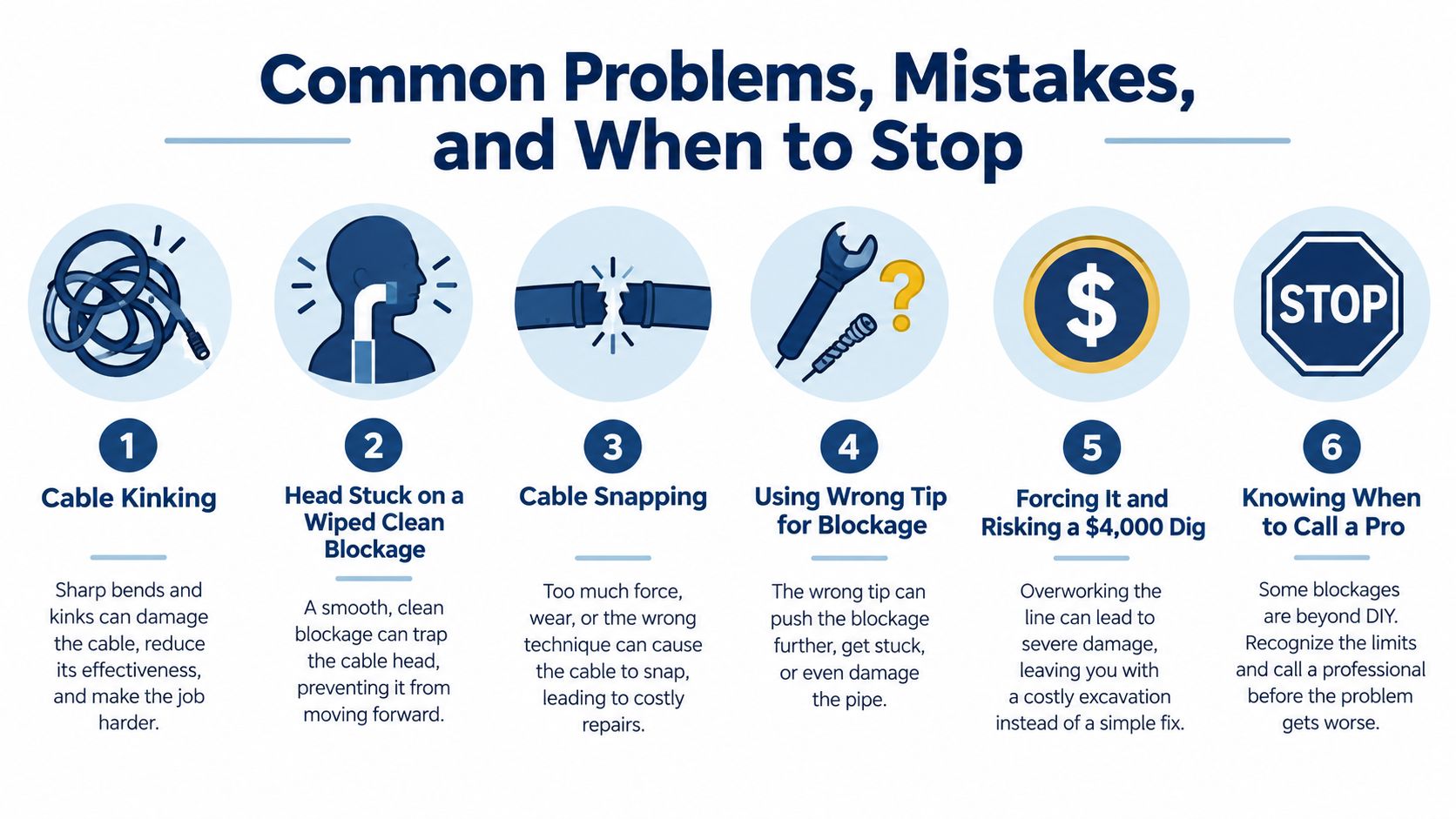
More cable doesn't automatically mean more progress. A long cable can pass the actual problem, jam at a bend, damage a weak pipe, or leave you believing the line is clear because water found a narrow temporary channel. Engineer Fix's discussion of main-drain snaking limits points out that blockages can sit deep beyond the access point and that forcing a snake can create pipe damage.
What the machine is telling you
- Cable kinking: Stop the drum, retract carefully, and inspect the cable. A kink means the cable is being forced, unsupported, or used against resistance it can't safely handle.
- Head stuck: Relieve forward pressure and reverse slowly while rotating. If the head is caught on a wiped-clean blockage or a bend, forcing it can leave the tool in the line.
- Roots keep returning: A root cutter may restore flow without removing the reason roots entered. Repeated root work calls for inspection and a repair decision, not endless cable passes.
- Old fittings loosen: If a clay or aging connection shifts, you may see seepage, soil, or a sudden change in cable feel. Stop and inspect instead of feeding farther.
- Dirty water rises elsewhere: Cover nearby fixtures and stop running water. The line may be more blocked than it first appeared.
- The auger spins freely: A freely spinning cable that never bites can indicate the wrong head, a passage around the obstruction, or a structural condition the cutter can't address.
A cable that brings back mud, pipe fragments, or unusual brittle material has found more than a routine clog.
Shut the machine off and call a licensed Los Angeles contractor if sewage smells strongly outdoors near the sidewalk, several fixtures back up at once, the cable retrieves mud or broken pipe fragments, or you feel a bend you can't explain. Also stop if the cable keeps returning without progress, the cleanout begins leaking around its base, or the pipe condition appears uncertain.
Safety failures happen quickly. Don't remove gloves near the rotating drum, don't guide a moving cable with bare hands, and don't work alone in a poorly ventilated basement. A rotating cable can wrap around a glove, sleeve, or hand before you can react.
Los Angeles Specifics Every Homeowner Should Know
Los Angeles homes don't all share the same sewer history. In older neighborhoods such as Los Feliz, Mid-City, Echo Park, and San Pedro, a lateral may use vitrified clay pipe installed during earlier neighborhood buildout, and root intrusion is a common reason those lines clog. A snake can reopen the passage, but it may be a temporary clearing rather than a permanent repair when roots enter through joints.
That changes what you should ask after the water starts moving. If the line has recurring root trouble, request a camera inspection and ask where the intrusion sits, what material the pipe uses, and whether the joints or pipe body are damaged. The background on main-drain snaking history and changing pipe materials also helps explain why mechanical cleaning became important as residential plumbing systems expanded and older materials were replaced over time.
Responsibility and permits
The ownership boundary near the sidewalk can affect who handles a blockage and who pays, but the answer depends on the exact location, easements, and local rules. Don't assume that a sidewalk cleanout automatically makes the city responsible. Have the line located and ask the contractor to document where the obstruction sits before authorizing excavation or repair.
Snaking an existing cleanout generally doesn't require the same approval as changing the plumbing system. Installing a new cleanout or altering the sewer connection is different, and hillside properties can involve additional local requirements. Check with Los Angeles Department of Building and Safety or use a licensed contractor familiar with the property's jurisdiction before starting construction work.
Low-flow fixtures and water-saving habits can leave less moving water to carry grease, paper, and settled debris through a line. Keep fats and oils out of the drain, and don't treat a recurring backup as a disposal problem. If an exterior cap is loose, secure it appropriately rather than leaving it resting in place, since ground movement can dislodge a poorly fitted cap and create another obstruction.
For local service options, EZ Plumbing's Los Angeles drain cleaning service handles mechanical clearing and can help determine whether a recurring line needs inspection or a different cleaning method.
Prevention, Follow Up, and Quick Answers
A clear line still needs observation after the machine leaves. Re-run water through the cleanout, flush fixtures, and monitor the lowest drain over the following two weeks. Gurgling after laundry, a slow shower after several fixtures discharge, or a soggy strip in the yard can point to residual blockage, root intrusion, a cracked lateral, or another structural issue.
A practical maintenance checklist
- Monthly: Use hot water and an enzyme-based treatment as a maintenance step, not as a substitute for clearing a blocked line.
- Quarterly: Look at the cleanout cap for seepage, movement, or visible root intrusion.
- Seasonally: Clean hair and lint strainers and remove debris that can enter exterior drainage points.
- Annually: Consider a camera inspection if the home was built before 1970 or mature trees sit within 15 feet of the lateral, based on the maintenance guidance provided for this topic.
The line must be fully clear before prevention can do much good. If water backs up again within 1 to 2 days, the first breakthrough may have been incomplete or a deeper structural problem may remain, as noted in the main-line augering guidance from Networx. Report the symptom, not just the fact that the snake ran.
How long should a cleared main stay open? There isn't one dependable timetable. A sound line with a simple soft blockage may remain open, while roots, grease, scale, or a damaged pipe can bring the problem back.
Does hydro-jetting beat snaking for recurring issues? It can remove more buildup from suitable pipe, while a snake is often better for opening a blockage or retrieving an object. Pipe material and condition should be checked before high-pressure cleaning.
What does one trip charge cost in Los Angeles? It varies by contractor, timing, access, equipment, and whether the job requires inspection or emergency response. Get the scope and pricing explained before work begins.
Should renters snake a main drain? Report multiple-fixture backups to the landlord or property manager immediately. Main-line equipment, sewage exposure, and possible pipe damage make this a poor renter DIY project.
EZ Plumbing provides Los Angeles homeowners, property managers, HOAs, and commercial facilities with drain cleaning, main-line snaking, hydro jetting, sewer diagnostics, and emergency plumbing response. If your cleanout is inaccessible, the cable won't break through, or wastewater is already backing up indoors, visit EZ Plumbing to schedule professional help.